

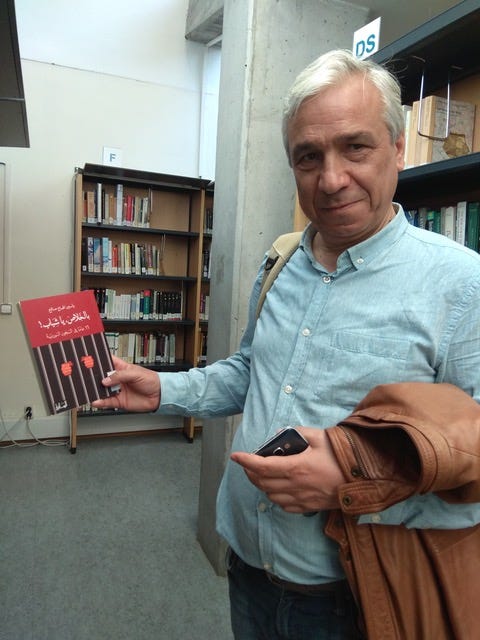
As part of its long-form interview series, The Syria Dispatch speaks with scholars, writers, thinkers, and practitioners whose ideas help illuminate Syria’s future. These conversations look beyond the news cycle to the deeper intellectual, historical, and moral questions raised by the country’s ongoing transition.
Few contemporary Syrian thinkers have shaped that conversation more than Yassin al-Haj Saleh. A writer and public intellectual, he spent sixteen years in Assad’s prisons before becoming one of the Syrian revolution’s most influential voices. Over four decades, his work has examined authoritarianism, political imprisonment, revolution, memory, sectarianism, Islamism, and the difficult work of building a democratic political community in Syria. Since the fall of the Assad regime in December 2024, he has continued to write extensively on the possibilities and dangers facing the country.
In this conversation, he explains what he means by “political poverty” and why he believes agency must come before institutions; how religion came to occupy the political space Assadism emptied; why decentralization needs a strong center and fair representation within it; how victimhood can produce a sense of entitlement; what the disappearance of his wife, Samira Khalil, and their friends reveals about justice in the new Syria; why he sees the evil Syrians endured as radical rather than banal; and what it might mean to love Syria without nationalism.
(Please note that Substack allows readers to listen to articles by clicking the “play” button in the top-right corner of the article.)
What Political Poverty Means
The Syria Dispatch: You have described Assadism as producing “political poverty”: depriving people not only of rights, but of the capacity to associate, act collectively, and speak in their own names. This recalls Hannah Arendt’s understanding of politics as the creation of a shared world through speech and action. After decades in which Syrians were denied that experience, how can political poverty be overcome? Can institutions alone produce citizens, and if so, who builds them? Or must political agency be relearned first? Put differently: is it democracy that produces democrats, or democrats who produce democracy?
Yassin al-Haj Saleh: Let me first say what I mean by political poverty. I first used the notion in 2003, based on my experience of the Damascus Spring and some of the political developments that followed.
Political poverty is the condition of people who are denied the right to gather or associate and to speak freely. When you are denied these fundamental things, you are below the political poverty line. I developed the notion as a parallel to economic poverty, which is the condition of people who lack the income they need to live. A growing percentage of Syrian society was suffering from income-related deprivation (37% in 2007), and everyone was suffering from political poverty. Even in private homes, you were not allowed to associate freely with others or talk about politics and public affairs. This is precisely why religion came to play such a large role in Syria, but we will come back to that. [See “The One Gathering That Could Not Be Disbanded” below.]
The Damascus Spring was about overcoming political poverty and taking ownership of politics. This primarily took the form of forums: gatherings in private homes, with dozens or sometimes a few hundred people, to talk about politics.
In 2011, the revolution carried that urge to own politics into much wider circles: from elites and private spaces to ordinary people and public spaces. It was also about re-owning the country itself. The idea of political poverty later led me to the idea of a privatized state, in which those in power owned the state as their main asset and used it to control the country itself.
Now that the Assad regime is gone, there is a new opportunity to overcome political poverty. But how do we do this? I would prioritize people’s agency—their capacity to gather and talk freely—over institutions, because we do not have real political institutions. We did not have them under a regime that lasted fifty-four years, a very long time in a society where some 96% of people are under sixty. The main political institutions of that period were the security apparatuses, which prevented people from assembling and expressing themselves, and the National Progressive Front, a façade whose assembly and speech were politically irrelevant.
So we have no tradition of strong and inclusive political institutions. That is why the focus should be on the agency of the people, on the democrats, as you say.
Of course, this will be very difficult. Close to 90% of people are below the poverty line, according to UN figures, and at least half need humanitarian support. So, simply put, a sustainable democracy in Syria is still distant. Still, this is the direction Syrians should be moving in, and what gives meaning to the work of people like us is pushing things in that direction.
“We Never Wanted Them to Solve Our Problems”
The Syria Dispatch: If agency should come before institutions, how can people exercise that agency when there are no institutions? Is the public space, the space for civil society, wide enough today for people to express themselves?