

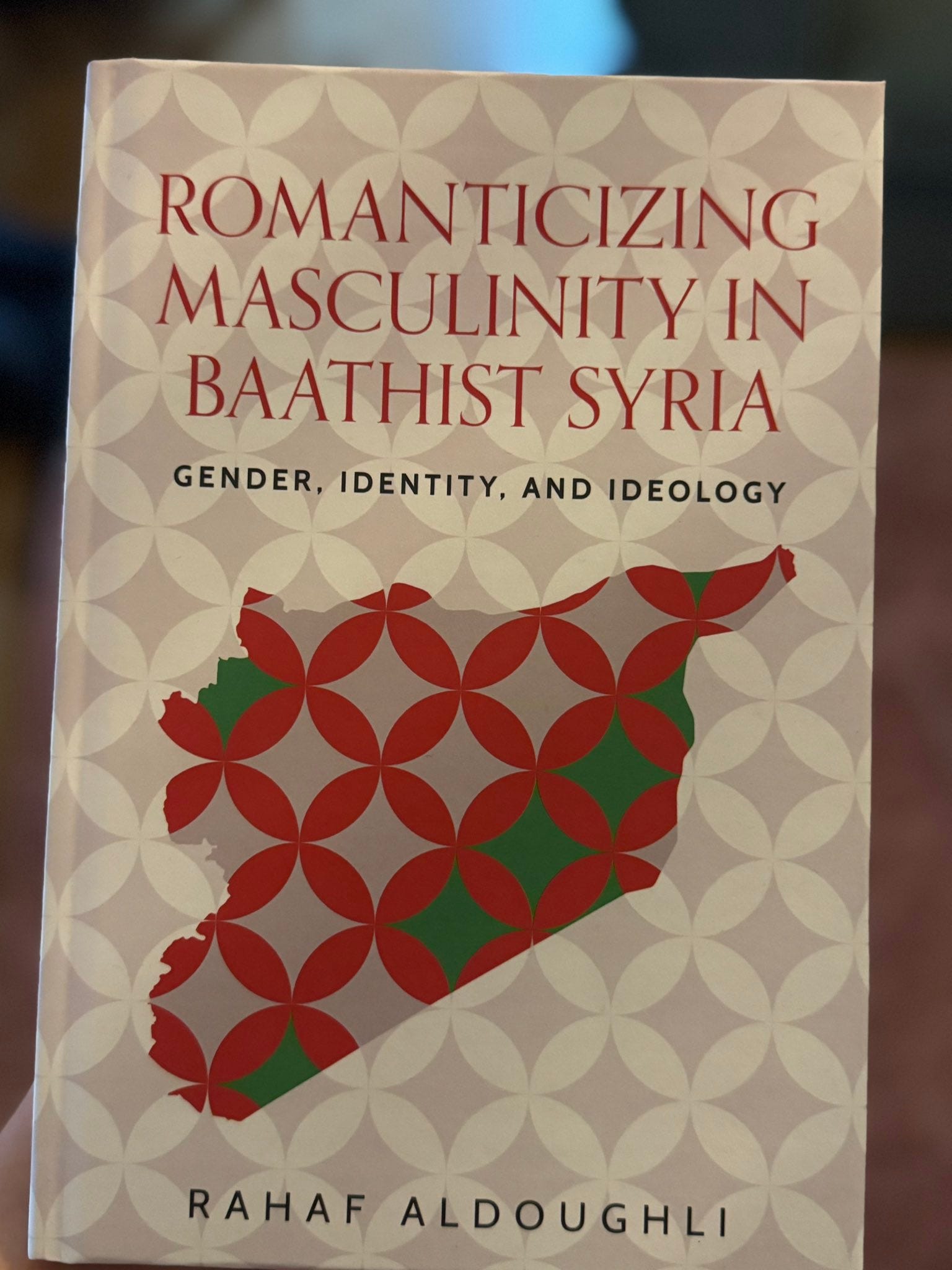
Dr. Rahaf Aldoughli is an award-winning academic, a lecturer at Lancaster University, and a senior editor at Cogent Social Sciences, published by Taylor & Francis. Her book Romanticizing Masculinity in Baathist Syria was published almost exactly as the regime it analyzed collapsed. It argued that masculinity in Syria was not a byproduct of authoritarian rule but one of its instruments: a configuration of manhood enforced from above and eventually internalized, which supplied the terms of loyalty, belonging, and national identity.
Since December 2024, she has continued interviewing fighters and commanders across Syria and the region, work that will feed a forthcoming book on fighters’ motivations before and after the fall of Assad, alongside a second forthcoming book, Who Owns Sunnism.
In this conversation with The Syria Dispatch, she discusses what she would revise eighteen months on, the competing forms of manhood she calls transitional masculinities, the shift from institutional repression to character assassination, the women contesting rules at the door rather than in public, and why she reads the new order as saturation without consolidation.
(Please note that Substack allows readers to listen to articles by clicking the “play” button in the top-right corner of the article.)
What the Fall of Assad Did Not Undo
The Syria Dispatch: Your book was published right as the regime fell, and you’ve said you couldn’t celebrate holding it in person. Looking back at the thesis now, with eighteen months of post-Assad material to test it against, is there anything in Romanticizing Masculinity in Baathist Syria you would revise, or has the transition mostly confirmed what you argued?
Rahaf Aldoughli: The central argument of the book was that masculinity in Baathist Syria was not a byproduct of authoritarian rule but one of its instruments. For more than five decades, a particular configuration of manhood was enforced from above and eventually internalized by loyalists. It was a state masculinity that supplied the terms of national identity, of belonging, and of loyalty; crucially, loyalty to Assad rather than to Syria. Manhood was the currency used to pay for political legitimacy.
That was the claim: masculinity as an authoritarian tool used to upgrade and sustain the regime’s authority, not merely masculinity as an outcome of authoritarianism.
What I would not revise is the claim that none of this ended with the regime. The book was entirely about the form of masculinity manufactured under Assad, not about the opposition masculinity that was also being generated over the long war since 2011. But the fall of one authority does not dissolve a fusion of gendered identity, survival, and authority built over fifty years. Removing the man who sat at the top of it does not remove a gendered identity that has been manifesting and being internalized.
Syrians are not now facing the residue of a regime. They are facing a whole political culture in which masculinity operated simultaneously as a source of legitimacy and as a strategy of survival. And it is that culture, more than any particular institution, that will hinder the prospects for civic building.
What I would extend is the assumption that this repertoire was Baathist in any deep sense. I treated it in the book as a specifically Baathist formation, tied to the party, the army, the cult of the leader. Eighteen months later, what strikes me is its portability. The fighters I have interviewed were not regime men. They were fighting the regime. And yet they articulated honor, moral injury, protection, and the obligation to die for the collective in an idiom the Baathist state had spent fifty years institutionalizing. The opposition inherited the political culture it was fighting.
So if I were writing the book now, I would frame it less as a Baathist pathology than as a technology of rule, a way of ruling.
The second extension is mechanism rather than scope. The book gives you masculinity as a structure: a configuration of practice, in Raewyn Connell’s sense, sustained institutionally and from above. What it underspecifies is how a norm becomes an obligation that a man experiences as his own. That requires attention to the affective and moral processes—humiliation, moral injury, shame, the desire for repair—through which a structural condition is converted into a felt duty. That is what I have been working on since, and it is what the book’s image of a reservoir was gesturing at without fully specifying.
The Syria Dispatch: Your mention of ‘portability’ echoes what I have heard about the many areas of continuity between the previous and current administrations. We usually expect revolutions to produce a total break with what came before. Yet in many areas we see continuities: the use of the penal code, the cybersecurity law, documented cases of torture under the new authority. Does the same hold for broader social and societal dynamics imposed and exploited by the state, such as masculinity?
Rahaf Aldoughli: Definitely. There has been a rupture in terms of political structure. The structure is completely different from the one Assad ruled through. But that does not mean we have a different political culture. The culture that cultivated this form of masculinity is still operating, only under different attire, under a different suit.
Was the Baathist State Ever Secular?
The Syria Dispatch: In your book, you write that religious tradition “never appeared to be the main problem” (p.8) for women under Baathism, because the state was officially non-religious and restricted public religious expression. Under the new authorities, religion is actively promoted, from the Ministry of Endowments’ daʿwa campaigns to restrictions on gender-mixing and makeup. Has the main problem genuinely shifted from secular-nationalist militarism to religious authority, or is religion supplying new packaging for the same underlying masculinist logic?
Rahaf Aldoughli: I am always cautious when I get this question, because it can be answered in a way that flatters a secular-versus-religious framing that I do not think holds.
Two things need separating: whether Syrians are culturally religious, and whether the Assad state could tolerate free religious expression. The answer to the first has always been yes for the majority. The answer to the second is no.
Baathism was never indifferent to religion. It managed it. It co-opted particular currents, especially the Damascene Sufi traditionalist networks, of which Ahmad Kuftaro is the obvious case in the early 2000s. But after 2011, it did far more than manage it; it manufactured loyal Sunni constituencies to rally for its survival, producing a fissure between the loyal Sunni and the opponent who could be filed under takfiri or terrorist. It built an institutional architecture to make that permanent: Decree No. 16 of 2018 subjected every imam and religious teacher to state accountability, and the Mufti’s office was folded into the state apparatus, which converted political dissent into doctrinal defiance. Assad claimed, in his own words, to be correcting fourteen centuries of false interpretation of Islam.
That is not a secular state. That is a state asserting what I call doctrinal sovereignty: the claim that it decides what legitimate Sunni belief is.
It also left Personal Status Law—the single most consequential body of law for women’s lives—under religious jurisdiction, and essentially unreformed since 1953. Baathist secularism was public, and it was thin. Inside the family, it never arrived. So when I wrote that religious tradition was not the main problem for women under Baathism, I was writing about the axis of public conflict. I was not claiming that the legal order was secular.
The regime could not allow free religious expression because it always felt insecure as a state ruling a Sunni majority it could not credibly claim to speak for. That is precisely why it co-opted a particular Sufi Sunni current with no political ambition that could threaten Assad’s rule.
The Syria Dispatch: And what changed after the fall?
Rahaf Aldoughli: There was a euphoric feeling among the majority. Sunnis long attached to their religious practice, and to an activism against the regime that had been conducted in a religious idiom, felt they had finally been recognized. The new authority played a significant role in cultivating that feeling. We saw public displays of prayer on a scale Syria had never seen.
My reading is not that Syrians suddenly became more religious. In a survey of a thousand Sunni respondents living in regime-controlled areas, conducted between 2022 and 2024, before the regime fell, respondents did not express any substantive trust in the regime’s fatwa council, and nearly two-thirds preferred a plural religious authority to a single state-appointed one.
What has changed, in my opinion, is that religion has become available to the new authority as an instrument of recognition and legitimation. The packaging has changed, and the mechanism has changed. The logic has not. Both orders assert custody over the criteria of belonging. What differs is the idiom and the instrument.
The instrument is the interesting part. The Baathist project was legislated: decrees, curricula, codified doctrine. Which meant it could be contested, precisely because it had been articulated. The present configuration proceeds through circulars, governing directives, sermonic guidance, and daʿwa campaigns run by actors the state neither endorses nor suppresses. Under Assad, the state declared itself secular in explicit terms. Al-Sharaa has never said in an official statement that Syria is a Sunni state.
The new authority does not face the threat to its representation of the Sunni majority that the old one faced. Think of the early 1970s, when Hafez Assad needed Moussa Al-Sadr’s ruling that the Alawites belonged to Shiism and Shiism to Islam, so that he could be a legitimate ruler of Syria. The current authority has no equivalent problem.
But it remains chaotic. The state has not yet built its ideology, or its national narrative. That is still ambiguous, not transparent, not clear—perhaps because, given where the current authority comes from, it needs to show the West, the regional powers, and the public that it has divorced itself from its past. It may simply be too early to see what the new authority’s project is.
So, is religion playing a greater role than before? Yes, definitely. We see it in the Ministry of Endowments. Under Assad, the ministry was focused on producing a Sunni loyal to the state, to the Syria Assad was manufacturing, but it never intervened in the private sphere, in what people wear and do not wear. Now we see the ministry giving lectures on what a good or pious woman should wear.
I had a personal experience of this. When I visited the Ministry of Endowments, I was required to wear a hijab before meeting the minister. I was visiting a state institution, not a mosque, and my body was policed by that institution.
At the same time, I cannot say that this is only top-down. There is also a bottom-up dimension: Syrians wanting to express themselves as Sunnis who won the revolution. The two now work and interact together. So under Assad, certain forms of Sunnism were permitted in the public sphere. Under the current Ministry of Endowments, we see more pressure on what a good Sunni should be in the private sphere, which we didn’t see before.
Transitional Masculinities
The Syria Dispatch: So would you say the key shift is not from a secular state to a religious one, but from one form of state-controlled authority to another, with religion providing a new language for the same underlying structures?
Rahaf Aldoughli: Definitely, yes. I have started calling what is emerging ‘transitional masculinities’, because I am seeing several forms at once, not only a state masculinity.
We see the polished, presentable image of a former Hayat Tahrir Al-Sham (HTS) commander who is now very well dressed, in an expensive suit, attentive to his appearance. His masculinity has shifted from the fighter who wanted to win the revolution to the state-builder. These are men who are welcomed not only by Western media but by Western policymakers and diplomats, and who make their own visits to Western capitals.
Then we see another form: fighters, revolutionary fighters, who fought against Assad and still do not feel they have been recognized. That relates directly to what has happened over the last eighteen months. Take the SDF integration agreement between Mazloum Abdi and Al-Sharaa. Tribal Arab fighters look at that elite bargaining at the top and see that their grievances have not been met. Their integration into the Ministry of Defense or the Ministry of Interior remains incomplete. Loyalty over competence remains in both ministries. Fighters who came from HTS receive their salaries regularly; fighters from the SNA or other factions do not.
So we are talking about revolutionary fighters, Sunni fighters, who feel that what has been achieved in Syria has not brought them the recognition they expected. The moral injury is still there. That is what I call ‘grievous masculinity’ and ‘combat-driven masculinity’. Grievous masculinity is about a fighter feeling that everything he paid, all he sacrificed, has not come to fruition with what he wanted to achieve.
Most of these men were not fighting for money. They were fighting for a moral cause. In the years when it was a stalemate, and Syria had disappeared from the news feed, I would ask them why they were still fighting, and the answer was moral.
Because the two ministries are not structured properly, and because the Disarmament, Demobilization, and Reintegration (DDR) process is not being handled well, this form of transitional masculinity could undermine Syria’s stability. The masculinity we might see under the new authority is still taking shape. It depends on which trajectory Syria heads towards: an inclusive, plural Syria, or a state that recognizes only HTS cadres.
What Does This Mean for Women?
The Syria Dispatch: With women making up around 20 percent of National Dialogue participants, one woman among 23 ministers, and 22 of 210 MPs, should transitional masculinities be understood as fundamentally man-centric: men working out what they are and what they will become, with women disregarded? Or is there something in it for women?
Rahaf Aldoughli: There are two things to say.
First, I regret not researching Kurdish female fighters, because this is an important component. The Women’s Protection Units are being integrated into the Ministry of Interior, and I have seen women training there. A whole security unit for women is being built. That is good news.
But I worry that it comes as an accessory: something that pleases Western criteria. And it is still early days to know whether this is an empowerment of women, or whether these women will be used to police women even further. Without oversight from the government or the parliament, without independent institutions and an independent judiciary, women’s security units can be used against women.
That is at the state level. When it comes to what transitional masculinity means for women in the private sphere, I am also guilty of not having expanded my work into what it means for women to live in a society of militarised masculinity. There is research in other contexts — Colombia, India, Ghana — asking what the emergence of armed groups means for women’s lives, for women in the private sphere, for the wives of fighters and commanders. There is definitely an outcome. Women face extra subordination when they live in a highly militarised society.
And we have already seen it in official statements. When spokespeople were asked why there are so few women in the Parliament and in state institutions, most of the answers came in sarcasm. One said that men now need their own feminism, because Syrian men still do not feel recognized.
This is exactly what happens after long years of armed conflict. Armed men come and sit around the negotiating table, each one gets his position, and women are left at the sidelines. Hundreds of armed factions have been dissolved and absorbed into state institutions, and the incentive given to those men is to stay silent, because if they were not absorbed into the two ministries, they might endanger Syria’s stability.
Women will not have an armed group and rally for their rights using guns.
I am not saying that Europeans or Western stakeholders should come and campaign for Syrian women’s rights. But without that pressure, women would be left out entirely, as in other examples around the world.
A Meal in the Northeast
The Syria Dispatch: Based on the information you have gathered during your fieldwork interview with a large number of male fighters, do you think Kurdish women can actually be accepted into the Ministry of Interior? These female fighters seem to represent a double clash: these are women disrupting what these men see as the natural order, but these are also women they were fighting until recently.
Rahaf Aldoughli: I heard a funny story from a man who is now in the Ministry of Interior. It was during the early days after Ministry of Defense forces were allowed into the north-east, in the first stage of meeting female Kurdish fighters.
Days before that, on social media, men were saying that it was shameful for men to accept these female fighters telling them what to do. The masculinity was running very high: we will kill them, we will not allow them; who do these heval (female comrade, in this context), think they are?
And then he told me: I was sitting with a heval, and I was very hungry, and she made me zaatar with oil, and we ate together.
I am not giving you a policy analysis. But that small incident tells you something. Men whose masculinity has come full circle into recognition—men who feel they fought for a long time and are now in a good position—are more able to accept this. A man whose masculinity is frustrated is not. A fighter from the SNA might still say he would rather shoot her.
I do want to add that international pressure played a very positive role here. In the mediation between European stakeholders and actors on the ground, the Europeans worked hard to prevent a military confrontation. They were not neutral, but they pushed both parties to sit around the negotiating table. Difficulties lie ahead, but this is a milestone.
Why Speaking Out Feels Different Now
The Syria Dispatch: You’ve previously mentioned to me that you have become far more cautious about what you post now than you were under Assad, when you were more outspoken. Can you say more about that shift?
Rahaf Aldoughli: Under Assad, the risk was legible. You knew who your adversary was, you had a reasonable sense of where the lines fell, and the cost was borne largely by you and was knowable in advance. Speaking out also had a community attached to it. Criticizing the regime placed you within a shared moral position, so it conferred standing rather than costing it.
We knew what the price was. In 2020, they held my father for eight hours, and he told them he did not know where I was, that I had left the family completely, that he had disowned me. For those of us speaking from the diaspora, the highest price was not being able to visit Syria.
What has changed is not that the risk is greater because it is, in some respects, smaller, but that it has become diffuse and social rather than centralized and political. Since Assad’s fall, outspoken criticism does not make you institutionally liable in the same way. Instead, public figures face character assassination. It started the minute Assad fell, with social media figures close to the authority, people with millions of followers, beginning to target critics.
The instrument now operates through networks rather than institutions: coordinated online campaigns, questions about who funds you, whether you are really Syrian, whether you spent the war comfortably abroad, and what your morals are. There is no institution to appeal to and nothing that can be formally answered. You are no longer fighting a political regime; you are placed in front of society and culture.
The charge has changed, too. Under Assad, the accusation was treason against the nation, and that you were a terrorist, an Islamist, an agent of Israel or America. Among the opposition, that functioned almost as a credential. Now the accusation is betrayal of the revolution, or betrayal of a fragile hope; the argument being that criticism at this moment serves Syria’s enemies and that one ought to wait. That lands differently, because it comes from people whose politics you share and whose losses you respect, and because it fractures the community that dissent used to create. I would say that it is this, rather than fear, that has changed how much I post.
The old regime also never said anything about our reputation as women, about my private life or my morals. Now the attack is on your reputation, your cultural background, and your work. Character assassination has become a form in itself for silencing women, men, and activists.
There is also a fear I cannot always rationalize, and a tangible one alongside it. Many of us do not want to be barred from going to Syria again, and I have seen several friends, women, targeted in exactly this way. So I am always cautious about writing criticism in Arabic now. If I write it in English, a specific audience will read it, and it becomes less applicable. I have had many invitations to comment on events in Arabic on Syrian channels, and I say no, because during the interview, I would be watching what I say. I don’t think it is just me. Many Syrian women are doing the same.
The Women You Do Not See
The Syria Dispatch: You also said that less publicly visible Syrian women may be navigating power on the ground with more resilience and courage than academics or public figures. What have you observed there?
Rahaf Aldoughli: The first point is structural. Those women are less exposed, and visibility is what makes character assassination efficient. A woman without a public profile has less to lose in that particular currency, which paradoxically gives her more room to act.
What I have found more striking, from my communications with women navigating this daily, is that their resistance is not declarative. It takes place at the point of enforcement. Segregation at the Umayyad Mosque, segregation in the judicial system, and dress requirements introduced in offices and institutions. These are contested at the door, in the corridor, at the desk, by individual women who argue, negotiate, delay, comply selectively, or persuade the man in front of them not to apply the rule that day. Some of the most effective work I have heard described consists of women talking to security men and convincing them.
I would not treat that as a lesser form of politics. It is the form that actually changes what happens, precisely because these restrictions are administrative and discretionary rather than legislated. They depend on individual enforcement, which means they can also be undone individually.
There is a body of theory that describes this. Deniz Kandiyoti’s account of the patriarchal bargain captures the negotiation-within-constraint quite precisely, and Asef Bayat’s work on social non-movements and the quiet encroachment of the ordinary describes dispersed, uncoordinated, cumulative action of exactly this kind.
Who Gets Access
The Syria Dispatch: Does that mean foreign researchers and activists have more freedom to work on Syria than Syrians do?
Rahaf Aldoughli: Of course. Take the early welcoming of scholars with certain Western affiliations, because the authority wanted to send a message through those affiliations. It was not keen to meet independent Syrians.
We have seen Western academics visit Syria and be welcomed, and even hailed and celebrated for writing on Syria. I have heard from them that they feel they can pass messages without being investigated. The assumption seems to be that a Western scholar will know less than a Syrian scholar and can be more easily managed. My Western colleagues and friends know very well that some of this amounts to whitewashing and legitimizing the authorities. But it gives them access, a good reputation in their policy work, and access not only to the current authority but to Europeans as well. It runs both ways.
For me, this goes back to my fieldwork. In the early days, when I first got access to fighters and commanders, a Western scholar would be asked which university they came from, where they would publish, and whether they would end up portraying their interviewees as terrorists or jihadis. With me, they asked whether I was Sunni or not. It was surveillance over what I believe, treating me not as a scholar but as a person who might get emotional in interpreting. They were working out which side I was on.
And a Syrian cannot be told that we cannot have inclusivity because Syria is a masculine society. I know Syria has been a masculine society for millennia. That is not something new. You may convince someone else with that narrative. You will not convince me.
Who Hardens, and Who Defects
The Syria Dispatch: Your forthcoming book tracks fighters’ motivations before and after Assad’s fall, including follow-up interviews after the coastal massacres and Suweida. Can you say more about the typology you are building? What made some fighters harden, and others defect?
Rahaf Aldoughli: The starting point is the distinction between the two formations. Grievous masculinity is organized around an injury, which means it requires an object. Combat-driven masculinity is organized around a practice, which means it requires an arena.
That distinction does a good deal of work after December 2024. Men in whom the grievous formation dominated tended to re-target: the regime disappeared, but the injury did not, and it migrated onto whoever could be made to stand in for the old order. Men in whom the combat formation dominated were less ideologically fixed but more easily reactivated, and their loyalty followed the unit and the commander rather than the cause, which is one reason they can be led out of an institution and then led back into it.
But the variable that actually sorts hardening from defection, on my material, is recognition. The transitional period produced a very specific situation. Men whose entire biography had been organized around a costly past arrived at the moment when that past was supposed to be honored, only to find the honor distributed to a narrower group. The message of man yuharrir yuqarrir (من يحرر يقرر)—‘he who liberates decides’—was effectively conveyed to a fighter who had served since 2014, been displaced repeatedly, and lost family members: he belonged among the liberated rather than the liberators because he had not taken part in the final operation. Add the age criteria that disqualified men over thirty from enrolment, and recruitment that ran on factional loyalty rather than qualification, and you have recognition withheld at scale.
What that produces is not the adaptive recalibration the reintegration literature would predict. It produces defensive intensification. The identity sharpens rather than dissolves, and it reaches for whatever materials the war years made emotionally available, which in this case means a specifically Sunni vocabulary of sacrifice and vindication.
The second axis, and the one I would still want to test properly, concerns whether a man has an alternative masculine biography available to him, because that is what makes exit possible. A man with a profession, an education, a trade, a standing in his community that predates the war can leave the institution and still be a man. A man for whom fighting constituted the whole of his adult selfhood cannot, because leaving would dissolve the self. One fighter from Douma put this to me directly: after all those years, he had known nothing in life other than belonging to the revolution, and if he could not be in the army, where could he be? He also said the marginalization felt harsher than Assad’s violence, because it came from the comrades of pain. That is not a man weighing options. That is a man with nowhere to stand.
The Wardrobe Changes, the Claim Does Not
The Syria Dispatch: In your MERIP piece, you compared Al-Sharaa’s staged persona to the Cuban hombre nuevo archetype. Has that self-fashioning changed as he has spent more time performing statesmanship internationally, or has it stayed remarkably constant?
Rahaf Aldoughli: My reading is that it has not changed so much as stratified, which is a different process.
When I wrote the MERIP piece, I described a deliberately hybrid form of self-fashioning: militant and diplomatic at once, pious and modern, Sunni but not Salafi. We saw Al-Sharaa enter the Aleppo Citadel in military dress, drawing on the iconography of the conquering man and adopting the name Al-Fatih (الفاتح), the Conqueror. We then saw him appear before the armed factions in January to announce their dissolution, relocating legitimacy away from party or ideology and concentrating it in a single male body: the ruler presented as the man capable of disarming other men and absorbing their political and military standing. Alongside this was another Al-Sharaa: suited, clean-shaven and composed, performing the language and demeanor of the technocratic statesman in international interviews.
What the past eighteen months have done is not replace the martial register with the statesman’s register, but allocate these registers to different audiences and political spaces. The suit belongs increasingly to foreign capitals and international broadcasters. The mosque, Eid prayer, and post-dawn address speak more directly to the domestic constituency. And then there are moments such as the December 8, 2025, parade, with its Umayyad symbolism, when the martial register is deliberately reactivated, reassuring the base that the revolutionary and conquering figure has not disappeared beneath the suit.
The wardrobe changes, but the underlying claim remains remarkably consistent: authority is embodied in a singular masculine figure capable of containing, disciplining, and ultimately absorbing the standing of other men.
Who Owns Sunnism?
The Syria Dispatch: Your forthcoming book Who Owns Sunnism is where the concepts of sectism and hyper-Sunnism come from. Can you walk me through how you arrived at that distinction?
Rahaf Aldoughli: What I am really trying to understand in this book is how sectarian identities in Syria have been produced, governed, and contested: by whom, through what institutions and mechanisms, and with what political consequences. I deliberately do not ask whether Syria is a sectarian society, because that question already presupposes what we need to explain.
I also do not start from the assumption that there is something called “the Sunni community” that behaves as a coherent political actor. Syrian Sunnis are Arabs, Kurds, Turkmens and Circassians; they are rural and urban, religious and secular, regime loyalists and opposition supporters. So, following Rogers Brubaker’s critique of groupism, I treat Sunnism less as a bounded group than as a site of contestation: a category through which religious identity has been governed and mobilized, but also one through which different actors have competed to define authority, authenticity and belonging.
What I found, looking at state–religion relations under Assad, is that the regime was doing something much more ambitious than simply controlling religion. It was trying to intervene inside the Sunni religious field and establish the authority to determine what legitimate Sunnism looked like. I call the outcome of this project ‘Conformist Sunnism’. The regime cultivated particular religious authorities, institutionalized particular forms of religious practice, and marginalized others. It was not simply a secular authoritarian state confronting religion from outside. It became an actor within the religious field itself.
But the book’s bottom-up material (interviews, surveys, and other primary research) shows the limits of that project. The state could regulate institutions and reward particular religious actors, but that did not mean it had acquired the religious legitimacy or consent it sought. That distinction between institutional control and religious authority became very important to me.
This is what led me to develop the concept of ‘sectism’. By sectism, I mean the persistent struggle within the Sunni field over who has the authority to define authoritative Sunnism: who is a proper Sunni, who can speak in its name, and how theology, political power, and political interest interact in producing claims to religious authenticity.
I draw here on Talal Asad’s understanding of Islam as a discursive tradition, constituted through arguments about the proper form of its own practice, and on Pierre Bourdieu’s understanding of the religious field as structured by competition over the authority to consecrate orthodoxy. Where I depart from much of the sectarianism literature is that it explains boundary-making between communities—Sunni and Alawi, Sunni and Shia, Muslim and Christian—but offers fewer tools for understanding the struggle inside one religious field.
And sectism did not begin with the Syrian conflict or with HTS. I see it as constitutive of the Sunni field itself. Conflict changes the intensity of the competition, the actors involved, and, crucially, the resources available to them. But it does not create the contest.
One argument I would most strongly defend in the book is that these two levels depend on each other. You cannot credibly mobilize Sunnis against an external communal threat until you have established some authority to say who “the Sunnis” are and what their interests are. Inter-communal mobilization depends upon prior intra-communal authorization. And what is fascinating about Syria is that nobody ever fully achieved that authorization.
You can see this very clearly in the opposition. The moderate-nationalist current produced documents such as the Aleppo Petition, the Muslim Brotherhood’s Covenant, the Islamic Council’s Five Principles and the Social Contract, which spoke overwhelmingly through the language of citizenship rather than Sunnism. But I argue that this was itself a sectist position. They were effectively saying: this is what proper Sunni politics should look like; authentic Sunnism is compatible with equal citizenship for all Syrians.
The hardline current offered a competing definition in which Sunnism becomes constitutive of the state. But I am very careful in the book about saying that this current won. It did not necessarily win the ideological argument. It won the court buildings. Where armed factions possessed coercive power, they established parallel courts, and people used those courts partly because their decisions could actually be enforced. That tells us something very important about state–religion relations: institutional dominance should not automatically be read as ideological consent.
The Syria Dispatch: And after December 2024? Is hyper-Sunnism moving towards consolidation into something more like an actual Islamist state project, or is “saturation without consolidation“ a stable equilibrium the authorities could maintain indefinitely?
Rahaf Aldoughli: What I am seeing is not straightforward Islamisation, and I do not think the evidence supports describing the new state simply as a Salafi project. “Hyper-” does not mean more Sunni or more religious. It describes a structural condition.
Sunni reference now saturates public life in ways that were impossible under Assad. We see it in sovereign performance, political language, public symbolism, institutional appointments, and the grammar through which authority presents itself. But no consolidated ideological or institutional program explains what all of this means for the state. That is why I describe hyper-Sunnism as saturation without consolidation.
And the absence of articulation is not incidental. It is part of the phenomenon itself. We do not yet have a coherent doctrine saying: this is the relationship between Islam and citizenship; this is where religious authority resides; this is the relationship between Sunni reference and the law; this is what the religious identity of the state institutionally entails.
That is the sharpest contrast with the Assad period. The Baathist project was extraordinarily interventionist. It operated through decrees, ministries, recognized religious authorities, institutional practices and publicly articulated claims. You could identify what the state was doing, and precisely because it was articulated, people could negotiate with it, resist it, or contest it.
What I am observing now is much more dispersed. Individual ministries, local authorities, religious actors, and political figures make interventions that accumulate without necessarily forming part of a single, centrally articulated religious program. No authority has yet established an uncontested capacity to regulate the Sunni field as the previous state attempted to do.
This is why I resist interpreting everything we are seeing as evidence of a coherent Islamist transformation. The absence of regulation is politically productive in itself. It allows multiple actors to invoke Sunnism, compete over its meaning and embed Sunni references across public life without resolving what an officially Sunni political order would actually mean.
So in a sense the book begins with the Assad state’s extraordinary attempt to govern Sunnism and ends with almost the inverse problem: what happens when the architecture that governed the religious field disappears, but the struggle over who has the authority to define Sunnism remains? For me, that is the central continuity across the regime’s fall. The actors have changed, the institutions have changed, and the distribution of power has changed dramatically. But the contest over who owns the authority to define Sunnism has not disappeared. It has become more visible.

Saddam in Old Damascus
The Syria Dispatch: You draw on an analogy some Sunni Syrians reportedly make between Al-Sharaa and Saddam Hussein’s model of masculine authority. Is that something you have heard directly and repeatedly, and is it made approvingly, critically, or both?
Rahaf Aldoughli: On my visits to Syria after the fall of the regime, photographs of Saddam Hussein were on display across old Damascus, which under Assad would have been unthinkable. That imagery was taboo, and its sudden visibility is itself the datum.
What it registers is not a governance preference but a symbolic attachment held in reserve for a long time. Saddam carries a particular charge in the imagination of many Syrian Sunnis, and what it condenses is a set of perceived grievances against Shia political and religious power.
A specific, local injury also lies beneath it. Under the previous regime, families were forced out of their homes in old Damascus, and those properties were transferred to Shia shrine complexes. That is not an abstract sectarian resentment. It is a dispossession with an address, and the people who experienced it are still there. So when the photographs appear in those quarters in particular, they are doing commemorative work about property and displacement as much as anything else.
And the timing is important. The rise of Saddam symbolism resonates with shifting regional dynamics, and I read its visibility as tracking that shift rather than expressing a considered political program.
Why Masculinity, and Not Feminism
The Syria Dispatch: You interview mostly men, and you work on masculinity rather than on women or feminism. Why?
Rahaf Aldoughli: The choice I made was never between gender and something else; it concerned where, within gender, the explanatory power lies in the Syrian case, and my answer is that it lies with the dominant category rather than the subordinated one.
Scholarship on women has told us a great deal about the effects of power, about who is excluded, who is harmed and what is foreclosed, but it is less well positioned to explain how that power is produced and reproduced, because the category doing the producing remains unexamined and therefore continues to appear natural rather than constructed. If one wants to account for how a regime governed Syria for five decades, why men fought in the ways they did, and why the structures that sustained them survived the collapse of the state that built them, then the dominant term has to become the object of analysis rather than the unremarked background against which analysis proceeds.
When I began interviewing fighters, I expected to encounter the incentive structures the literature assumes, whether material calculation, coercion or sectarian identification, and what the interviews returned instead was a vocabulary of honour, obligation, recognition, and moral injury, in which commitment was sustained far less by what men stood to gain than by what they understood manhood to require of them. Such a finding is not available from a research design that treats gender as a question only about women, and it is what led me to argue that masculinity in Syria is not a by-product of Baathist rule but one of its mechanisms, and that its structures have outlived the regime that produced them.
The same analytical gap runs through the study of sectarianism, which is where I have made the argument most directly. The field takes sect as the operative category and treats gender, on the rare occasions it appears at all, as a variable bearing upon women, and yet the mobilisation of sectarian identity in Syria works through claims about protection, honour and masculine duty, so that sectarianism read without gender appears primordial and inherited, whereas read through masculinity it becomes legible as a technique of rule.
None of this amounts to a dismissal of feminist scholarship, or of the Syrian feminist movement, which has achieved a great deal under conditions that make any achievement extraordinarily costly. My position is rather that we need a feminism generated from Syrian social conditions instead of transposed onto them, and that examining how masculine authority is constructed, legitimated and maintained forms part of building such a feminism rather than a departure from it.
The Syria Dispatch: But doesn’t that leave a gap in your work, then?
Rahaf Aldoughli: Yes, and it is one I now want to close: how this masculinity is affecting women, and especially the wives of central commanders.
I will give you two examples. In 2022 I was in Kilis, on the border, meeting the commander of Al-Jabha Al-Shamiya. It was in an apartment rather than an office, and since he knew I would be scrutinizing him, he brought a lawyer to make sure his answers were politically correct. When I asked him about women in his areas and how they were dealing with them, he said: “Doctora, we are completely pro-women’s rights. Do you know that we have asked our wives to launch an NGO to promote women’s rights?” And this was while I was telling him what I had heard from women activists: that their centers were being raided by his security men. So even that isn’t enough; these commanders can use women too. You see the complexity.
The other story is from the commander of the Third Corps. I always begin with the same questions: why did you join, how did you defect, what was the first feeling? He was from Hama, and he had been a military pilot. The first time the regime ordered him on a mission, he said he was ill. The second time, his wife told him that if he went, she would go outside unveiled and shame him. She told him she would rather receive him as a martyr than have him go and kill others.
He said it in passing. But for me, the gender component was enormous. His wife’s shaming forced him to defect and act manly.
We are grateful to Dr Rahaf Aldoughli for her time, openness, and generosity throughout this conversation.
Readers interested in exploring her work further can begin with Romanticizing Masculinity in Baathist Syria: Gender, Identity and Ideology (Manchester University Press, 2024), which she discussed at length in an interview with SyriaUntold. Her forthcoming books are Who Owns Sunnism, on sectism and the struggle over religious authority in Syria, and a study of Syrian armed groups and fighters’ motivations in the Syrian war.
Her recent writing on post-Assad Syria includes “Syria’s New Men: Masculinities and the Post-Asad Political Order“, the MERIP essay referred to above, and “Syria’s New Rulers Are Working To Unify Military Power“ in New Lines Magazine. Her academic work on fighters includes “‘The end of the revolution (al-thawra) but not revolutionaries (thuwwār)’: insights from Syrian fighters“, published in Conflict, Security & Development, and “‘Loyalism’ as masculinist identity politics: navigating the use of symbolic discourse in the Syrian war“, published in Contemporary Levant. On the Baathist state’s management of religion, see “Departing ‘secularism’: boundary appropriation and extension of the Syrian state in the religious domain since 2011“ in the British Journal of Middle Eastern Studies, and “Authoritarianism and the Emergence of Parallel State Dynamics: Evidence From the Syrian Earthquake“ in Digest of Middle East Studies.
Recent interviews and recorded discussions include “Syria remains an entirely masculinist state“ with L’Orient Today, “Al-Sharaa must be put under pressure“ with Qantara, and a talk on “End of the Revolution but not Revolutionaries“.
A fuller collection of her books, articles, and public-facing writing is available on her Lancaster University profile and her Google Scholar page.