

First Diplomatic Ties
In the late 1950s and early 1960s, Syria had no relationship with the European Economic Community (EEC). Leading up to the establishment of the EEC in 1957, Syria’s ties with the soon-to-be member states were tepid. In November 1956, Syria severed all ties with France, its most important partner in Western Europe, following the Suez Crisis.1 At the same time, hostility towards Israel, growing ties with the Soviet Union (USSR), and the short-lived union with Egypt distanced Syria from the Western bloc and limited the scope for any early engagement with the newly created EEC.
Following the coup d’état that brought the leftist Ba’ath Party to power in Syria in 1963, Syria’s ties with the USSR grew stronger. Yet, early Ba’athism also advocated some form of neutrality between the two blocs, meaning that, ultimately, Damascus’ refusal to be tied to any foreign state, at least symbolically, allowed it to maintain ties with the West until the Six-Day War.
In the meantime, Damascus and Paris had mended their relationship, with Syria viewing rapprochement with Gaullist France, and by extension with the EEC, as a way to diversify its Western ties without falling into dependence on the United States, while also benefiting from access to the European common market. 2
While Syria had already engaged with EEC member states,3 the first official contact with the EEC occurred in February 1964, when Syria expressed concern about the conclusion of a trade agreement between the EEC and Israel, ultimately resulting in the Syrian government summoning the Six’s representatives to Damascus.4 This was noteworthy: Syria’s first formal engagement with the Community emerged not through alignment, but through objection, underscoring how political distance and economic relevance coexisted from the outset.
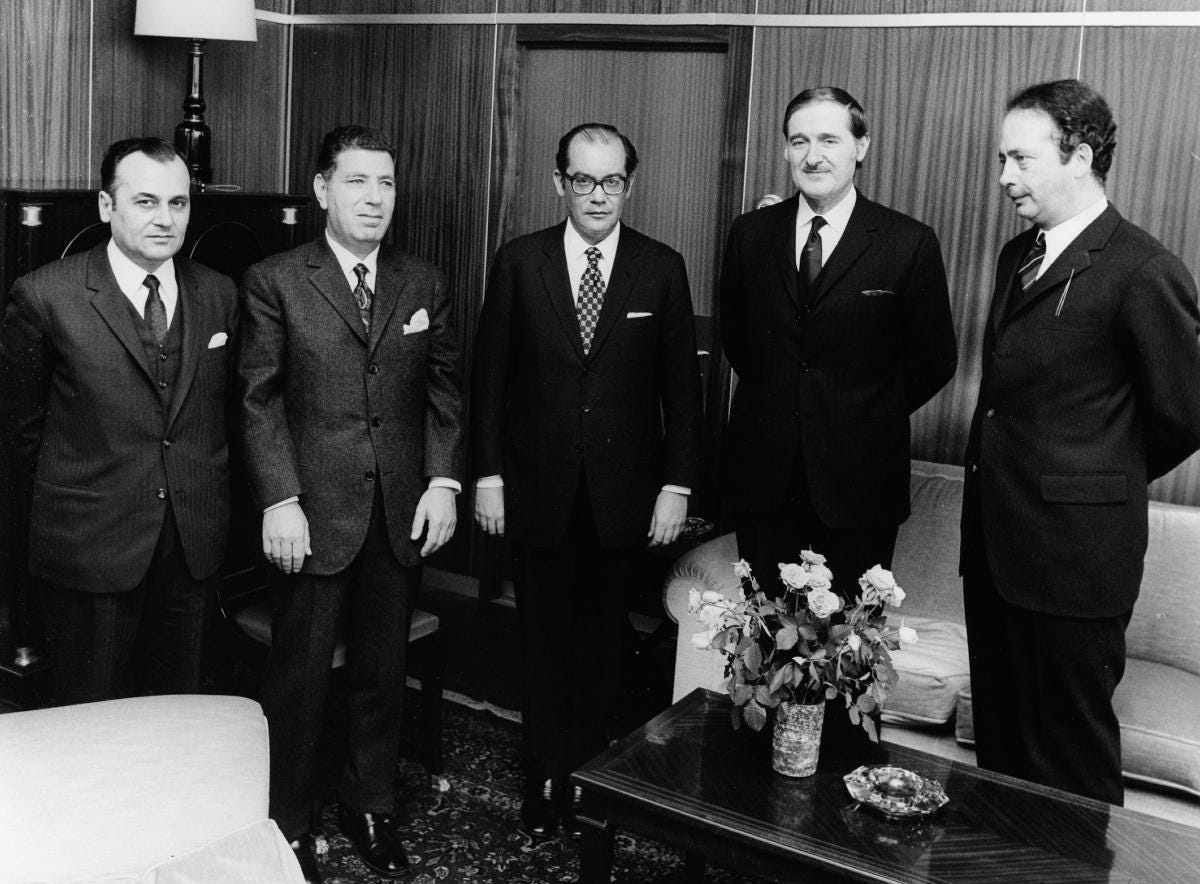
Still, the first demand to establish an official diplomatic relationship between the EEC and Syria came on April 10, 1964. On this date, the Syrian embassy in Brussels conveyed, by verbal note, Damascus’s wish to establish a diplomatic mission to the EEC.5 On May 25, 1964, the EEC’s Council of Ministers approved the opening of the Syrian diplomatic mission. The small office remained mostly inactive in the years that followed. Syria did not appoint a Chargé d’Affaires, Selim Al-Yafi, until January 11, 1967—three years after the Commission approved the Syrian mission.6
Initially, the establishment of diplomatic ties failed to materialize into anything concrete. Syria’s involvement in the Six-Day War in 1967 strained its newly established relationship with the EEC, and the Syrian authorities would then wait three years—until June 23, 1970—to send a full-fledged head of mission, Adib Daoudy, to the EEC.7 Alongside sending Mr. Daoudy, Damascus expressed its desire to strengthen its diplomatic ties with the European Communities by extending the Syrian diplomatic mission to the EEC to include the European Coal and Steel Community (ECSC) and the European Atomic Energy Community (EAEC).8 The Council of Ministers approved the expansion of diplomatic ties with these two communities on July 20 and August 18, 1970, respectively.9
This marked an important milestone in the bilateral relationship and gave real substance to what had until then remained a mostly nominal diplomatic connection. Up to that point, chronic instability within Syria, together with its image in European eyes as a disruptive regional actor, had made the Community cautious about deepening engagement with Damascus.
Shortly after strengthening ties with Brussels, Damascus seized the opportunity to request food aid from the EEC, amounting to 80,000 tonnes of wheat, on July 20, 1970.10 This demand came at a time when the Syrian agricultural sector had suffered from neglect and political instability.11 The nationalization of most of the country’s economic sectors, which led to stagnation in the agricultural sector and rapid population growth (+40 percent between 1960 and 1970), also increased food needs.12 This, coupled with the fact that most of the country’s agriculture was rainfed and thus subject to potentially significant annual fluctuations, allowed food aid to act as a buffer against extreme weather events.
Two years later, the EEC acceded to this request and granted Syria food aid, albeit under conditions. On April 11, 1972, the two parties signed the “agreement between the EEC and the Syrian Arab Republic on the supply of common wheat as food aid,” ultimately equivalent to 7,500 tonnes of wheat. Provided under strict conditions, the agreement stipulated, among other things, that the profits linked to the sale of the European food aid—in case Damascus acquired food aid that was not needed to meet the Syrian population’s needs at the time—were exclusively deposited in a specific account intended to cover Syria’s expenses in terms of financing development projects.13 In subsequent food aid agreements, the Europeans reinforced this conditionality by requiring that any development projects financed through the proceeds of these sales receive prior approval from the European Commission.14
Fluctuating Trade Relations
Despite the lack of significant diplomatic and political ties, EEC-Syria trade ties were important for Damascus. Before 1957, Western Europe was Syria’s most significant trading partner. Afterward, the situation evolved so that the largest purchasers of Syrian goods were no longer the largest suppliers (Western Europe at the time). Arab and ‘communist countries’, particularly China, became significant buyers of Syrian goods, such as cotton. Still, Western European countries, specifically those within the EEC, remained Syria’s primary suppliers. According to European trade data (see table below),15 Syria’s imports from EEC countries accounted for about one-third of its total imports, while about one-fifth to one-quarter of its total exports went to the EEC.16
Although these percentages were already significant, the potential for bilateral trade was much higher. Despite the general non-discrimination in trade regulations between EEC member states and Syria, Western exporters faced difficulties due to delays in currency transfers from Syrian importers. At the time, the lack of a bilateral payment agreement between the EEC and Syria meant that Syrian importers had to wait longer to secure export currency. Thus, Syrian importers were inclined toward countries with which Syria had signed such agreements, such as China and Eastern European nations, to circumvent currency issues. This delay in currency transfers led to Western products being more expensive, as importers had to secure currency through the parallel monetary market (black market), where foreign currency was about 8 percent more expensive.17
At the same time, the USSR had seized the opportunity offered by the Syrian coup of February 1966 to strengthen its ties with Syria,18 thereby leading to a significant increase in trade between the two countries. Between 1965 and 1967, Syrian imports from the USSR multiplied by four, while exports to the USSR increased by 15 percent.
Overall, the 1960s revealed a structural feature that would long shape relations between Damascus and Brussels: political hesitation coexisted with economic interdependence. Syria remained wary of closer alignment with Western Europe and continued to deepen its strategic ties with the Soviet bloc, yet the EEC and its member states retained a central place in Syria’s external economic relations, particularly as suppliers of industrial goods and, increasingly, as a potential source of development support. In that sense, the first decade of EEC-Syria relations did not produce a full-fledged partnership, but it did establish the basic pattern on which later cooperation would rest: political caution on both sides, combined with a persistent Syrian need for European markets, technology, and finance.
The start of the 1970s, marked by Hafez al-Assad’s consolidation of power and the beginning of a relative economic and political opening (infitah) in Syria, seemed to have facilitated a diplomatic rapprochement with Western powers. Relations with the West, hitherto fluctuating due to various conflicts with Israel, thus seemed to warm up from 1974 onward.
A delegation from the EEC was sent to Damascus on 26 and 27 March 1974 to discuss the possibilities of cooperation between Syria and the EEC.19 Around the same time, Syria had signed two agreements with France in July and November 1974,20 and resumed diplomatic relations with the United Kingdom in May 1973, the United States in June 1974, and with the Federal Republic of Germany (FRG) the following month.21
The development of trade relations between the EEC and Syria mirrored this apparent political rapprochement. The EEC once again became Syria’s largest trading partner, accounting for 32.9 percent of Syria’s total foreign trade, compared with 26.7 percent for the Eastern Bloc.
Compared to the Eastern Bloc, the EEC benefited from technological and industrial advances, enabling it to produce goods essential to Syria’s development plans that were not available domestically or in neighboring regions at the required quality and scale. While it is true that Syria benefited from significant development aid from the socialist bloc, such as roads, dams, and ports, under conditions that were difficult for Western Europeans to compete with, the long construction times and limited profitability still made it necessary for Syrians to seek equipment elsewhere in the short term. Syrian imports from the EEC included high-tech industrial goods, machinery, and equipment needed to develop Syria’s infrastructure and industrial base.22
Thus, the share of Syria’s imports coming from the EEC rose from roughly one-quarter in 1970 to nearly 40 percent in 1974. As for exports, Syria primarily exported raw materials and agricultural products, which were in less demand in EEC countries (see table below).23 Moreover, the quality of Syrian industrial products was often not competitive enough for the demanding European markets, which limited their attractiveness as imports in the EEC. As a result, only one-fifth of Syria’s total exports reached the EEC markets.
In the early 1970s, the main goal of Syrian economic policy was to improve the “terms of trade” by enhancing the quality and finishing of local industrial productions, aiming to reduce the export of raw materials in favor of finished and semi-finished goods.24 It was with this objective in mind—which could be accomplished with European development aid—that Damascus would seek to expedite the signing of a bilateral cooperation agreement.
Showing its willingness to develop deeper ties with its European counterparts, the Syrian government would even use the ‘trade argument’, among others, to push for the conclusion of a cooperation agreement between Damascus and Brussels, which would eventually come into effect in 1977.
During the first session of negotiations on a cooperation agreement between the EEC and Syria, the Syrian delegation presented this expansion in trade not as a passive trend, but as the result of a deliberate political choice by Damascus. Ammar Jamal, then Deputy Minister of the Syrian Ministry of Economy and Trade, declared that:
Syria, under the presidency of Mister Hafez Al-Assad, has shown its goodwill towards the Common Market25 by considerably increasing the volume of our trade with the Member States of the E.E.C. Our imports from the E.E.C. constituted in 1970, 26.6 percent of our total imports; this percentage rose to 39.2 percent in 1974.26
Conclusion
The 1960s marked the beginning of Syria’s engagement with the EEC, yet this relationship remained tentative and largely driven by economic pragmatism rather than political alignment. While Syria was deepening its ties with the Soviet Union, it also saw the EEC as a potential economic partner, particularly as a source of trade and development support. However, the diplomatic engagement was hesitant—Damascus took years to fully establish its mission to the EEC, and political instability in Syria, coupled with its role in regional conflicts, made European policymakers wary of deepening ties.
Despite these limitations, the decade laid an essential foundation for future cooperation. Syria’s uneven trade relationship with the EEC highlighted the country’s dependence on European markets for imports, while the challenges it faced, including currency transfer delays and reliance on food aid, underscored the economic vulnerabilities that would later shape its approach to European partners.
More fundamentally, the 1960s revealed a pattern that would endure for decades: political caution coexisted with economic relevance. Syria did not move closer to the EEC in strategic or ideological terms, yet the Community was already becoming an important economic interlocutor, as a supplier of industrial goods, a potential source of development support, and eventually a diplomatic channel worth cultivating. As Syria entered the 1970s, these limited openings gradually evolved into a more structured framework for cooperation, culminating in the 1977 Cooperation Agreement. While political convergence remained limited, the foundations laid during this earlier period helped shape the trajectory of EEC-Syria relations for the decades that followed.
This paper is the first of a series of six papers examining the relationship between the European Union (including its earlier institutional incarnations) and Syria. Drawing on diplomatic archives, grey literature, trade statistics, and contemporaneous policy documents, the series seeks to shed light on a scarcely documented relationship that has oscillated between strategic pragmatism and political estrangement.
By tracing the evolution of diplomatic contacts, trade flows, aid conditionality, and cooperation frameworks, the series aims to unpack how economic interdependence often preceded political alignment and how mutual caution repeatedly constrained deeper integration.
You can read Part 1, on the 1960s and the first diplomatic ties between Syria and the EEC, here, and Part 2, on the 1970s and the EEC-Syria Cooperation Agreement, here.
Tannous, Manon-Nour. Chirac, Assad et les autres. Les relations franco-syriennes depuis 1946. Presses Universitaires de France, 2017.
Ibid.
Belgium, France, West Germany, Italy, Luxembourg, and The Netherlands.
General Secretariat of the Council of the European Union, Comptes rendus de 287ème à 291ème réunions et des réunions restreintes tenues à l’occasion des 287ème 291ème réunions du Comité des représentants permanents. Texte(s) d. », Archives historiques CM 2/1964 n° 0171.
Ibid.
General Secretariat of the Council of the European Union, Dossier concernant les représentations et missions des États tiers auprès des communautés européennes. Textes f, d, i, nl et en partiellement, Archives historiques CM 2/1967 n° 1076.
General Secretariat of the Council of the European Union, Dossier concernant la représentation de la Syrie auprès de la CEE, la CECA et la CEEA, Textes d, i et nl partiellement, Archives historiques CM 2/1970 N°1352.
Ibid.
Ibid.
General Secretariat of the Council of the European Union, « Dossier concernant la décision 72/162/CEE du Conseil du 22.03.1972 portant sur la conclusion d’un accord entre la CEE et la République arabe syrienne relatif à la fourniture de froment tendre à titre d’aide alimentaire. Accord signé le 11.04.1972. Textes de, it et nl partiellement. », Archives historiques CM 2/1972 n° 1461.
Richards, Alan. Syrian food security in the 1970s and 1980s. Food policy 16.6 (1991): 487-492.
Ibid.
Ibid.
General Secretariat of the Council of the European Union, Accord du 25.03.1974 entre la CEE et la République arabe syrienne relatif à la fourniture de froment tendre à titre d’aide alimentaire, Archives historiques CM2/1974 N°1851 ; Accord du 11.11.1974 entre la CEE et la République arabe syrienne relatif à la fourniture de farine de froment tendre à titre d’aide alimentaire, Archives historiques CM2/1974 N°1859.
General Secretariat of the Council of the European Union, Rapport des conseillers commerciaux des pays de la CEE en Syrie. Textes nl partiellement, Archives historiques CM2/1966 n° 0971.
Ibid.
Ibid.
George W. BRESLAUER, Soviet Strategy in the Middle East, Routledge, 1990, p. 5.
General Secretariat of the Council of the European Union, Rapport des conseillers commerciaux des pays de la CEE en Syrie, Archives historiques, CM 2/1975, n° 2066.
Farahat OTHMAN, Les accords franco-arabes : des origines des relations bilatérales à nos jours, Paris, L’Harmattan, 2001.
Archives historiques CM 2/1975 n° 2066, op. cit.
Ibid.
Commission of the European Communities, EEC-Syria Cooperation Agreement. 1977.
Archives historiques CM 2/1975 n° 2066, op. cit.
The ‘Common Market’ is the name given to the European internal or single market, within which EU member states trade without restrictions on movement.
General Secretariat of the Council of the European Union, Accord de coopération entre la Communauté économique européenne et la République arabe syrienne, signé à Bruxelles le 18.01.1977. (Règlement (CEE) n° 2216/78 du Conseil du 26.09.1978 concernant la conclusion de l’accord de coopération entre la Communauté économique européenne et la République arabe syrienne, Archives historiques CM 2/1978 n° 370.2).