

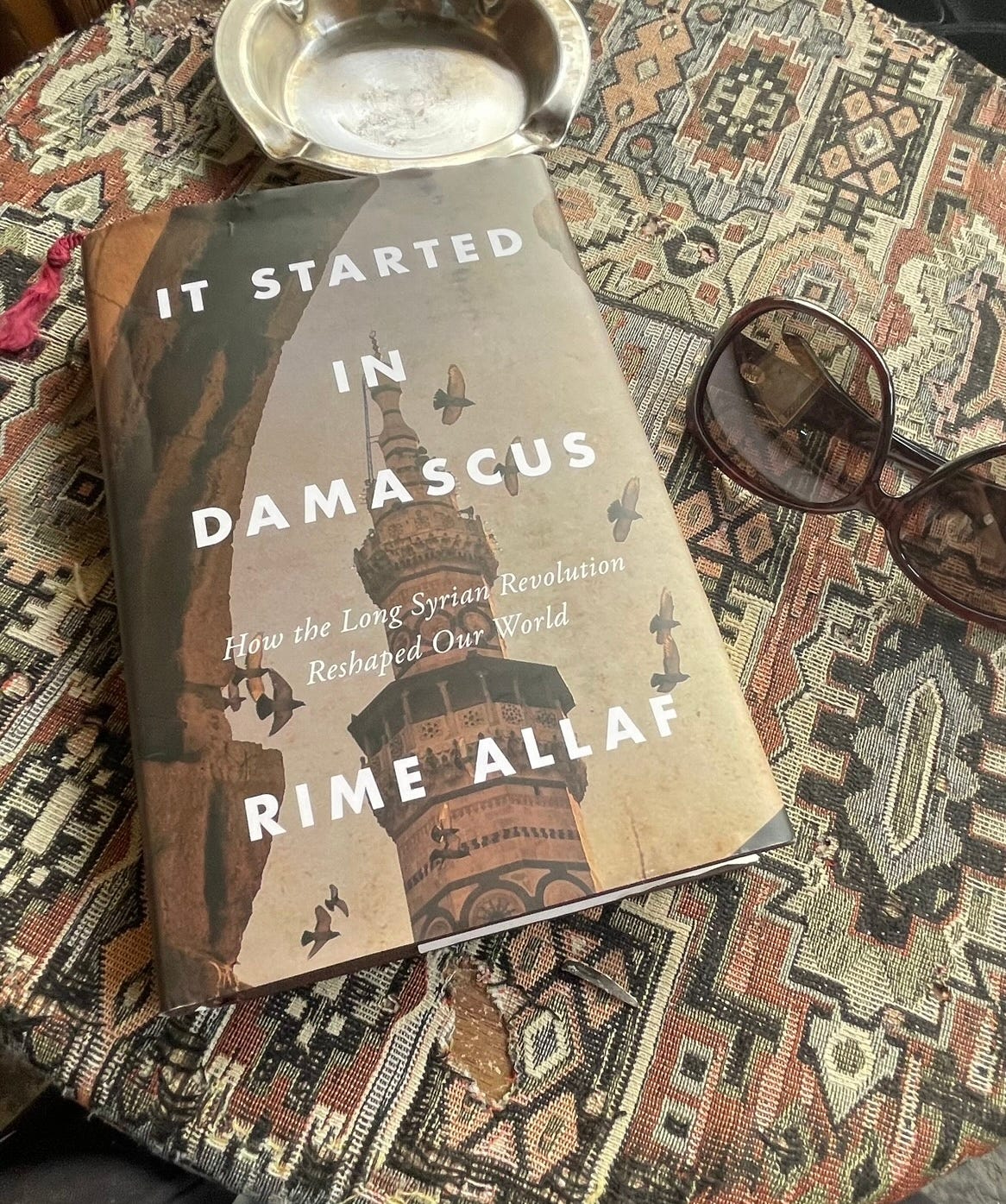
More than fifteen years after the start of the Syrian revolution and less than two years after the fall of the Assad regime, Syria finds itself confronting a question that goes far beyond politics: how does a society rebuild after decades of authoritarian rule, war, displacement, and fragmentation? In It Started in Damascus: How the Long Syrian Revolution Reshaped Our World, Syrian writer and policy adviser Rime Allaf argues that understanding Syria’s future requires first understanding the lived experiences that shaped its past. In this interview with The Syria Dispatch, she discusses why she wrote the book, how life under the Assad regime shaped everyday behavior and social relations, the importance of memory and justice, and the opportunities—and risks—facing Syria’s post-Assad transition.
(Please note that Substack allows readers to listen to articles by clicking the “play” button in the top-right corner of the article.)
Why this book, and why now?
The Syria Dispatch: After decades of writing and commenting on Syria, what made you decide that now was the right moment to write and publish It Started in Damascus? Looking back, was there a particular moment that convinced you that Syria’s story needed to be told in this form?
Rime Allaf: The book was always in the back of my mind. Throughout the years, especially at the beginning of the revolution, a couple of people in the business approached me and asked whether it was time. But I never felt it was the right moment. At the time, I was very intellectually and emotionally involved in what was happening in Syria. I felt that, to write deeply about something like this, you needed perspective. You needed a little bit of distance.
I began thinking more seriously about the project around 2019–2020. By then, the hopes many people had held were fading. We had already gone through so much. Idlib was becoming the focus of attention, and then the pandemic happened. In some ways, that should have been the perfect opportunity to write. Everybody was sitting at home. But I still wasn’t ready.
The moment that changed everything came in May 2023. I was staying with friends in Geneva. The idea of the book was there. The concept was there. But I still hadn’t committed to writing it. Then I was watching the news and saw Bashar Assad being welcomed back into the Arab League in Saudi Arabia.
Without any doubt, that was the moment.
It felt like a dagger in my heart. It felt like an affront to the intelligence of Syrians. After everything that had happened, after all the destruction, the suffering, the displacement, the deaths, it suddenly felt as though the world was saying: “That’s enough. Let’s move on.”
And I thought: no. The story isn’t over.
People had lost interest in Syria. There were surprisingly few books being written. The country was disappearing from public debate. Yet from my perspective, the Syrian story was far from finished.
So I decided that I had to write it.
The proposal was sold a few months later, and I was supposed to deliver the manuscript in January 2025. By the end of November 2024, I was around 90 percent finished. The entire structure of the book was already there. Most of the manuscript was written.
Then the military operation began in northern Syria.
I remember writing to my agent and my publisher. At first, I simply told them that something important was happening and that we should keep an eye on it. A few days later, I wrote again and said: “They’re at the doors of Hama. I can’t write anymore.”
When the regime fell, like many Syrians, I simply stopped functioning normally. I spent days glued to multiple screens. I was crying for hours watching events unfold. Many Syrians experienced something similar.
What is important to understand, however, is that the fall of the regime did not change the book itself.
I didn’t go back and rewrite it. I didn’t suddenly turn it into a book about the collapse of Assad. The only part that changed significantly was the final chapter. The original conclusion was going to argue that Syria’s story was not over, despite the international rehabilitation of Bashar Assad. After December 2024, obviously, that chapter had to be rewritten.
But the central argument remained exactly the same.
This was never a book about the Syrian revolution itself.
It is a book about why there was a Syrian revolution.
That distinction matters enormously.
Too often, people begin their analysis of Syria in 2011. They focus on the revolution, the war, the Islamists, the foreign powers, the geopolitics. But if you do not understand what Syrians lived through under Hafez Assad and Bashar Assad, if you do not understand the restrictions, the fears, the frustrations, the hopes and disappointments that shaped everyday life, then you cannot fully understand why people rose up in 2011.
And I think that problem still exists today.
Many people have returned to discussing Syria primarily through geopolitics: Turkey, Saudi Arabia, Israel, Iran, the Islamists. But Syria is also a society. Syrians are not all the same, but they lived through many of the same structures of repression. If we don’t understand that history, we cannot understand why Syrians behave the way they do today.
“It” Started in Damascus
The Syria Dispatch: The title of the book is deceptively simple. You have said that this is not primarily a book about the revolution itself. So what exactly is the “it” that started in Damascus? Is it the revolution? A longer struggle for dignity? Or something else entirely?
Rime Allaf: Hope.
Or perhaps more precisely: the conviction that a normal life was finally possible.
You discover this very early in the book because the opening chapter begins with the death of Hafez Assad in June 2000.
What people often forget today is just how much expectation surrounded that moment.
Many observers look back and say, “Well, Bashar Assad arrived and people were naïve.” But that interpretation misses something important.
The Syrian people were exhausted.
They had lived through three decades of Hafez Assad. They had experienced a system of extraordinary control and restriction. They were not dreaming of grand political transformations. They were not expecting Western-style democracy. They were asking for something much more modest.
They wanted a normal life.
This is one of the reasons I insist that Syria cannot simply be compared to every other Arab dictatorship. Every authoritarian system is different. The Syrian experience was unique in many ways.
People today sometimes forget how restrictive everyday life could be.
For years Syrians could not import cars. Everyday goods were unavailable. People spent enormous amounts of energy trying to secure basic necessities. The state inserted itself into countless aspects of ordinary life.
When Bashar came to power, many Syrians genuinely believed that this would change.
What started in Damascus was not simply hope in an abstract sense. It was the conviction that Syria was finally beginning a journey toward normality.
People looked at neighbouring countries and thought: perhaps we can be like that. Perhaps we can have a little more freedom. A little more economic opportunity. A little more dignity.
And that conviction also explains something else that is often forgotten.
It explains why Bashar Assad initially enjoyed so much support.
People weren’t supporting him because he had already proven himself to be a reformer. They supported him because they desperately wanted to believe that change was possible. They invested enormous hopes in him because they had already waited so long.
That, ultimately, is what “started in Damascus.” It was the belief that the future could finally be different.
A Chronicle, Not a Memoir
The Syria Dispatch: The book has been described in different ways: part history, part memoir, part social chronicle. Yet you’ve pushed back against some of those labels. How do you think readers should understand the book? And how did you navigate the balance between personal experience and historical analysis?
Rime Allaf: I usually describe it as a chronicle.
People often call it part memoir because I appear in the book. I insert myself at the beginning of many chapters. I tell stories from my own life. I recount moments that I witnessed personally.
But I don’t really think of it as a memoir.
If it were a memoir, I would have written a memoir.
The reality is that I am present in the book primarily as a guide for the reader.
I often compare it to a theatre play. Sometimes a narrator steps onto the stage, explains where we are, introduces the scene, and then disappears while the story unfolds. That’s essentially my role in the book.
The focus is not on me. The focus is on Syria.
The reason I chose this approach is because I wanted the book to be accessible. I did not want to write something that felt like an academic text. I wanted someone with no prior knowledge of Syria to be able to pick it up and stay engaged.
The target audience was never specialists or historians.
It was my neighbours. My friends. People who hear about Syria, hear about Syrian refugees, hear about the war, but don’t necessarily understand how we got here.
That’s why the personal anecdotes matter.
They provide an entry point.
At the same time, they are also representative. Many of the stories I tell are not important because they happened to me. They are important because they illustrate how Syrians experienced life under the Assad system.
In fact, there is far less of me in the book than people might imagine. I left out far more than I included.
The book moves between the personal, the social, the cultural, the political, the regional and the international. It explains what the Assads did inside Syria, but also in Lebanon, Palestine, Iraq and elsewhere. It follows different themes across different decades.
That is why I call it a chronicle.
It is not a rigid history, even though it contains history. It is not a memoir, even though I appear in it. It is an attempt to tell a larger Syrian story in a way that remains accessible to ordinary readers.
I wanted readers who knew nothing about Syria to arrive at the revolution and think: “Now I understand why this happened.”
That was always the objective.
Beyond Politics: Why Everyday Life Matters
The Syria Dispatch: A review of your book by Syria in Transition argued that one of its strengths is the way it examines Assadism not only as a political system, but through the lens of everyday life and lived experience. Why was it important for you to focus on those dimensions rather than solely on institutions, ideology, or political events?
Rime Allaf: Because for decades Syria was analysed almost entirely through geopolitics.
People spoke about Syria as a strategic actor. They discussed alliances, negotiations, wars, regional balances, peace talks, and security questions. Syria was treated as a geopolitical file.
What was largely ignored was the lived experience of Syrians.
There was an assumption that Syria was simply another Arab dictatorship, that all authoritarian systems in the region functioned more or less the same way. I reject that entirely.
Even Saddam Hussein’s Iraq was different. Saddam committed terrible crimes, but he also invested in infrastructure, education, and public services at first. Syria under the Assads was a different kind of system.
One of the chapters in the book is called Banana Politics. People laugh when they hear the title, but it reflects something important. Syrians spent years dreaming of giving a banana to their children. A banana.
This was not because Syria was naturally poor. Syria was not a poor country. It was because scarcity became part of how the regime governed.
People outside Syria often don’t understand what daily life was like. They hear about intelligence services and repression, but they don’t understand the countless small restrictions that shaped ordinary existence.
For years, people struggled to obtain basic goods. You could not simply start a business. You could not move freely. You could not speak freely. You could not trust freely.
The regime wanted people focused on survival.
When you force people to spend their lives worrying about obtaining basic necessities, navigating bureaucracy, securing employment, or avoiding trouble with the authorities, you leave them with little space to think about politics.
And that is why everyday life matters.
The regime did not only control institutions. It shaped behaviour.
When children entered school, they immediately entered the Baathist system. Every morning they repeated slogans. They learned which opinions were acceptable and which were not.
The point was not necessarily ideological conviction. Most people were not committed Baathists. The point was social conditioning.
Eventually, people adapted.
They learned how to behave. They learned how to survive. They learned what could and could not be said.
That is one of the reasons I wanted to focus on daily life. Because if you don’t understand how people actually lived, you cannot understand either the revolution or what followed it.
What Remains of Assadism Today?
The Syria Dispatch: In previous interviews, you’ve spoken about how Syrians learned to “pretend” under authoritarian rule—that performance, conformity, and self-censorship eventually became second nature. Since returning to Syria after the fall of the regime, what aspects of Assadism have struck you as most persistent? What legacies do you think will be the hardest to overcome?
Rime Allaf: This is one of the most difficult questions facing Syria today.
What people often overlook is that Syrians are no longer a society that has lived through a shared experience.
We all experienced Assadism, but we did not all experience the revolution and the war in the same way.
For me, one of the most important distinctions today is not between Sunni, Alawi, Christian, Kurd, or Druze. The more important distinction is between Syrians who spent the last fourteen years in different environments.
There are Syrians who remained under regime control.
There are Syrians who rebuilt their lives in Europe, where they learned new languages, entered new institutions, and experienced different political systems.
There are Syrians who spent years in camps in Jordan, Lebanon, or along the Turkish border.
There are Syrians who lived in opposition-held areas and experienced entirely different forms of governance.
These are radically different experiences.
When people speak about rebuilding Syria, they often focus on physical infrastructure. Roads, electricity networks, housing, water systems.
But there is another infrastructure that was destroyed.
The social contract.
Trust between people.
Trust in institutions.
Trust in the future.
For decades under Assad, people learned not to trust.
They learned to be careful with what they said, whom they spoke to, and how they behaved. Then came the revolution, displacement, war, exile, and fragmentation.
Today, even Syrians who oppose the old regime often struggle to understand one another because they lived through completely different realities.
The challenge is not simply that Assadism created fear.
It is that Assadism destroyed the foundations upon which trust is built.
That is why I become frustrated when people reduce Syria’s problems to sectarianism.
Sectarian tensions exist, of course. But for me, sectarianism is often a symptom rather than the root cause.
The deeper issue is that millions of Syrians have emerged from radically different experiences and now have to rebuild a country together.
That is an enormously difficult task.
Fear, Memory, and Justice After Assad
The Syria Dispatch: Can a society stop being afraid simply because the regime that produced the fear has disappeared? More broadly, how should Syrians remember the Assad era? Is justice primarily about trials and accountability, or is it also about preserving memory and understanding how the regime shaped society?
Rime Allaf: We need both.
We need memory, and we need justice.
The stories of Syrians need to be documented and preserved. We need more Syrian voices telling what happened, because there are still too many aspects of Syrian life that remain misunderstood.
But memory alone is not enough.
There must also be accountability.
One of the things that worries me today is the sense of unresolved injustice.
Many Syrians still do not understand what is happening with former regime officials, former perpetrators, or the broader accountability process.
Part of the problem is communication.
The government may have reasons for the decisions it is making. Perhaps there are practical constraints. Perhaps there are legal constraints. But people need to understand the process.
There needs to be a vision.
There needs to be an explanation.
There needs to be a conversation with Syrians about what justice is going to look like and what is realistically possible.
Because if people feel that everything is being decided behind closed doors, resentment begins to accumulate.
And this matters because justice is not simply about punishment.
Justice is also about restoring trust.
It is about demonstrating that the rules have changed.
It is about showing people that the future will not function according to the same logic as the past.
At the moment, I think one of the government’s weaknesses is communication.
For the most part, Syrians are trying to understand major political developments through rumours, social media, Facebook posts, and word of mouth.
That is not sustainable.
Communication is not a cosmetic issue.
It is a state-building issue.
People need to understand where their country is going.
They need to understand why decisions are being made.
And they need to feel that they are part of the process.
Without that, rebuilding trust becomes much more difficult.
Is 2026 Another 2000?
The Syria Dispatch: Many Syrians remember the optimism that accompanied Bashar Assad’s arrival in 2000. Today, after the fall of the regime, there is once again a sense of possibility. What feels different this time? And are there lessons from the disappointments of 2000 that Syrians should keep in mind today?
Rime Allaf: I actually disagree quite strongly with the comparison.
I understand why people make it. Both moments are associated with a sense of hope and the possibility of change. But I think the similarities stop there.
The Syria of 2000 had not experienced what Syrians have experienced over the last fifteen years.
The revolution, the war, the displacement, the destruction, the abandonment by much of the international community—these experiences fundamentally transformed Syrian society.
The other major difference is external.
For the first time in decades, there is broad agreement among regional and international actors that Syria needs to be stabilized.
Saudi Arabia, Turkey, Jordan, Qatar, much of the Gulf, and large parts of Europe all understand that the collapse of Syria has been enormously costly. They may not all have the same vision for the country, but they broadly agree that another collapse would be disastrous.
This was not the case in 2000.
Today, there is a much stronger support structure around Syria.
Part of that is because everyone wants refugee returns. Part of it is because everyone wants stability. Part of it is because the region has seen what happens when Syria collapses.
I also think there is a greater sense among Syrians themselves that this opportunity cannot be wasted.
The price paid over the last fifteen years has simply been too high.
That does not mean success is guaranteed. Far from it.
But I do think the circumstances today are fundamentally different from those that existed when Bashar Assad came to power.
Communication, Legitimacy, and the New Syria
The Syria Dispatch: During our conversation, you repeatedly returned to the importance of communication. Why does this matter so much for Syria’s transition?
Rime Allaf: Because communication is not simply a public relations issue.
It is part of governance.
One of the frustrations many Syrians feel today is that major decisions are being made without sufficient explanation.
People often do not understand why certain policies are being adopted, why particular individuals are being appointed, or how the government intends to address questions of justice and accountability.
That creates uncertainty.
To be fair, I think the current authorities are often listening to public reactions. We have seen examples where criticism emerges and adjustments are made.
But listening is not the same thing as communicating.
Communication means explaining decisions, outlining objectives, sharing constraints, and involving people in the process.
Many Syrians today are learning about major developments through Facebook, social media, and rumours. That is not healthy.
A government needs to talk directly to its people.
One of the reasons I commented on Ahmad al-Sharaa’s public apology after the controversy surrounding his father’s remarks was precisely because it showed another side of leadership.
The apology itself was important, but what interested me more was the willingness to acknowledge that people were offended and to address the issue publicly.
For decades, Syrians lived under a system where rulers never admitted mistakes.
That does not mean symbolic gestures are enough. Ultimately, institutions matter more than symbolism.
But symbols matter too.
Political cultures do not change overnight. Sometimes a small gesture can signal that a different relationship between rulers and citizens is possible.
The challenge is ensuring that these gestures are eventually translated into institutions and practices that endure.
Syria’s Greatest Test
The Syria Dispatch: Much of the discussion about Syria today focuses on reconstruction, sanctions, investment, governance, or geopolitics. Yet transitions often succeed or fail for reasons that are less obvious at the time. What do you think will ultimately determine whether Syria’s transition succeeds or fails?
Rime Allaf: Justice.
Not revenge. Justice.
I think Syrians need to feel that what happened to them matters and that there is a meaningful process of accountability.
That does not necessarily mean putting every perpetrator on trial. But it does mean showing people that there is a path forward and that the future will not simply reproduce the injustices of the past.
At the same time, people need something much more basic.
They need a normal life.
And this is something that connects directly back to the beginning of the book.
When Hafez Assad died in 2000, Syrians were not dreaming of grand ideological projects. They wanted normality.
Today, after everything they have endured, they want the same thing.
They want housing.
They want electricity.
They want water.
They want jobs.
They want schools.
They want to know that their children will have a future.
If Syria can provide that, then I think there is reason to be optimistic.
And I am optimistic.
Despite everything, I remain optimistic.
The circumstances are difficult, but there is also an extraordinary opportunity.
The challenge is transforming that opportunity into functioning institutions, accountability, and a social contract capable of bringing Syrians back together.
That is what will ultimately determine whether this transition succeeds.
What Does the World Still Misunderstand About Syria?
The Syria Dispatch: Throughout your book, you challenge many of the assumptions that outsiders have made about Syria and Syrians. If there is one thing you wish both Syrians and the rest of the world understood better about Syria today, what would it be?
Rime Allaf: That Syria is not a geopolitical abstraction.
Too often, Syria is discussed through the language of states, alliances, sects, armed groups, and foreign powers.
Of course those things matter.
But Syria is also a society.
The revolution did not emerge from nowhere. Nor did the transition that followed.
Both are rooted in the lived experiences of millions of Syrians.
If we want to understand where Syria is heading, we must first understand what Syrians lived through under the Assads, how those experiences differed during the years of war and displacement, and how they continue to shape the choices people make today.
That, ultimately, is what I hoped to capture in It Started in Damascus.
Because before we can understand the revolution, we have to understand why there was a revolution in the first place.