

A Decade Marked by Two Phases
Between the signing of the EU-Syria cooperation agreement in 1977 and the early 1990s, only minimal amendments were made to the bilateral cooperation framework. Beyond the adoption of the Second Financial Protocol (1982–1986),1 the only technical amendment made to the cooperation framework before the launch of the Barcelona Process in 1995 was introduced on June 16, 1988. This amendment formalized the establishment of a Euro-Syrian Economic and Commercial Cooperation Committee to facilitate information exchange between the two parties, and also integrated Greece, Spain, and Portugal into the EEC-Syria agreement following their accession to the European Economic Community (EEC).2
During the early 1980s, EEC-Syria relations were stable and expanding, though largely one-sided, with Brussels steadily increasing its financial support for Damascus. This period of engagement culminated in the signing of the Second Financial Protocol in June 1982, reinforcing the EEC’s commitment to Syria’s economic development.3
However, this era of growing bilateral cooperation came to a sudden halt in April 1986. The Abu Nidal Organization (ANO),4 which operated with Syrian support, had intensified its attacks against European targets and interests in the meantime, leading to a sharp deterioration in relations. The fallout from ANO-linked terrorism, particularly a failed bombing in London, triggered an abrupt but short-lived diplomatic rupture between the EEC and Syria, marking the most severe crisis in their relations since they were first established back in 1964.
Bilateral Cooperation Flourishes
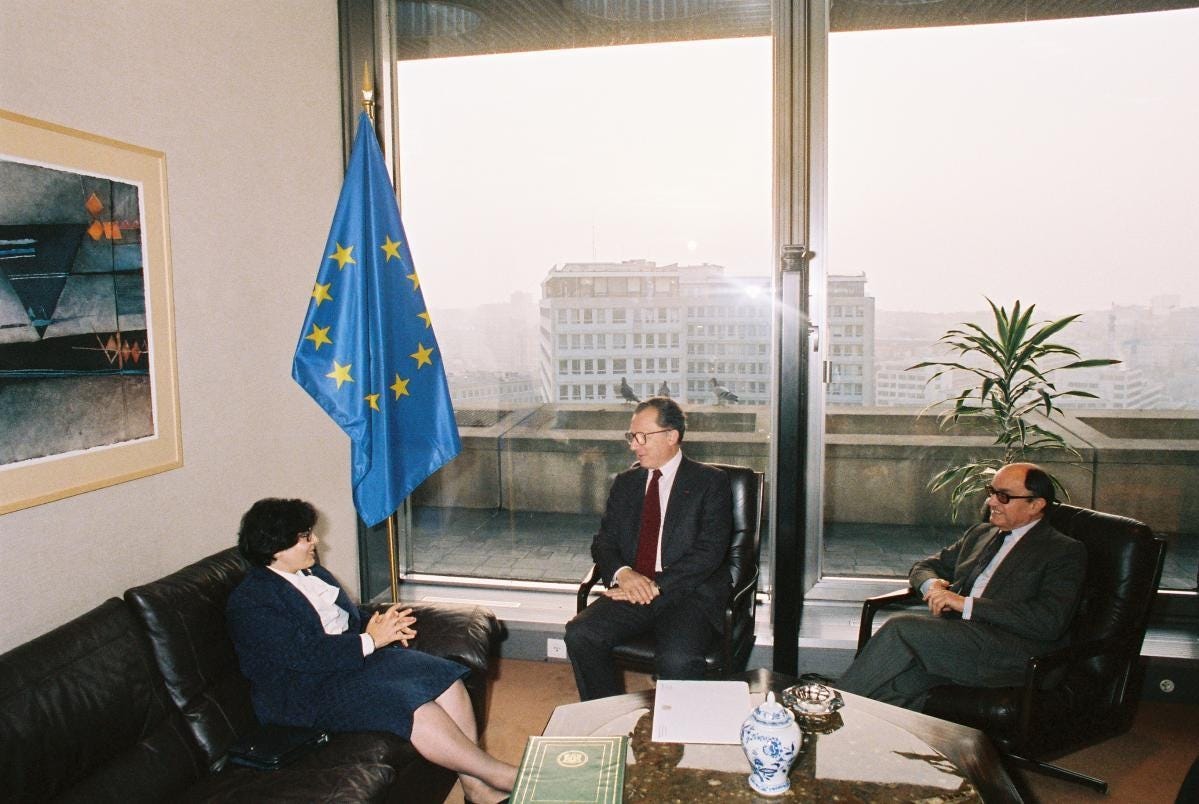
In April 1982, a joint delegation from the European Commission and the European Investment Bank (EIB) visited Syria to prepare the second financial protocol under the EEC-Syria cooperation framework. Led on the Community side by Maurice Foley, Christopher Lethbridge, and Ernest Lamers, and on the Syrian side by Vice-Minister for Planning Hamid Merei, the mission reached agreement on an indicative programme for future financing.5 The Community’s own programming paper made clear that its priorities in Syria were agriculture, small- and medium-industry, energy, infrastructure, and technical assistance.6
It is worth noting that the archival records of the time are strikingly technocratic and frame Syria almost entirely in terms of development needs, project pipelines, and implementation capacity. European diplomats make no mention of the security developments that unfolded throughout the late 1970s, culminating in the Hama Massacre of February 1982.7 While it can be understood that the mission was economic in nature, previous such economic missions did mention periods of turmoil and instability within the country, at least through an economic prism.
This omission can be understood within the broader geopolitical context of the time. Given the Iranian Revolution’s profound impact on Western policymakers, the dominant Western discourse shifted toward combating Islamism,8 leading to muted reactions to events like Hama. Likewise, Syria’s military intervention in Lebanon in 1976—which neither the EEC nor, more importantly, the United States actively opposed9—did not deter the EEC from maintaining its economic engagement with Damascus.
At the economic level, then, the joint Commission-EIB delegation painted a mixed picture of Syria’s economy and its needs. The delegation recognized Syria’s significant untapped potential in agriculture, industry, energy, and infrastructure, but also highlighted structural inefficiencies, poor planning, and weak coordination between government agencies and project execution bodies.10 While modernization efforts—particularly in agriculture and industrial development—were emphasized to reduce Syria’s dependence on foreign capital and increase employment, bureaucratic hurdles and mismanagement hindered the effective implementation of reforms.11
Without substantial external support and strategic reforms, Syria’s economy risked stagnation. In agriculture, the gap between food consumption and local production was widening, exacerbated by rapid population growth (3.3% per year12) and low irrigation levels, which leave the sector vulnerable to climate fluctuations and droughts. Meanwhile, the energy sector faced an impending crisis, as projections indicated that the electricity supply would become insufficient by 1985, unable to keep up with rising industrial, agricultural, and domestic demands.13
European officials also expressed frustration over the sluggish implementation of previously funded projects. Many investments, particularly in infrastructure and industry—both central to Syria’s import-substitution strategy aimed at fostering industrial development, modernization, and private-sector growth—had yet to yield tangible results due to delays in fund allocation, poor project execution, and a lack of financial discipline.14 Additionally, Syrian authorities hesitated to utilize EIB loans, preferring alternative financing options with more favorable interest rates.
Indeed, instead of fully engaging with European financial mechanisms, the Syrian government increasingly turned to Arab and international lenders offering more favorable terms. For example, through the Arab Fund for Economic and Social Development (AFESD), Syria secured approximately USD 65 million in loans on highly preferential terms.15 This reluctance, combined with weak institutional capacity and administrative inefficiencies, created an environment where funding commitments often failed to translate into meaningful economic progress.
For instance, the first financial protocol signed between the EEC and Syria, which was supposed to cover the four-year period from 1977 to 1981, had been implemented only partially by June 1982. Despite a total allocation of ECU 60 million, only a small fraction of the funds had been effectively disbursed, with bureaucratic inefficiencies, delays in project execution, and reluctance to use EIB loans cited as major obstacles.16
By mid-1982, only 20.3% of the non-repayable grants had been disbursed, while EIB loans remained largely untouched. Some projects, such as the Tall Tamir-Tall Alo Road construction, were approved but had not yet received any funding. Others, such as the industrial study and dairy farm projects, suffered delays due to administrative bottlenecks and poor coordination between planning authorities and executing bodies.17
The Second Financial Protocol between the EEC and Syria, signed in 1982 for a period covering 1982 to 1986, aimed to address the shortcomings of the First Protocol while continuing financial cooperation in key sectors. With a proposed allocation of ECU 97 million, split among ECU 64 million in the form of EIB loans, and, from the Commission, ECU 22 million in the form of grants and ECU 11 million in the form of loans on special terms; that is, repayable over 40 years at an interest rate of 1% per annum, with a 10-year grace period on interest.18
Throughout the second protocol’s negotiations, the EEC emphasized the need to modernize Syria’s economy, including expanding irrigation, increasing livestock production, improving energy infrastructure, and upgrading telecommunications and education facilities.19 However, European institutions were reluctant to commit to funding specific projects without clearer guarantees of improved execution and oversight. European officials stressed the need for stronger financial discipline, arguing that many of the delays in the First Protocol stemmed from poor project planning and coordination between Syrian authorities and European donors.20
The early 1980s revealed the structural limits of the EEC-Syria relationship, which had been formalized since 1977. On paper, the cooperation framework appeared stable, institutionalised, and increasingly ambitious; in practice, however, it remained narrow, technocratic, and weakly transformative. European institutions approached Syria primarily through the language of projects, sectors, and implementation capacity, even as political violence, regional intervention, and domestic repression were reshaping the Syrian regime’s position. At the same time, Damascus viewed the Community as a useful but ultimately secondary partner: a source of finance, equipment, and technical expertise, but not one to which it was willing to adapt its broader strategic behaviour. The result was a relationship resilient enough to survive weak implementation, yet too shallow to withstand a major political-security shock.
Short-Lived Severance of Ties
In that sense, the 1986 crisis did not simply interrupt an otherwise successful trajectory; it exposed the underlying contradiction of the relationship. The Community’s Mediterranean approach was built above all on economic instruments, with limited capacity to integrate hard political and security questions into its external action. Syria, for its part, had been able to compartmentalise its relations with Europe, benefiting from economic cooperation while pursuing regional policies that rested on very different calculations. Once terrorism entered the bilateral equation directly, that compartmentalisation became untenable for the Europeans, and the limits of the cooperation framework were suddenly laid bare.
It was in this context that EEC-Syria relations entered their deepest crisis to date. This rupture was all the more striking because it interrupted a relationship that, only a few years earlier, had been institutionalized through the 1982 Financial Protocol and a joint Commission-European Investment Bank mission.
The immediate trigger for the crisis was the attempted bombing of an El Al aircraft at London’s Heathrow Airport on 17 April 1986. The attack, carried out by the Jordanian national Nizar Hindawi, was widely understood in Western capitals as having involved Syrian official complicity.21
Indeed, although the ANO was responsible for a series of terrorist attacks across Europe—including in the United Kingdom, France, and Italy—the EEC targeted Syria because of Damascus’ well-documented support for the ANO’s activities.22 Syrian intelligence services had long provided operational backing to militant groups, and in the Hindawi Affair, direct Syrian involvement was deemed irrefutable. In response, the United Kingdom severed diplomatic ties with Syria, while the United States and Canada recalled their ambassadors from Damascus.23 Furthermore, the “Hindawi Affair,” as it became known, prompted the Twelve to adopt restrictive measures against Syria on 10 November 1986, shortly after Hindawi’s conviction by a British court.24 These measures included a ban on new arms sales to Syria, while allowing existing contracts to be honored; the suspension of high-level diplomatic visits; a review of Syrian diplomatic and consular activities in member states, with possible countermeasures; and tighter security measures for Syrian Arab Airlines operations within the Community.25
Yet the 1986 measures stopped short of a complete diplomatic rupture. The Community’s response was severe in symbolic and political terms, but limited in substance. The measures did not affect existing arms deliveries, and Syria primarily sourced its military equipment from the Soviet Union rather than from European suppliers.26 Even within the EEC, Greek officials openly questioned the effectiveness of the sanctions, with Deputy Foreign Minister Kostas Zouraris dismissing them as “three symbolic measures that mean nothing, plus a statement on arms sales.”27
However, Syria’s diplomatic isolation proved short-lived. By June 1987, just six months after the European measures were imposed, Damascus was able to re-engage with the international community following the closure of the ANO offices on its territory.28 Consequently, sentiment in Brussels shifted, and the European Commission, after several diplomatic exchanges (including contacts in Syria), proposed reviving negotiations for the Third Financial Protocol.29 Still, the United Kingdom remained firmly opposed, arguing that Syria’s involvement in terrorism had not changed. Given that financial protocols required unanimous approval, the Commission was unable to move forward with negotiations.30
Politically and diplomatically, EEC–Syria relations were effectively restored in the early 1990s. This normalization prompted the European Commission to reflect on the trajectory of the relationship. On May 24, 1991, in response to a written question posed a month earlier by a European Parliament member regarding the re-establishment of ties between Brussels and Damascus, the Commission outlined three key justifications for maintaining engagement with Syria.31
While acknowledging Syria’s shortcomings in human rights and democratic governance, the Commission argued that maintaining a framework for dialogue, information exchange, and vigilance was preferable to severing ties. Moreover, concerning Syria’s presence in Lebanon, the Commission emphasized the importance of avoiding Syria’s isolation, given its strategic influence in broader Middle Eastern conflicts. Finally, the Commission recognized that it could not unilaterally isolate Damascus, particularly when the United States and other Western powers had already begun to normalize relations in the context of the Gulf War.32
Conclusion
The 1980s marked the moment when EEC-Syria relations were tested against their own limits. The Second Financial Protocol (1982–1986) reinforced European financial support, but bureaucratic inefficiencies, weak implementation capacity, and Syria’s preference for more concessional external financing limited its practical impact. More fundamentally, the decade showed that the relationship remained politically shallow: substantial enough to sustain economic cooperation, but not deep enough to absorb a serious security crisis. The Hindawi Affair in 1986, therefore, not only triggered the first EEC-imposed sanctions on Syria; it also exposed the fragility of a partnership built on technocratic engagement and strategic ambiguity.
Yet Syria’s isolation proved short-lived. By 1987, Damascus had taken steps to restore ties with Europe, and by the early 1990s, bilateral engagement was resuming. The approval of two new financial protocols in 1992 and 1993, followed by Syria’s participation in the Barcelona Process in 1995, signalled a return to structured cooperation and set the stage for a more pragmatic, though still complex, relationship in the decade that followed.
This paper is the third of a series of six papers examining the relationship between the European Union (including its earlier institutional incarnations) and Syria. Drawing on diplomatic archives, grey literature, trade statistics, and contemporaneous policy documents, the series seeks to shed light on a scarcely documented relationship that has oscillated between strategic pragmatism and political estrangement.
By tracing the evolution of diplomatic contacts, trade flows, aid conditionality, and cooperation frameworks, the series aims to unpack how economic interdependence often preceded political alignment and how mutual caution repeatedly constrained deeper integration.
You can read Part 1, on the 1960s and the first diplomatic ties between Syria and the EEC, here, and Part 2, on the 1970s and the EEC-Syria Cooperation Agreement, here.
European Commission, Visit to Syria by Mr Cheysson, MEMO/86/63. 1986.
European Commission, Décision du Conseil, du 21 novembre 1988, concernant la conclusion du protocole additionnel à l’accord de coopération entre la Communauté économique européenne et la République arabe syrienne. Protocole additionnel à l’accord de coopération entre la Communauté économique européenne et la République arabe syrienne, JO L 327 du 30.11.1988. 1988.
European Investment Bank. Annual Report 1982, 1982.
The Abu Nidal Organization (ANO) was a radical Palestinian militant group founded in the 1970s by Abu Nidal, known for extreme violence and opposition to diplomacy with Israel. It carried out assassinations and attacks across Europe and the Middle East, becoming one of the most ruthless factions of its era.
European Commission, SEC(82) 1461, Document de travail: Rapports sur les missions de programmation des deuxièmes protocoles financiers en Égypte, Jordanie, au Liban, au Maroc et en Syrie, Archives historiques de la Commission, Collection des documents “SEC”, dossier SEC(82)1461, vol. 1982/0067. 1982.
Ibid.
In February 1982, Syrian regime forces crushed an Islamist uprising in the city of Hama with overwhelming force. The assault caused massive destruction and large-scale civilian deaths, with estimates of the death toll generally ranging from 10,000 to 30,000.
Maurits Berger, Religion and Islam in Contemporary International Relations, Clingendael Institute, 2010.
U.S. Department of State, Office of the Historian, Foreign Relations of the United States, 1969–1976, Vol. XXVI, Arab-Israeli Dispute, 1974–1976, Document 283, “Memorandum of Conversation,” Washington, April 7, 1976.
European Commission, SEC(82) 1461, Document de travail: Rapports sur les missions de programmation des deuxièmes protocoles financiers en Égypte, Jordanie, au Liban, au Maroc et en Syrie, Archives historiques de la Commission, Collection des documents “SEC”, dossier SEC(82)1461, vol. 1982/0067. 1982.
Ibid.
World Bank, Population growth (annual %) – Syrian Arab Republic, World Development Indicators (SP.POP.GROW).
European Commission and European Investment Bank, Rapport de la mission conjointe Commission/Banque européenne d’investissement chargée de déterminer les projets à financer dans le cadre de l’accord de coopération Communauté-Syrie, in SEC(82) 1461, Archives historiques de la Commission, dossier SEC(82)1461, vol. 1982/0067, 15 September 1982.
Ibid.
Arab Fund for Economic and Social Develop, AFESD Activities (Syria). List of all Projects.
European Commission, SEC(82) 1461, Document de travail: Rapports sur les missions de programmation des deuxièmes protocoles financiers en Égypte, Jordanie, au Liban, au Maroc et en Syrie, Archives historiques de la Commission, Collection des documents “SEC”, dossier SEC(82)1461, vol. 1982/0067. 1982.
Ibid.
European Commission, Protocol on financial and technical cooperation between the European Economic Community and the Syrian Arab Republic, Official Journal L 337, 29/11/1982 P. 0037. 1982
European Commission and European Investment Bank, Rapport de la mission conjointe Commission/Banque européenne d’investissement chargée de déterminer les projets à financer dans le cadre de l’accord de coopération Communauté-Syrie; and État d’exécution du premier protocole financier de l’accord de coopération CEE-Syrie, in SEC(82) 1461, Archives historiques de la Commission, dossier SEC(82)1461, vol. 1982/0067, 15 September 1982.
Ibid.
TOI Staff, 35 years after El Al bomb plot, security staff recount stopping unwitting bomber. Times of Israel. 2021.
Tyler MARSHALL, 11 of 12 in Common Market Agree to Sanctions on Syria. Los Angeles Times. 1986.
Abu Nidal Organization, U.S. Depart of Justice, Office of Justice Programs. 1991.
R (on the application of Hindawi) v Secretary of State for Justice [2011] EWHC 830 (QB), para. 5.
David COMMINS, David W. LESCH, Historical Dictionary of Syria, Scarecrow Press, 2013.
Volker Perthes, “The Syrian Economy in the 1980s,” Middle East Journal 46, no. 1. 1992.
Tyler MARSHALL, 11 of 12 in Common Market Agree to Sanctions on Syria. Los Angeles Times. 1986.
Jim HOAGLAND, Patrick E. TYLER, Syria Welcomes End of U.S. Sanctions, Washington Post. 1987.
European Commission, Note à l’attention de MM. les membres de la Commission, Dossier SI (88) 139 Vol. 1988/0003. 1988.
Ibid.
Eugenio MELANDRI, Conclusion d’un protocole financier avec la Syrie. Question écrite N° 710/91, Journal officiel des Communautés européennes C261. 1991.
Ibid.