

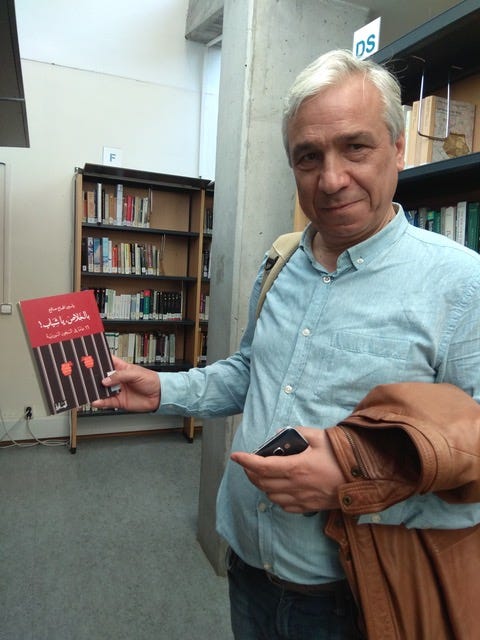
As part of its long-form interview series, The Syria Dispatch speaks with scholars, writers, thinkers, and practitioners whose ideas help illuminate Syria’s future. These conversations look beyond the news cycle to the deeper intellectual, historical, and moral questions raised by the country’s ongoing transition.
Few contemporary Syrian thinkers have shaped that conversation more than Yassin al-Haj Saleh. A writer and public intellectual, he spent sixteen years in Assad’s prisons before becoming one of the Syrian revolution’s most influential voices. Over four decades, his work has examined authoritarianism, political imprisonment, revolution, memory, sectarianism, Islamism, and the difficult work of building a democratic political community in Syria. Since the fall of the Assad regime in December 2024, he has continued to write extensively on the possibilities and dangers facing the country.
In this conversation, he explains what he means by “political poverty” and why he believes agency must come before institutions; how religion came to occupy the political space Assadism emptied; why decentralization needs a strong center and fair representation within it; how victimhood can produce a sense of entitlement; what the disappearance of his wife, Samira Khalil, and their friends reveals about justice in the new Syria; why he sees the evil Syrians endured as radical rather than banal; and what it might mean to love Syria without nationalism.
(Please note that Substack allows readers to listen to articles by clicking the “play” button in the top-right corner of the article.)
What Political Poverty Means
The Syria Dispatch: You have described Assadism as producing “political poverty”: depriving people not only of rights, but of the capacity to associate, act collectively, and speak in their own names. This recalls Hannah Arendt’s understanding of politics as the creation of a shared world through speech and action. After decades in which Syrians were denied that experience, how can political poverty be overcome? Can institutions alone produce citizens, and if so, who builds them? Or must political agency be relearned first? Put differently: is it democracy that produces democrats, or democrats who produce democracy?
Yassin al-Haj Saleh: Let me first say what I mean by political poverty. I first used the notion in 2003, based on my experience of the Damascus Spring and some of the political developments that followed.
Political poverty is the condition of people who are denied the right to gather or associate and to speak freely. When you are denied these fundamental things, you are below the political poverty line. I developed the notion as a parallel to economic poverty, which is the condition of people who lack the income they need to live. A growing percentage of Syrian society was suffering from income-related deprivation (37% in 2007), and everyone was suffering from political poverty. Even in private homes, you were not allowed to associate freely with others or talk about politics and public affairs. This is precisely why religion came to play such a large role in Syria, but we will come back to that. [See “The One Gathering That Could Not Be Disbanded” below.]
The Damascus Spring was about overcoming political poverty and taking ownership of politics. This primarily took the form of forums: gatherings in private homes, with dozens or sometimes a few hundred people, to talk about politics.
In 2011, the revolution carried that urge to own politics into much wider circles: from elites and private spaces to ordinary people and public spaces. It was also about re-owning the country itself. The idea of political poverty later led me to the idea of a privatized state, in which those in power owned the state as their main asset and used it to control the country itself.
Now that the Assad regime is gone, there is a new opportunity to overcome political poverty. But how do we do this? I would prioritize people’s agency—their capacity to gather and talk freely—over institutions, because we do not have real political institutions. We did not have them under a regime that lasted fifty-four years, a very long time in a society where some 96% of people are under sixty. The main political institutions of that period were the security apparatuses, which prevented people from assembling and expressing themselves, and the National Progressive Front, a façade whose assembly and speech were politically irrelevant.
So we have no tradition of strong and inclusive political institutions. That is why the focus should be on the agency of the people, on the democrats, as you say.
Of course, this will be very difficult. Close to 90% of people are below the poverty line, according to UN figures, and at least half need humanitarian support. So, simply put, a sustainable democracy in Syria is still distant. Still, this is the direction Syrians should be moving in, and what gives meaning to the work of people like us is pushing things in that direction.
“We Never Wanted Them to Solve Our Problems”
The Syria Dispatch: If agency should come before institutions, how can people exercise that agency when there are no institutions? Is the public space, the space for civil society, wide enough today for people to express themselves?
Yassin al-Haj Saleh: No, it is not. But our problem was never that we wanted those in power to solve our problems, or to offer us spaces to meet and talk. What we need is for them not to prevent people from meeting, from talking, and from developing our own forms of political expression and political activism. The issue with the Assad regime—and I think it is still the same—was never that we were asking them to solve our problems. The issue is that they will not let people solve what we can of our country’s problems.
For example, during the Damascus Spring and shortly after, people tried to clean the Barada River. It was voluntary, a civil society activity, and they were not allowed to do it. In Darayya in 2003, a group of young people organized a reading club guided by Sheikh Abd al-Akram al-Saqqa, but authorities quickly banned it, and al-Saqqa and his students were arrested for a few years. Sheikh Abd al-Akram al-Saqqa was again arrested at the start of the revolution and died in prison. And we are seeing similar things today. Recently, Dr. Fida’ al-Hourani, a highly respectable political figure from Hama, was supposed to give a lecture at the cultural center in Salamiyah, but she was not allowed to.
I cannot think of another way for people to build a society than owning politics, meeting, organizing, talking, and protesting. Right now, we are not a society, we are not a nation, and we have not had a state for a long time. We still do not have one, and it is unclear that we will have a public state—the overarching institutions that citizens have access to and through which political and social problems are dealt with. We are a deeply divided society. To move forward, to develop into an interactive society, we need to meet, talk, perhaps protest, and discuss things. That is why it is important to insist on political freedoms: on building parties, organizations, unions, whatever. These are the venues through which people train themselves to become citizens and to build their society.
The One Gathering That Could Not Be Disbanded
The Syria Dispatch: You have argued that Assadism destroyed almost every autonomous space for collective organization, while mosques and religious networks proved harder to eradicate. Did religion, therefore, become one of the few remaining ways for Syrians to act collectively and, in a sense, to reclaim politics? And to what extent did the regime’s destruction of political life help produce the opposition that eventually defeated it?
Yassin al-Haj Saleh: My analysis is that Islam, and religion more broadly, acted as a limit to political poverty. There was one gathering that no regime, however tyrannical, could disband: the gathering of believers in mosques—or, for that matter, in churches. And there was one opinion that could not be silenced: that of the sacred text, the prayers, these things. People were owning politics through religion.
But I wouldn’t say the regime manufactured the opposition that defeated it. It wasn’t intended, and the regime wasn’t that smart. But this is what happened, in fact.
Several things are relatively unique about Islam in Syria. The first is what I just said: through religion, people tried to own politics. This is unfortunate because we are talking about a rather outdated worldview on the one hand, and when you politicize it, it loses its spiritual and ethical components while failing to become a unifying principle. In fact, owning politics through religion means sectarianism: a divisive and irrational form of power that has afflicted our societies in the Middle East for decades.
In Syria, one can understand this version of Islamism by deconstructing the notion of the objective opposition. By objective opposition, I mean the opposition that the country’s conditions themselves produce and push forward. It responds to political poverty and answers the question of how to react to an extremely violent regime. Its answer is: through extreme violence.
People like us were a subjective opposition. Our opposition to the regime was based on values and ideology rather than on social structure. It has emancipatory potential because it comes from outside the existing political constellation. But for precisely this reason, it cannot easily articulate itself socially under conditions of political poverty and extreme violence.
Another distinctive feature of Islamism in Syria is that what we now have in power are Islamists who were nihilists and Salafi-jihadists. No longer, perhaps, but for sure, a team of Sunni supremacists who are quite sectarian.
They want power, and they want to stay in power—though not ila al-abad (إلى الأبد), forever, as the Assadists used to say. Just after the transition, when Ahmad al-Sharaa was made president, there was even talk of giving him the title of king.
An Artificial Country and a Question Never Answered
The Syria Dispatch: You have distinguished between the religious ummah and the political community of equal citizens. Today, religion is again becoming a claim to own the state and to define the nation, which is ultimately a question about who belongs to the political community and who does not. Is this a new problem, or a recurring one in Syria’s history? And has the country ever managed to constitute itself as a single people?
Yassin al-Haj Saleh: We are in the middle of this challenge today, and it will be a matter of struggle—a full political and social struggle.
Syria’s history has shown a kind of tempo: we have a major crisis every generation, every twenty-five or thirty years. Partly, this is because the country is very new in history, was mustana’ (مصطنع), artificial, as the Arab nationalists used to say. Egypt is far less artificial than Syria. Syria and Jordan are quite new, and before that, they were not centers of stable power. On the other hand, the Syrian elites, notoriously divided as they have always been, failed in the task of nation- and state-building. And I do not see this new team doing better.
Their political imaginary is haunted by the specters of the religious ummah rather than that of a community of citizens. This will only deepen the polarization that runs on many levels: ethnic, religious, sectarian, urban versus rural. All have been worsened in the long Assadist era, which represents more than half of the country’s entire existence in history. So we have it now. All these polarizations have come together at once.
Recognition Without Permanent Categories
The Syria Dispatch: You argue that Syria must become a public state belonging to equal citizens rather than a collection of inherited communities. At the same time, you recognize that many Syrians are seeking political guarantees because they fear erasure, domination, or renewed violence. We see this tension today: the SDF negotiates as a Kurdish-led actor, while negotiations over Suweida are likely to involve Druze political representatives.
Can Syria recognize these historical wounds and provide meaningful guarantees without turning Sunnis, Alawites, Kurds, or Druze into permanent political categories? And what happens if it fails to do so?
Yassin al-Haj Saleh: The next crisis is coming. I do not know when. It is still very early: the regime fell less than two years ago, after a very long period, and the country’s contradictions and tensions have already begun to surface. Maybe the conditions for political contention and struggle are not yet there, but they are coming. One of my most recent articles was about the four major national crises we have witnessed in a century of Syria’s history.
The next crisis could come within the next decade because so much about the country’s future remains uncertain.
I hope, of course, that we can avoid it. Up to 3% of Syrians were already killed—between half a million and 700,000 people—by all sides during the war. Hopefully, this experience will change the tempo of the country’s history. But I do not see signs of awareness of the need to avoid another crisis, or of a serious effort to build a more inclusive political system.
Before the revolution, we had already faced three major national crises. The first came when Syria appeared in history, and the French occupation “solved” it. The second came shortly after independence and manifested itself in coups and instability; it was not solved. Then, in the late 1970s and early 1980s, it was “solved” with the Hama Massacre, by destroying what remained of the independent political organizations of that generation.
Then came the revolution. And we still do not see that the problem of nation- and state-building has been addressed.
If we do not move in this direction during what remains of the transitional period—a little more than three years—we will not simply see another major crisis. We may see the country crumbling. You do not have infinite opportunities to survive big crises. And with each generational cycle, the cost in human lives and resources has grown exponentially. When I was young, tens of thousands of people were killed. By the time I was fifty, it was hundreds of thousands.
Today, two complementary challenges remain. The first is representing Syria’s diversity and plurality at the level of state power. The second is decentralizing the political system so that the Druze, the Alawites, the Kurds, or whoever can govern themselves in certain fields—lamarkaziyya idariyya (لامركزية إدارية), administrative decentralization.
This is urgently needed if Syria is to avoid falling into crisis again.
Decentralization Needs a Strong Center
The Syria Dispatch: I would like to continue on the idea of decentralization. When we hear it discussed in relation to Syria, it is usually framed around communities: the Kurds have their aspirations, the Druze theirs, the Alawites theirs. But that raises problems. The Kurds live in different places, so which part of the country would it be? What about non-Kurds in those regions, who would become minorities in their own decentralized part of the country? The same applies in Suweida, where there are many Druze but also other sects and ethnicities. Wouldn’t decentralization across the whole country make more sense?
Yassin al-Haj Saleh: Apart from Suweida, you do not have a contiguous area with a very large majority of one element of the Syrian people.
Christians are spread all over the country—their percentage is diminishing, but they are everywhere, from close to the Iraqi border to Suweida itself, to Daraa. Alawites are spread across cities where Sunnis are probably still a majority, and they are, of course, in the countryside of Latakia and Tartus, where they can be a majority, but also in the countryside of Homs and parts of Hama. Only in Suweida are the Druze a large majority. Most communities do not have distinct aqalim (أقاليم), regions.
What is needed is a combination of arrangements: positive discrimination for the Druze in Suweida, balanced representation, respect for the customs and traditions of these communities, and good representation of Alawites in the areas where they live. I think it is doable.
Two things have corrupted the debate about lamarkaziyya (لامركزية), decentralization, in Syria. First, many who talked about decentralization at certain times were talking in the same breath about separating from the country, so the talk wasn’t entirely honest or motivated by genuinely democratic demands. Second, decentralization requires a strong center, not a weak one. The more powerful the center, the more opportunities there are for idara mahalliyya (إدارة محلية), local administration.
You know that in the Autonomous Administration of North and East Syria, the idara dhatiyya (إدارة ذاتية) in Arabic, the self-administration, which was really the PKK, was by no means democratic or even minimally representative. It was a “self-administration” on paper. It does not work this way. You need a bigger share in central power at the same time as a decisive share of power locally.
You have to deal with it case by case. For Suweida, I would say the governor should be from the governorate, and so should the head of security, along with a respectable share in the central power. It can be done, and it shouldn’t be a big deal.
The principle is always the same: autonomy at the local level and fair representation in central power.
Victimhood That Deadens the Heart
The Syria Dispatch: You have written that suffering does not confer moral innocence: victims can become perpetrators, and memories of persecution can become claims to entitlement. Your analysis of the massacres of Alawites and of the history weighing on the new Syria warns, in particular, against turning Sunni victimhood under Assad into moral authorization for domination or revenge.
After preparing these questions, I was watching a program on Al-Ikhbariya in which a guest said that Sunnis had suffered the most, that a million of them had been killed, and that it was therefore their turn to decide and to rule the country. The host confronted him, saying he could not say such a thing and that it was sectarian.
In such a context, how can Syrians build a shared collective memory that does not erase competing experiences, but brings them into a common historical narrative?
Yassin al-Haj Saleh: This feeling is quite widespread. And that is why we have all these problems. There is this sense of entitlement. We were victims—and as we say, al-mazlumiyya tumit al-qalb (المظلومية تميت القلب), victimhood deadens the heart (of the victim). Because I am a victim, whatever I do is right. I am oppressed; therefore, I am right.
At some point, people will have to realize that yes, they have lived different experiences and suffered differently, but at the end of the day, everyone suffered. What that man said is exactly the opposite of what is needed. He could have said, instead: yes, it is true that there was discrimination and that there were these problems, but it is over, and now we have to move forward into an era of equality, of respect, of plurality, of freedom of speech and assembly, and we have to cooperate for a better future for all. Nothing determines that things must go from bad to worse. It is not a natural law. Nor is it the logic of asabiyya as Ibn Khaldun described it, where a dynasty dies out over three generations—first asabiyya, then luxury, then decay and decline.
It certainly does not work that way today, for two reasons. Sects themselves are politically manufactured. And the international system is a deciding actor in Syria (and the region): the United States, Türkiye, Israel, Saudi Arabia, etc. So it is no longer about asabiyya. It is no longer just Sunnis and Alawites and Druze, and Kurds and Arabs. It is about how you deal with all these tensions and all these actors. I am not a politician, but I do not think it should be that difficult.
“I Do Not Want Them to Be Santa Claus”
The Syria Dispatch: A collective narrative is also built out of individual stories. I wanted to ask about the disappearance of Samira Khalil, Razan Zaitouneh, Wael Hamada, and Nazem Hammadi, which is at once a national crime and an intimate wound for you. In “Between Amjad Youssef and Samir Kaakeh,” you argue that the real test of transitional justice is not whether the new government prosecutes the defeated regime’s crimes, but whether it is willing to investigate crimes committed by its own allies. Yet politics imposes constraints that moral principles do not: Ahmad al-Sharaa depends, at least in part, on the networks and armed groups that brought him to power, and prosecuting those closest to him could destabilize the transition.
How should we think about that tension between justice and political survival? Must we pursue equal justice immediately, even at the risk of destabilizing the transition, or is some sequencing unavoidable?
Yassin al-Haj Saleh: It is not about them. Our people were abducted and disappeared. We have rights.
Again, we don’t want them to solve our problems. We just want them not to prevent us from investigating, building the story, and bringing the criminals to justice. I understand the difficulties they may face in dealing with this inheritance—the past fifteen years, the past fifty-four years, the past sixty years. It is huge, and they cannot solve it. But do not prevent us from trying to develop solutions.
I do not want Ahmad al-Sharaa to arrest Samir Kaakeh—although he could, in fact. But this is not my problem. I do not want those in power to act like Santa Claus, while I sit and wait for them to tell me what happened to my wife and my friends and to deliver justice. That is not the way, I think, and I do not expect that of them. What I expect is at least respect for people’s rights, and that they deal with those who suffered according to consistent rules. Today, you arrest Amjad Youssef; the next day, you are in Douma, hand in hand with Samir Kaakeh, who is really a symbol of evil.
They are trying some of the big criminals of the regime, but I have never been approached by the National Commission for Missing Persons, and there is no mechanism through which to raise the issue of my disappeared wife and friends.
Radical Evil, Not Banal Evil
The Syria Dispatch: After prison, disappearance, massacre, and dictatorship, how do you understand evil today? Does the Syrian experience bring you closer to Arendt’s idea of radical evil, or to her later notion of the banality of evil? And does emphasizing the structures that produce violence risk obscuring the responsibility of those who choose to torture, betray, or kill?
Yassin al-Haj Saleh: Arendt used both formulas: radical evil in The Origins of Totalitarianism, and banal evil in Eichmann in Jerusalem.
I tend to think that banal evil is more related to bureaucratized forms of governance. Bureaucracy is the rule of nobody, according to Arendt herself, and it divides criminal action into small parts that many people carry out. Eichmann said that he never killed anyone, which is most probably true, and Bashar al-Assad could claim something similar.
But Syria is far less bureaucratic. One of the features of the Assad regime was to demolish the state bureaucracy itself through clientelism, nepotism, and the deregulation of public services.
So I think the evil we witnessed in Syria is closer to radical evil than to banal evil. Banal evil is evil without evildoers. Radical evil is evil with evildoers.
This is also related to what we were talking about—sectarianism. In Syria, we speak of al-mujtama’ al-ahli (المجتمع الأهلي): sects, tribes, and similar groups, which were consolidated over two generations. I don’t think anything about them is primordial or deterministic. They were consolidated because they became essential mechanisms of political power.
Evil with evildoers, I think, correlates with these consolidated social formations. So we cannot apply the notion of banal evil everywhere.
Maybe we need something a bit different. But this takes us to something I have described in relation to the Assad regime, and which still applies to those in power now: al-hukm al-yadawi (الحكم اليدوي), rule by the hand.
It is not the biopolitics of a disciplinary society. You rule through torture and by instilling fear in people in order to stay in power forever. There is a whole set of notions and practices there, and it can be quite complex.
The evil we have seen in Syria is related to these structures of power.
The Syria Dispatch: And those structures may be being replicated today?
Yassin al-Haj Saleh: Most probably, of course. I’d say it is not inevitable that they will be replicated, but most likely this is what is already happening.
Shortly before our conversation, there was the case of a young man who died after being beaten. This falls within the category of al-hukm al-yadawi (الحكم اليدوي): you rule by the hand; you beat, you torture. You do not rule by the mind, as in a disciplinary society.
This coarse form of power remains dominant in our society. It is not power as influence; it is power as coercion. You have to force people, to beat them, to instill fear in them, to kill some of them.
We are still within this paradigm.
Loving Syria Without Nationalism
The Syria Dispatch: You have often written about the weakness of Syrian national attachment, and about a country subordinated to dynasty, sect, religious community, ideology, or a larger imagined nation. In “The Ordeal of the Syrian Nation-State Today,” you argue that both the sectarianization of the state and the preference for the religious ummah over the national community have undermined the formation of a Syrian people.
Since Assad’s fall, there appears to be a renewed search for a common political identity. Does Syria need a stronger sense of national attachment? And what would that look like without turning nationalism into another form of exclusion?
Yassin al-Haj Saleh: I have observed that the way we Syrians do politics is dominated by antagonistic politics. It is usually: who is the enemy, and how do I mobilize against them? We Syrians love to hate—our enemies, those in power, the other community, the other group—rather than being positive and loving our country, or even our own community.
Charles de Gaulle said that nationalism is about hating other nations, while patriotism is about loving your own country. Sectarianism is like that. Sectarianism is not about being an Alawite, Sunni, or Christian and loving your community. It is not about your childhood, your parents, your family, your early years. The problem with sectarianism is not that people love their community or want their religion and beliefs to be respected. It is that sectarianism is about hating others.
At the national level, the dominant emotion has been hatred of those in power, or of this or that community, rather than love of our country.
Loving one’s country can indeed be suspect because it can also mean: my nation is the best. It can open the door to fanaticism or chauvinism. But in Syria, we face the opposite threat. You barely have Syrians who define themselves as Syrians rather than as Sunni or Alawite, Arab or Kurd, Christian or Muslim, Druze or Ismaili.
That is what I meant in that article: that we should be a bit more positive, care about our country, and calm the violent emotions that were always there but erupted even more violently after the fall of the regime.
I like to address questions of emotion and our collective psychological condition. It is an important and neglected topic. You cannot do politics without caring about emotions, about collective psychology. Those who are interested in politics should care about this.
The Syria Dispatch: I would tend to think that the lack of love for Syria was caused by over sixty years of dictatorship and the regime giving Syrians very little to love about the country. And you see it in small things: the pollution, the rubbish thrown on the ground, a general indifference toward public space. Many people don’t seem to feel they really belong to the country.
Yassin al-Haj Saleh: My brother arrived in Syria recently for the first time in fourteen or fifteen years, and he observed exactly this carelessness about public space. You visit friends, and their apartments and houses are very clean. One meter outside, garbage.
But to be honest, I am not sure it is only because we were alienated from our country, disowned when the country was appropriated by the Assad regime—although that is an important thing. I would say we never developed a sense of the public interest. We do not have an educational system. Part of my recent work is about the fact that we did not have a state for a long time, which means no bureaucracy, no justice, no education. European big cities were dirty in the 18th and 19th centuries. They are cleaner now because states and nations developed a faculty of cleanliness, so to speak. This has not happened in Syria.
The term I use to describe Syrian society is al-mujtama’ al-barri (المجتمع البري), which can be translated as a savage or wild society. It is like a piece of land that relies on rain rather than being watered. Rain may or may not come, and only small plants can grow. So we have a whole delinquent generation, people who became teenagers and then young men without education, with poverty, with high levels of testosterone, and with weapons available. Three delinquent generations.
The Syria Dispatch: The plants that survive in the desert are also the thorny, spiky ones.
Yassin al-Haj Saleh: Exactly. I am from a rural area, and when I was a child I would take our diminishing number of sheep to graze. But there was grass only when it rained well, which was not always. In the bad seasons, only a few plants can live there, but they are the most stubborn ones—thorny and small, as you say.
We are these plants. We are these herbs.

We are deeply grateful to Yassin al-Haj Saleh for his time, openness, and generosity throughout this conversation.
Readers new to his work in English can begin with The Impossible Revolution: Making Sense of the Syrian Tragedy (Hurst, 2017; Haymarket in the US), a collection of essays written between 2011 and 2016 from Damascus, Douma, Raqqa, and Istanbul. He has written nine books in Arabic on Syria, prison, contemporary Islam, and the experience of atrocity.
The themes of this interview are developed at greater length in “The Ordeal of the Syrian Nation-State Today,” “The Alawite Massacres and the Future of Syria,” “The Unruly History That Weighs on the New Syria,” and “A History of Violence.”
On justice and the disappeared, see his writing on the contrasting cases of Amjad Youssef and Samir Kaakeh, published in Arabic in Al-Jumhuriya, the platform he co-founded and where he writes regularly.
Among his recent conversations in English is “Genocide in Syria, Gaza, and Beyond: An Interview with Yassin al-Haj Saleh,” conducted by Wendy Pearlman for the Journal of Genocide Research.
A collection of his work in English—articles, interviews, and recorded discussions—is gathered at yassinhs.com, and the full archive of his Arabic writing, more than 1,500 pieces, is available on al-Hiwar al-Mutamaddin.