

On May 22, 2026, I joined Umutcan Yüksel on the first episode of PRISM Insights: The Future of Syria: Economic Recovery and EU–Syria Relations for a wide-ranging discussion on Syria’s economic recovery, reconstruction prospects, energy politics, refugee returns, and evolving relations with the European Union.
The conversation took place roughly 15 months after the collapse of the Assad regime, at a moment when Syria was no longer in outright economic freefall, but still far from genuine recovery. Inflation has eased, investor and consumer sentiment have improved, electricity provision has expanded in parts of the country, and regional engagement has accelerated. Yet the daily economic reality for most Syrians remains extremely difficult.
Below is a structured readout of the key arguments I made during the discussion.
1. From Collapse to Partial Stabilization
I began by arguing that Syria’s economy is best understood as being in a phase of fragile stabilization, not reconstruction.
“The country’s economy is no longer in freefall, but it is still very far from recovery.”
Over the past months, Syria has seen some improvements in macroeconomic indicators. Inflation has come down from extreme levels (but is picking up again), regional economic ties are reopening (but promises fail to materialize), refugees and IDPs are returning (to sometimes poor living conditions), and electricity provision has improved in parts of the country (unequally, and with prices increasing significantly). But these improvements start from an exceptionally low base.
The structural picture remains extremely fragile. GDP is still only a fraction of its pre-war level. Public institutions are overstretched. The banking system remains weak and disconnected, both from Syrians inside the country and from the international financial system. Purchasing power remains low, and investment announcements are still running ahead of actual implementation.
For that reason, I described Syria as moving:
“from collapse to partial stabilization, but not yet from stabilization to reconstruction.”
This distinction matters because, while stabilization can mean that the worst forms of collapse have slowed, it does not necessarily mean that households are better off, that businesses can operate normally, or that people feel a material improvement in their daily lives.
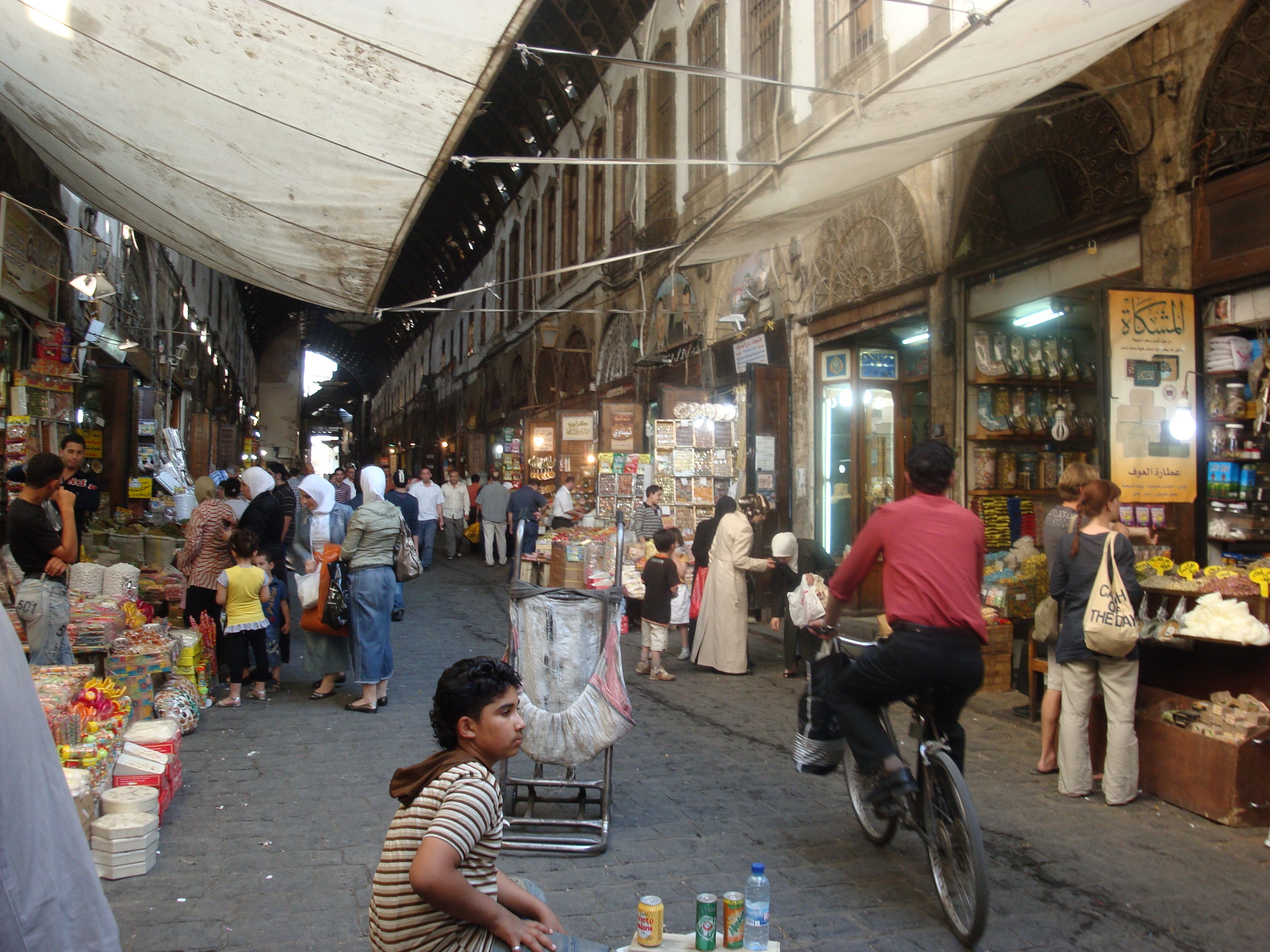
During my most recent trip to Syria in early May, what struck me most was the scale of frustration with the economic situation, including in Damascus. This is important because if people are struggling in Damascus, the situation is likely even more difficult in Aleppo, Idlib, the northeast, the coast, and other areas further away from the political and administrative center. This was confirmed to me by contacts on the ground and reporters who have made the trip to Northern Syria.
I also emphasized that it would be unfair to blame all of this on the current authorities. Syria is emerging from near-total economic collapse, institutional fragmentation, sanctions, destruction, and massive capital flight. Recovery was always going to be slow.
Still, several policy choices have increased pressure on vulnerable households. The gradual lifting of subsidies on bread, fuel, and electricity has weighed heavily on Syrians who were already economically insecure. Discussions around greater privatization in sectors such as healthcare have also generated anxiety.
One central challenge today, therefore, is the tension between macroeconomic stabilization and social protection.
2. Energy as the First Condition of Recovery
A major part of the discussion focused on energy. My main argument was rather straightforward: electricity is a condition for almost every form of recovery, not just one sector among others.
“Energy is absolutely central. It affects not only one sector, but many.”
Electricity affects factory production, irrigation, cold storage, hospitals, schools, water pumping, telecoms, household welfare, and the ability of local markets to function. Where the lights are on, people are more likely to return, businesses are more likely to restart, and local economies are more likely to recover.
This is why recent energy arrangements are so important. Qatar has provided gas through Jordan. Azerbaijan has provided gas through Turkey to Aleppo. MOUs have been signed for new power plants. The government has also sought to regain control over oil and gas resources in the northeast.

Yet energy recovery also involves a difficult balancing act. Emergency gas and fuel support can improve electricity supply quickly, but new power plants, offshore exploration, oil and gas development, and grid rehabilitation are much longer-term projects.
The government, therefore, needs to ensure that short- and medium-term support from countries such as Qatar, Turkey, Azerbaijan, Saudi Arabia, Jordan, and Egypt remains durable enough to allow time for deeper rehabilitation.
I also warned that energy recovery can create an uneven geography of reconstruction. Areas connected to gas supply, generation, or transmission improvements will recover faster. Areas outside those networks may lag, even if they are politically important or resource-rich.
3. EU–Syria Normalization: Politically Significant, Economically Slow
We then turned to EU–Syria relations. I argued that the improvement in relations between the European Union and Syria is politically significant, but its immediate economic impact should not be overstated.
The EU lifted most economic sanctions in 2025 and moved to restore the full application of the 1978 EU–Syria Cooperation Agreement. This marks a major political normalization after years of rupture. But it does not mean that European companies or banks will quickly return to Syria.
“The legal environment may be more permissive today, but firms and banks still worry about compliance, reputational risk, payment channels, dispute resolution, property rights, and political uncertainty.”
Sanctions relief changes the legal environment, but it does not automatically solve Syria’s operational constraints. Banks remain cautious. Companies still face uncertainty. Payment channels are weak. The investment climate remains difficult.
The same applies to European aid and socio-economic support. The EU has pledged substantial funding since Assad’s fall, but implementation remains slow. It is difficult to find reliable partners on the ground, difficult to move money into Syria, and difficult to align European and Syrian priorities around reconstruction and recovery.
Moving from an emergency humanitarian framework toward development assistance and socio-economic recovery takes time. For that reason, I argued that EU–Syria normalization is very important politically, but will require time before it becomes economically meaningful.
This is not only true for Europe. Gulf countries, Turkey, and other partners have also promised significant support and investment. But in many cases, announcements have moved faster than implementation.
4. Aid, Investment, and the Limits of the “We Want Investment, Not Aid” Narrative
Another central tension in Syria’s recovery is the government’s insistence that it wants investment, not aid.
Politically, this makes sense. No postwar government wants its legitimacy to rest solely on humanitarian dependency. The new Syrian authorities want to project sovereignty, normality, and economic revival. They want power plants, industrial projects, tourism, ports, logistics, and private investment, not only aid convoys and emergency relief.
But economically, aid and investment solve different problems.
“Investment will go where returns are possible. Energy, ports, real estate, telecoms, logistics, industrial projects, and tourism. Humanitarian aid goes where markets do not function and where people cannot really pay.”
Private investment will not replace humanitarian support in areas where people are poor, services are weak, and markets are not functioning. With millions of Syrians still requiring assistance and the humanitarian response facing major funding gaps, Syria cannot simply substitute aid with investment.
At the same time, I understand why the government wants to move beyond the emergency framework. If people only continue to see humanitarian trucks and aid deliveries, while officials announce large investments abroad, frustration will grow. Syrians need to see recovery materialize in visible and practical ways: better electricity, functioning services, jobs, and local economic activity.
The challenge is therefore not to choose between aid and investment, but rather to manage both.
The government should give international organizations and NGOs enough room to operate, while also pursuing investment in sectors that can restart economic life. Excessive centralization of aid and recovery processes risks slowing delivery and alienating donors.
As I put it in the discussion, the government cannot simply refuse aid. It still needs billions of dollars per year in external support. The more constructive approach would be to frame aid, development support, and investment as complementary parts of the same recovery process.
5. Syria, Lebanon, Turkey, and the Political Economy of Refugee Returns
We also discussed Syria’s economic relationship with neighboring countries, especially Lebanon and Turkey.
On Lebanon, I argued that Syria and Lebanon are deeply economically interdependent. Their relationship has long involved labor, trade, informal finance, smuggling networks, refugee flows, and transport corridors. If Syria stabilizes, Lebanon could benefit through voluntary returns, renewed trade, transport activity, tourism, and cross-border commerce.
But Lebanon’s own collapse limits its ability to play the role it once did. Lebanese banks are damaged, the state is weak, and border infrastructure remains vulnerable.
I made the point (maybe somewhat bluntly and controversially) that:
“Lebanon needs Syria more than Syria needs Lebanon.”
This is because Syria is Lebanon’s only viable land gateway to the Arab hinterland. Beirut needs Damascus for overland trade, transit routes, potential electricity interconnection, and possibly future energy flows.
At the same time, refugee returns should not be celebrated too quickly. Large-scale returns could reduce pressure on Lebanese housing and services, but they could also reduce humanitarian funding flows into Lebanon and shrink parts of the low-wage labor force.
The same applies, in different ways, to Turkey. Syrians in Turkey are relatively well integrated compared to Syrians in Lebanon, Jordan, Egypt, or Iraq. They are active in the Turkish economy, including in sectors that depend on low-wage labor. A large-scale return of Syrians would therefore have economic consequences for Turkey as well.
More broadly, I argued that European and regional expectations around returns remain too simplistic. Many assumed that once Assad fell, Syrians would return quickly. But return is not just a question of permission or safety.
“Returns are only sustainable if people are returning to a minimum economic ecosystem, not just a physical location.”
That means housing, electricity, schools, water, healthcare, documentation, security, and livelihoods. Without these, return risks becoming a transfer of vulnerability: Syrians who were vulnerable in Turkey, Lebanon, Jordan, Iraq, Egypt, or Europe may simply become vulnerable inside Syria.
Some Syrians will return. Many already have. But others will not, especially those with citizenship, residency, jobs, family ties, and social networks in host countries. European and regional policymakers need to accept that some Syrians will stay abroad, and that this is not necessarily a bad thing.
6. What Gives Me Hope and What Worries Me
The final question was more personal: what gives me hope, and what worries me?
What gives me hope is the ability of Syrians to rebuild economic and social life from almost nothing.
In Syria, this is visible everywhere: small businesses reopening after years of destruction, families returning despite uncertainty, traders reconnecting supply chains, young people launching projects, and communities trying to restore some form of normality after more than a decade of war and displacement.
“Every time I go back to Syria, I am reminded of the resilience, adaptability, and entrepreneurial spirit that still exists, despite everything the country has gone through.”
There is also an international and regional opening today that did not exist before. Syria is no longer isolated diplomatically or economically. Regional actors, international organizations, investors, the IMF, and the World Bank are all engaging in ways that would have been unimaginable only a few years ago.
But what worries me is the possibility that reconstruction becomes too narrow politically and economically.
There is a risk that recovery becomes too centralized, too opaque, and too focused on large headline investments. Syria could end up with announcements, luxury projects, diplomatic meetings, and reconstruction contracts — but without meaningful improvements in the daily lives of most Syrians.
“I worry that recovery becomes something visible in official announcements, luxury projects, and diplomatic meetings, but not something that materially improves the daily lives of most Syrians.”

I also worry about expectations. Many Syrians expected the fall of the Assad regime to quickly translate into better living conditions, more dignity, and greater economic opportunity. But recovery after this level of destruction will be long, uneven, and painful. If the gap between expectations and lived reality becomes too wide, frustration could grow quickly.
At the end of the day, Syria does not just need capital or reconstruction contracts.
It needs trust, functioning institutions, credible rules, social protection, and a recovery process that people can actually feel in their daily lives.
We are not there yet. But with enough support, engagement, pressure, and institutional learning, Syria can still move from partial stabilization toward a recovery that is not only visible in macroeconomic indicators but felt by ordinary Syrians.
I would like to thank Umutcan Yüksel and PRISM Insights for the invitation and for launching the podcast series with such a substantive discussion.
You can listen to the full episode here:
👉 https://www.prismonitor.eu/insights/the-future-of-syria-economic-recovery-and-eu-syria-relations
The episode runs for 42 minutes and covers Syria’s economic recovery, energy constraints, EU–Syria relations, aid and investment, refugee returns, regional interdependence, and the challenge of turning political normalization into material recovery.
Read the report from my previous podcast appearance, “Centralization First: Syria’s Emerging Political Economy,” based on my discussion with Colin Powers and Richard Solomon on Sultat al Mal, where we explored reconstruction, Gulf capital, sovereign debt, and the risks of managed access.
Centralization First: Syria’s Emerging Political Economy

On December 4, 2025, I joined Colin Powers and Richard Solomon on Sultat al Mal – The Power of Money (Episode 9: Ahmed al-Sharaa’s Syria: A Political Economy – Part 1) for a wide-ranging discussion on Syria’s emerging economic model.