

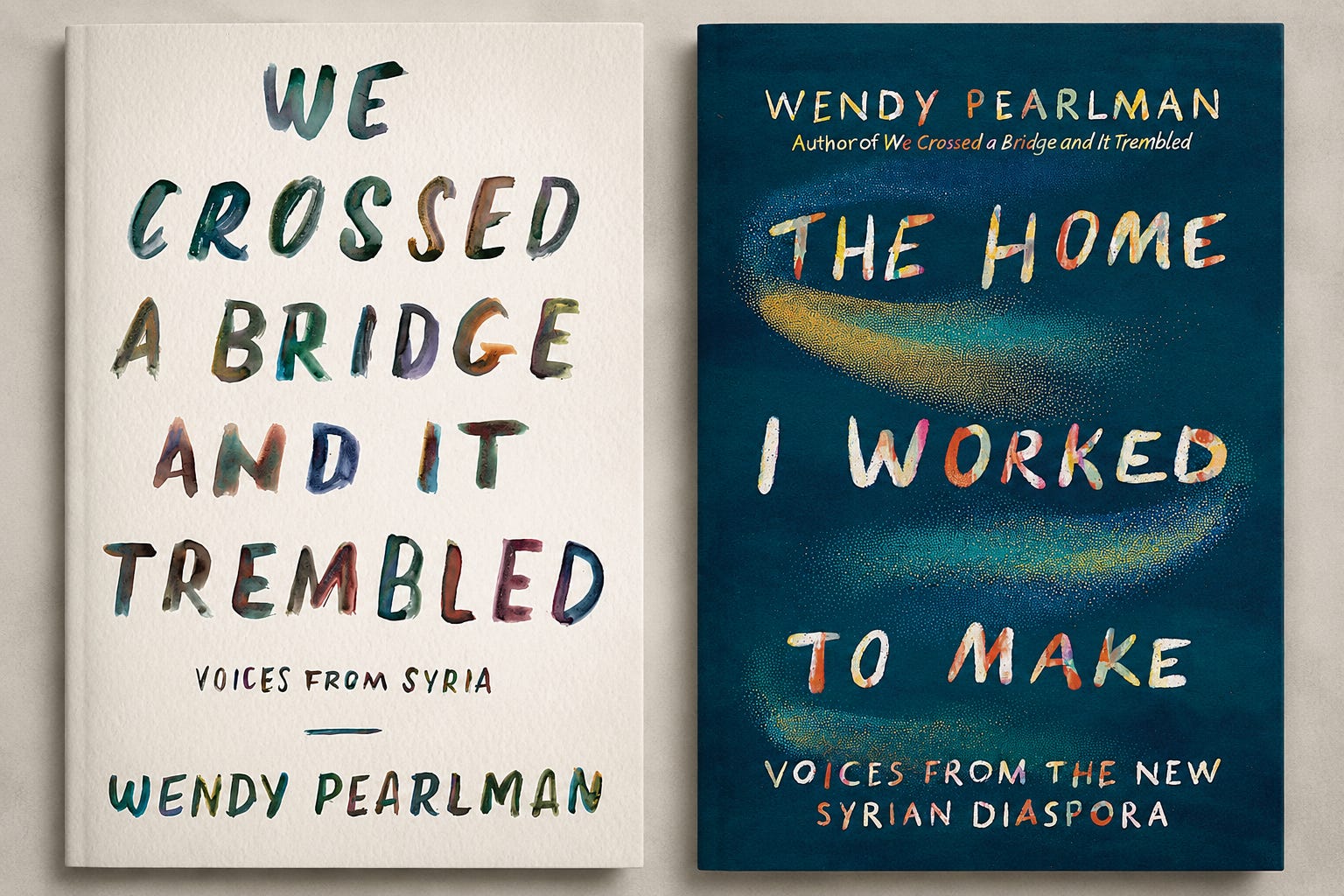
For nearly fifteen years, Professor Wendy Pearlman has documented the experiences of Syrians living through revolution, war, displacement, and exile. Her 2017 book, We Crossed a Bridge and It Trembled, traced Syrians’ political awakening and the transformation of the uprising, while The Home I Worked to Make explored how displaced Syrians rebuilt their lives, identities, and sense of belonging across the world. Following the fall of the Assad regime and her return to Syria, Pearlman is now confronting a third and still-unfolding chapter. In this interview with The Syria Dispatch, she discusses the dangers of declaring Syria’s story finished, the complex relationships between those who stayed and those who left, why “return” is often a misleading word, and how encountering Syria as an actual place is reshaping her work as a researcher.
(Please note that Substack allows readers to listen to articles by clicking the “play” button in the top-right corner of the article.)
A Third Phase in the Syrian Story
The Syria Dispatch: Your work has moved from documenting Syrians’ political awakening in We Crossed a Bridge and It Trembled to following displacement and home-making in The Home I Worked to Make. Has Assad’s fall opened a third phase in your work? What are you trying to understand now that neither of those books could have asked?
Wendy Pearlman: This new phase poses questions that I did not even imagine being able to ask, and that I think most of the people I interviewed did not imagine they might confront in their own lives.
I began interviewing displaced Syrians in 2012. I was interested in the Syrian uprising. And as I felt that it was too dangerous, or I was too afraid, to go inside Syria, I began interviewing Syrians who had left the country.
My interviews are very open-ended. I always say that I ask people two questions: “Do I have your permission to record?” and “Tell me about yourself.” And then people talk. My early interviews focused on fear, breaking the barrier of fear, and how people came to participate in protests. When I started the first book, I did not think there would be a second one. The story was “the uprising.” The uprising became a war, and the war led to displacement. That’s where the first book ends. I did not think that displacement would become so protracted, but as it did, new questions emerged about exile, home, and belonging. And when people spoke about belonging, they were not simply asking whether Syria was still home or whether a new place had become home. They were also saying: the world that I once knew has been shattered. Who am I amid all of this?
That is the focus of the stories in The Home I Worked to Make. It is a book about migration and exile, but also about making meaning in a context that people who identified with the uprising were regarding as defeat. It was written at a time when people were saying that Assad had “won”: the revolution had been defeated, the conflict was frozen, countries were beginning to normalize with Assad, and he seemed to have survived this tremendous challenge to his rule. One of the themes of the book is about moving forward in the face of that political reality. So, it is a heavy book that captures something of the mood of that time.
When the regime fell, it became clear that it would be premature to end there. A whole new and incredibly different chapter had opened. So, I said to myself, “Now these two books need to become a trilogy.”
The second book now makes more sense as the middle phase of the story: between the beginning of the revolution and the end of Assad. I am now happy that the second book captures what those years were like for so many Syrians, because that could otherwise get lost between the excitement of the revolution’s beginning and all the messiness of the current moment.
I still do not know what a third book about post-Assad experiences will look like because the situation is still tremendously dynamic, complex, and unclear.
People often speak of books having a narrative arc. My first book of Syrian interviews had a very clear arc from authoritarianism to the height of the revolution, and then to militarization, war, and displacement. The second book starts with what compelled someone to leave home and then passes through the stages of journeying, searching, losing, building, and gradually feeling that one might be in a place where it is possible to move forward.
I do not know what the narrative arc of the post-Assad era is. We know the beginning: the military offensive and the fall of the regime. But if I had to draw the shape of Syrian politics since December 8, 2024, I do not know what kind of line I would draw. Is it a curve? Does it go up and down like the heartbeat on a heart monitor?
Right now, we are in the middle of it. It is hard to know where the train is headed when you are on the train, and it is moving very fast. So, I might be working on this third book for several years to come. For now, my hope is simply to conduct as many interviews as I possibly can. This can be my call: I’m excited to speak with any Syrian, anywhere in the world, who might be interested in telling their story or sharing their perspective. I want to connect and collect, and then discover how the contours of the story become clearer with time.
The Danger of Declaring an Ending Too Soon
The Syria Dispatch: You said that “it would be premature to end [the story] there,” which resonates with what you wrote in the introduction to The Home I Worked to Make. You emphasized that these stories, Syrians’ stories, have not ended. Assad’s fall may nevertheless tempt observers to impose an ending on the Syrian revolution and war: victory, return, reconstruction, or reconciliation. Which ending are people most in danger of declaring too soon?
Wendy Pearlman: I think we can definitively say that the Assad regime has ended and that we are in a post-Assad moment. But this is a political transition, and political transitions are very complicated. They are not necessarily linear. Transitions from authoritarianism do not necessarily move from authoritarianism to democracy.
There are all sorts of trajectories that many Syrians, and many of us watching Syria, hope Syria will experience: from authoritarianism to a pluralistic, democratic country governed by the rule of law and respect for human rights; from conflict to civil peace; from economic devastation to reconstruction and recovery; and from displacement to return—for those who want to return.
These trajectories may or may not happen in that way. Even if things eventually move in those directions, there may be stops, reversals, circularities, one step forward and many steps back. It could be a very long-term process. There is still a great deal to be contested and for Syrians to figure out together.
There are questions of national identity: What does it mean to be Syrian? There are questions of economic recovery: How will it happen, and on what terms?
Return is also a major question. Some people who were displaced have already returned. Some have not yet returned and want to return. Some do not. Some have returned and are wondering whether they made the right decision.
Human lives are so complex that there is no automatic path that is best for everyone. There is no single redemptive narrative in which what was wrong in the past will now be corrected in one specific way. These things will be worked out through interactive and complicated processes that are not predetermined.
Hope, Disappointment, and the Shape of the Post-Assad Story
The Syria Dispatch: There are indeed “all sorts of trajectories that many [Syrians] hope Syria will experience.” Thus, could this third phase of your work ultimately be a book about hope, about what Syrians hoped Assad’s fall would make possible?
Wendy Pearlman: There is certainly hope. Most people I speak with say that the worst is behind them and that nothing can be as bad as Assad. In that sense, there is absolutely a sense of possibility. Things are no longer stuck and can only get better than what they were.
During the early days after Assad fell, people asked: Are you optimistic or pessimistic? Many still struggle with that question. And as we speak in July 2026, you can talk to many Syrians who will speak about disappointment.
Those disappointments take many forms. There is disappointment with the slowness of economic recovery, inflation, the lack of jobs, the slow restoration of basic services such as electricity and water, and the slow pace of rebuilding housing.
There is tremendous pain caused by the violence that has happened since December 8, from sporadic and isolated incidents of kidnappings and killings to the sectarian massacres on the coast in March and in Suwayda in July. Identity-based violence has crushed some people’s hopes of what the post-Assad era would be. Disappointment is too mild a word to describe that.
There is hate speech and sectarian incitement online, and the fractures and divisions among citizens. Something I hear many Syrians speak about is the breakdown of friendships and close relationships over these issues, and especially over people’s reactions to the massacres. There are people who they love, who might once have been comrades in the revolution, and now they have been shocked at the things they have said and don’t feel like they can sustain those relationships anymore.
There is so much hope, but there is also already a great deal of pain. I think this pain needs to be acknowledged if the country is to move forward.
And this says nothing of people’s frustration with the slow pace of transitional justice and progress on the very difficult issue of getting information on the fate of people who were forcibly disappeared. The pain of family members still searching for their loved ones is unbearable. So, hope is an essential part of this phase, but there is also fear, sadness, and so much uncertainty.
Can Syrians Still Build a Collective Narrative?
The Syria Dispatch: You have highlighted that Syrians emerged from the past fifteen years with profoundly different experiences. This echoes what Rime Allaf argued in a previous interview with The Syria Dispatch: that even Syrians who opposed the old regime often struggle to understand one another because they lived through completely different realities. In the absence of a single shared story, what might still allow Syrians to rebuild a common sense of belonging?

Wendy Pearlman: I think there are so many different ways of thinking about differences within Syrian society. There are differences of sect and ethno-religious background, but also between those who left and those who stayed, those who are staying outside and those who came back, those who lived under regime control and those who lived under rebel control, people in cities and people in the countryside, and people with different class backgrounds, ideologies, and levels of religiosity.
It is a tremendously complex landscape of people with different experiences who, because of politics, war, and distance, have not had full opportunity to encounter each other and understand one another’s experiences.
That is both the challenge and, potentially, the beauty and hope of this moment. If people can listen to one another, I imagine they will discover, first of all, that everyone has suffered.
Perhaps people have suffered different things in different ways. But I do not think anyone has made it through this reality that we call Assadism and this brutal war without some form of pain, loss, fear, and being denied something of their dignity.
What is dangerous is when suffering becomes a competition or a hierarchy: that is, when the focus is on who suffered most, or when acknowledging someone else’s suffering is seen as somehow diminishing one’s own.
It might sound very dark to say that suffering is a kind of common ground. But it can also be a space for healing. People who have suffered want what happened to them to be acknowledged and recognized. That is part of transitional justice. It is part of moving forward.
The idea here is not to create a new national identity based on suffering, but to cultivate a kind of dialogue that can allow people to meet one another, understand one another’s experiences, and build the empathy, sympathy, and respect that enable them to say: We are part of the same society, and there is space for all of us.
Those Who Left and Those Who Stayed
The Syria Dispatch: There are also important differences between those who left Syria and those who remained. Yet many displaced Syrians also shared remarkably similar experiences of exile. As they visit or move back, they are encountering people who experienced the past fifteen years very differently. What are they discovering about one another?
Wendy Pearlman: Every individual is unique, and therefore every story of displacement is unique. But certain themes and stages are shared by many people who were forced to leave.
There is the experience of leaving, how people got out, the journey itself, the danger, the smuggling, the expense, the risk, and the crossing of borders. Some people were able to board a plane and fly far away, but many landed first in a country neighboring Syria. Most people spent some time in Türkiye, Lebanon, or Jordan and, to a lesser degree, Iraq or Egypt.
Even people who eventually went further to Europe, North America, or Australia often still had a “Türkiye phase” or a “Lebanon phase” that allows them to understand the experiences of those who remained in those countries.
There are shared questions about dealing with the host society, discrimination and prejudice, learning a new language, finding one’s way, trying to get children into school, and finding work; probably work that was not what one was trained to do, and that one might feel was beneath their professional qualifications. You might have a university degree and be working in a textile factory in Türkiye. Or you might reach somewhere where your degree can be recognized, where you can find a path to financial and legal stability and, if you are lucky, eventually obtain another passport.
Those are phases of displacement that different people experienced in different ways, along with homesickness and ghorba (غربة).
Many people outside Syria had family members inside with whom they spoke to daily and, because of video calling, perhaps saw regularly on their screens. That technological connection could give people a sense that they were in close contact. But family members living in Syria might not have communicated certain things because they were afraid to speak openly on the phone, or because they did not want their loved ones abroad to worry, or because there were things that are simply impossible to put into words.
But now, as people from outside come back, whether to visit or to move permanently, there is a moment of discovering what they knew and what they did not know. In the interviews that I am gathering now, people talk about what they discovered in a new way when they arrived in the country and saw things with their own eyes.
For example, people describe being surprised by the degree of hardship. Everyone knows the statistics about the devastation of the country, the billions of dollars needed for reconstruction, and the hundreds of thousands of buildings that have been destroyed. Everyone has seen videos and photographs. But there is nothing like seeing it with your own eyes: kilometer after kilometer of destruction in some areas.
There are also the small details of daily life. I have heard many people say that, before returning, they did not fully realize what it was like to live without electricity or hot water. They knew these things intellectually: there is no electricity, there is no water. But they arrive and realize: my mother has been showering in cold water for years or not bathing at all. Now I understand what that means.
I heard an interesting anecdote from many Syrians who returned during the first months after Assad’s fall. They would arrive at their parents’ or relatives’ homes and find that all sorts of things were broken and had not been repaired.
They would say: “Mom, this window is broken and cold air is coming in. Why don’t you fix it? This has not been repaired in fifteen years.”
Those who stayed might be thinking: First, we do not have the resources to repair these things. Second, why bother fixing it? It is just going to get broken again. Third, perhaps there was no longer a sense of the future that made a long-term investment in fixing those types of things feel worthwhile.
For somebody coming from outside who had not been living in that reality, this could be a shock. These small details provide windows into the world of the person who remained: What was their life like? How did they see themselves in the world? How did they see their own rights, dignity, and aspirations?
So, I think there is a process of mutual discovery between those who left and those who stayed. People are discovering one another and discovering themselves.
The crucial thing, I think, is that all people have been changed by what Syria endured. It might be easier for us to imagine how somebody who was displaced changed because they were forced to deal with a new society, learn a new language, confront a new environment, and adapt. Someone who had to survive in Türkiye and then Germany is obviously going to be a changed person.
It is easy to imagine that those who remained instead became stuck—that they were preserved in formaldehyde. But, of course, those who stayed also changed with every phase of politics, war, and economic crisis.
Is “Return” Really Return?
The Syria Dispatch: Syrians may cross back into the same country or town, but they are not returning to the same neighborhoods, institutions, family structures, or versions of themselves. Does the word “return” mislead us? Could going back to Syria be understood as another form of migration?
Wendy Pearlman: You have taken the words right out of my mouth. “Return” is not simply an oversimplification. It is actually misleading.
“Return” implies going back to what was. And that is not possible. In any context, no person can simply return to the past. And in the Syrian context, there are the layers of other change that have been forced upon people. Given the scale of destruction, a displaced person who is “returning” may find that their house no longer exists. Their entire neighborhood or town might have been so badly destroyed that they no longer exist as it once did. Many of the people who lived there and made it the community it was might have also been forced to leave, or people who were forced to leave their homes elsewhere might have relocated there.
Materially and socially, the community might have changed. And you have changed as a person, and whoever remained has also changed. And you are entering a political and social reality that is changing by the minute. Everything is in flux: a political system is forming itself, laws and institutions are being created, and access to power and resources is shifting.
“Return” also becomes a microcosm for many internal debates. Displaced Syrians are grappling with incredibly difficult decisions about where they and their families should make their lives. They are dealing with nostalgia, family obligations, economic challenges, and uncertainty about where Syria is headed and what their lives might be like if they move there.
There are also enormous questions of identity: Who am I? How have I changed? Where do I feel that I belong after a decade or more outside the country? Where will I be able to achieve my aspirations? Where do I feel most at peace?
It is asking a lot of the word “return” to capture all of this. And on top of that, the word is problematic because it has become such a buzzword in countries with large populations of displaced Syrians. These are often countries that are quite eager to get rid of their refugee populations.
We see anti-refugee and anti-migrant sentiment all over the world. We see political parties competing over who can be most anti-refugee, and opinion polls showing that people want refugees and migrants to “go home.” Return is a political football that politicians kick around.
In Türkiye, Lebanon, and across Europe, you hear people asking, “Will Syrians return?” It is often a disguised way of saying: How do we get rid of the refugees whom we did not want in the first place?
It would be interesting to eliminate the word return and instead say “migrate again.” Instead of asking Syrians in Türkiye, “Are you going to return home?” people could ask, “Are you going to migrate again?”
At least that would acknowledge that what people are doing is actually very hard. It is as difficult as another migration. People are not simply going back to where they were and picking up life from where they left it. They are going to a new place, as a new person, to build a new life.
“Return” implies that this is easy. You simply fall backward. It does not take effort, initiative, creation, or rebuilding. It is the default right option; things naturally go back to where they are supposed to be.
In reality, it is an undertaking of creation, change, and building, no less than what it took for people to establish their lives in exile in the first place. It is not easy. Nor is it necessarily any more natural than remaining where one was forced to seek refuge.
Return should not be assumed to be what people want, what they need, or what is best for them. That is a decision people must be able to make for themselves.
Can a Homeland Be Inherited?
The Syria Dispatch: In “Dear Syria,” you describe children who have moved with their parents to what is, for them, an unfamiliar country. Can a homeland be inherited? What might Syria mean to a generation whose connection to it was formed mainly through family stories, language, food, loss, and memory?
Wendy Pearlman: Some children were born in Syria but left at such a young age that they do not have clear memories. Young adults might have only bad memories of violence, war, and fear.
And millions of children were born abroad, meaning that they have never set foot in Syria. They would be “returning” to where they have never been. The country of exile is the only home they have ever really known. That is another reason to criticize the language suggesting that refugees should simply “go home.”
These children might not speak Arabic, or their Arabic might not be at the level they need for school. They are moving from one school system and curriculum to another. They may be going from one quality of life and set of norms about their physical environment to another, from having electricity to not having electricity, or from living somewhere with parks to somewhere with rubble and destruction.
On the other hand, they might be discovering an entire extended family that they did not have during displacement, and that might be wonderful. They might be relieved to leave a situation of prejudice, discrimination, and bullying.
For example, last summer, I spoke with school-age Syrian boys in Türkiye who could not wait to move to Syria with their families, even though they had no memories of Syria. The bullying in Türkiye was so severe that they simply could not stand living there anymore.
So just as it might be difficult moving to Syria for the first time, these children might also be leaving extraordinarily difficult circumstances. That is the reality of a generation that has been forced to confront so much hardship at such a young age, and from so many different directions.
The larger questions—what does homeland mean, and what does home mean?—are terrific questions. What I came to appreciate in writing The Home I Worked to Make is that home is a tremendously dynamic and multidimensional concept.
For some people, home is a place. For others, home is not a place; it is a feeling, people, experiences, memories, or a sense of comfort or possibility.
Home is always changing. That is true not only for a Syrian who has experienced dramatic displacement and war, but for any person in any setting. Whatever home meant to you as a child might be different from what it means at later stages of your life.
Home and homeland will continue to change for this generation of refugee children as well. What they are experiencing now might mean something completely different to them in five or ten years.
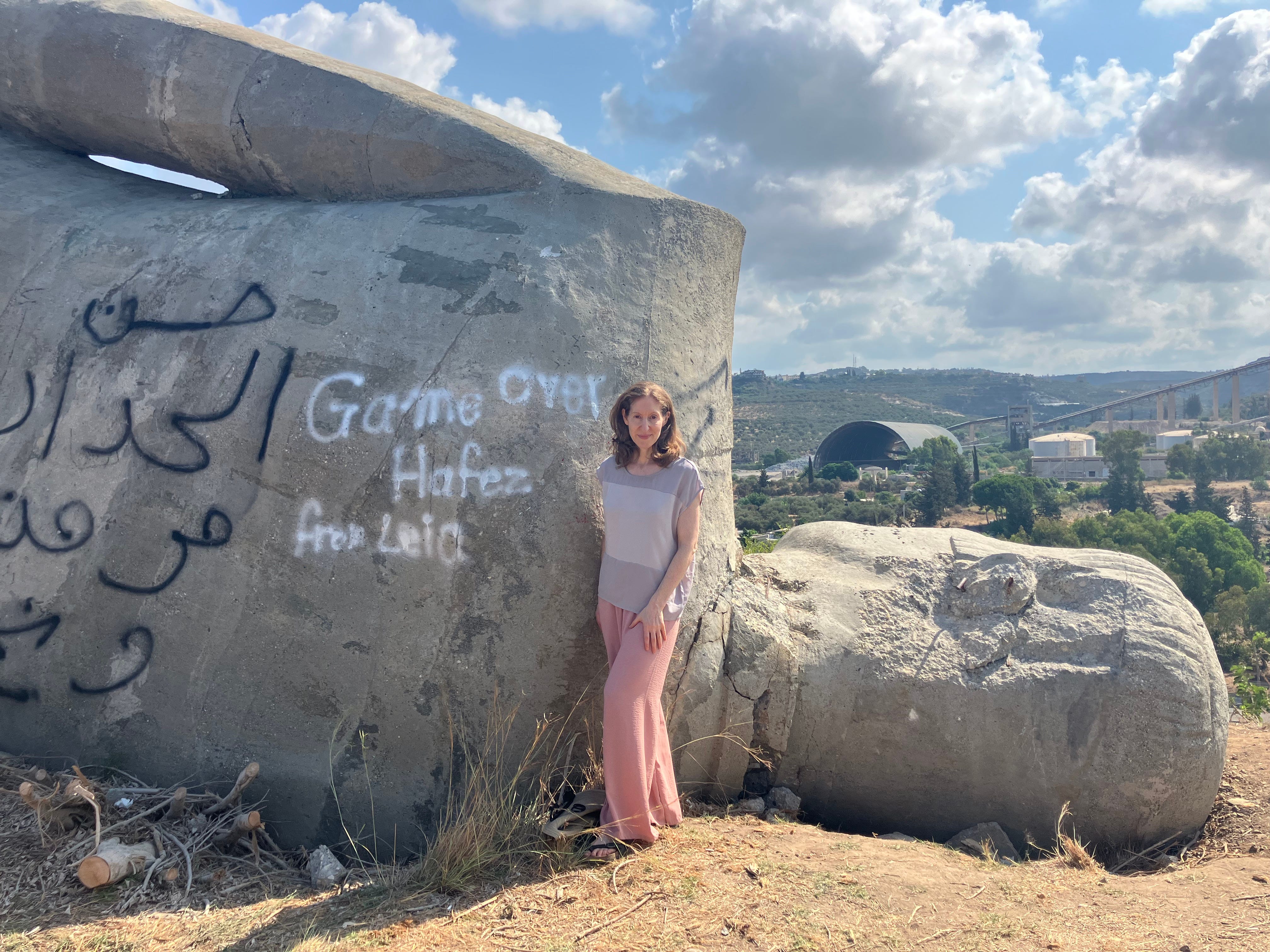
From an Imagined Syria to Syria as an Actual Place
The Syria Dispatch: You visited Syria in 2008 and then did not return until 2025. What was it like to visit Syria after Assad’s fall?
Wendy Pearlman: When I returned in 2025, many Syrians asked me: “What has changed since 2008? What do you see differently?” But my frame of reference was not the Syria I had visited in 2008. I was comparing the Syria that I was discovering in 2025 with the Syria I had constructed in my imagination after fourteen years of interviewing Syrians abroad.
I came to know Syria, or to feel like I knew Syria, through the interviews I conducted. The 2008 visit was a relatively short touristic trip. It did not leave the impression on me that years and years of talking to Syrians did.
As I write about in my essay “Dear Syria,” those conversations led me to construct a kind of imagined Syria in my mind. Syria became larger than life to me. Every aspect of it was heavy with the meaning of war, dictatorship, and revolution.
That is why it felt so important to see Syria with my own eyes, and why it remains important to continue going back: to develop a relationship with Syria as an actual place where people live, and not only as the scene of these enormous political struggles.
Of course, it should not be a surprise that Syria is also a place of everyday life. But knowing that and experiencing it firsthand are emotionally different. It is an incredible privilege for me to be able to experience that now.
How Entering Syria Changes the Research
The Syria Dispatch: Has being able to experience Syria directly changed how you approach the country as a researcher, the kinds of questions you ask, the conclusions you draw, or the way you interpret the testimonies you gathered abroad?
Wendy Pearlman: I think I am still figuring that out. I am still in a state of semi-shock that all of this is possible.
I have spoken with Syrians who say that even now they sometimes wake up and cannot believe that it really happened. They ask themselves: Is Assad really gone? Absorbing the enormity of it is a gradual process.
For all those years, I knew that basing my research on only interviews with Syrians who had left the country was incomplete. In my academic work, I wrote many times that the people I interviewed were not a representative sample of the Syrian polity.
But it was still easy to slip from interviewing only displaced persons to drawing conclusions or making claims about Syria as a whole.
My first book is composed entirely of interviews with Syrians who left the country, but it is a book about the uprising and the war, in general. It tries to be a book about Syria. Now I have to take a step back and ask: How might the book have been different if it included the voices of people who remained? What did I miss? What might I have misunderstood? What questions did I fail to ask? What stories did I not hear?
Everyone I interviewed had spent most of their lives in Syria. But when they described their experiences in Syria, they were not narrating their actual lives at that moment. They were narrating memories of a life different from the one they were currently living. They were speaking from the outside. Did being outside color their memories? Unconsciously or consciously, did it shape what they said or did not say to me?
Also, I was not able to see them living their lives in Syria. I only had their stories—the narratives that they chose to put into words.
I could observe aspects of their lives in Türkiye, Lebanon, Jordan, Germany, and the other places where I met them. I could develop a feeling for displaced communities because that was something I could experience with all my senses. I could ride minibusses, visit homes, hear conversations, and see people in the contexts that they were living in.
But when they described their lives in Syria, all I had were words. That is not at all about people being honest or dishonest. It’s simply about the complexity of memory, narration, and place.
I still need to grapple with whether there are conclusions or ideas that I developed over the years that I now need to reevaluate. I know there are gaps in my knowledge and understanding. I am still discovering what those gaps are, and I think I need to spend much more time in Syria to appreciate them.
When going to Syria was not an option, it was perhaps easier to know intellectually that these gaps existed but ignore them. Now, there is no excuse to ignore them. You can at least try to fill them.
That is both a wonderful opportunity and an obligation for many of us who analyze and research Syria for a living.
We are deeply grateful to Professor Wendy Pearlman for her time, openness, and generosity throughout this conversation.
Readers interested in exploring her work further can begin with her books We Crossed a Bridge and It Trembled: Voices from Syria, The Home I Worked to Make: Voices from the New Syrian Diaspora, and Muzoon: A Syrian Refugee Speaks Out.
Her recent writing on post-Assad Syria includes the personal essay “Dear Syria …”; “Syria One Year After Assad,” co-authored with André Bank and Marc Lynch as part of the wider POMEPS volume Syria After Assad; From ‘Refugee Crisis’ to ‘Integration’ to ‘Return’? Conceptual Lenses in the Study of Syrian Displacement and Diasporisation, published in International Migration; Genocide in Syria, Gaza, and Beyond: An interview with Yassin al-Haj Saleh, published in the Journal of Genocide Research.
Her recent recorded discussions include “Understanding Syria”, “Making Sense of Syria”, and a book talk on The Home I Worked to Make.
A fuller collection of her books, essays, and public-facing writing, academic research, and interviews is available on her website.