

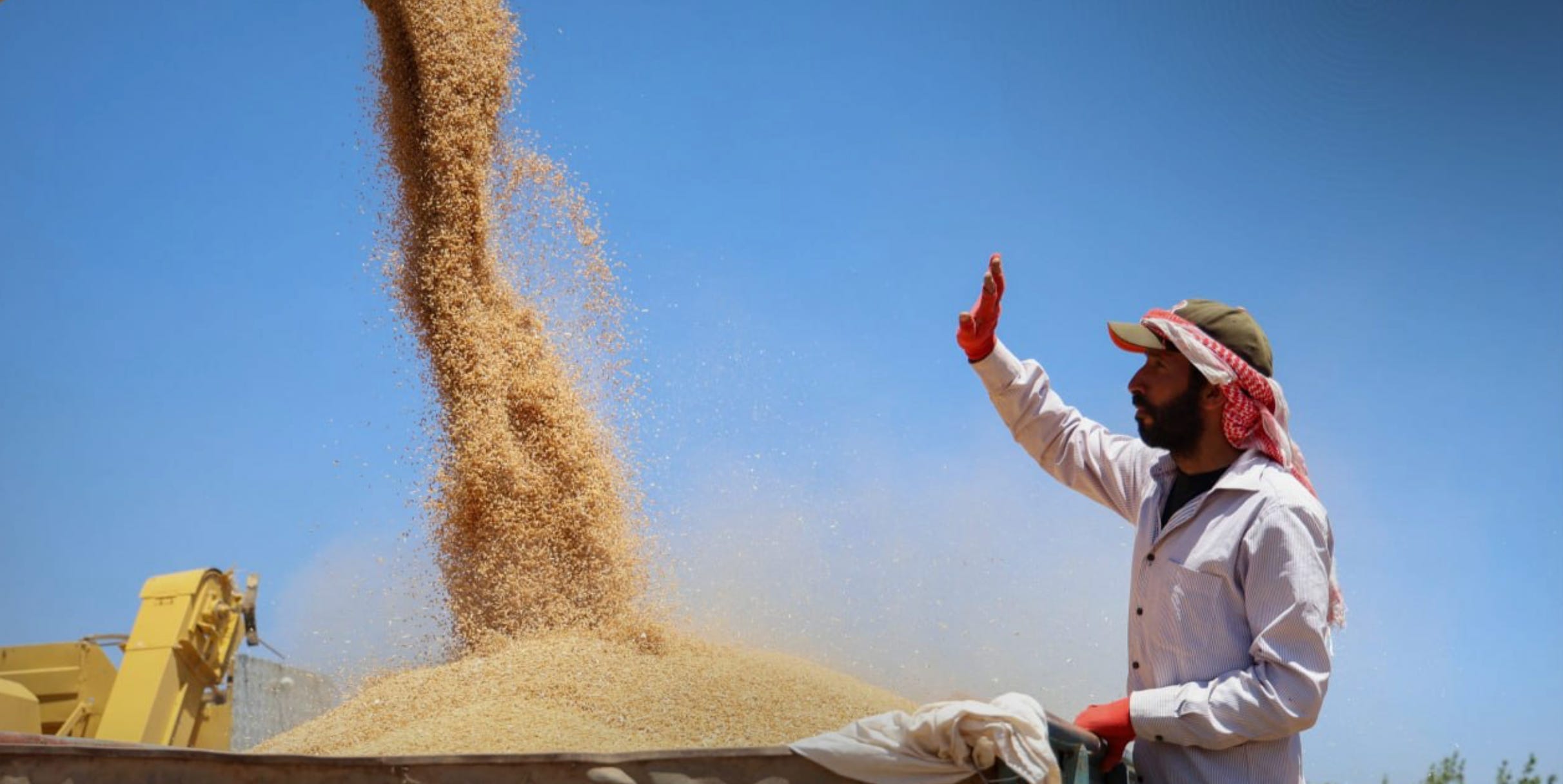
The announcement that Syria has achieved wheat self-sufficiency for the first time since 2010, with the Syrian Grain Establishment receiving 2.7 million tons of wheat, marks a significant milestone for the nation’s food security. However, a rigorous assessment of this achievement requires not only an evaluation of total tonnage but also a detailed compositional breakdown of the harvest, specifically, the proportions of soft (Triticum aestivum) and durum (Triticum durum) wheat (also known as hard wheat), as this directly determines the crop’s functional utility for domestic consumption, particularly for Arabic bread production.
The stakes are real: Syria’s wheat import requirement for the 2025/26 marketing year had been forecast at around 3 million tons, which at recent global prices of roughly USD 220 per ton would imply an import bill in the high hundreds of millions of dollars, the bill this year’s harvest is intended to avoid.
A note on terminology before proceeding: the Grain Establishment’s self-sufficiency benchmark, 2.55 million tons, is narrower than Syria’s total wheat requirement, and this is not a one-off figure. The Grain Establishment cited essentially the same 2.5 million-ton “consumption” benchmark a full year earlier, in September 2025, and Syria’s Central Bureau of Statistics has historically described pre-war average local consumption the same way: roughly 2.5 million tons, against production exceeding 4 million tons and an export surplus of 1.2–1.5 million tons.
Set against this, a Ministry of Agriculture official put Syria’s total annual wheat requirement closer to 4 million tons in 2026, a figure that closely echoes an FAO/GIEWS estimate from as far back as 1999, which put domestic wheat requirements at 3.8 million tons. The consistency of both figures across nearly three decades suggests the roughly 1.3–1.5 million-ton gap between them is a real, structural feature of Syrian wheat demand likely taking the form of non-bread uses such as seed stock, animal feed, and bulgur production. An independent estimate, built from an FAO ration standard of 275 grams of flour per person per day scaled to Syria’s population and converted to wheat-equivalent at typical extraction rates, puts minimum bread-wheat need in the range of 2.6–3.1 million tons, consistent with, if slightly above, the 2.55-million-ton figure. This triangulation supports treating the 2.55-million-ton benchmark primarily as a bread-wheat proxy in the analysis that follows, though it remains an assumption rather than an officially confirmed figure.
Thus, based on available procurement data up to mid-July 2026, which recorded a total intake of 2,076,754 tons, the partial harvest was distributed as follows:
Soft wheat: 1,129,462 tons (54.4%)
Durum (hard) wheat: 947,293 tons (45.6%)
If these same proportions are applied to the final reported total of 2.7 million tons (acknowledging that the definitive breakdown for the full amount has not yet been officially published), the estimated breakdown would be approximately:
Soft wheat: ~1.469 million tons (54.4%)
Durum wheat: ~1.231 million tons (45.6%)
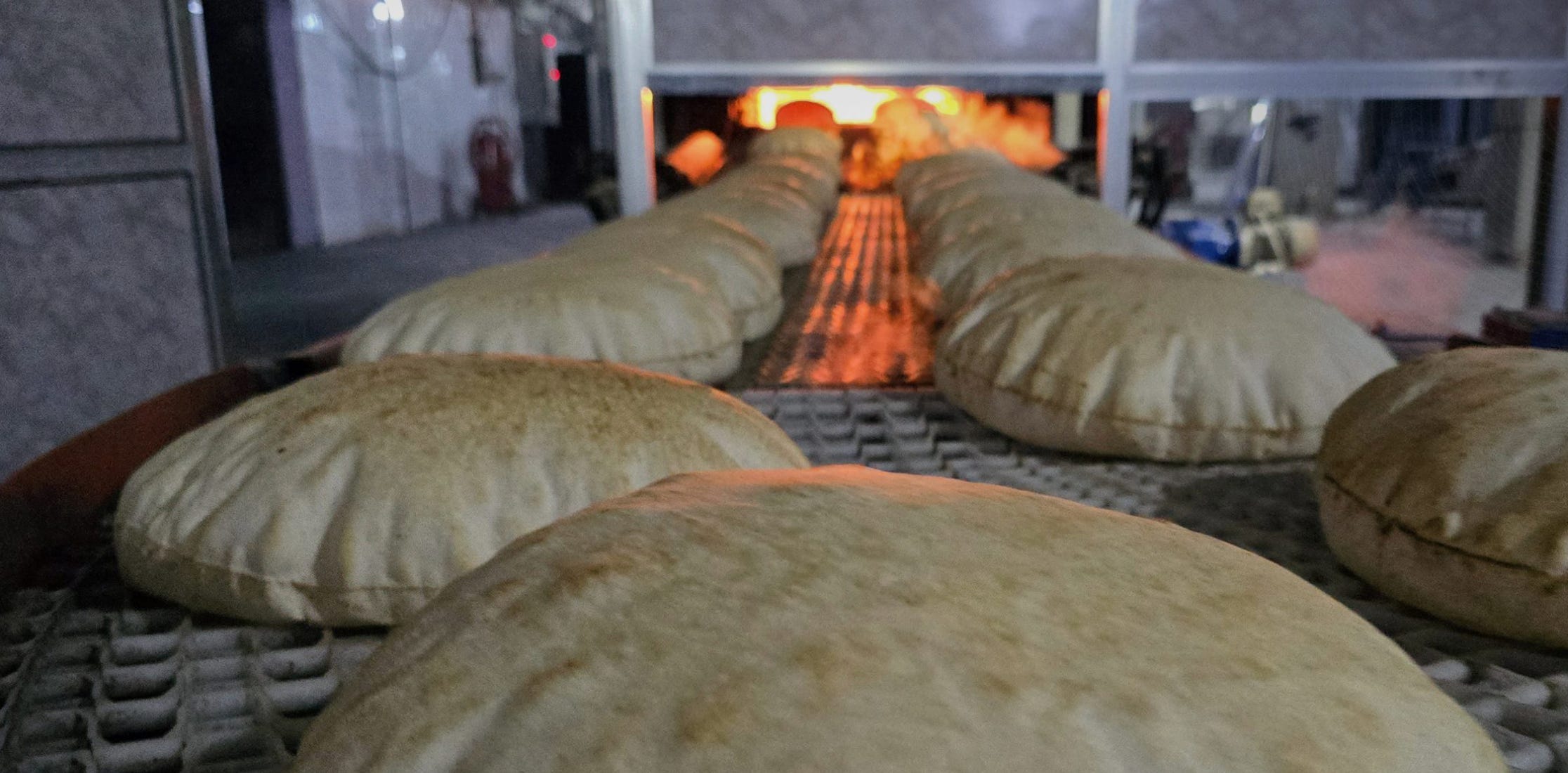
The functional distinction between these two wheat classes is critical, as Syria‘s primary food staple—Arabic flatbread—requires a specific flour blend. Based on Syrian milling practices, Syrian flour blending for Arabic bread in Syria typically comprises approximately 75–80% soft wheat and 20–25% durum wheat. Without going into too many details, this ratio is designed to optimize dough strength, elasticity, and high-temperature baking performance. For the purpose of this analysis, a conservative blend of 80% soft wheat and 20% durum wheat is assumed.
Based on the above figures, a significant structural imbalance is evident. Given the total wheat required to meet the national annual consumption requirement of 2.55 million tons of wheat, and applying the 80/20 blending specification, wheat needs would stand at :
Required soft wheat: 2.55 × 0.80 = ~2.04 million tons
Required durum wheat: 2.55 × 0.20 = ~0.51 million tons
Comparing this with the estimated actual production based on the 54.4/45.6 split:
Actual soft wheat available: ~1.47 million tons
Actual durum wheat available: ~1.23 million tons
This yields the following deficits and surpluses:
Soft wheat shortfall: 2.04 − 1.47 = ~0.57 million tons (roughly 570,000 tons)
Durum wheat surplus: 1.23 − 0.51 = ~0.72 million tons (roughly 720,000 tons)
Turning to the harvest composition itself, while the 2.7-million-ton total does exceed the Grain Establishment’s 2.55-million-ton benchmark, aggregate sufficiency masks a compositional imbalance. The harvest contains a disproportionately high share of durum wheat and an insufficient share of soft wheat to meet the standard Arabic-bread milling specification, even though total volume clears the government’s headline benchmark.
In practical terms, this composition points in two directions at once: Syria’s durum surplus is a potential export opportunity, although the estimated surplus should be treated as a gross quantity rather than a directly exportable volume, since the final grain-quality, grade, moisture, and other quality characteristics of the full crop have not yet been publicly verified. Meanwhile, its soft wheat shortfall means the country will likely still need to import wheat for bread, even in a year officially declared self-sufficient. Both implications are explored in detail below.
Global Production Context and the Scarcity of Durum Wheat
To fully appreciate the strategic significance of Syria‘s durum wheat production, it is essential to situate it within the broader context of global wheat output. Worldwide wheat production is overwhelmingly dominated by soft wheat (Triticum aestivum), which accounts for approximately 95% of global production. Durum wheat (Triticum durum), by contrast, constitutes only the remaining 5% of global wheat output. Some estimates place the durum share slightly higher, at approximately 5–6% of total production and less than 10% of cultivated area. Regardless of the precise figure, the fundamental reality remains: durum wheat is a minority crop on the global stage, representing less than 10% of total wheat production.
This scarcity is a primary driver of the persistent price premium that durum wheat commands over soft wheat in international commodity markets. The limited global supply, combined with the specific and non-substitutable end-uses of durum, underpins its higher valuation. On Euronext (the only exchange with a liquid durum futures contract), European Durum Wheat futures (September 2026 delivery) settled at EUR 290 (about USD 335) per ton in August 2026, against approximately EUR 229 (about USD 265) per ton for the equivalent Euronext Milling Wheat (soft wheat) contract, a premium of roughly USD 70 per ton. This is consistent with the physical market: in March 2026, Tunisia’s state grain agency purchased soft wheat at approximately USD 272 per ton (cost and freight (C&F)) and durum at approximately USD 334 per ton (C&F) in the same international tender, a durum premium of nearly USD 62 per ton.
Beyond the scarcity factor, the price premium of durum wheat is also rooted in its unique technological and culinary properties, which render it irreplaceable for a range of food products. Durum wheat possesses a distinct protein composition that gives it exceptional firmness, elasticity, and cooking stability. These properties make durum the essential raw material for:
Pasta (spaghetti, macaroni, penne, and other extruded products), where its high protein content and firm texture are indispensable.
Couscous, a staple across North Africa and the Levant, requires durum semolina for its characteristic granular texture and ability to absorb flavors without disintegrating.
Bulgur, a cracked wheat product widely used in Middle Eastern cuisine, is where durum's firmness and nutty flavor are preferred.
Specialty flatbreads in the Middle East and North Africa use durum, either pure or blended, to achieve the desired texture and structure.
Critically, soft wheat cannot substitute for durum in these applications. Pasta made from soft wheat lacks the firmness, yellow color, and cooking quality that consumers expect. Couscous produced from soft wheat fails to achieve the proper granularity and tends to become mushy during cooking. The technological specificity of durum wheat means that for these product categories, there is no viable alternative. This non-substitutability further reinforces durum‘s strategic value and its elevated position in global markets.
Syria as a Durum Wheat Producer: Historical Context and Strategic Positioning
Over the years, with available governorate-level data (2011–2025), Syria’s durum share has consistently exceeded half of total wheat production, ranging from roughly 53% to 65%. The 2026 harvest’s 45.6% durum share falls below this entire historical range, with the reasons for this large year-on-year drop remaining unclear.
Based on figures from the Ministry of Agriculture and Agrarian Reform (MAAR), Syria’s wheat production held above 4 million tons a year through most of the 2002–2007 period, peaking at 4.93 million tons in 2006, when the country remained self-sufficient and a net exporter. That run broke sharply in 2008, when frost and a severe spring drought cut production to 2.14 million tons, roughly half the prior year’s crop. Production partially recovered through 2009–2013, but never returned to the pre-2008 peak, averaging closer to 3.4 million tons even before the war’s effects compounded the underlying climate volatility. From 2014 onward, output became substantially more erratic, swinging between lows near 1.1–1.2 million tons (2018, 2022) and highs above 3 million tons (2019, 2023). This volatility culminated in 2025’s collapse to 934,000 tons, the worst year on record, before the sharp 2026 rebound.
The production data underscore why irrigated capacity functions as a buffer against Syria’s chronic rainfed volatility. Across the 21 years of complete data from 2002 to 2023, in the 13 years when non-irrigated yield fell from the prior year, it did so by an average of roughly 35%, while irrigated yield, in those same years, fell by an average of only about 7%, and in four of the thirteen years actually rose despite the rainfed collapse (see charts below).
The pattern is starkest in Syria’s worst individual drought years: in 2008, non-irrigated yield fell 79% year-over-year against a 32% decline in irrigated yield; in 2021, non-irrigated yield fell 84% against an 18% irrigated decline; and in 2018, non-irrigated yield fell 71% while irrigated yield was essentially flat. Irrigated wheat has not been immune to Syria’s droughts, but it has consistently absorbed a fraction of the damage that rainfed cultivation sustains in the same year — a resilience gap of roughly five to one across the full series.
Beyond self-sufficiency, Syria was also a net exporter of wheat. The country’s durum wheat was competitive in international markets, and Syria’s position in the world wheat trade was growing. UN Comtrade data (see chart below) traces the shape of this trajectory precisely: durum exports were negligible in 2000, seemingly worth just USD 770 for a token 4.3 tons, before climbing rapidly to USD 116.7 million (608,091 tons) by 2002 and peaking in 2007 at USD 237.8 million for 961,645 tons, implying an average export price of roughly USD 247 per ton that year. That peak coincided with the onset of the 2008 drought, and exports collapsed the following year to USD 21 million on just 59,147 tons, even as the implied per-ton price rose to around USD 356, consistent with a tighter domestic crop pushing up the value of what little was still shipped abroad, against the backdrop of the 2007–08 global food price spike.
A brief partial recovery followed in 2010 (USD 6.9 million, 29,085 tons), but by 2011, as the war began, Syrian durum exports had fallen to USD 761, effectively zero, a complete reversal of the trade position built up over the preceding decade.
Strategic Implications of the Durum Surplus
The compositional imbalance identified in the 2026 harvest—a surplus of approximately 720,000 tons of durum wheat alongside a deficit of approximately 570,000 tons of soft wheat—means that Syria’s wheat mix remains structurally misaligned with its own consumption needs, aggregate self-sufficiency notwithstanding. The government’s headline claim is accurate on its own narrow terms: 2.7 million tons does exceed the 2.55-million-ton benchmark, but it describes volume, not composition. On that basis, Syria has not achieved the kind of self-sufficiency that reduces its dependence on trade; it has reproduced the same structural pattern that has defined Syrian wheat production for decades.
On the one hand, the durum surplus cannot be fully utilized in the standard Arabic bread flour blend without compromising product quality. Substituting durum for soft wheat beyond the 20–25% threshold would alter the dough’s properties, potentially affecting consumer acceptability. It should also be noted that the 720,000-ton figure, calculated only against the bread-flour blend requirement, is an upper bound rather than a precise net-exportable volume, since it does not separately account for domestic durum demand from bulgur and pasta production, meaning the true exportable surplus likely sits somewhat below 720,000 tons.
On the other hand, durum wheat’s price premium over soft wheat, established earlier, means this is not a new problem for Syria, nor an unmanageable one. Pre-war Syrian agriculture already lived with this dynamic as the country’s standing trade pattern: since Syria produces a higher ratio of hard to soft wheat than is ideal for bread-making, and hard wheat commands a higher price internationally, the country would export hard wheat in years of surplus and import soft wheat in years of deficit. The 2026 harvest fits this pattern exactly. Today, then, the question is whether Syria can afford to resolve this imbalance through trade, as it did routinely before the war.
At current international prices of approximately USD 330–335 per ton for durum, the surplus could yield export revenues in the range of USD 238–241 million; revenue that could be strategically deployed to finance the roughly USD 151–155 million in soft wheat imports the shortfall implies, grossing to a commodity-value differential on the order of USD 85–90 million before freight and logistics differentials, and before accounting for the smaller, bulgur-adjusted surplus noted above.
Conclusion and Recommendations
The 2.7-million-ton harvest represents a remarkable agricultural recovery and a significant step toward food security. But a complete evaluation of Syria’s wheat self-sufficiency must extend beyond aggregate tonnage. On its own narrow terms, the government’s claim holds: total procurement exceeds the stated 2.55-million-ton benchmark. But whether that translates into practical bread-wheat self-sufficiency depends on the final soft-to-durum composition, milling requirements, grain quality and the availability of stocks and trade. On the assumptions used in this analysis, the 2026 harvest appears to reproduce the same structural pattern that has characterized Syrian wheat production for decades: a relatively high share of durum alongside a potential soft-wheat deficit, a mismatch that has historically been managed through trade.
In fact, the first wheat shipments arriving through Tartous in August underscore the distinction: Syria can simultaneously meet its aggregate domestic production benchmark and remain an active participant in the wheat trade. The policy question, therefore, is not simply whether Syria produces enough wheat, but whether it produces the right wheat, in the right qualities, and at the right cost.
Strategically, Syria should consider:
Exporting the durum surplus to capture its international price premium, and using the proceeds to finance soft wheat imports. This swap, netted against itself, points to a gross foreign-currency gain of about USD 85–90 million before freight and logistics differentials, and before accounting for the smaller, bulgur- and pasta-adjusted surplus discussed above.
Investing in value-added processing (pasta, couscous, bulgur) to capture additional value from domestic durum production, rather than exporting raw grain alone.
Re-establish trade corridors that lapsed with the conflict by building on Syria’s pre-war track record as a competitive, quality durum exporter.
Weighing the case for shifting some procurement incentives or seed distribution toward soft wheat against the comparative-advantage logic of the current pattern. While, given durum’s price premium, exporting durum and importing soft wheat is, in principle, more profitable per hectare than growing soft wheat domestically to substitute for imports, a good case for rebalancing is resilience through the reduction of Syria’s exposure to a strategy that depends, every single year, on functioning trade execution for a bread-critical staple.
Prioritizing investment in irrigated wheat cultivation, which has consistently outperformed rainfed production in both yield and resilience. This should be pursued carefully, given competing demands on Syria’s water resources and the risk that poorly managed expansion could deplete or degrade the same water sources the strategy depends on.
Managing the communications gap between the self-sufficiency announcement and the wheat imports that are likely to continue regardless. Having publicly declared self-sufficiency for the first time since 2010, the government risks a credibility cost if Syria continues importing wheat in the months ahead. Framing imports as a targeted response to a specific compositional gap, rather than as a reversal of the self-sufficiency claim, would be both more accurate and less likely to erode public trust than an unexplained resumption of imports following a headline declaration of food security.
Official publication of the final, fully verified soft-to-durum breakdown for the entire 2.7-million-ton crop remains essential to resolve the remaining uncertainties in this analysis and to inform evidence-based policy decisions regarding imports, exports, milling strategies and agricultural planning for future seasons. As established earlier, the roughly 1.3–1.5 million-ton gap between the Grain Establishment’s narrower benchmark and Syria’s broader annual wheat requirement likely reflects non-bread uses and other components of wheat demand.
Further Reading: Syria’s 2025–2026 Agricultural Season
This piece builds on ongoing coverage of Syria’s wheat sector in The Syria Dispatch. For more on how this season unfolded month by month:
May 2026 — Wheat Price Protests Force Bonus as Stronger Harvest Season Tests Grain Procurement
June 2026 — Stronger Agricultural Harvest Prospects Meet Fuel, Storage, and Marketing Bottlenecks
July 2026 — Strong Wheat Harvest Exposes Storage, Payment, and Marketing Constraints
These articles are part of the Syria Monthly Economic Digest, a monthly publication tracking Syria’s economic developments across a wide range of topics. You can access the full archive here.
The Syria Dispatch is an independent publication covering Syria’s economy, politics, and society, founded and edited by Benjamin Fève.
Subscribe to receive future issues, research, and analysis directly.
Looking for research, analysis, or advisory support on Syria? Benjamin Fève provides independent consulting on Syria’s political economy, reconstruction, and economic governance — including research design, briefings, interviews, and tailored analysis for organizations, investors, and policymakers. Get in touch to discuss a project.
I wonder, is every Syrian Pound in ShamCash backed up by a physical Syrian Pound in ShamCash Central Bank account?