

This article is part of the July 2026 edition of the Syria Monthly Economic Digest. Click here to explore the full edition.
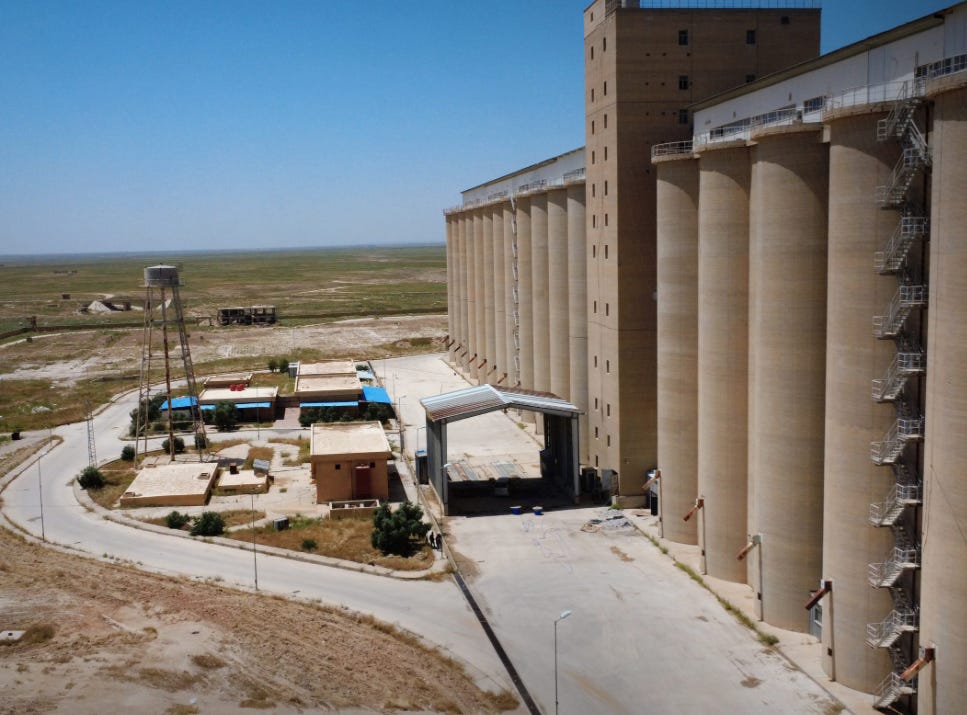
Key Developments: Syria just had its strongest wheat procurement season in years: the Syrian Grain Corporation says official collection centers had taken in 2.5 million tons by July 29, well above recent seasons and enough to meaningfully rebuild public stocks.
Detailed figures published earlier showed that 2.08 million tons had been delivered through more than 116,000 transactions at 84 centers across 11 governorates. Soft wheat accounted for 54.4% of the total and durum wheat for 45.6%, although most deliveries were classified as second-, third-, or fourth-grade rather than first-grade. Officials expected wheat marketing to continue until the end of August. Procurement also began in Suweida in July, where preliminary estimates similarly pointed to better yields and grain quality than in previous years.
But a harvest this large strained storage, transport, and payment systems. Silos and collection centers in the northeast reached capacity during the procurement peak, forcing the authorities to open additional centers in Hasakah, use outdoor bulk-storage areas, transfer grain between governorates, and allow farmers to deliver to centers in Damascus and Homs, with the Grain Corporation covering transport costs. The recently rehabilitated Adra silo, now Syria’s largest with a capacity for 200,000 tons, helped absorb part of the surplus, while further silo repairs are underway.
The government also relied heavily on its new electronic booking platform, which initially caused registration difficulties but later reduced congestion and allowed officials to anticipate delivery volumes and coordinate weighing, testing, accounting, and payment procedures. The more serious bottleneck was liquidity. Delays of around a month in paying farmers reportedly encouraged the emergence of a parallel grain market, with cash buyers purchasing wheat at prices around 20% below the official rate of new SYP 55,000 per ton from farmers needing to repay debts, cover harvesting and transport expenses, or finance the next season.
The government also allocated around old SYP 10 trillion (new SYP 100 billion) for procurement and began transferring funds to the Agricultural Cooperative Bank, but payment preparations were still continuing in parts of Hasakah by mid-July. By that time, however, it was reported that most obstacles had been resolved and that the Agricultural Cooperative Bank would start disbursing payments soon, albeit with significant delays. For instance, on July 26, the bank’s Izraa branch in Daraa was still processing farmers who had delivered wheat between June 1 and June 10, with payments dependent on the funds transferred by the Central Bank’s Daraa branch.
Nevertheless, the new SYP 100 billion reportedly set aside for procurement does not look like enough to cover what has already been delivered. At the official procurement price of new SYP 55,000 per ton, purchasing the 2.5 million tons collected by the end of July would cost approximately new SYP 137 billion (around USD 1 billion), roughly one-third more than the funding reportedly allocated.
That shortfall likely explains why farmers have been waiting so long to get paid and why the government is implementing a new payment process.
On 21 July, Syrian media reported that the Agricultural Cooperative Bank had introduced a new payment schedule for larger grain invoices. Payments of up to new SYP 1 million would continue to be made in full, while invoices between new SYP 1 million and 5 million would receive an initial payment of new SYP 1 million, with the balance paid in three monthly installments. Invoices exceeding new SYP 5 million would instead be settled over four monthly installments. The measure spreads out the state’s costs, but it also leaves bigger producers and traders waiting on cash right when they need it most: to repay debts, cover operating costs, and gear up for the next planting season.
Subsequent reporting from the Agricultural Cooperative Bank’s Izraa branch stated that individual beneficiaries could initially receive up to new SYP 100 million (around USD 741,000), with any remaining balance paid in three or four monthly installments. Although this amount would be unusually high for an individual farmer (equivalent to payment for more than 1,800 tons of wheat), it may apply more broadly to agricultural companies, cooperatives, traders, or other entities delivering aggregated quantities. Still, the report may have confused old and new currency denominations. Old SYP 100 million is equivalent to new SYP 1 million, matching the threshold cited in earlier reporting.
Vegetable, fruit, and other market-crop farmers had a very different season. Farmers interviewed across Rural Damascus, Quneitra, Hama, and southern Syria described an increasingly unviable cost structure: seeds, fertilizers, pesticides, fuel, electricity, machinery, and transport are priced directly or indirectly in dollars, while crops are sold in Syrian pounds into a domestic market with very weak purchasing power
They also reported widespread sales of expensive but ineffective or unlicensed pesticides, large differences in prices between agricultural pharmacies, limited access to formal credit, and heavy dependence on wholesalers and traders willing to provide inputs on credit. One watermelon producer estimated that cultivating a single dunum costs around USD 750, while the net crop sold for only about USD 337, implying a loss of more than USD 400 before accounting for all financial risks.
Farmers also blamed the absence of a clear planting calendar and continuing barriers to exports through Jordan, Iraq, Saudi Arabia, and other Gulf markets, where inspections, visa requirements, and lengthy border procedures can damage perishable produce before it reaches buyers. These pressures help explain why the improved wheat harvest has not translated into a comparable improvement in food security (For more on efforts to improve cross-border trade, transport, and agricultural cooperation, see our article on Syria–Lebanon economic relations.)

Why It Matters: At the national level, the 2026 wheat season is a clear win for Syria. Procurement of more than 2.5 million tons should allow the government to rebuild strategic stocks, reduce near-term wheat imports, and protect flour and bread supplies after two poor seasons. As discussed in the June edition of this digest, stronger domestic production can also reduce demand for foreign currency and ease pressure on the trade deficit and the Syrian pound. Still, much of this year’s improvement resulted from favorable rainfall rather than a structural increase in agricultural productivity. One good season does not resolve the sector’s dependence on weather (three-quarters of Syria’s cultivated land is rainfed), costly imported inputs, weak irrigation infrastructure, limited credit, or unreliable export access.
The procurement campaign also showed where the state-led wheat system runs out of road: financially and institutionally. The authorities successfully encouraged farmers to deliver large quantities of grain, but storage capacity, transport arrangements, banking coverage, and cash availability did not expand at the same pace. If confirmed, the installment-payment circular would effectively shift part of the government’s financing burden onto farmers, who would be financing the state’s grain purchases for months at a time. That matters most for indebted producers, who need cash now to repay traders, cover household expenses, and get ready for the next planting season.
The planned reopening of Agricultural Cooperative Bank branches in Hasakah and Qamishli is therefore particularly important. The northeast supplied around two-thirds of the wheat collected nationally, yet it continues to have some of the country’s weakest formal banking coverage. Restoring the bank’s presence would help settle outstanding wheat invoices, but its longer-term significance lies in reopening access to agricultural credit and basic financial services. As argued in the May digest, the value of the Agricultural Cooperative Bank should not be assessed solely through commercial profitability: it remains one of the few institutions specifically designed to finance farmers and rural production.
But more wheat in national stocks doesn’t mean better food security at the household level. Crisis-level food insecurity is expected to persist in parts of northeastern and northwestern Syria through January 2027, with many poorer rural households using additional seasonal income to repay debts rather than increase consumption. Flooding along the Euphrates, thousands of agricultural fires, higher fuel and input costs, currency depreciation, and reduced subsidized bread allocations have further limited the benefits of the harvest. Syria may therefore have considerably more wheat this year without many farming households becoming materially better off.
Continue Reading the July 2026 Syria Monthly Economic Digest


Explore Previous Editions
Browse every edition of the Syria Monthly Economic Digest, featuring monthly analysis of Syria’s political economy, governance, reconstruction, and regional developments.
Never Miss an Issue
Receive the Syria Monthly Economic Digest, along with original research, expert interviews, and in-depth analysis on Syria’s political economy, governance, and reconstruction—delivered directly to your inbox.