

This article is part of the July 2026 edition of the Syria Monthly Economic Digest. Click here to explore the full edition.
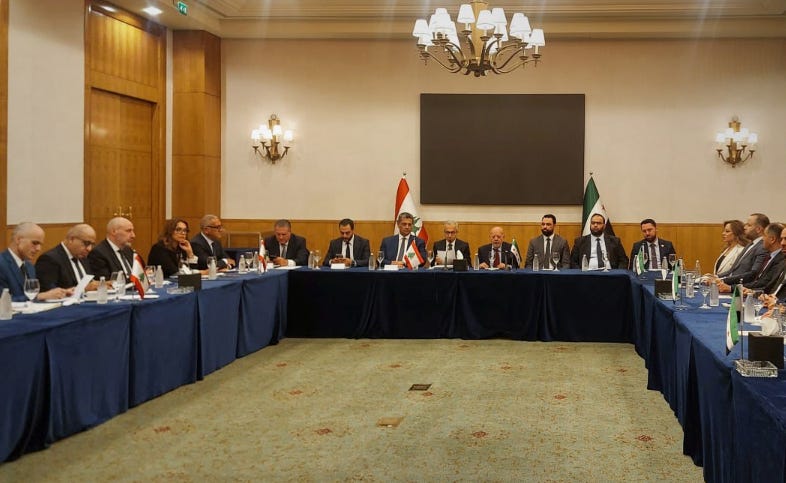
Key Developments: Syria and Lebanon took several steps to place their bilateral relationship on a more formal, state-to-state footing, with immediate priorities identified as being electricity interconnection, trade, transport, and easier movement of people and goods.
These developments started in early July, during Syrian Foreign Minister Asaad al-Shaibani’s visit to Beirut on July 2, when the two governments established a new Syrian-Lebanese Higher Committee (SLHC) intended to coordinate cooperation across economic, political, security, infrastructure, energy, water, telecommunications, and social affairs. The visit also included the inaugural meeting of a new Lebanese-Syrian Business Council.
The SLHC will review more than 40 agreements and memoranda inherited from the Assad period, including frameworks governing investment, taxation, visas, and other aspects of commercial relations, with the process eventually leading to a broader bilateral trade agreement, although revising the existing framework is expected to take several months.
At the economic level, relations advanced further during a two-day visit to Damascus by a Lebanese delegation headed by Economy and Trade Minister Amer Bisat on July 14 and 15. Bisat met President Ahmad al-Sharaa and Syrian Economy and Industry Minister Nidal al-Shaar and participated in a joint roundtable bringing together officials, chambers of commerce, investors, and business representatives. The discussions covered trade facilitation, investment, customs and transport barriers, business mobility, and mechanisms for improving the exchange of economic and commercial information. On commercial ties, Bisat argued that trade could eventually reach several billion dollars, given the two countries’ geographical and commercial interdependence.
The meetings also produced new private-sector cooperation arrangements. The Federation of Syrian Chambers of Commerce and the Beirut and Mount Lebanon Chamber of Commerce, Industry and Agriculture signed a memorandum covering information exchange, commercial opportunities, joint economic events, and support for concluding transactions between businesses. A separate memorandum between the Syrian-Lebanese and Lebanese-Syrian business councils sought to create a permanent institutional channel to address barriers to trade and investment and expand direct contact between companies in both countries.
Agricultural cooperation also advanced on July 27, when the two countries agreed to prepare a protocol regulating cross-border trade in vegetables and other agricultural products. The proposed framework is intended to reduce congestion during peak seasons, harmonize laboratory testing, and strengthen coordination on plant health, livestock, food processing, and agricultural policy.
Energy cooperation also moved beyond general statements of intent. Earlier trilateral discussions with Jordan had identified gas transit through Syria and the reactivation of Syrian-Lebanese electricity interconnections as priorities. On July 22, Lebanese Energy Minister Joe Saddi said Türkiye had proposed either an electricity-swap arrangement under which Türkiye would supply Syria and Damascus would provide an equivalent amount to Lebanon or a new cable running through the Syrian coast toward Tripoli.
Transport and border infrastructure were another major focus. Lebanese Public Works and Transport Minister Fayez Rassamny and Syrian border and customs officials discussed upgrading shared crossings, reducing truck delays, coordinating customs procedures, and improving freight and transit flows. Lebanon also proposed a new facility at Masnaa closer to the Syrian border post.
Syria separately announced that the al-Dabousiyeh crossing would reopen in early September following bridge repairs, restoring a direct route between the Port of Tripoli and central and northern Syria and easing pressure on the main Damascus–Beirut corridor. The Lebanese government had launched a tender in May to study and modernize a railway from the Port of Tripoli to al-Abboudieh on the Syrian border. Technical studies were expected to take six months, although implementation would depend on feasibility and financing.
Why It Matters: These developments matter less for their immediate economic impact than for what they signal: an attempt to define what a ‘normal’ relationship between Syria and Lebanon should look like. Economic ties between the two countries have always been unusually dense, but the institutional framework governing them developed under decades of Syrian political and security dominance in Lebanon and often depended on informal networks, discretionary decisions, and unequal treatment.
Customs valuation, tariffs, certificates of origin, truck access, transloading, transit guarantees, passenger rules, informal crossings, and security coordination all need workable agreements before this counts as normalization. Tariff treatment is also unequal: Bisat said Lebanese exporters currently face a tariff that does not apply to their Syrian counterparts, an imbalance that any broader trade agreement will have to address.
February’s abrupt restrictions on foreign trucks showed the costs of getting this wrong, producing congestion, protests, repeated handling of goods, and higher import costs. Both Syria and Lebanon have a strong incentive to move quickly: Lebanon depends on Syrian territory for access to Jordan, Iraq, and the Gulf, giving Damascus an opportunity to collect transit revenues, while Syrian exporters still benefit from access to Lebanese ports and services.
The scope for commercial complementarity is nevertheless considerable. Lebanese contractors, engineers, logistics companies, tourism operators, professional-services firms, and diaspora investors possess skills, networks, and, in some cases, capital that could support Syria’s recovery. Lebanon’s banking collapse means it can no longer automatically resume its former role as Syria’s financial gateway, but its private sector still retains experience in sectors where Syrian capacity has been severely weakened. Syria, meanwhile, could regain a substantial nearby market and help improve its trade balance by supplying the Lebanese market with agricultural goods, food products, construction materials, and manufactured inputs while using Lebanese services and ports where they remain competitive.
Throughout most of the 2000s, Syria consistently recorded a trade surplus with Lebanon, with exports peaking at around USD 340 million in 2010 against imports of USD 221 million. Since the conflict, however, that pattern has largely reversed, with Syria recording persistent trade deficits in most years after 2012. Although bilateral trade recovered modestly to a total of nearly USD 300 million in 2025, it remains well below its pre-war trajectory, illustrating the significant scope for renewed commercial integration.
Energy could again become an important part of the relationship: Beirut says an electricity-import contract with Damascus, separately from the Turkish proposal, is nearly ready, while the Arab Gas Pipeline would also make Syria an essential transit country for supplies reaching Lebanon. Tourism also offers a faster source of hard currency. Syria received 8.5 million visitors, among 20% Lebanese according to Syrian Planning and Statistics Commission data viewed by The Syria Dispatch, and generated an estimated USD 8.4 billion from tourism in 2010. While most Lebanese came on day-trips, easier and more welcoming entries for Lebanese visitors could quickly revive business travel, family visits, weekends, restaurants, hotels, and transport services, thereby bringing significant foreign currency even if they “do not spend much.”
Still, historic and mutual distrust, continued insecurity in Lebanon, smuggling networks, weak enforcement, and the collapse of Lebanon’s banking system will limit how quickly trade and investment recover. Reducing Syrian fuel and commodity subsidies should narrow some of the price gaps that encourage smuggling, but formal trade will only displace informal networks if customs duties, transport costs, and payment channels become competitive.
Saudi Arabia’s earlier restrictions on Lebanese imports followed repeated drug-smuggling cases, and their removal came only after renewed efforts to strengthen state control. That regional precedent is one thing Syria should note as it works to keep smuggling networks from undermining formal trade.
But Lebanon also offers a more direct warning for Syrian reconstruction itself. Its post-war model concentrated heavily on finance and high-end real estate, and the Solidere experience remains associated with contested expropriations, elite capture, and the exclusion of former residents and small businesses. Lebanese expertise can support Syria’s recovery, but Syria should draw on that expertise without reproducing the same model: housing, infrastructure, productive sectors, and local employment should come before speculative redevelopment.
Continue Reading the July 2026 Syria Monthly Economic Digest


Explore Previous Editions
Browse every edition of the Syria Monthly Economic Digest, featuring monthly analysis of Syria’s political economy, governance, reconstruction, and regional developments.
Never Miss an Issue
Receive the Syria Monthly Economic Digest, along with original research, expert interviews, and in-depth analysis on Syria’s political economy, governance, and reconstruction—delivered directly to your inbox.