

This article is part of the July 2026 edition of the Syria Monthly Economic Digest. Click here to explore the full edition.
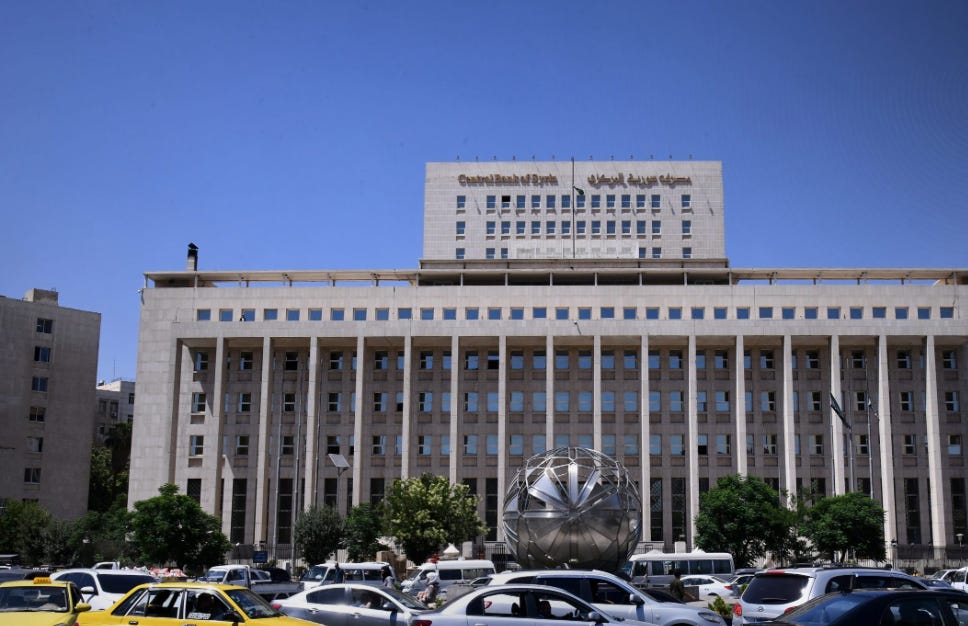
Update (August 2, 2026): On August 2, 2026, the Central Bank of Syria announced that old banknotes could be exchanged for new ones at all public and private banks and Syrian Post branches across the country for one week following the end of the main replacement process—that is, until August 6, 2026. The Central Bank also updated its estimate of the old monetary mass replaced to more than 95%.
Key Developments: Following up on the currency redenomination and replacement process, the Central Bank reported in July that around 80% of the old monetary mass had been replaced, up from 63% at the beginning of June, as the nationwide currency-replacement process approached its final deadline. The Central Bank re-explained that, following July 30, old banknotes are no longer considered legal tender and have ceased to be accepted for ordinary payments. The Central Bank nevertheless clarified that holders would retain the right to exchange old notes directly through the Central Bank in Damascus for another five years.
Populations in eastern Syria remain unhappy about the implementation of this process, however, as it remains highly uneven and potentially regressive. Residents of Hasakah called for another extension, arguing that the limited number of authorised centres made it impossible for many people to complete the process before the deadline, despite the 11 currency-replacement centres designated in late June. Local residents claimed that old notes still represented more than 90% of liquidity circulating in the governorate, while some money changers reportedly imposed commissions or applied different exchange rates to transactions involving old and new banknotes.
Hasakah residents also pointed to the refusal of some petrol stations and businesses to accept old notes, despite their continued legal-tender status, which added to the pressure. Damascus and Rural Damascus have also witnessed such a phenomenon. Similar difficulties were reported in Raqqa, where currency replacement was concentrated in the central post office and a small number of additional locations, leading to long queues, shortages of personnel and equipment, and cases in which exchange offices reportedly charged additional fees reaching around 15% of the amount exchanged. In the final days of the replacement period, the Commercial Bank of Syria extended branch opening hours until 5 p.m. on July 28 and 29, and both the Commercial Bank and Real Estate Bank remained open until 8 p.m. on July 30 exclusively for currency exchanges, reflecting the heavy last-minute demand and congestion at replacement centers, but did not resolve the uneven geographical access to those centers.
Early in the month, the Central Bank continued to expand its physical presence in areas that had lacked normal banking services during the conflict. Its Idlib branch reopened on July 1, followed by the Hasakah branch reopening on July 2, following the earlier restoration of operations in Raqqa and the designation of additional exchange points in the northeast. Following the re-opening of the Idlib branch, Central Bank Governor Safwat Raslan announced preparations to gradually withdraw the Turkish lira from circulation there, beginning with an agreement to stop additional Turkish currency from entering the Syrian market and encouraging residents and businesses to return to the Syrian pound.
The end of the currency-replacement process coincided with a broader shift in the Central Bank’s policy messaging. On July 13, Raslan said the bank was implementing a new monetary policy aimed at stabilizing the exchange rate in coordination with the Ministry of Finance, while stressing that the exchange rate should not be treated as the sole measure of monetary-policy performance. He said the Central Bank was revising the laws and regulations governing the banking sector, expanding cooperation with domestic and international financial institutions, and implementing short-, medium-, and long-term plans to modernize the financial system, while continuing work on its national anti-money-laundering and counterterrorist-financing strategy. The Central Bank is also reportedly preparing a regulatory framework for licensing electronic wallets and digital-payment services.
At the fiscal-policy level, the Ministry of Finance began preparing a framework for Syria’s first sovereign sukuk issuance. Finance Minister Yisr Barnieh reviewed a draft strategy covering government securities, including Treasury bills, Treasury bonds, and sovereign sukuk. Sukuks are Sharia-compliant instruments whose returns are linked to an underlying asset, project, or economic activity rather than conventional interest-bearing government debt. The ministry said the instruments were intended to provide “real, non-inflationary” financing for the state budget, establish a benchmark yield curve for pricing financial assets and services, and provide the Central Bank with securities that could eventually be used for liquidity management and open-market operations. The 2026 state budget had already identified sukuk as a principal means of financing the projected deficit. In that context, Barnieh met a delegation from Jordan’s Ministry of Finance and Central Bank to examine Jordan’s experience with sovereign sukuk and discuss support for Syria’s first issuance.
An International Monetary Fund mission also concluded consultations in Damascus in late July, meeting the Ministry of Finance, Central Bank, Planning and Statistics Commission, Energy Ministry, Syrian Petroleum Company, border and customs authority, and the Syrian sovereign fund. The discussions covered economic recovery, fiscal performance, financial- and banking-sector reforms, domestic financing instruments—including sovereign sukuk—and preparations for the 2027 budget. The mission also worked with the authorities on a medium-term macroeconomic and fiscal framework, improved economic data, and stronger coordination between state institutions.
Why It Matters: The currency exchange process is likely to reproduce inequalities that the government seems unable to offset between the western and eastern parts of the country. Indeed, requiring holders of old notes to travel to the Central Bank’s headquarters in Damascus, present at least 100 banknotes, and receive the equivalent through a bank account creates obvious barriers for people outside the capital, particularly in eastern Syria, where formal banking access remains limited and travel to the capital can be costly… or unsafe. The recent devastating incident on the Damascus-Deir Ezzor highway is again highlighting such risks and inequalities, with residents of the locality where the incident happened calling on President Ahmad Al-Sharaa to intervene to relieve their city, and more generally, within the context of the incident, local feelings of marginalization, residents of Deir Ezzor are protesting the marginalization and the lack of services.
Discontent regarding the end of the currency replacement process intensified on the final day of the exchange period. Hundreds reportedly queued outside banks and post offices across Hasakah, Raqqa, and Deir Ezzor, while protests in Dhiban included road closures and burning tires. Residents in parts of Hasakah said they had to travel to Hasakah city or Qamishli because no exchange center operated locally, while intermediaries reportedly bought old notes at discounts of up to 15 percent.
Back to the currency replacement process, the post-July 30 setup is especially difficult to justify now that Central Bank branches have reopened in most governorates. In practice, many people who cannot meet these conditions may continue to rely on brokers and money changers, leaving them exposed to discounts, commissions, and other forms of exploitation.
The closer coordination between the Central Bank and the Ministry of Finance is, nevertheless, a positive development. Syria’s fiscal and monetary problems cannot be managed separately or arbitrarily, as was the case over the past decade. Deficit financing, liquidity, exchange-rate stability, government borrowing, and banking-sector reform are closely connected. The proposed issuance of Treasury bills, bonds, and sovereign sukuk suggests that the government is trying to move away from financing the budget primarily through direct monetary expansion. If these instruments mobilize existing savings rather than newly created money, they could provide a less inflationary source of financing while also giving the Central Bank securities that can eventually be used for open-market operations and more active liquidity management.
The 2026 budget projects a deficit of around USD 1.8 billion, equivalent to roughly 5 percent of GDP, which the government plans to finance mainly through bonds and sovereign sukuk. This marks a break with Assad-era practice: between 2011 and 2019, fiscal deficits averaged around 12 percent of GDP and were financed largely through Central Bank borrowing, contributing to inflation and currency depreciation; even in 2024, the deficit was estimated at 8 percent of GDP and was expected to be financed primarily by the Central Bank. By contrast, the government recorded a small budget surplus in 2025 while refraining from monetary financing.
The impact of sovereign sukuk will, however, depend on how they are structured and who buys them. Syria’s banking system already provides very little credit to businesses, and government securities could crowd out private-sector lending if banks prefer relatively safe sovereign instruments to financing firms and productive investment. The risk is particularly important in an economy with limited liquidity and weak financial intermediation. On the other hand, sukuk could support recovery if they attract dormant savings or external investors and finance clearly identified, economically viable infrastructure or productive projects. Their success will therefore depend less on the Islamic label than on project selection, transparency, repayment capacity, and whether the proceeds create future economic value rather than simply covering recurrent expenditure.
Finally, the planned regulation of electronic wallets is an important step toward formalizing Syria’s rapidly expanding digital payments sector. This is particularly relevant for Sham Cash, which has controversially become one of the country’s most widely used payment platforms while operating in a largely unregulated environment. There is no public record (in the Official Gazette or elsewhere) that Sham Cash currently holds a formal license, though the company registered in Damascus last year and may hold some form of authorization from the Central Bank or the former Syrian Salvation Government that has not been publicly disclosed. For many Syrians, especially in areas with limited banking infrastructure, electronic wallets have increasingly substituted for traditional bank accounts, making their integration into a formal regulatory framework an important prerequisite for rebuilding confidence in the financial system.
In this regard, Sham Cash’s announcement on July 2 that it would begin implementing new regulatory standards and compliance requirements, in line with the Central Bank’s guidance and international best practices, suggests the company is positioning itself for an eventual licensing framework while anticipating greater regulatory oversight of the sector. More broadly, it also signals that the authorities are serious about moving from a de facto monopoly toward a regulated market in which additional electronic-wallet providers could eventually operate under common rules. There is little indication so far that the government would oppose licensing competitors. Still, Sham Cash’s head start is now substantial enough that a more open licensing regime would not necessarily translate into a more competitive market.
Sham Cash could remain the government’s default partner for state-linked payment flows regardless of how many licenses are issued, and there is a real risk that licensing conditions end up designed, deliberately or not, in ways that only an incumbent of Sham Cash’s scale can currently meet, thereby entrenching rather than breaking the existing monopoly. Interestingly, the July 2 statement was also released in English, apparently a first for the company, which may indicate an effort to signal to potential foreign partners, investors, and payment providers that Sham Cash intends to align itself with internationally recognized regulatory and compliance standards.
Continue Reading the July 2026 Syria Monthly Economic Digest


Explore Previous Editions
Browse every edition of the Syria Monthly Economic Digest, featuring monthly analysis of Syria’s political economy, governance, reconstruction, and regional developments.
Never Miss an Issue
Receive the Syria Monthly Economic Digest, along with original research, expert interviews, and in-depth analysis on Syria’s political economy, governance, and reconstruction—delivered directly to your inbox.