

This article is part of the July 2026 edition of the Syria Monthly Economic Digest. Click here to explore the full edition.
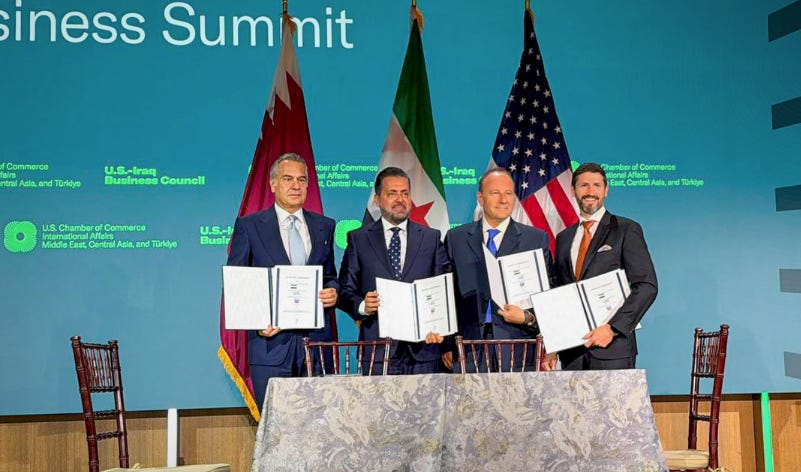
Key Developments: On July 17, the Syrian Petroleum Company (SPC) and Iraq’s Basra Oil Company signed a memorandum of understanding at the US Chamber of Commerce in Washington to rehabilitate the Haditha–Baniyas pipeline, historically associated with the Kirkuk–Baniyas route. A second memorandum, signed with a consortium comprising Chevron, UCC Holding, and TI Capital, provides for technical and financial studies and the preparation of an implementation framework.
The historic Kirkuk–Baniyas pipeline, which previously carried around 300,000 barrels per day, could reach an operational capacity of one million barrels per day by 2029 and two million barrels per day by 2030. The proposed line should follow the historic route for approximately 1,520 kilometers, with a preliminary diameter of 52 inches and planned capacity of up to two million barrels per day. Because the old pipeline is heavily damaged and considered beyond repair, the project would largely involve replacing it with a new line. Construction is estimated to take around 30 months after the completion of studies and the signature of a final implementation contract.
The US State Department welcomed (and backed) the agreement as a priority infrastructure project and supported the involvement of a US-led international consortium, as Washington seeks to develop alternatives to the Strait of Hormuz.
The agreement builds on an export corridor that is already operating on a smaller scale following the closure of the Hormuz Strait, though Iraqi and Syrian officials have said that they intend to retain the corridor even if normal traffic through the Strait resumes.
Iraqi fuel oil has been transported by road to Baniyas since the spring, with daily traffic rising from around 10 tanker trucks in April to approximately 1,000 by late July. By July 28, SPC officials said that some 2.1 million tons had crossed Syria for export through Baniyas, with one maritime cargo leaving approximately every seven to ten days. Between June and July, three Aframax tankers loaded approximately 1.42 million barrels of Iraqi fuel oil at Baniyas for delivery to the Bahamas, Texas, and the wider US Gulf Coast, representing the first such shipments from Syria to the United States. Cargoes exported through Baniyas have also reached Spain and Egypt.
More generally, foreign interest in Syria’s own oil and gas sector endured, although it remains to be seen at a large scale. TotalEnergies Chief Executive Patrick Pouyanné said during President Emmanuel Macron’s visit that the company would discuss moving from its May offshore exploration memorandum towards a formal contract. He nevertheless stressed that insecurity continued to rule out a return to onshore operations and identified the restoration of Iraqi oil-transit routes through Syria as the more immediate priority.
Still, some previously announced foreign partnerships nevertheless began moving towards implementation. On July 3, the SPC began executing its project with Saudi Arabia’s ADES to develop gas fields in central Syria. The project aims to raise production from the covered fields by 25% during the first six months and by 50% by mid-2027, bringing their combined output to approximately four million cubic meters per day, primarily to support electricity generation. In Hasakah, Gulfsands prepared an investment plan covering the rehabilitation of existing wells and the drilling of new ones operated by Dijla Petroleum, while HKN assumed operational responsibilities at the Remilan fields.
Only around 40% of the country’s oil and gas wells are currently operating, producing approximately 130,000 barrels of oil and 6.3 million cubic meters of gas per day, according to SPC official Ayman al-Marai. Conditions varied considerably between individual fields. Al-Omar is reportedly producing around 5,000 barrels per day, compared with approximately 40,000 previously, while the Conoco gas field remained destroyed and out of service. Only around 15% of wells at the Jabsa fields are operational, although officials expected the proportion to rise to 60% within two months, whereas the Rmeilan fields were described as being in comparatively better condition.
As for refining, Syria is preparing for a temporary reduction in capacity. An official at the Syrian Petroleum Company said that the Baniyas refinery would close for approximately four months from the end of July or the beginning of August for extensive rehabilitation. The work is intended to raise its capacity from around 90,000 to 130,000 barrels per day, while an import plan was prepared to cover domestic requirements during the shutdown. The company previously issued a tender for a proposed 210,000-barrel-per-day refinery at Furqlus in Homs and announced plans for a 70,000-barrel-per-day refinery in Deir Ezzor.
Yet, regional and investment developments contrasted sharply with renewed disruption in Syria’s domestic fuel market. A reduction of between 14% and 20% in fuel prices at the end of June was followed by long queues and temporary closures at filling stations. Energy Minister Mohammad al-Bashir attributed the disruption to the rejection of a substandard petrol shipment, reduced orders by station operators anticipating the price cut, consumers delaying purchases, and the sudden release of accumulated demand once the new prices took effect. He apologized for the crisis, while the ministry dispatched more than 25 million liters of petrol (9.77 million liters) and diesel (15.34 million liters) to filling stations and storage facilities. The Minister later ordered inspections of fuel quality across filling stations following complaints about petrol specifications. On July 27, two tankers also arrived at Baniyas carrying 64,324 tons of diesel and 5,620 tons of liquefied gas.
Against this backdrop, filling station operators, however, argued that the disruption also reflected poor coordination around the price reduction, noting that stations had purchased fuel at the previous, higher prices without any compensation mechanism to cover subsequent losses. According to the head of the filling-station owners’ union in Damascus and Rural Damascus, some stations lost more than old SYP 60 million, prompting operators to reduce orders or delay sales, while black-market petrol reportedly sold for between old SYP 20,000 and old SYP 25,000 per liter, about 60% to 100% higher than official prices. Meanwhile, the government raised fuel prices twice during July, bringing the price of 90-octane petrol to old SYP 14,500 per liter, 95-octane petrol to old SYP 14,900, and diesel to old SYP 12,100. Compared with the June 30 prices, these represented increases of 16%, nearly 15%, and around 13%, respectively, in less than one month.
Why It Matters: The emerging Iraq–Syria corridor is strategically significant, but the existing truck-based route should be understood as an emergency workaround rather than a commercially mature alternative to the Strait of Hormuz. Moving Iraqi fuel oil across the border in hundreds of tanker trucks before reloading it at Baniyas adds transport, handling, insurance, and border costs, while the cargoes are intended primarily for re-export rather than for supplying Syrian motorists. Its commercial rationale could therefore weaken once Gulf shipping normalizes. A functioning pipeline would alter that calculation, but its long-term value would rest principally on providing Iraq with redundancy and greater export security, not necessarily on being the cheapest route under normal market conditions.
The corridor will also require greater mutual confidence between Baghdad and Damascus. In July, Iraqi tanker drivers complained of attacks and insecurity on Syrian roads, as at least two trucks were attacked by unknown assailants in April and June, and others were detained in July. At the same time, Syrian authorities announced several anti-smuggling operations involving cargoes arriving from Iraq, including the seizure of weapons allegedly destined for Lebanon’s Hezbollah.
The lack of security guarantees was also highlighted by Patrick Pouyanné, thereby reinforcing a point repeatedly made in previous editions: Syria’s geographical position and hydrocarbon potential are insufficient by themselves to attract investment. Over the past months, several attacks were carried out by the Islamic State near oil fields, including al-Omar, one of Syria’s largest (February, May).
On a positive note, UN Comtrade mirror data (see table below) nevertheless show that Syria recorded around USD 110.8 million in crude and refined-product exports between July 2025 and March 2026, equivalent to approximately 1.58 million barrels, destined for Germany, the Netherlands, Italy, and Bulgaria. This represents a meaningful, if still episodic, return to international oil trade. It should not, however, be confused with a broad recovery in production or domestic energy security, particularly when most wells remain inactive, and Syria continues to rely heavily on imported petroleum products.
The domestic fuel crisis, meanwhile, provided an early test of the government’s more market-oriented pricing system, especially following the launch of a permanent committee to determine the prices of petroleum products and mineral resources. Linking retail prices more closely to international costs may help limit subsidies and protect the continuity of imports, but it also transfers much greater global price volatility to Syrian consumers and distributors. Still, the July developments demonstrated how abrupt adjustments, weak communication, and the absence of a mechanism for compensating stations holding higher-priced inventories can turn a pricing decision into queues, reduced orders, and black-market activity.
The contrast is striking but not contradictory: Syria can earn transit and port revenues by re-exporting Iraqi fuel oil while still struggling to provide sufficient and affordable petrol and diesel domestically, since these involve different products and supply chains. A credible market-based system will therefore require a transparent pricing formula, advance notice, arrangements for existing inventories, and targeted protection for households and transport-dependent sectors.
Continue Reading the July 2026 Syria Monthly Economic Digest


Explore Previous Editions
Browse every edition of the Syria Monthly Economic Digest, featuring monthly analysis of Syria’s political economy, governance, reconstruction, and regional developments.
Never Miss an Issue
Receive the Syria Monthly Economic Digest, along with original research, expert interviews, and in-depth analysis on Syria’s political economy, governance, and reconstruction—delivered directly to your inbox.