

This article is part of the July 2026 edition of the Syria Monthly Economic Digest. Click here to explore the full edition.
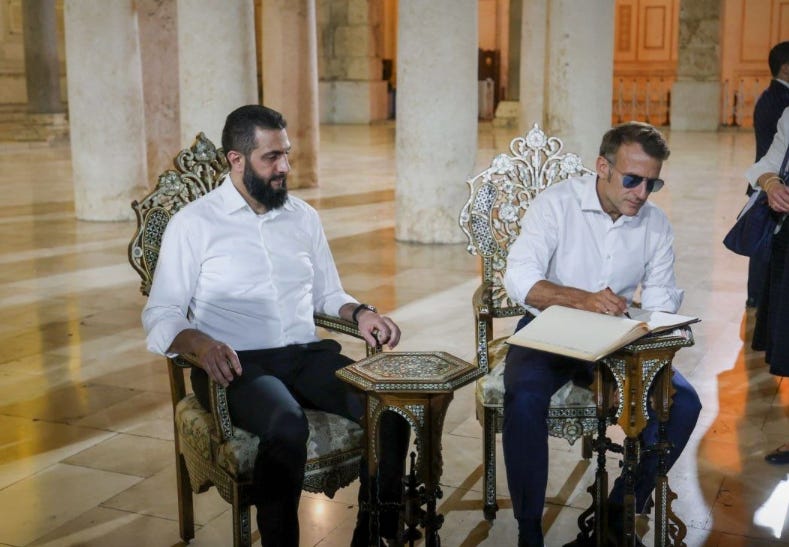
Key Developments: French President Emmanuel Macron visited Syria on July 6–7, becoming the first head of state from the European Union to travel to the country since the fall of the Assad regime in December 2024. The visit followed Syrian President Ahmad al-Sharaa’s trip to Paris in May 2025 and included bilateral talks, meetings with Syrian civil-society representatives, and a French-Syrian economic forum focused on reconstruction and strategic regional corridors.
During the visit, Syria and France agreed to exchange ambassadors after a 14-year interruption in full diplomatic relations, with plans to reopen the French embassy in January 2027, according to diplomatic sources speaking with The Syria Dispatch. Paris and Damascus also signed a framework agreement to expand bilateral cooperation across political, economic, and institutional fields. France further announced that more than EUR 50 million recovered from assets linked to Rifaat al-Assad would be returned through development projects benefiting the Syrian population.
The economic component of the visit covered transport and logistics, aviation, institutional and financial support, health, water and energy infrastructure, higher education, investment law, and bilateral trade (see table at the end of the article).
One of the principal agreements expanded the role of the French shipping and logistics group CMA CGM beyond its existing operation and development of the Latakia container terminal. President al-Sharaa said the company had committed an additional EUR 200 million to the terminal. The new partnership covers the continued development of dry ports in Damascus and Aleppo, an integrated logistics zone at the Nassib border crossing, the rehabilitation of railway connections between Syria’s seaports and inland logistics centers, and cooperation in air-cargo handling and marketing. The partnership builds on CMA CGM’s 30-year agreement, signed in May 2025, to develop and operate the Latakia container terminal through planned investments of EUR 230 million.
Civil aviation cooperation was also expanded through a declaration of intent between Syria’s General Authority for Civil Aviation and the French Ministry of Transport. Follow-up discussions were held later in the month, when France’s Chargé d’Affaires, Jean-Baptiste Faivre, met Omar al-Hosari, director of the Syrian civil-aviation authority. Al-Hosari also announced the signing of a memorandum with Thales to modernize air-traffic management, communications, navigation, and surveillance systems. The Syrian Aviation Holding Company, formerly Syrian Arab Airlines, also signed a strategic partnership with CMA CGM Air Cargo covering cargo-aircraft operations, technical expertise, and logistics services. Syrian civil-aviation authorities separately announced that procedures were in their final stages for the acquisition of eight Airbus aircraft, which are expected to enter service progressively between the final quarter of 2026 and the first quarter of 2027.
In the financial sector, the Central Bank of Syria announced the reactivation of its account with the Banque de France and the restoration of direct institutional relations between the two central banks. The Central Bank of Syria and Expertise France also signed a memorandum covering institutional strengthening, technical assistance, and capacity-building. Cooperation announced during the visit further included French support for the restoration of Syrian financial institutions, reconstruction financing, and the re-establishment of banking services and access to credit. President Macron also said France was prepared to support the reconstruction of Syria’s payment, clearing, and financial systems; cooperation with the Financial Action Task Force (FATF); banking-sector restructuring; and Syria’s work with the International Monetary Fund and, eventually, the Paris Club on legacy debt.
Other agreements covered development, reconstruction, health, and institutional capacity-building through Expertise France and the French Development Agency (AFD). French company NovaKamp signed a protocol concerning modular water-treatment and energy solutions in Homs. The Syrian Investment Authority signed a memorandum with French law firm Gide Loyrette Nouel covering legal and institutional cooperation related to the investment environment. The Ministry of Higher Education signed a memorandum with Ellipse Projects concerning the development of university hospitals and medical-training institutions. It should be noted that all of NovaKamp, Gide Loyrette Nouel, and Ellipse Projects participated in the French business delegation that visited Syria in October 2025.
Energy and regional connectivity also featured in the discussions. President Macron said TotalEnergies was considering activities related to oil and gas, renewable energy, regional energy transit, and the possible rehabilitation of the Kirkuk–Baniyas corridor. French Foreign Minister Jean-Noël Barrot subsequently described Syria as a possible alternative route for energy shipments amid disruptions affecting the Strait of Hormuz.
In private-sector development, Proparco, the AFD Group’s private-sector financing arm, also advanced discussions on a possible return to Syria. According to a French official speaking to The Syria Dispatch, the institution is currently examining several potential projects with the European Union, including support for microfinance and small and medium-sized enterprises, although no investments have yet been formally announced. President Macron also said that France could eventually support project preparation in Syria through the Fonds d’étude et d’aide au secteur privé (FASEP).
Finally, the Conseil d’Affaires Franco-Syrien (CAFSY) and MEDEF International’s Conseil d’Entreprises France-Syrie (CEFS) signed a cooperation agreement to support French companies seeking to enter the Syrian market or expand their activities in the country.
The visit also included the return of 23 Syrian archaeological objects that had been loaned to the Arab World Institute in Paris in 2010 and had remained in France after bilateral diplomatic relations were suspended. The objects, originating from museums in Damascus, Aleppo, Latakia, and Palmyra, were transported to Syria aboard the French presidential aircraft and transferred to the National Museum in Damascus.
Why It Matters: France’s return to Damascus carries particular historical significance. French-Syrian relations (greatly described by Manon-Nour Tannous’ fantastic book ‘Chirac, Assad et les autres’) have long been marked by a tension between proximity and mistrust: France’s mandate-era legacy left a lasting political and cultural imprint, while also fostering enduring suspicion of French interventionism. After independence, Paris sought to preserve influence through its broader Middle East strategy, maintaining relations with Hafez al-Assad despite recurring disagreements and later attempting to reintegrate Bashar al-Assad into international diplomacy before relations collapsed following the 2011 uprising.
Until the collapse of the Assad regime, France had remained one of the most consistent European supporters of the Syrian opposition, maintaining its refusal to normalize relations with Assad, welcoming the defector known as Caesar, and pursuing legal cases against senior regime figures. As journalist Wassim Nasr has argued, this consistency helped build credibility with Syria’s new authorities. President Macron’s early engagement with President al-Sharaa, including becoming the first European leader to speak with him by telephone and hosting his first visit to a European capital, further underlined the privileged nature of the relationship.
Still, for all the progress on the political and diplomatic front, the commercial relationship between the two countries has yet to catch up, but not for lack of effort by President Macron and French diplomats to fast-track ties with the new Syrian government. CMA CGM may be behind the largest of the few investment projects actually moving forward, but that has more to do with the company’s long history in Syria (the company has operated in Syria since 2009) than with any new related developments. In fact, the MEDEF business delegation that visited Syria in October 2025 is a useful reminder of how this can go: barely any of the agreements signed at that time materialized.
Thus, President Macron’s visit was, in part, an attempt to make up for that lost time (comparatively to other countries with more advanced economic, commericla and political relations with Damascus) through presidential diplomacy, the exchange of ambassadors, and a highly visible batch of commercial and institutional agreements. Worth noting, though: most of what was signed was technical and developmental rather than straightforwardly commercial. Given the underlying obstacles still impeding economic recovery, French officials described the visit to The Syria Dispatch as a chance to move past political symbolism and start addressing the practical obstacles slowing Syria’s recovery. According to the same source, President Macron raised business-environment issues that continue to impede business dealings in Syria directly with President al-Sharaa.
In fact, President Macron later argued that attracting investment starts with a “shock of confidence,” reliable banking, functioning payment systems, debt restructuring, anti-money laundering reform, and stronger financial governance. In other words, France seems to see institutional reform, not big financial pledges, as the real prerequisite for reconstruction.
For French business interests to materialize in Syria, one French official told The Syria Dispatch, sustained technical assistance is needed in the form of helping reform the financial sector and pulling Syria further into international financial and trade systems. Paris sees its edge not just in flagship companies like CMA CGM or TotalEnergies, but in institutions, such as the Banque de France, Expertise France, AFD, the French Treasury, whose job is rebuilding the institutional groundwork that longer-term private investment needs.
Given the current regional context, President Macron also framed reconstruction as a means, not an end, to larger ambitions for Syria. He tied the country’s recovery to a bigger vision: new logistics, energy, and digital corridors linking the Gulf and Europe. That overlap between French and Syrian strategic thinking is a big part of why transport, ports, civil aviation, and energy dominated the agreements signed during the visit.
In the end, whether any of this matters will come down to implementation. French companies might have connections, sector expertise, and political backing, but they are facing the same headwinds as everyone else investing in Syria: weak banking links, legal uncertainty, thin purchasing power, patchy infrastructure, and a bureaucracy still not equipped to prepare and run complex projects.
Continue Reading the July 2026 Syria Monthly Economic Digest


Explore Previous Editions
Browse every edition of the Syria Monthly Economic Digest, featuring monthly analysis of Syria’s political economy, governance, reconstruction, and regional developments.
Never Miss an Issue
Receive the Syria Monthly Economic Digest, along with original research, expert interviews, and in-depth analysis on Syria’s political economy, governance, and reconstruction—delivered directly to your inbox.