

This article is part of the July 2026 edition of the Syria Monthly Economic Digest. Click here to explore the full edition.
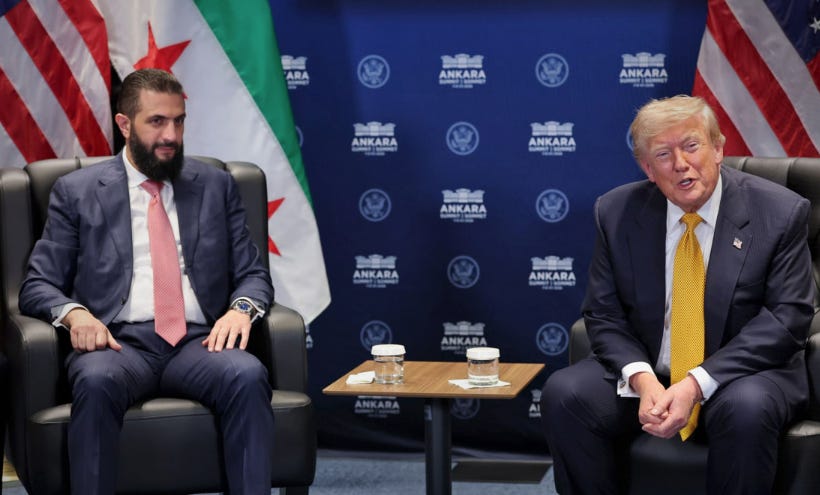
Key Developments: On July 8, President Donald Trump notified Congress of his intention to rescind Syria’s designation as a State Sponsor of Terrorism, beginning the statutory 45-day process required before the decision takes effect. Syria has remained on the list since 1979. The designation entails restrictions on US foreign assistance, defense exports, certain dual-use goods, and financial transactions. A week later, Representative Joe Wilson said that Under Secretary of Commerce Jeffrey Kessler had also committed to accelerating revisions to Syria-related export regulations, potentially facilitating greater access to US equipment and technology for civilian sectors.
Syrian officials welcomed the announcement. President Ahmad al-Sharaa described the decision as a major achievement and credited the shift in US policy, alongside support from Türkiye and Gulf states, with helping Syria unify the country and move towards recovery. Finance Minister Yisr Barnieh called it a “historic moment” that could accelerate investment and economic recovery, while Central Bank Governor Safwat Raslan described it as a positive turning point that would strengthen confidence and support Syria’s reintegration into the global financial system. Qatar, Jordan, the United Arab Emirates, Bahrain, and the Gulf Cooperation Council also welcomed the announcement.
Meanwhile, congressional scrutiny continued to focus on the Syrian government’s counterterrorism cooperation, protection of minorities, treatment of foreign fighters, governance record, and commitments regarding regional security.
Why It Matters: Removing Syria from the State Sponsors of Terrorism list matters for considerably more than the country’s international reputation. Although Washington had already dismantled most comprehensive sanctions in 2025, the designation continued to create a separate layer of legal risk.
Under the terrorism exception to the US Foreign Sovereign Immunities Act (28 U.S.C. § 1605A), eligible claimants can sue designated states for specified acts of terrorism, while Section 201 of the Terrorism Risk Insurance Act allows holders of qualifying judgments to attach and execute against the blocked assets of a designated state or its agencies and instrumentalities in order to satisfy compensatory damages.
This risk is concrete. In Foley v. Union de Banques Arabes et Françaises (UBAF), holders of terrorism-related judgments against Syria pursued Syrian government-controlled funds held by UBAF in Paris. In March 2026, a federal court in New York granted partial summary judgment in their favor on the turnover claims, finding that approximately USD 50 million in Syrian government-controlled assets held by the French bank were subject to turnover. The decision showed that Syrian assets did not necessarily have to be held directly in the United States to become exposed: a US court could, under certain circumstances, order a foreign bank subject to its jurisdiction to bring Syrian assets into New York for execution.
Banks were therefore not automatically liable merely for holding Syrian money, but they could be drawn into discovery, restraint, attachment, and turnover proceedings. Institutions accused of routing or concealing Syrian transactions could also face separate sanctions-enforcement and litigation risks; something integrated with banks’ internal risk policies. It is estimated that US courts have already entered more than USD 31 billion in judgments against Syria since 2011, while at least 186 additional cases remain pending.
Delisting will not erase existing judgments against Syria or necessarily prevent litigation arising from conduct committed while the country was designated. Its effect on existing claims may therefore remain limited, though the extent to which this can be chilling for international financial institutions is unclear. It should, however, reduce uncertainty surrounding future Syrian state assets and transactions, particularly if accompanied by the removal of remaining blocking measures. This could lessen the litigation and compliance risks that have discouraged international banks from processing Syrian government-related payments or rebuilding correspondent relationships.
Recent developments already point in that direction. On July 15, the Central Bank organized a technical workshop with Citibank, attended by representatives of the Ministry of Finance, covering correspondent-banking relationships, US-dollar clearing, cross-border payments, and the infrastructure required for international financial settlement. While presented as a capacity-building exercise rather than the establishment of a new correspondent-banking relationship, the workshop illustrated the practical work now underway to reconnect Syria’s financial institutions to global payment networks. Two weeks later, the Central Bank of Syria and the Central Bank of the Republic of Türkiye signed an agreement allowing the Syrian central bank to open a Turkish-lira deposit account at its Turkish counterpart and held technical discussions on payment systems, financial infrastructure, digitalization, and banking-system interoperability.
While these developments cannot be attributed solely to the SST decision, they would have been considerably more difficult while the designation remained in force. The risk that Syrian state funds could be restrained or attached to satisfy terrorism judgments created a powerful deterrent for institutions considering correspondent banking, dollar clearing, or the custody of Syrian assets. Delisting does not eliminate legacy claims, but it materially improves the legal environment for new accounts and future transactions.
More broadly, the decision reinforces a clear shift in US policy from merely permitting economic engagement with Syria towards actively facilitating it. It follows the termination of the comprehensive sanctions program, the repeal of the Caesar Act, the publication of a US State Department-funded investor handbook and sector guides, and increasingly direct support for American commercial participation. US companies have since entered agreements covering gas-field development and offshore exploration, while Washington has backed efforts to revive the Kirkuk–Baniyas pipeline, with Chevron linked to the prospective consortium. The political breadth of this shift was illustrated by late Senator Lindsey Graham, previously one of the most skeptical voices regarding Syria’s new leadership, who said after meeting Ahmad al-Sharaa that working with him was in the US national interest and that he represented the best chance for a functioning and united Syria.
Still, the transactional nature of President Donald Trump’s foreign policy could eventually create friction if economic engagement becomes increasingly tied to US regional security priorities. President Trump has repeatedly suggested that Syria could play a role in confronting Hezbollah in Lebanon, whereas President Ahmad al-Sharaa has consistently stated that Damascus has no intention of intervening militarily there. Syria undoubtedly has an interest in securing its border, limiting arms trafficking, and preventing Hezbollah from destabilizing Syrian territory (Read this month’s Syria-Lebanon relations article). However, direct involvement in Lebanon would carry significant political and sectarian risks while diverting scarce state capacity away from domestic consolidation and reconstruction.
Secretary of State Marco Rubio’s subsequent emphasis on Syria addressing its own internal challenges and securing the border suggests a more restrained approach, but the difference remains important: the present positive trajectory could be tested if continued US economic support becomes tied to regional security demands that Damascus considers either destabilizing or beyond its capabilities.
Continue Reading the July 2026 Syria Monthly Economic Digest


Explore Previous Editions
Browse every edition of the Syria Monthly Economic Digest, featuring monthly analysis of Syria’s political economy, governance, reconstruction, and regional developments.
Never Miss an Issue
Receive the Syria Monthly Economic Digest, along with original research, expert interviews, and in-depth analysis on Syria’s political economy, governance, and reconstruction—delivered directly to your inbox.