

This article is part of the July 2026 edition of the Syria Monthly Economic Digest. Click here to explore the full edition.
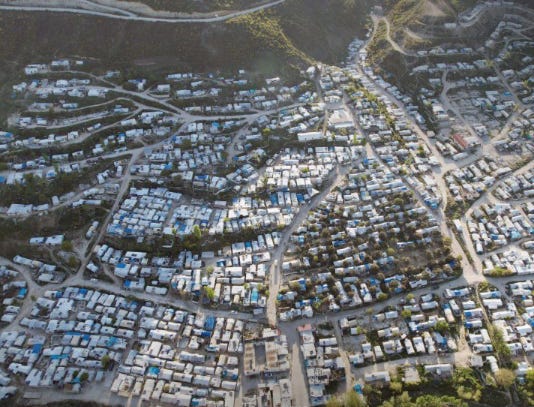
Key Developments: Return movements continued at scale during the first half of 2026. As of May 31, approximately 1.67 million Syrians have returned from neighboring countries since December 2024, alongside around 1.96 million internally displaced people who have returned to their areas of origin as of June 2026. Türkiye and Lebanon remained the principal countries of departure, followed by Jordan, while most returnees headed toward Aleppo, Idlib, Hama, Homs, Damascus, and Rural Damascus.
Returns from Türkiye accelerated further during the summer. Turkish Interior Minister Mustafa Çiftçi said in July that around 1,000 Syrians were returning each day, bringing the number returning since the fall of the Assad government to approximately 710,000, and 1.5 million since 2016, while around 2.26 million Syrians remained registered under temporary protection.
In Lebanon, General Security extended until September 30 an exemption allowing Syrians and Palestinian refugees from Syria with irregular status to leave through land crossings without paying accumulated fees or fines and without receiving entry bans. UNHCR and IOM also continued to support voluntary returns through cash assistance and organized transport, with returning refugees eligible for USD 100 per person and some vulnerable families receiving an additional USD 300 grant. Among the roughly 581,000 returnees from Lebanon between March 2 and June 30, 2026, fewer than 140,000 said they intend to remain in Syria even if conditions in Lebanon improve, implying that most of the remainder would consider going back to Lebanon if circumstances there change.
Returns from Jordan also continued to rise. By July 18, more than 208,000 UNHCR-registered Syrian refugees had returned from Jordan since December 2024, including nearly 6,900 in June alone and an additional 4,500 in the first 18 days of July.
Movements from Egypt remained more limited. Return-related case closures slowed in May because of operational and funding constraints, as well as families waiting for the school year to end, although return activity during the first five months of 2026 remained above 2025 levels. Interestingly, departures are beginning to reshape the economic networks of Syrians who remained in Egypt. Syrian women operating home-based catering, cleaning, childcare, and tutoring businesses reported shrinking customer bases, stronger competition, and falling incomes, with some food producers receiving only one or two orders per week.
Overall, decisions to return are shaped by family reunification and perceived improvements inside Syria, but also by conflict, worsening economic conditions, and increasingly restrictive protection environments in host countries. Still, conditions after return remain the central concern.
A study of 425 refugee and IDP returnees across seven governorates found that 91 percent arrived in communities missing essential services, 71 percent were living in damaged housing, 44 percent encountered conditions worse than expected, and only 18 percent received sufficient support during the return process. Despite the return of nearly two million internally displaced Syrians, more than 5.5 million people remained internally displaced, including approximately 1.2 million living in formal or informal camps.
As for the Syrian government, its “Syria Without Camps” initiative aims to support the closure of displacement camps and provide safer and more durable accommodation by the end of 2027. Yet, the scale of the challenge remains considerable: an assessment in Idlib alone identified 736 camps accommodating around 91,000 families. Housing, service, livelihood, documentation, and funding gaps continue to limit the pace at which displaced families can return sustainably.
Yet, following a July visit to Syria, UN Special Rapporteur on the human rights of internally displaced persons Paula Gaviria Betancur welcomed the government’s commitment to ending camp-based displacement but warned that camp closures must result from durable, rights-based solutions rather than substitute for them. She emphasized that sustainable returns would require housing and property protections, mine clearance, livelihoods, functioning services, and measures to prevent secondary displacement.
Why It Matters: The situation of Syrian refugees in Türkiye warrants particular attention. Ankara increasingly appears to be pursuing a dual-track transition away from open-ended temporary protection: facilitating the voluntary return of Syrians who wish or need to go back, while gradually regularizing those who have become embedded in—and continue to contribute to—the Turkish economy. The June announcement exempting Syrians under Temporary Protection from work permit requirements is particularly significant because it constitutes an explicit recognition that Syrian workers fill structural labor shortages. Although employment is still expected to be formally registered, removing the work permit requirement should substantially lower barriers to formal employment. While the legal basis for such exemptions dates back to an amendment published in the Turkish Official Gazette in October 2024, the June 2026 decision is reportedly its first broad application to Syrians under Temporary Protection (TP).
The June decision follows the January 2026 healthcare reform, which ended broadly automatic health coverage for Syrians under TP and tied comprehensive care instead to formal employment through the Social Security Institution (SGK), private insurance, or means-tested assistance.
Read together, the two moves suggest Ankara is shifting away from TP status as the basis for access to benefits, and toward formal labor-market participation, while making that participation easier to achieve. The likely goal is twofold: keep economically active Syrians whose skills the Turkish economy relies on, and push more Syrian employment into the formal system, which would also widen the pool of workers and employers paying into SGK at a moment when the fund is under real strain.
International donors, per sources who spoke to The Syria Dispatch, are increasingly drawing the same distinction: treating support for voluntary return and investment in long-term integration as separate tracks, on the assumption that not all displacement will reverse anytime soon. EU programming for 2025–2027 reflects that split, earmarking funds for voluntary returns while still investing heavily in education, healthcare, and livelihoods for refugees expected to stay in Turkey for the medium-term.
In a similar vein, Jordan also pursues a partial integration policy aimed at integrating Syrian refugees into the labor market, primarily through work permits issued under the Jordan Compact, an initiative launched jointly by the Jordanian government and the EU in 2016.
In June, Jordan introduced a temporary regularization program for non-Jordanian workers, offering a 50 percent reduction in accumulated work-permit fees from previous periods and waiving certain penalties for workers and employers who regularize their status by September 30. The measure is likely to benefit Syrian workers significantly, although it applies to non-Jordanian labor more broadly, and should also support the Jordanian labor market, given the country’s longstanding dependence on foreign labor. Moreover, in July 2026, Jordan eased entry requirements for Syrian investors by extending visa facilitations to the spouses and children of eligible Syrian entrepreneurs, signaling an effort to sustain cross-border economic ties despite expectations of refugee returns. This transition is nevertheless taking place under mounting financial pressure. As of June 2026, UNHCR’s Jordan operation faced a funding gap of more than USD 200 million, covering only around 28 percent of its requirements.
Unlike Türkiye and Jordan, Lebanon continues to pursue a predominantly return-oriented policy, combining administrative incentives for departure with tighter enforcement of residency rules. It has nevertheless maintained limited, time-bound avenues for regularizing Syrian workers, reflecting the continued dependence of sectors such as agriculture and construction on Syrian labor. In line with this dependence, the Ministry of Labor and the Ministry of Agriculture are reportedly reviewing a proposal to register Syrian agricultural workers through the National Farmers’ Registry.
Across the region, return decisions reflect both changing conditions inside Syria and deteriorating alternatives in host countries. Many Syrians are returning not only because they perceive greater safety or hope for family reunification, but because the economic and legal conditions sustaining their displacement have narrowed. Some formally “voluntary” returns are therefore better understood as the least untenable option available. Humanitarian organizations consulted by The Syria Dispatch similarly identified rising living costs, irregular employment, declining access to healthcare, documentation problems, and family reunification as major drivers of return, often outweighing purely security-related considerations.
Inside Syria, returning citizens can restore skills, labor, consumption, entrepreneurial activity, and family networks. Yet the country’s capacity to absorb returnees is not keeping pace with the scale of arrivals: as noted above, the large majority arrived in communities lacking essential services or housing in poor condition. More than 80 percent were also unable to find work despite often possessing substantial prior experience.
In some areas, accelerated returns are already intensifying pre-existing pressures. Residential rents reportedly increased by 50–100 percent in parts of Homs following the arrival of returnees. In Damascus and surrounding areas, additional families are returning to communities where water, electricity, sewage systems, roads, and schools were already severely overstretched. In Al-Hajar al-Aswad, thousands of families have returned despite extensive infrastructure damage, while residents in Tal Kalakh have reported growing competition over school places, fuel allocations, housing, and employment.
The principal challenge is therefore no longer simply facilitating return, but ensuring that returns remain sustainable and do not instead produce renewed poverty, social tensions, or secondary displacement inside Syria.

*This article benefited from additional research and analytical support from Ekin Keleş.
Continue Reading the July 2026 Syria Monthly Economic Digest


Explore Previous Editions
Browse every edition of the Syria Monthly Economic Digest, featuring monthly analysis of Syria’s political economy, governance, reconstruction, and regional developments.
Never Miss an Issue
Receive the Syria Monthly Economic Digest, along with original research, expert interviews, and in-depth analysis on Syria’s political economy, governance, and reconstruction—delivered directly to your inbox.