

This article is part of the June 2026 edition of the Syria Monthly Economic Digest. Click here to explore the full edition.
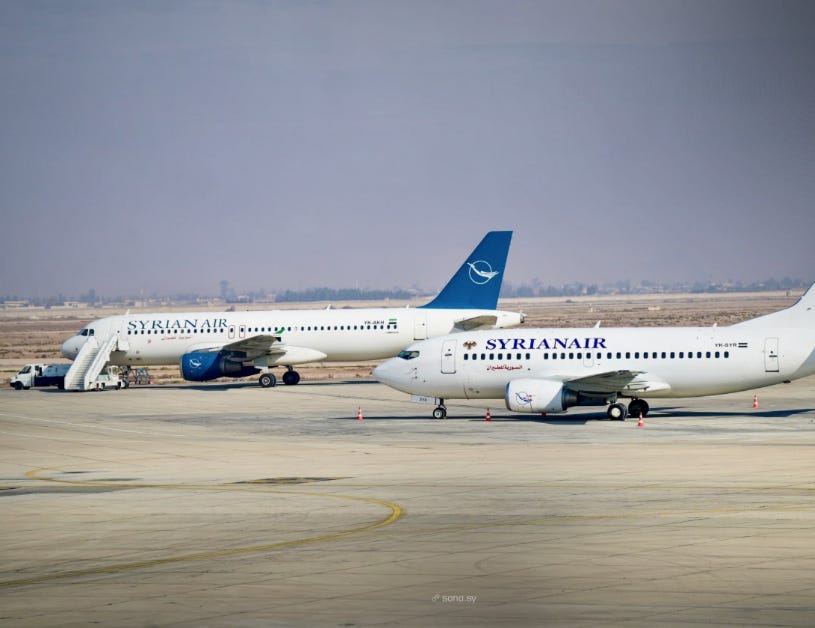
Key Developments: Syria’s air connectivity continued to expand with several European routes announced or under negotiation. On June 25, Syrian Arab Airlines said it would launch direct Damascus-Amsterdam flights on July 2, marking its first return to Western European operations since EU measures introduced in October 2012 barred it from EU airports and from EU individuals and entities working with the carrier. The Syrian Aviation Holding Company said the route followed technical, legal, and diplomatic work aimed at restoring the national carrier’s European presence, while Omar al-Hosari, head of the General Authority of Civil Aviation and Air Transport, described Amsterdam as the first step in a broader expansion plan.
However, the operational structure of the route appears more complex than the initial announcement suggested. Dutch aviation media reported that tickets had gone on sale for Amsterdam-Damascus flights under Syrian Airlines flight numbers, with services scheduled on Mondays, Thursdays, and Saturdays. Schiphol Airport’s own flight information page listed flight RB271 from Amsterdam to Damascus, while the aircraft details for the July 2 flight showed an Airbus A320 registered LY-MAU. Flight-tracking and fleet data identify LY-MAU as an Airbus A320 operated by Lithuania’s Heston Airlines, an EU-based aircraft, crew, maintenance and insurance (ACMI) and charter carrier. This suggests that the route is being marketed under Syrian Airlines’ RB flight numbers but operated by Heston Airlines’ aircraft, rather than by Syrian Airlines’ own fleet.
Germany could follow the Netherlands, although approvals remain pending. Reports that Sundair planned to begin twice-weekly Berlin-Damascus flights from August 1 prompted the Syrian Civil Aviation and Air Transport Authority to clarify that no final operational approval had yet been granted. The authority said the route still depends on regulatory and operational approvals from the German side, as well as the completion of technical procedures, while Hosari said a final German decision was expected in the first half of July.
Aleppo also gained a new European connection. On June 19, Romania’s Dan Air announced it would begin direct scheduled flights from Bucharest to Aleppo starting July 1, adding to its existing Bucharest-Damascus service. Dan Air said it had carried more than 30,000 passengers between Bucharest and Damascus during its first year of operations in Syria, with an average load factor of 88 percent, and that it would become the only EU carrier operating scheduled flights to both Damascus and Aleppo.
These route announcements come amid a broader rebound in the use of Syrian airspace. Some 11,801 flights crossed Syrian airspace in May, more than double February’s level and around 375 percent higher than in May 2025, as regional airlines rerouted around disrupted airspace elsewhere in the Middle East.
Why It Matters: The Amsterdam route remains symbolically important, but its operational structure should be interpreted with caution. Operations by Heston Airlines under an ACMI or wet-lease-style arrangement do not necessarily mean that Syrian Airlines itself has regained full operational access to the EU market.
This distinction matters for regulatory reasons. Under EASA rules, any third-country operator intending to conduct commercial air transport into, within, or out of the EU and EFTA area must hold a Third Country Operator (TCO) authorization. EASA confirmed with The Syria Dispatch on June 26 that, as of that date, no Syrian operator held such an authorization. It also clarified that one-off notification flights are limited to humanitarian or ambulance flights in the public interest and cannot be used as a workaround for regular commercial service. As of July 2, 2026, no Syrian air carrier appears among the TCO-licensed carriers. An EU carrier such as Heston does not face that same TCO requirement when operating under its own European approvals, although the route would still require the relevant national permits, Syrian approvals, airport procedures, insurance, and security arrangements.
The Heston structure therefore makes the Amsterdam route more plausible but provides less definitive evidence of Syrian Airlines’ full return to Europe as an operator. It is closer to a commercial and diplomatic reopening than a complete regulatory normalization of Syrian civil aviation. Still, the arrangement also shows how Syria’s aviation reintegration may proceed in stages. European carriers, charter operators, and ACMI providers can reconnect Syrian airports to Europe before Syrian operators themselves clear all safety, regulatory, and insurance hurdles. That could help meet immediate demand from the Syrian diaspora, family travelers, business visitors, and possibly return-related travel, while buying time for Syrian aviation authorities and airlines to rebuild compliance capacity.
Still, the risks have not disappeared. European countries can, however, impose national restrictions, something which appears to be the current impediment to Sundair’s Berlin-Damascus route. Added to this is EASA’s wider conflict-zone guidance, which may further restrain flights to Syria. Indeed, EASA’s Syria conflict-zone bulletin, revised on May 12 and valid until October 31, continues to advise operators not to use Syrian airspace because of military activity, fragmented airspace control, air-defense risks, Israeli strikes, drones, rockets, and MANPADS.
Such guidance may also affect insurance costs. While Syria-specific premium data are not publicly available, war-risk coverage has become more expensive for some Middle East operations, and insurers are likely to approach Syria with caution given the security environment, residual compliance risks, and airport security concerns.
Demand is unlikely to be the main obstacle. Direct flights would serve Syria’s large diaspora in Europe, facilitate family travel and business links, and potentially support voluntary refugee returns, a priority for several European governments. This gives the Amsterdam route political significance, especially after the June 24 Dutch visit to Damascus, where migration, reconstruction, and refugee returns were reportedly discussed.
Continue Reading the June 2026 Syria Monthly Economic Digest


Explore Previous Editions
Browse every edition of the Syria Monthly Economic Digest, featuring monthly analysis of Syria’s political economy, governance, reconstruction, and regional developments.
Never Miss an Issue
Receive the Syria Monthly Economic Digest, along with original research, expert interviews, and in-depth analysis on Syria’s political economy, governance, and reconstruction—delivered directly to your inbox.