

This article is part of the June 2026 edition of the Syria Monthly Economic Digest. Click here to explore the full edition.
Key Developments: June opened with renewed pressure on Syrian households’ purchasing power, as the Syrian pound continued to weaken during the first half of the month before partially recovering in the final week, while markets rapidly absorbed the effects of recently approved salary increases.
The executive instructions for implementing Presidential Decrees No. 67 and No. 68 of 2026, which added 50 percent to fixed salaries and wages, had barely been issued before price increases began eroding the raise. The increases, which take effect in June 2026, were poised to be diluted by exchange-rate volatility and precautionary pricing. However, the pound’s late-June rebound means the final dollar value of salaries depends on the exchange-rate benchmark used.
As prices of basic food and non-food items rose by up to 25 percent following the pound’s decline, some traders priced goods against a precautionary exchange rate of around (old) SYP 16,000 (new SYP 160) to the dollar to hedge for future inflation. This behavior reflected a broader breakdown in price visibility and led to a widening gap between official and black-market rates (see chart below).
In the final week of June, however, the Central Bank took active steps to narrow the gap between the official and black-market rates. On June 25, it raised the official dollar rate to (new) SYP 118.5 for buying and 119.5 for selling, the third official devaluation in less than two months. On June 28, the official rate was raised again to (new) SYP 121.5–122.5, while the parallel-market rate reportedly stood at around (new) SYP 128. This reduced the official-parallel gap to around 4.9 percent, while the Central Bank narrowed the permitted exchange-rate margin from 9 percent to 3 percent.
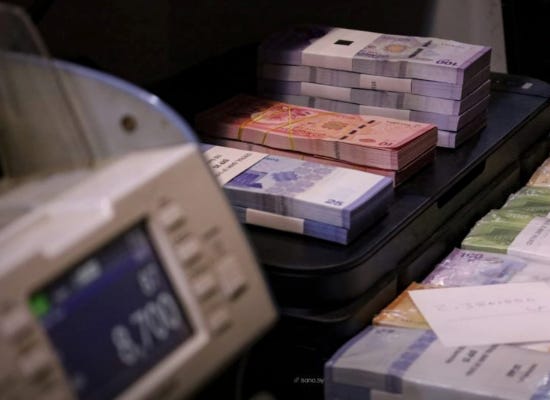
Still, volatility coincided with continued uncertainty around the currency replacement process. On June 1, Central Bank Governor Mohammed Safwat Raslan said more than 63% (then 66% on June 10) of the nationwide currency replacement process had been completed, and announced a 30-day extension, from July 1 to July 31, as a final opportunity for holders of old banknotes to exchange them. He also instructed banks, exchange companies, and money-transfer firms not to reintroduce old notes into circulation and to provide customers with only the new Syrian pound for withdrawals, exchanges, and cash payments. Raslan later clarified that the end of the exchange period through banks and exchange companies would not cancel citizens’ right to hand in old notes and receive new ones during a five-year withdrawal period, under mechanisms to be announced later.
It should be noted that implementation remained uneven, especially in northeast Syria, where Hasakah had effectively been outside the normal currency-replacement cycle due to the closure of public banks and the absence of functioning financial institutions in parts of the governorate, particularly amid the continued administrative division between Damascus and the SDF. The Central Bank moved to address this gap: on June 23, it designated 11 currency-replacement centers in Hasakah Governorate through al-Haram and Osoul exchange and transfer companies, distributed across Hasakah, Qamishli, Darbasiyah, and Amuda, with nine reportedly ready to receive citizens and two still under preparation. Two days later, the Central Bank branch in Raqqa resumed official operations for the first time since 2013, offering services including currency replacement and wheat-payment processing.
At the policy level, Raslan used the first National Conference for Dialogue with the Private Sector in early June to signal a more coordinated approach. He said the Central Bank’s next phase would rely on institutional work and planning rather than “improvised or unilateral decisions,” while acknowledging that the widening gap between official and market exchange rates affects investment decisions, depositor behavior, confidence in the financial market, banking activity, and the investment climate. The Central Bank Governor also mentioned that a study to develop Islamic financial products is forthcoming. (On Islamic finance, READ here)
Why It Matters: The exchange-rate movement fed directly into prices, but the more important issue is not only depreciation. It is volatility. A currency that weakens sharply, partially rebounds, and changes several times within the same day still undermines pricing, wage expectations, and market confidence.
In a volatile exchange-rate environment, traders price not only according to current costs but also in anticipation of future depreciation. The use of precautionary exchange rates is therefore both a response to inflation and a driver of it. It protects traders from replacement-cost risk, but it also transmits expectations of further depreciation into current prices. In this sense, the problem is not only that the pound lost value in the first half of June. It is that no single exchange-rate anchor was credible enough to guide transactions, contracts, salaries, or inventories.
The Central Bank’s late-June adjustments therefore represent a move towards defensive stabilization after months of seeming apathy in the face of the depreciating pound. By raising the official rate and narrowing the permitted margin, the Central Bank reduced (at least for now) the gap with the parallel market. It limited the space for arbitrage, speculation, and multiple pricing references. These decisions should help reduce the official-market gap, stabilize expectations, and protect government revenues priced against the official exchange rate. Still, this remains exchange-rate management, not yet a full monetary policy framework.
The redenomination process compounds this problem because the exercise is going well beyond a purely technical one. It has become a test of administrative capacity and public trust. The repeated extensions suggest that implementation has been slower and more uneven than planned due to weak logistical capacity at Central Bank branches and commercial banks, the continued appearance of old cash holdings in the market, concerns over excluding poorer and rural households, and possible shortages or distribution problems affecting the new notes.
Such limitations are especially important in northeast Syria, where Hasakah’s delayed access to replacement services revealed the territorial and institutional limits of monetary policy. If some governorates have better access to banks, exchange companies, and replacement centers than others, the redenomination can create uneven monetary conditions inside the same national economy. This risks deepening cash-market fragmentation, encouraging informal brokers, and weakening confidence in the state’s ability to administer a national currency. The subsequent designation of 11 replacement centers in Hasakah and the reopening of the Central Bank branch in Raqqa are therefore important corrective steps. Still, they also underscore how closely monetary stabilization is tied to the reintegration of state institutions across the country… and hint that redenomination might have been premature for this reason, at least.
Raslan’s emphasis on coordination with ministries, institutions, and the private sector is analytically significant for this reason. It implicitly acknowledges that the Central Bank cannot stabilize the currency through announcements alone. Exchange-rate policy, redenomination, banking access, fiscal management, customs, imports, wheat payments, salary increases, and market regulation interact. If coordination remains weak, each measure risks undermining the next: wage increases feed prices, currency replacement creates uncertainty, exchange-rate gaps encourage arbitrage, and traders hedge against future instability.
Continue Reading the June 2026 Syria Monthly Economic Digest


Explore Previous Editions
Browse every edition of the Syria Monthly Economic Digest, featuring monthly analysis of Syria’s political economy, governance, reconstruction, and regional developments.
Never Miss an Issue
Receive the Syria Monthly Economic Digest, along with original research, expert interviews, and in-depth analysis on Syria’s political economy, governance, and reconstruction—delivered directly to your inbox.