

This article is part of the June 2026 edition of the Syria Monthly Economic Digest. Click here to explore the full edition.
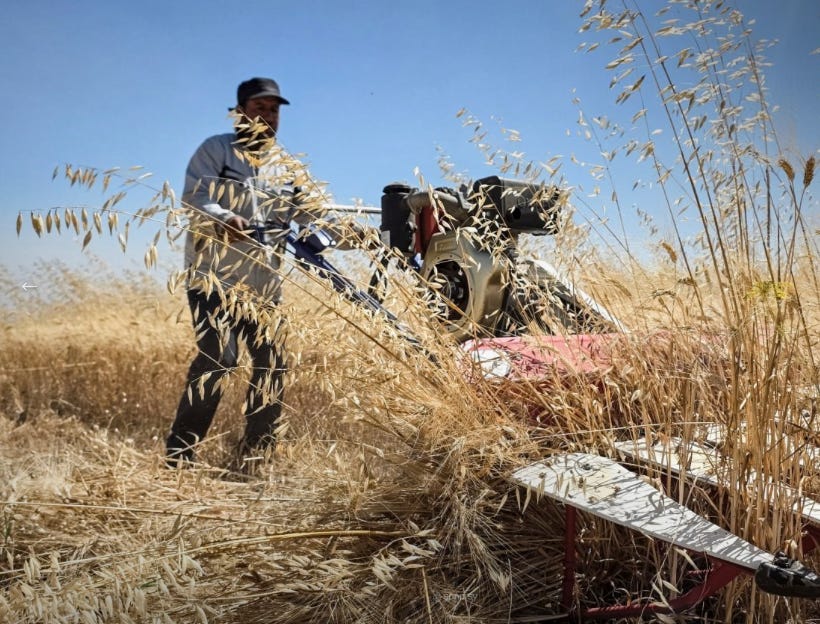
Key Developments: Syria’s 2026 wheat season entered June significantly stronger than in previous years, supported by improved rainfall and better crop conditions across several key producing areas. In Hasakah, the Syrian Grain Establishment (SGE) expected to receive 800,000 to 1 million tons of wheat, while preliminary estimates put total Jazira production at around 1.1–1.2 million tons. Aleppo expected a much stronger season than last year, with projected wheat production of around 571,000 tons and some estimates suggesting output could exceed 600,000 tons. The SGE prepared 20 collection centers across the Hasakah Governorate and said existing wheat stocks of 400,000–500,000 tons were being transferred to other governorates to free storage capacity for the new harvest. By June 30, Hasakah farmers had delivered 480,000 tons of wheat to government procurement centers, with the harvest nearing completion and official estimates still indicating that total provincial production would exceed 1.025 million tons.
The stronger harvest is already affecting import planning. The SGE said available wheat stocks were sufficient to meet basic ration needs and maintain stable bread and flour supplies, and that wheat imports would be temporarily paused this season pending the final harvest outcome.
However, the stronger harvest did not automatically translate into improved livelihoods for farmers or rural workers. In Raqqa, the harvest season created jobs in harvesting, transport, bagging, and grain collection centers, but rising unemployment and a larger pool of available workers pushed wages down. Workers also said weak rainfed yields in parts of the governorate reduced earnings for those paid by the quantity harvested or bagged, while local observers warned that exchange-rate volatility could erode farmers’ income once payments were made. Concerns were also raised that a potentially large injection of Syrian pounds into the market could put pressure on the exchange rate, further eroding the value of earnings (see “Exchange-Rate Volatility Tests Syria’s Redenomination Process”).
Payment uncertainty also persisted. By June 13, farmers’ grain dues had not yet begun to be paid, as the authorities were waiting for the Central Bank to transfer the required funds. Payments were still expected to be made through the Agricultural Cooperative Bank, as in the previous season.
To ease procurement bottlenecks, the government launched new administrative tools. The Ministry of Agriculture launched an electronic platform for farmers wishing to market their crops, allowing them to register and reserve delivery slots. The platform triggered pushback, however. On June 16, farmers in Tell Tamr (Hasakah) staged a sit-in in front of the Agriculture Directorate, arguing that weak rural internet access, delayed appointments, and the difficulty of using digital tools could slow wheat delivery and increase costs during a time-sensitive harvest season. In Hasakah, officials later announced measures to reduce congestion at collection centers, including accepting loose wheat in open storage areas, opening additional sites as needed, allowing wheat to be transported to other governorates at government expense, and exempting wheat trucks from axle-load penalties for loads up to 25 percent above the legal limit.
By late June, the authorities had expanded the number of receiving centers in Hasakah to around 30 after opening ten additional centers, while daily intake reportedly reached around 70,000 tons nationwide, including about 30,000 tons per day in Hasakah alone. Four new payment points were also announced in Hasakah, Qamishli, al-Malikiyah, and al-Darbasiyah, starting in early July, to reduce farmers’ travel burden and speed up invoice payments.
Still, farmers continued to raise concerns about agricultural inputs, especially fertilizers, fuel allocations, and diesel for harvesters and tractors, in addition to the need to announce strategic crop prices before the planting season. Fuel shortages, especially, remained one of the most immediate threats to the season. In rural Qamishli and Hasakah, diesel shortages and prices of up to (old) SYP 20,000 per liter halted many harvesters, leaving wheat fields at risk of grain loss and fires before the crop could be collected. These pressures overlapped with wider fuel protests in Hasakah Governorate and earlier official promises to send subsidized diesel to support farmers during the harvest season. This recent wave of protests also followed a wave of farmer protests in May 2026.
Why It Matters: The stronger 2026 harvest is good news, but it remains far from recovery. Improved rainfall has improved output prospects, yet farmers still struggle with structural challenges. While rainfall can account for better yields, farmers still rely on debt, expensive inputs, and trader/broker arrangements that can leave them selling crops below market value. This situation has led to the paradox described earlier, in which Syria may produce more wheat, yet many farmers may not feel significantly better off, as the aforementioned challenges quickly erode the benefits of a stronger harvest.
It is also worth noting that the government’s response shows how agriculture remains one of the most interventionist parts of Syria’s recovery. Despite broader rhetoric around liberalization, private investment, and a larger role for the market (recently toned down, however), Damascus remains deeply involved in wheat procurement, collection centers, payment channels, fuel allocations, crop pricing, marketing platforms, and now plans to establish an agricultural holding company. This is not surprising. Agriculture is tied to food security, rural employment, exports, and social stability, and the state cannot easily step back from a sector on which much of the country still depends. According to Agriculture Minister Basil al-Suwaidan, around 30 percent of Syria’s population relies, directly or indirectly, on agriculture for income and employment.
Still, the calculus is not necessarily a bad one, quite the contrary. Prioritizing agriculture, especially given Syria’s productive potential, could help ease several macroeconomic pressures at once. Wheat import requirements for the 2025/26 marketing year were forecast at around 3 million tons, nearly 70 percent above the five-year average, following two weak domestic production seasons. At recent global wheat prices of roughly USD 220 per ton, this implies an import bill in the high hundreds of millions of dollars. Reducing that bill through increased local production would not only support food security but also ease pressure on foreign-currency demand, the trade deficit, and, ultimately, the Syrian pound.
Continue Reading the June 2026 Syria Monthly Economic Digest


Explore Previous Editions
Browse every edition of the Syria Monthly Economic Digest, featuring monthly analysis of Syria’s political economy, governance, reconstruction, and regional developments.
Never Miss an Issue
Receive the Syria Monthly Economic Digest, along with original research, expert interviews, and in-depth analysis on Syria’s political economy, governance, and reconstruction—delivered directly to your inbox.