

This article is part of the June 2026 edition of the Syria Monthly Economic Digest. Click here to explore the full edition.
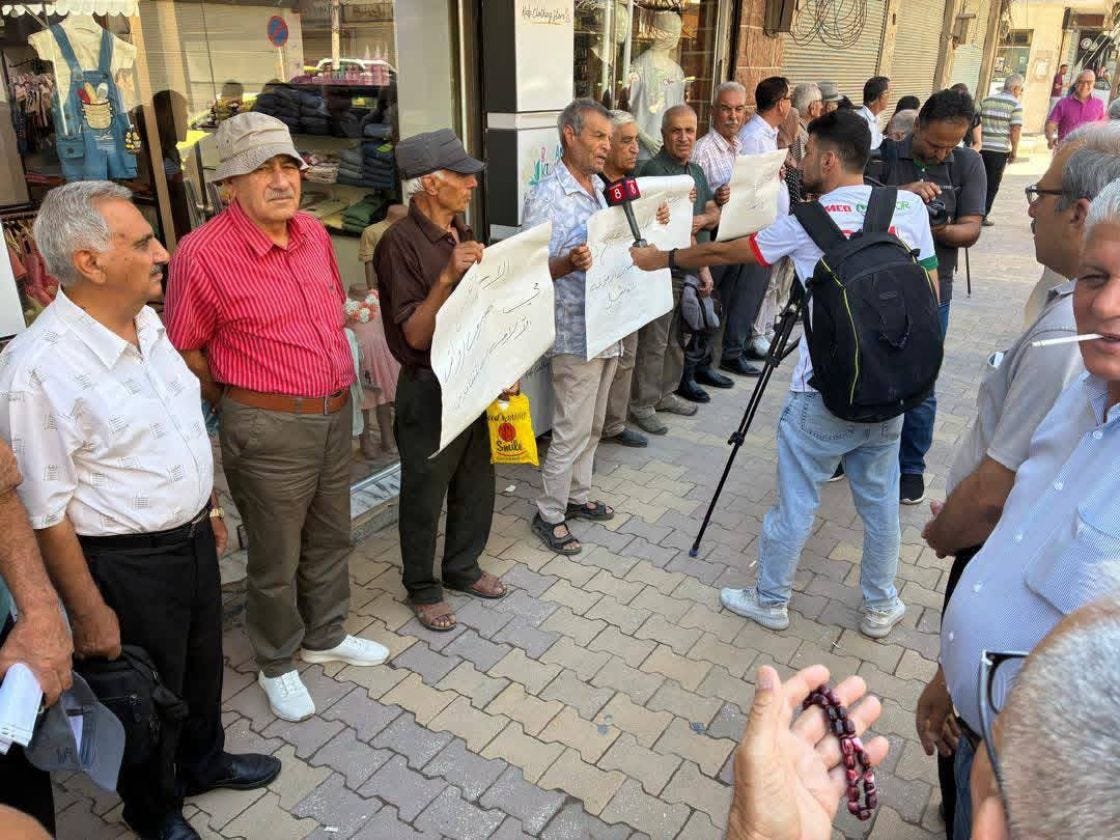
Key Developments: Qamishli witnessed a continuous wave of protests in late June that began with a retirees’ mobilization over delayed pensions and expanded into broader demonstrations over fuel prices, electricity shortages, public services, and deteriorating living conditions.
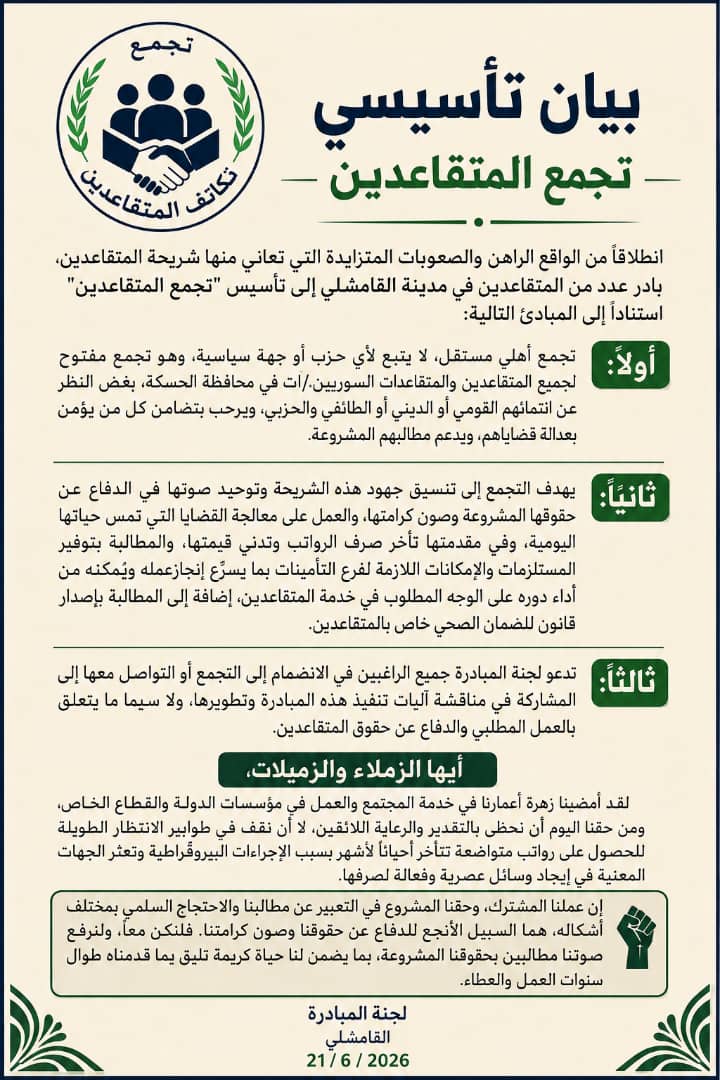
On June 20, dozens of retirees held a sit-in in front of the Social Insurance branch, demanding the payment of delayed pensions and faster processing of their files. The action was organized by the newly formed Retirees’ Solidarity Gathering (تجمع تكاتف المتقاعدين). The organization later announced its formal establishment, describing itself as an independent civic initiative open to all retirees in Hasakah Governorate, focused on addressing pension delays and low pension amounts, improving the work of the local Social Insurance branch, and demanding a dedicated health insurance law for retirees. Some retirees reported they had not received pensions for around a year, while others reported delays ranging from several months to a year and a half.
The following day, a new wave of protests was sparked after fuel prices rose and service allocations were reduced. On June 21, residents and shop owners blocked roads and burned tires in central Qamishli after diesel prices reportedly rose from 55 to 75 cents per liter. Fuel allocations for bakeries, generators, and transport were also cut by more than half, forcing many private generators to reduce hours or stop operating during a period of high summer temperatures. Protesters demanded lower fuel prices, a more stable electricity supply, improved public services, and action to contain the rising costs of bread, transport, and basic goods. The protests continued into a second and third day, expanding beyond fuel alone. On June 23, protesters continued to call for basic living needs to be secured, prices to be brought under control, and services to be improved and later chanting slogans such as “the people want better living conditions,” “protest against poverty and hunger,” “we will continue until prices are reduced,” and “our daily demands are bread, peace, and freedom.”
These protests were part of a broader pattern of growing popular anger in the Hasakah Governorate. More than 40 protest events were recorded across Hasakah Governorate between June 1 and June 28 alone. The demands varied, but most centered on delayed salaries and pensions, fuel and electricity shortages, rising prices, unemployment, poor services, and the release of detainees (see table below).
Earlier in the month, the authorities had already moved to contain similar fuel-related unrest in rural Hasakah. On June 10, Deputy Governor Ahmad al-Hilali said one million liters of subsidized diesel would be sent to the governorate, with priority given to the agricultural sector during the harvest season. Hilali also linked the accumulated service challenges to the ongoing process of completing institutional integration and fully reactivating state directorates in Hasakah.
Earlier protests in al-Hol, al-Shaddadi, Tell Brak, and Ghazila had already focused on the contradiction between Hasakah’s oil resources and its shortages of fuel, water, electricity, and jobs. In several areas, residents blocked roads used by oil tankers, arguing that local communities remained underserved despite the daily movement of fuel and oil through the governorate.
This contradiction also shaped the language of the Qamishli protest movement. In a statement read on behalf of protesters on June 25, participants described the Jazira as one of Syria’s richest regions in resources but among the poorest in services, framing their demands around cheap and clean bread, electricity, drinking water, security, and an end to corruption and the extraction of local wealth. The statement also rejected narrow party agendas, presenting the mobilization as a broader social and livelihood protest.
Back to fuel, the supply shock quickly spread to transport, agriculture, and daily commerce. The regular Qamishli-Damascus bus fare rose from (old) SYP 135,000 to 290,000, while business-class bus fares increased from (old) SYP 185,000 to 400,000, and the price of the Qamishli-Hasakah route also doubled. Subsidized transport gasoline rose from (old) SYP 450 (USD 0.03)* to USD 0.55, prompting taxi and internal transport drivers to protest in front of the fuel committee (Sadcop) on June 23 and demand that the decision be reversed. The crisis also affected the wheat harvest, with fuel shortages and diesel prices of up to (old) SYP 20,000 (USD 0.7) per liter halting many harvesters in rural Qamishli and Hasakah, raising fears of crop losses and field fires.
(*Edited on July 3, 2026, to correct the dollar conversion of old SYP 450 from USD 0.30 to USD 0.03.)
The protests prompted at least a limited policy response. On June 23, Energy Minister Mohammad al-Bashir issued Decision No. 822 of 2026 forming a permanent committee to determine prices for petroleum products and mineral resources. The committee includes representatives from the Energy Ministry, Finance Ministry, Economy and Industry Ministry, Central Bank, and relevant oil and mineral-resource bodies, and is tasked with reviewing petroleum prices in light of global prices, costs, the exchange rate, subsidy mechanisms, and other indicators.
On June 27, the committee held an extraordinary meeting to review pricing, supply costs, operating costs, and local and global market conditions, and raised new recommendations to the Energy Ministry. It also recommended adopting the Syrian pound as the sole currency for pricing petroleum products, a step presented as an effort to unify pricing mechanisms and strengthen the use of the national currency in the fuel sector. Later that day, the Energy Ministry approved fuel-price reductions ranging from more than 14 to 20 percent: 95-octane gasoline was cut by 20.39 percent to (new) SYP 130 per liter, 90-octane gasoline by 19.97 percent to (new) SYP 125, diesel by 14.37 percent to (new) SYP 107, domestic gas cylinders by 15.49 percent to (new) SYP 1,500, and industrial gas cylinders by 15.49 percent to (new) SYP 2,400.
Why It Matters: Beyond the immediate backlash against the fuel-price increase, the Qamishli protests represent another stress test of the state’s attempt to reintegrate northeast Syria administratively, fiscally, and economically. Fuel was the immediate trigger, but the chronology of the protests points to a broader accumulation of grievances: delayed pensions and salaries, weak services, electricity cuts, wheat-marketing problems, unemployment, detainee files, and unclear institutional responsibility. In this sense, this month of protests encapsulates the terms on which Hasakah Governorate is being brought back into the national system.
While protest movements have emerged across the country, the Hasakah Governorate is especially sensitive because the northeast is moving from years of Autonomous Administration and SDF-linked governance toward a difficult handover to Damascus. The fuel issue illustrates the tension clearly: Damascus may be trying to unify prices, reduce distortions, and regularize supply, but residents experience this as the loss or weakening of previous support systems before reliable Damascus-based state services have arrived. In an area where generators substitute for public electricity, transport depends heavily on fuel availability, and many salaries or pensions are delayed, fuel pricing is not a narrow technical matter.
The protests also carried a strong distributive message linked to historic grievances. Hasakah is one of Syria’s most resource-rich governorates, yet residents repeatedly contrasted the movement of oil and fuel through the governorate with shortages of electricity, water, jobs, and basic services. Stability in the northeast will require significant support for and development of this region (see “Deir Ezzor Redevelopment Push Accelerates Across Transport, Oil, Water, and Electricity”).
Continue Reading the June 2026 Syria Monthly Economic Digest


Explore Previous Editions
Browse every edition of the Syria Monthly Economic Digest, featuring monthly analysis of Syria’s political economy, governance, reconstruction, and regional developments.
Never Miss an Issue
Receive the Syria Monthly Economic Digest, along with original research, expert interviews, and in-depth analysis on Syria’s political economy, governance, and reconstruction—delivered directly to your inbox.