

This article is part of the June 2026 edition of the Syria Monthly Economic Digest. Click here to explore the full edition.
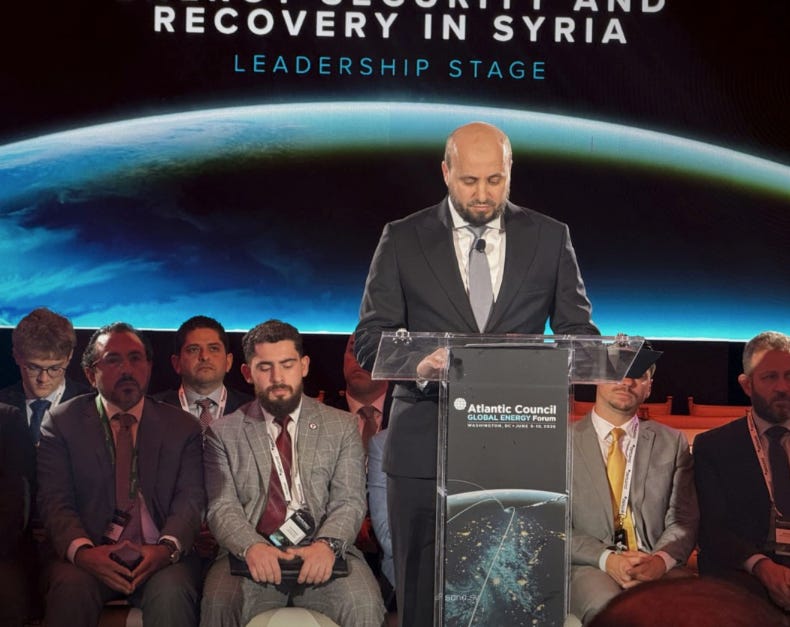
Key Developments: On June 10, Energy Minister Mohammad al-Bashir used the Global Energy Forum in Washington to present Syria as a potential regional energy hub linking the Gulf, Iraq, and the Eastern Mediterranean to regional and international markets. He cited cooperation with Chevron, ConocoPhillips, GE Vernova, and HKN Energy, as well as partnerships with TotalEnergies, Siemens, and Ansaldo Energia, and said that advanced discussions were also underway with Eni and other companies.
On June 16, the Syrian Petroleum Company (SPC) signed a contract with ConocoPhillips and Novaterra to develop several gas fields and increase production from existing fields, with the stated aim of supporting the electricity sector and other vital sectors. The contract followed an earlier memorandum of understanding signed in November 2025 and was presented by Energy Minister Mohammad al-Bashir as a step toward raising domestic gas production, improving operational efficiency, and restoring confidence in Syria’s energy investment environment. Syria will receive a 56 percent share under the contract, with the two investing companies receiving 44 percent. The deal could increase daily gas output by around 4–5 million cubic meters within a year.
The same day, the SPC denied reports that Australia’s AXP Energy had entered Syria’s oil and gas sector or signed an agreement with the company. The denial followed AXP’s announcement that it had secured the right to earn up to 25 percent in an onshore Block 9 production-sharing contract in the Palmyra Basin through a farm-in arrangement. SPC said all official agreements and partnerships would be announced exclusively through its own channels and in accordance with the relevant legal and institutional frameworks.
Foreign interest also moved toward formal bidding. On June 18, SPC said it planned to launch an international bid round for four oil fields in Deir Ezzor in Mahash, Akissyah, East Khrata, and Qusaibeh, grouped as the “MAKK Area” (northwest of Shell’s former al-Furat Petroleum Company), with commercial bids due by July 19.
Offshore and midstream discussions also advanced. On June 23, SPC CEO Youssef Qiblawy met with a Chevron delegation to discuss converting the existing memorandum of understanding on offshore exploration in Block 1 into an executive contract. The meeting also covered the possibility of Chevron’s participation as a strategic partner in reviving the Kirkuk-Baniyas crude oil pipeline. On the same day, SPC discussed cooperation with UAE-based ENOC and Horizon Terminals to rehabilitate and develop pipelines and oil terminals.
Why It Matters: The June announcements further indicate that Syria’s energy sector is moving in a positive direction. Foreign companies are now beginning to move toward contracts, bid rounds, and more concrete discussions over upstream, offshore, and midstream assets.
Still, the announcements should be treated carefully. Signing a contract is not the same as implementation, and Syria’s oil and gas sector remains challenging: infrastructure is damaged, security risks persist, sanctions and compliance concerns have not entirely disappeared, banking channels remain weak, and the legal status of some legacy concessions remains unclear. The AXP Energy episode illustrates another issue: transparency, or the lack thereof. It raised basic questions about who owns what and how the new authorities will treat contracts or concessions originating under the Assad era. SPC’s denial was useful, but it also showed the need for clearer public rules on approval, disclosure, and contract validity.
There is also a governance issue. Oil and gas contracts concern strategic national assets, and attracting foreign companies may require generous fiscal terms, especially given Syria’s political, technical, and security risks. That may be understandable in the short term, but it increases the need for transparency and institutional oversight. Syria does not need to publish every commercial detail, but major energy contracts should be subject to some form of public or parliamentary scrutiny, clear procurement procedures, and reporting on revenue-sharing, investment obligations, production targets, environmental safeguards, and local employment. With these types of contracts, the issue is not simply who is in charge — whether a public, private, local, or foreign actor — but what terms were set. (Read: Syria Needs More Electricity. Does It Matter Who Builds It?). In that context, having international bidding rounds for various blocks and fields is a step in the right direction.
The local dimension will be just as important. Many of the assets under discussion are in or near eastern Syria, where communities have long viewed the oil and gas sector as extractive: resources leave the region while services, jobs, electricity, fuel, and water remain inadequate. The recent protests in Hasakah, including the blocking of oil trucks, show that this grievance remains politically salient (see this month’s entry on the Qamishli and Hasakah protests). Recent protests related to the closure of makeshift refineries are another wake-up call for the government not to overlook local populations. Reviving production in Deir Ezzor, Hasakah, or central Syria could support local recovery if it creates jobs, repairs infrastructure, and channels visible benefits back into producing regions. If not, energy investment could deepen social tensions… and those tensions are themselves bad for business. Recent moves by SPC to hire local workers, reinstate previously dismissed employees, and relocate parts of the upstream administration closer to Deir Ezzor suggest that the authorities have understood this risk. The same applies to the government’s wider emphasis on developing the eastern governorates.
Continue Reading the June 2026 Syria Monthly Economic Digest


Explore Previous Editions
Browse every edition of the Syria Monthly Economic Digest, featuring monthly analysis of Syria’s political economy, governance, reconstruction, and regional developments.
Never Miss an Issue
Receive the Syria Monthly Economic Digest, along with original research, expert interviews, and in-depth analysis on Syria’s political economy, governance, and reconstruction—delivered directly to your inbox.