

This article is part of the May 2026 edition of the Syria Monthly Economic Digest. Click here to explore the full edition.
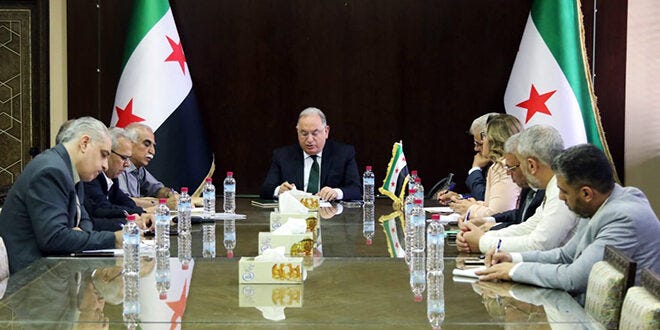
Key Developments: Syria’s public banking sector saw several reform-related developments in May. Oliver Wyman reportedly completed the first phase of its review of Syria’s six state-owned banks, with options under discussion including restructuring, privatization, or strategic partnerships. Separately, Finance Minister Mohammad Yisr Barnieh met with directors of public banks to discuss the implementation of Presidential Decree No. 70 of 2026 on distressed loans, while the Ministry of Finance later issued executive instructions covering exemptions, rescheduling, and settlement mechanisms for borrowers at government banks.
Several public banks also announced operational measures. The Agricultural Cooperative Bank prepared its branch network to pay farmers’ grain dues during the wheat season, and issued instructions for settling farmers’ distressed loans under Presidential Decree No. 70 of 2026. The Popular Credit Bank resumed limited-income loans with a ceiling of (new) SYP 100,000 (+/- USD 720), though debate later emerged over loan interest rates following an earlier Court of Cassation ruling on usurious interest. The Industrial Bank and the Ministry of Finance also discussed launching a Sharia-compliant banking window and financing tools to support the repair of damaged industrial facilities.
Governance and integrity concerns remained visible. Oversight reporting raised allegations of embezzlement linked to Saving Bank offices. Separately, the Ministry of Finance announced disciplinary and anti-corruption measures against 256 employees and accountants, adding that future lists would include employees in government banks.
Why It Matters: Public-sector banks were cornerstones of Syria’s development in previous decades because they served as the primary financial channels through which Syria allocated credit to specific social and productive groups. The Agricultural Cooperative Bank is designed to finance rural communities and agricultural activities; the Industrial Bank to support industrial projects; the Popular Credit Bank to serve low-income borrowers and small productive activities; and the Real Estate Bank to finance housing and construction.
This makes the reform debate politically sensitive. The Oliver Wyman review, therefore, raises a central policy question: should Syria modernize its public banks, privatize them, or preserve them as development-oriented institutions? Given the government’s broader shift toward a more liberal economic agenda, including discussions around the privatization of state-owned enterprises, which has yet to be settled, such a move would not be surprising. Yet a reform agenda focused mainly on profitability could weaken the banks’ development role, especially if institutions originally designed to serve farmers, industrialists, small borrowers, and housing finance are pushed toward purely commercial lending.
The resumption of lending is one of the most important signals in the public banking sector because formal credit had virtually disappeared during the conflict. In 2020, Syrian authorities ordered public and private banks to stop granting credit facilities, including at the Real Estate and Agricultural banks, and Syria’s broader banking collapse severely weakened access to credit for businesses and households. Against that backdrop, Presidential Decree No. 70 of 2026and the reopening of Popular Credit Bank lending could prove significant. Presidential Decree No. 70 of 2026 is designed to clean up non-performing loans through interest waivers, penalty exemptions, and rescheduling, while the Popular Credit Bank’s return to personal lending gives limited-income public-sector employees access to formal credit again.
The Islamic finance debate adds another layer. Syria already has an Islamic finance base: Islamic banks greatly outperformed traditional banks throughout the conflict, with rising demand for Islamic tools such as murabaha and Islamic bank assets growing from SYP 18.2 trillion to SYP 25 trillion. The government is also exploring sukuk: Finance Minister Mohammad Yisr Barnieh said Syria was working on the legal, regulatory, and technical framework for the country’s first sovereign sukuk issuance, while debate has emerged over whether such instruments should finance productive projects or simply cover budget gaps. The debate over the use of sovereign sukuk issuance is not new, as the Ministry of Finance was reportedly already finalizing a draft regulation to legislate such financial instruments in 2024.
Taken together with the Popular Credit Bank’s return to interest-based lending, the proposal to allow Islamic banking windows, and the renewed public debate over bank interest, these developments raise broader questions about the government’s financial direction. The issue is not Islamic finance itself, which can broaden participation and attract savers or borrowers who avoid conventional interest-based products, and which has proved to be extremely popular. The risk is that debates over “usurious interest” could narrow the space for ordinary credit precisely when Syria needs multiple financing channels. There is also a question of sequencing. Given the state’s limited legislative and administrative bandwidth, prioritizing new Islamic-finance frameworks while existing financial tools remain underused could slow more urgent reforms.
Finally, this debate also intersects with uncertainty about the government’s willingness to take on loans. Observers continue to ask whether the reluctance reflects a preference for interest-free or Sharia-compliant financing, concerns over already mounting public debt, or simply the difficulty of accessing affordable external credit. It remains to be seen whether Syria builds a plural financial system (conventional, Islamic, development-oriented, and donor-backed) or whether ideological and fiscal constraints limit the range of tools available for broad-based economic recovery and reconstruction.
Continue Reading the May 2026 Syria Monthly Economic Digest


Explore Previous Editions
Browse every edition of the Syria Monthly Economic Digest, featuring monthly analysis of Syria’s political economy, governance, reconstruction, and regional developments.
Never Miss an Issue
Receive the Syria Monthly Economic Digest, along with original research, expert interviews, and in-depth analysis on Syria’s political economy, governance, and reconstruction—delivered directly to your inbox.