

This article is part of the May 2026 edition of the Syria Monthly Economic Digest. Click here to explore the full edition.
Key Developments: On May 11, Syria identified an offshore block for its first deep-water oil and gas exploration project with Chevron and Qatar’s UCC Holding, paving the way for final contracts and technical operations to begin in the summer. One day later, the Syrian Petroleum Company signed a memorandum of understanding with ConocoPhillips, TotalEnergies, and QatarEnergy to conduct technical studies, prepare a work program, and draft an exploration contract for offshore oil and gas exploration in Block 3 near Latakia. Separately, INA Croatia and MOL Group (Hungary) held talks with Syrian counterparts over a possible restart of projects suspended since 2012.
Onshore, the Syrian Petroleum Company continued efforts to restore production in eastern Syria. In Deir Ezzor, SPC restarted wells 110 and 116 at the al-Tanak field, adding around 800 barrels per day to the current output. The company said al-Tanak had produced 50,000–60,000 barrels per day before 2011, but that 90–95% of its infrastructure had been damaged, leaving current production at around 3,000–5,000 barrels per day. Still, amid constrained oil supplies, it was reported that Russia had become Syria’s dominant crude supplier after Assad’s fall, with shipments rising by 75% to around 60,000 barrels per day in 2026.
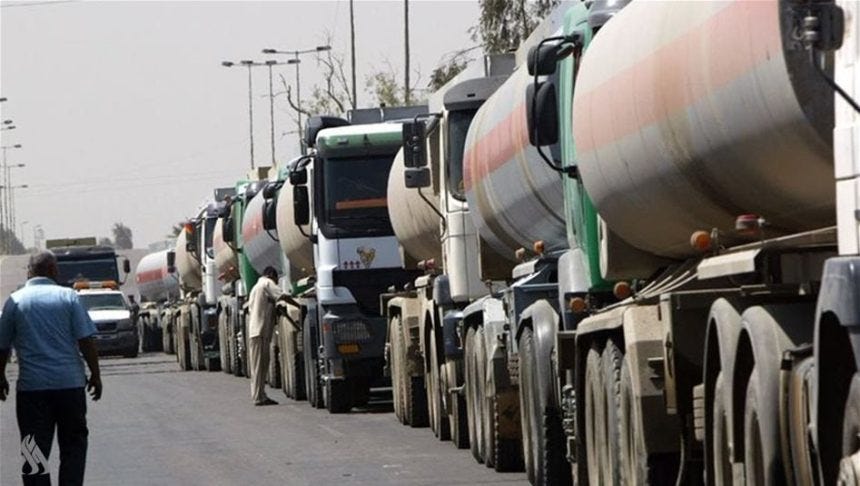
Iraqi oil also became an increasingly important part of Syria’s energy and transit picture. Iraq sent its first crude shipment to Syria through the reopened Rabia–al-Yarubiyah crossing in early May, with an initial 70 tanker trucks, while the Syrian Petroleum Company raised daily unloading capacity for Iraqi oil at Baniyas refinery to around 500 tankers, up from 300. Iraq’s Oil Ministry also discussed opening an Iraqi shipping office at Baniyas port and reviving the Iraqi–Syrian oil pipeline, while Baghdad separately announced plans for a 700-kilometre Basra–Haditha pipeline with a planned capacity of 2.5 million barrels per day and possible export routes toward Baniyas, Ceyhan, and Aqaba. At the same time, SPC said recent increases in domestic petroleum-product prices were driven by higher supply, transport, production, storage, maintenance, insurance, and global fuel costs, and were intended to maintain stable distribution across governorates.
Why it Matters: The return of the main eastern oil fields to government control is economically significant, but it should not be mistaken for a rapid return to pre-war production. Syria’s oil output had already been declining long before 2011, after peaking in the 1980s, and the war then accelerated the collapse through infrastructure destruction, sanctions, underinvestment, primitive refining, smuggling, and repeated changes in control. This does not mean recovery is impossible. New drilling, reservoir management, digital monitoring, enhanced oil recovery, horizontal wells, and better seismic interpretation could make some previously marginal fields or old discoveries more viable today than they were 15 years ago.
But Syria is not, and has never been, a major oil power capable of living off hydrocarbons without major discoveries. Even at its historic peak, its output was modest by regional standards, and much of the known onshore base is mature, damaged, or under-assessed. But that is why offshore exploration, albeit speculative, still matters: it offers upside that the mature eastern fields may not. It should be noted, however, that Syria has not yet made a commercial offshore discovery, and Lebanon’s nearby offshore campaigns have so far failed to produce a positive discovery.
This makes the more ambitious targets floated by SPC leadership. SPC Director Youssef Qiblawi said current output had reached around 133,000 bpd, projected roughly 300,000–350,000 bpd by end-2027, and repeated a target of around 800,000 bpd by late 2029 or early 2030. His explanation relied on a combination of rehabilitating damaged fields such as al-Omar and al-Tanak, expanding Rmeilan, and drilling new onshore blocks. While these targets are politically important because they signal confidence to investors and the public, they remain highly ambitious given the state of infrastructure, reservoir damage, financing needs, and operational risks.
Nevertheless, offshore exploration is technically complex, and that is precisely why it matters. A single exploration or delineation well can cost close to USD 100 million before any production is guaranteed, so any move toward drilling involves mobilizing substantial capital, personnel, and technical capacity in Syria. For now, however, the sector’s near-term significance lies in credibility, capital inflows, and energy security. Agreements involving Chevron, TotalEnergies, ConocoPhillips, QatarEnergy, and UCC can bring technical studies, seismic work, drilling commitments, service contracts, and foreign capital even before production begins. Onshore investment will remain more constrained and will depend, among other things, on investors’ ability to price political, legal, insurance, and operational risks and move capital into Syria.
Continue Reading the May 2026 Syria Monthly Economic Digest


Explore Previous Editions
Browse every edition of the Syria Monthly Economic Digest, featuring monthly analysis of Syria’s political economy, governance, reconstruction, and regional developments.
Never Miss an Issue
Receive the Syria Monthly Economic Digest, along with original research, expert interviews, and in-depth analysis on Syria’s political economy, governance, and reconstruction—delivered directly to your inbox.