

This article is part of the May 2026 edition of the Syria Monthly Economic Digest. Click here to explore the full edition.
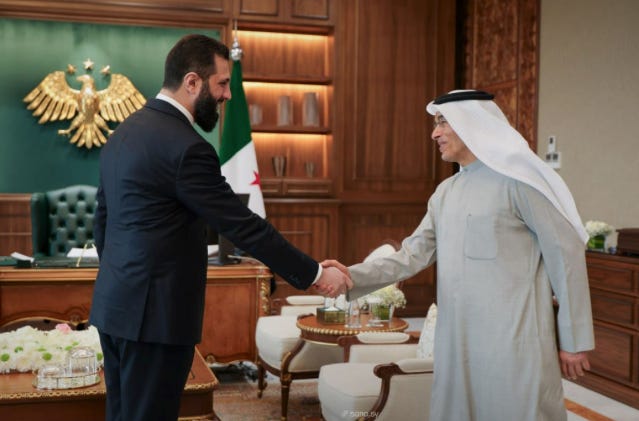
Key Developments: Syria–UAE economic engagement accelerated in May with the first Syrian–Emirati Investment Forum in Damascus and a high-level UAE business delegation led by UAE Minister of Foreign Trade Thani al-Zeyoudi. The delegation met President Ahmad al-Sharaa and included more than 120 Emirati companies and institutions. The visit coincided with renewed Emirati interest in Syria following an earlier visit by Emaar Properties founder Mohamed Alabbar, who said he was assessing investments worth up to USD 18 billion, including USD 5–7 billion on the Syrian coast and up to USD 11 billion in Damascus and its surroundings. It was also reported that Alabbar-linked Eagle Hills is studying two much larger master-planned projects in Dummar and Latakia, with a combined development cost exceeding USD 50 billion, though the projects remain in the early stages of discussion.
While Syrian officials used the forum to promote investment incentives and regulatory reforms, some Emirati investors raised concerns over exchange-rate stability, banking and transfer mechanisms, sovereign guarantees, and the need for clearer regulatory frameworks. Despite the scale of the projects discussed, no signed investment agreements or memoranda of understanding were publicly announced, although it was reported that the two sides had reached preliminary agreements on several investment tracks.
UAE Foreign Trade Minister Al-Zeyoudi said bilateral non-oil trade reached USD 1.4 billion in 2025, up more than 130% year-on-year, while discussions focused on industry, agriculture, renewable energy, logistics, the digital economy, tourism, aviation, and private-sector partnerships. Separately, the UAE announced support for the restoration of the Umayyad Mosque in Damascus, adding a cultural dimension to renewed bilateral engagement.
Why It Matters: The Syria–UAE forum marks a genuine Emirati rapprochement, but one likely to remain cautious, transactional, and step-by-step. Abu Dhabi moved more slowly than Qatar and Saudi Arabia after Assad’s fall, partly because of its long-standing hostility to Islamist movements, its unease with HTS’s links to Türkiye and Qatar, and its previous rapprochement with the Assad regime. The UAE is therefore not simply “returning” to Syria; it is testing the new authorities through trade, investment, heritage diplomacy, and high-level business channels. Sharaa’s visit to Abu Dhabi earlier in April and his public solidarity with the UAE helped accelerate this opening, while the UAE officials also publicly noted Syria’s support. Still, the relationship carries a trust deficit on both sides.
The visit also needs to be read through the lens of Gulf competition. Both Qatar and Saudi Arabia are much better positioned in Syria, and the UAE does not want the post-Assad transition to become an arena shaped only by these players, including Turkiye. Abu Dhabi wants a stake in the emerging economic order, especially in real estate, ports, logistics, aviation, tourism, digital services, and urban development. But the large figures attached to Alabbar and Eagle Hills should be treated as positioning rather than implementation, especially given the difficulties most prospective investors face in moving from signing to implementation of their investments.
The Israel angle is also important, though it should not be reduced to a formal precondition for normalization. The UAE may continue to engage Syria without waiting for a Syria–Israel agreement, but Abu Dhabi could also serve as an additional channel for indirect contact between the two sides. It was previously reported that the UAE had facilitated secret indirect talks between Syria and Israel. From an investment perspective, it is difficult to imagine large-scale Emirati capital flowing into Syria while the risk of Israeli escalation remains high, or while Israel may view Emirati investment as strengthening a state it still treats as an adversary. A formal Syria–Israel normalization deal may not be required, but some form of security understanding, de-escalation mechanism, or tacit Israeli acceptance would likely be more conducive to UAE–Syria rapprochement and investment.
Continue Reading the May 2026 Syria Monthly Economic Digest


Explore Previous Editions
Browse every edition of the Syria Monthly Economic Digest, featuring monthly analysis of Syria’s political economy, governance, reconstruction, and regional developments.
Never Miss an Issue
Receive the Syria Monthly Economic Digest, along with original research, expert interviews, and in-depth analysis on Syria’s political economy, governance, and reconstruction—delivered directly to your inbox.