

This article is part of the May 2026 edition of the Syria Monthly Economic Digest. Click here to explore the full edition.
Key Developments: On May 15, President Ahmad al-Sharaa appointed Mohammed Safwat Raslan as Governor of the Central Bank of Syria, replacing Abdulkader Husrieh, who was subsequently appointed Syria’s ambassador to Canada. Shortly before his departure, Husrieh had announced the Central Bank’s 2026–2030 strategy, which focuses on monetary stability, exchange-rate management, banking-sector integrity, digital payments, financial inclusion, and reintegration into the global financial system.
The Central Bank also formally launched a sector-wide gap assessment with consultancy firm Oliver Wyman covering both the Central Bank and the wider financial sector. Separately, reports indicated preparations for a Damascus Foreign Exchange and Gold Market intended to provide a centralized platform for foreign-exchange trading and price formation.
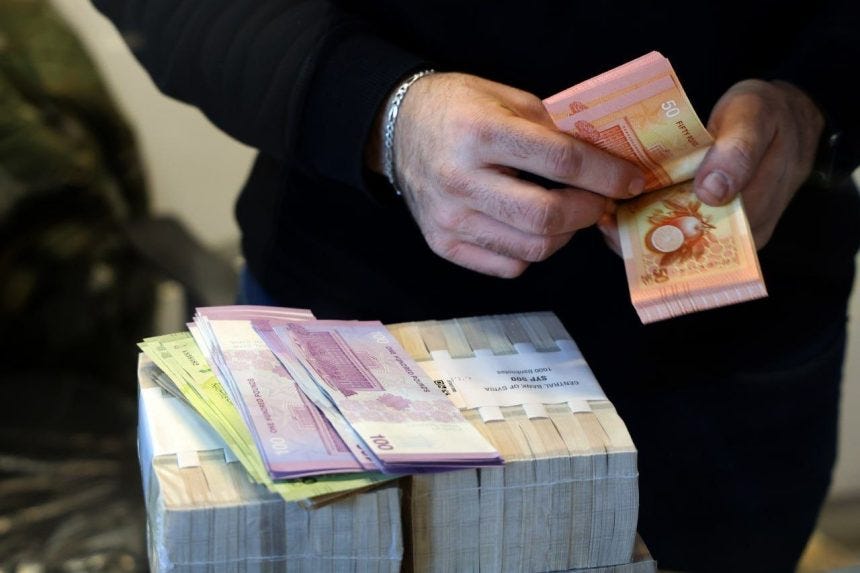
High on the Central Bank’s agenda, currency replacement remained a central policy priority throughout the month. On May 1, the Central Bank extended the exchange period for old banknotes until June 30, while Husrieh reported that 56% of the old monetary mass had already been replaced. By the end of May, Raslan extended the deadline again until July 30 and announced that replacement rates had exceeded 63% nationwide. Throughout the month, the Syrian pound traded at roughly SYP 13,500–14,000 per USD ((new) SYP 135-140) in the parallel market, remaining significantly weaker than the official exchange rate.
Why It Matters: The replacement of Abdulkader Husrieh with Safwat Raslan came at a sensitive moment for Syria’s monetary transition. Husrieh had overseen several key post-Assad initiatives, including the currency replacement process, the 2026–2030 strategy, and the Oliver Wyman gap assessment, and was at the forefront of efforts to reconnect Syria’s financial system with international institutions. Husrieh’s sudden reassignment, therefore, sends mixed signals, especially given the lack of public criticism against him: it may reflect an effort to bring in a younger, more implementation-oriented figure with experience in private banking, governance, and digital transformation, but it also raises questions about policy continuity and the degree of autonomy granted to the Central Bank, especially given reports of competing influence within the institution itself.
At the policy level, the new strategy broadly targets Syria’s main financial weaknesses: low confidence in the pound, a fragmented foreign-exchange market, weak banking intermediation, limited digital payments, and the need to reconnect with global financial channels. As for the currency replacement process, it shows progress, but the repeated extensions and the recent decision to reopen exchanges through exchange and transfer companies also suggest that the Central Bank is still adapting the rollout to administrative bottlenecks, weak banking coverage, and the realities of a cash-based economy. Reopening the process to exchange and transfer companies matters because bank-branch coverage remains uneven, especially outside major cities, while money-transfer networks have long been central to Syrian cash circulation.
Continue Reading the May 2026 Syria Monthly Economic Digest


Explore Previous Editions
Browse every edition of the Syria Monthly Economic Digest, featuring monthly analysis of Syria’s political economy, governance, reconstruction, and regional developments.
Never Miss an Issue
Receive the Syria Monthly Economic Digest, along with original research, expert interviews, and in-depth analysis on Syria’s political economy, governance, and reconstruction—delivered directly to your inbox.