
Syria Monthly Economic Digest - June 2026
Monetary stabilization, agricultural recovery, social unrest, and Syria's regional reintegration.
Welcome to the June 2026 edition of the Syria Monthly Economic Digest. Each month, we select the political and economic developments we think matter most for Syria’s transition, summarise what happened, and explain why it matters.
This is not meant to be an exhaustive news roundup. The aim is to track the developments that reveal where the country is heading — from reconstruction and investment to banking, energy, public services, regional connectivity, and the evolving relationship between the state and society.
This month’s digest covers seven developments across four broad themes: exchange-rate volatility and the redenomination process; agriculture, wheat procurement, and rural livelihoods; protests and service pressures in northeast Syria; and Syria’s accelerating reintegration into regional transport, aviation, and energy networks.
You can read more about The Syria Dispatch and the purpose of this publication at the end of the post. If you have comments, corrections, or suggestions, you can also find my contact details there and reach out directly.
In this month’s edition:
Exchange-Rate Volatility Tests Syria’s Redenomination Process
Stronger Agricultural Harvest Prospects Meet Fuel, Storage, and Marketing Bottlenecks
Qamishli Protests Erupt Over Fuel, Electricity, and Living Conditions
Deir Ezzor Redevelopment Push Accelerates Across Transport, Oil, Water, and Electricity
Türkiye, Saudi Arabia, Syria, and Jordan Advance Regional Transport Corridor Plans
Air Connectivity Expands as Syria Eyes Return to European Routes
Exchange-Rate Volatility Tests Syria’s Redenomination Process
June opened with renewed pressure on Syrian households’ purchasing power, as the Syrian pound continued to weaken during the first half of the month before partially recovering in the final week, while markets rapidly absorbed the effects of recently approved salary increases.
The executive instructions for implementing Presidential Decrees No. 67 and No. 68 of 2026, which added 50 percent to fixed salaries and wages, had barely been issued before price increases began eroding the raise. The increases, which take effect in June 2026, were poised to be diluted by exchange-rate volatility and precautionary pricing. However, the pound’s late-June rebound means the final dollar value of salaries depends on the exchange-rate benchmark used.
As prices of basic food and non-food items rose by up to 25 percent following the pound’s decline, some traders priced goods against a precautionary exchange rate of around (old) SYP 16,000 (new SYP 160) to the dollar to hedge for future inflation. This behavior reflected a broader breakdown in price visibility and led to a widening gap between official and black-market rates (see chart below).
In the final week of June, however, the Central Bank took active steps to narrow the gap between the official and black-market rates. On June 25, it raised the official dollar rate to (new) SYP 118.5 for buying and 119.5 for selling, the third official devaluation in less than two months. On June 28, the official rate was raised again to (new) SYP 121.5–122.5, while the parallel-market rate reportedly stood at around (new) SYP 128. This reduced the official-parallel gap to around 4.9 percent, while the Central Bank narrowed the permitted exchange-rate margin from 9 percent to 3 percent.
Still, volatility coincided with continued uncertainty around the currency replacement process. On June 1, Central Bank Governor Mohammed Safwat Raslan said more than 63% (then 66% on June 10) of the nationwide currency replacement process had been completed, and announced a 30-day extension, from July 1 to July 31, as a final opportunity for holders of old banknotes to exchange them. He also instructed banks, exchange companies, and money-transfer firms not to reintroduce old notes into circulation and to provide customers with only the new Syrian pound for withdrawals, exchanges, and cash payments. Raslan later clarified that the end of the exchange period through banks and exchange companies would not cancel citizens’ right to hand in old notes and receive new ones during a five-year withdrawal period, under mechanisms to be announced later.
It should be noted that implementation remained uneven, especially in northeast Syria, where Hasakah had effectively been outside the normal currency-replacement cycle due to the closure of public banks and the absence of functioning financial institutions in parts of the governorate, particularly amid the continued administrative division between Damascus and the SDF. The Central Bank moved to address this gap: on June 23, it designated 11 currency-replacement centers in Hasakah Governorate through al-Haram and Osoul exchange and transfer companies, distributed across Hasakah, Qamishli, Darbasiyah, and Amuda, with nine reportedly ready to receive citizens and two still under preparation. Two days later, the Central Bank branch in Raqqa resumed official operations for the first time since 2013, offering services including currency replacement and wheat-payment processing.
At the policy level, Raslan used the first National Conference for Dialogue with the Private Sector in early June to signal a more coordinated approach. He said the Central Bank’s next phase would rely on institutional work and planning rather than “improvised or unilateral decisions,” while acknowledging that the widening gap between official and market exchange rates affects investment decisions, depositor behavior, confidence in the financial market, banking activity, and the investment climate. The Central Bank Governor also mentioned that a study to develop Islamic financial products is forthcoming. (On Islamic finance, READ here)
Why It Matters: The exchange-rate movement fed directly into prices, but the more important issue is not only depreciation. It is volatility. A currency that weakens sharply, partially rebounds, and changes several times within the same day still undermines pricing, wage expectations, and market confidence.
In a volatile exchange-rate environment, traders price not only according to current costs but also in anticipation of future depreciation. The use of precautionary exchange rates is therefore both a response to inflation and a driver of it. It protects traders from replacement-cost risk, but it also transmits expectations of further depreciation into current prices. In this sense, the problem is not only that the pound lost value in the first half of June. It is that no single exchange-rate anchor was credible enough to guide transactions, contracts, salaries, or inventories.
The Central Bank’s late-June adjustments therefore represent a move towards defensive stabilization after months of seeming apathy in the face of the depreciating pound. By raising the official rate and narrowing the permitted margin, the Central Bank reduced (at least for now) the gap with the parallel market. It limited the space for arbitrage, speculation, and multiple pricing references. These decisions should help reduce the official-market gap, stabilize expectations, and protect government revenues priced against the official exchange rate. Still, this remains exchange-rate management, not yet a full monetary policy framework.
The redenomination process compounds this problem because the exercise is going well beyond a purely technical one. It has become a test of administrative capacity and public trust. The repeated extensions suggest that implementation has been slower and more uneven than planned due to weak logistical capacity at Central Bank branches and commercial banks, the continued appearance of old cash holdings in the market, concerns over excluding poorer and rural households, and possible shortages or distribution problems affecting the new notes.
Such limitations are especially important in northeast Syria, where Hasakah’s delayed access to replacement services revealed the territorial and institutional limits of monetary policy. If some governorates have better access to banks, exchange companies, and replacement centers than others, the redenomination can create uneven monetary conditions inside the same national economy. This risks deepening cash-market fragmentation, encouraging informal brokers, and weakening confidence in the state’s ability to administer a national currency. The subsequent designation of 11 replacement centers in Hasakah and the reopening of the Central Bank branch in Raqqa are therefore important corrective steps. Still, they also underscore how closely monetary stabilization is tied to the reintegration of state institutions across the country… and hint that redenomination might have been premature for this reason, at least.
Raslan’s emphasis on coordination with ministries, institutions, and the private sector is analytically significant for this reason. It implicitly acknowledges that the Central Bank cannot stabilize the currency through announcements alone. Exchange-rate policy, redenomination, banking access, fiscal management, customs, imports, wheat payments, salary increases, and market regulation interact. If coordination remains weak, each measure risks undermining the next: wage increases feed prices, currency replacement creates uncertainty, exchange-rate gaps encourage arbitrage, and traders hedge against future instability.
Stronger Agricultural Harvest Prospects Meet Fuel, Storage, and Marketing Bottlenecks
Key Developments: Syria’s 2026 wheat season entered June significantly stronger than in previous years, supported by improved rainfall and better crop conditions across several key producing areas. In Hasakah, the Syrian Grain Establishment (SGE) expected to receive 800,000 to 1 million tons of wheat, while preliminary estimates put total Jazira production at around 1.1–1.2 million tons. Aleppo expected a much stronger season than last year, with projected wheat production of around 571,000 tons and some estimates suggesting output could exceed 600,000 tons. The SGE prepared 20 collection centers across the Hasakah Governorate and said existing wheat stocks of 400,000–500,000 tons were being transferred to other governorates to free storage capacity for the new harvest. By June 30, Hasakah farmers had delivered 480,000 tons of wheat to government procurement centers, with the harvest nearing completion and official estimates still indicating that total provincial production would exceed 1.025 million tons.
The stronger harvest is already affecting import planning. The SGE said available wheat stocks were sufficient to meet basic ration needs and maintain stable bread and flour supplies, and that wheat imports would be temporarily paused this season pending the final harvest outcome.
However, the stronger harvest did not automatically translate into improved livelihoods for farmers or rural workers. In Raqqa, the harvest season created jobs in harvesting, transport, bagging, and grain collection centers, but rising unemployment and a larger pool of available workers pushed wages down. Workers also said weak rainfed yields in parts of the governorate reduced earnings for those paid by the quantity harvested or bagged, while local observers warned that exchange-rate volatility could erode farmers’ income once payments were made. Concerns were also raised that a potentially large injection of Syrian pounds into the market could put pressure on the exchange rate, further eroding the value of earnings (see “Exchange-Rate Volatility Tests Syria’s Redenomination Process”).
Payment uncertainty also persisted. By June 13, farmers’ grain dues had not yet begun to be paid, as the authorities were waiting for the Central Bank to transfer the required funds. Payments were still expected to be made through the Agricultural Cooperative Bank, as in the previous season.
To ease procurement bottlenecks, the government launched new administrative tools. The Ministry of Agriculture launched an electronic platform for farmers wishing to market their crops, allowing them to register and reserve delivery slots. The platform triggered pushback, however. On June 16, farmers in Tell Tamr (Hasakah) staged a sit-in in front of the Agriculture Directorate, arguing that weak rural internet access, delayed appointments, and the difficulty of using digital tools could slow wheat delivery and increase costs during a time-sensitive harvest season. In Hasakah, officials later announced measures to reduce congestion at collection centers, including accepting loose wheat in open storage areas, opening additional sites as needed, allowing wheat to be transported to other governorates at government expense, and exempting wheat trucks from axle-load penalties for loads up to 25 percent above the legal limit.
By late June, the authorities had expanded the number of receiving centers in Hasakah to around 30 after opening ten additional centers, while daily intake reportedly reached around 70,000 tons nationwide, including about 30,000 tons per day in Hasakah alone. Four new payment points were also announced in Hasakah, Qamishli, al-Malikiyah, and al-Darbasiyah, starting in early July, to reduce farmers’ travel burden and speed up invoice payments.
Still, farmers continued to raise concerns about agricultural inputs, especially fertilizers, fuel allocations, and diesel for harvesters and tractors, in addition to the need to announce strategic crop prices before the planting season. Fuel shortages, especially, remained one of the most immediate threats to the season. In rural Qamishli and Hasakah, diesel shortages and prices of up to (old) SYP 20,000 per liter halted many harvesters, leaving wheat fields at risk of grain loss and fires before the crop could be collected. These pressures overlapped with wider fuel protests in Hasakah Governorate and earlier official promises to send subsidized diesel to support farmers during the harvest season. This recent wave of protests also followed a wave of farmer protests in May 2026.
Why It Matters: The stronger 2026 harvest is good news, but it remains far from recovery. Improved rainfall has improved output prospects, yet farmers still struggle with structural challenges. While rainfall can account for better yields, farmers still rely on debt, expensive inputs, and trader/broker arrangements that can leave them selling crops below market value. This situation has led to the paradox described earlier, in which Syria may produce more wheat, yet many farmers may not feel significantly better off, as the aforementioned challenges quickly erode the benefits of a stronger harvest.
It is also worth noting that the government’s response shows how agriculture remains one of the most interventionist parts of Syria’s recovery. Despite broader rhetoric around liberalization, private investment, and a larger role for the market (recently toned down, however), Damascus remains deeply involved in wheat procurement, collection centers, payment channels, fuel allocations, crop pricing, marketing platforms, and now plans to establish an agricultural holding company. This is not surprising. Agriculture is tied to food security, rural employment, exports, and social stability, and the state cannot easily step back from a sector on which much of the country still depends. According to Agriculture Minister Basil al-Suwaidan, around 30 percent of Syria’s population relies, directly or indirectly, on agriculture for income and employment.
Still, the calculus is not necessarily a bad one, quite the contrary. Prioritizing agriculture, especially given Syria’s productive potential, could help ease several macroeconomic pressures at once. Wheat import requirements for the 2025/26 marketing year were forecast at around 3 million tons, nearly 70 percent above the five-year average, following two weak domestic production seasons. At recent global wheat prices of roughly USD 220 per ton, this implies an import bill in the high hundreds of millions of dollars. Reducing that bill through increased local production would not only support food security but also ease pressure on foreign-currency demand, the trade deficit, and, ultimately, the Syrian pound.
Qamishli Protests Erupt Over Fuel, Electricity, and Living Conditions
Key Developments: Qamishli witnessed a continuous wave of protests in late June that began with a retirees’ mobilization over delayed pensions and expanded into broader demonstrations over fuel prices, electricity shortages, public services, and deteriorating living conditions.
On June 20, dozens of retirees held a sit-in in front of the Social Insurance branch, demanding the payment of delayed pensions and faster processing of their files. The action was organized by the newly formed Retirees’ Solidarity Gathering (تجمع تكاتف المتقاعدين). The organization later announced its formal establishment, describing itself as an independent civic initiative open to all retirees in Hasakah Governorate, focused on addressing pension delays and low pension amounts, improving the work of the local Social Insurance branch, and demanding a dedicated health insurance law for retirees. Some retirees reported they had not received pensions for around a year, while others reported delays ranging from several months to a year and a half.
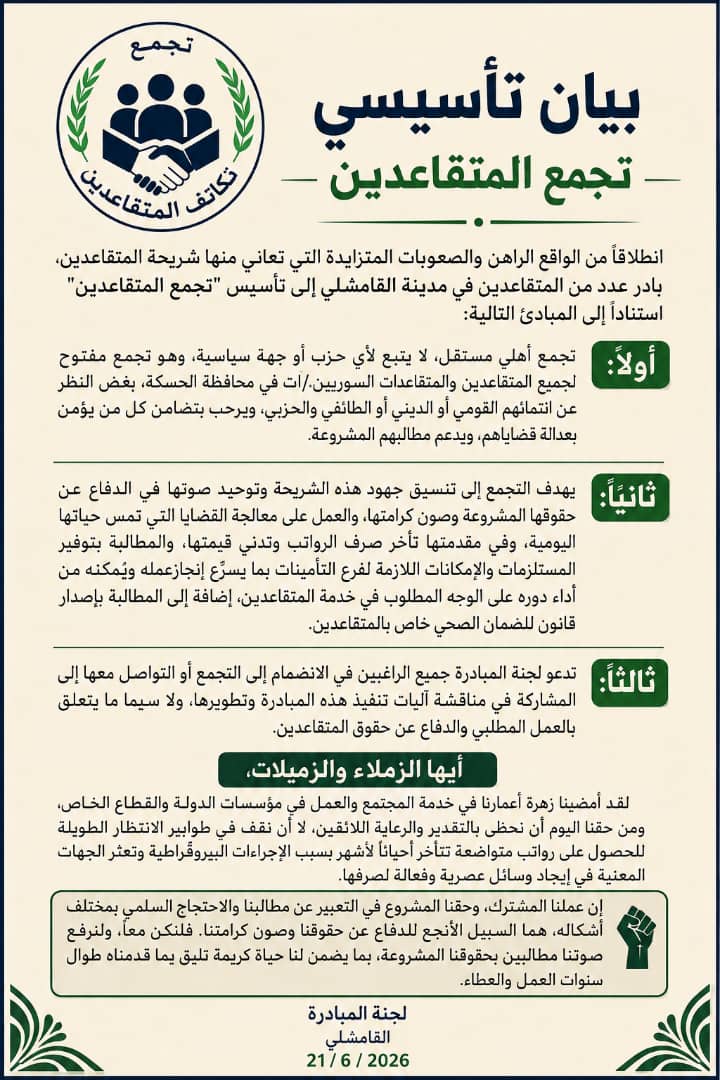
The following day, a new wave of protests was sparked after fuel prices rose and service allocations were reduced. On June 21, residents and shop owners blocked roads and burned tires in central Qamishli after diesel prices reportedly rose from 55 to 75 cents per liter. Fuel allocations for bakeries, generators, and transport were also cut by more than half, forcing many private generators to reduce hours or stop operating during a period of high summer temperatures. Protesters demanded lower fuel prices, a more stable electricity supply, improved public services, and action to contain the rising costs of bread, transport, and basic goods. The protests continued into a second and third day, expanding beyond fuel alone. On June 23, protesters continued to call for basic living needs to be secured, prices to be brought under control, and services to be improved and later chanting slogans such as “the people want better living conditions,” “protest against poverty and hunger,” “we will continue until prices are reduced,” and “our daily demands are bread, peace, and freedom.”
These protests were part of a broader pattern of growing popular anger in the Hasakah Governorate. More than 40 protest events were recorded across Hasakah Governorate between June 1 and June 28 alone. The demands varied, but most centered on delayed salaries and pensions, fuel and electricity shortages, rising prices, unemployment, poor services, and the release of detainees (see table below).
Earlier in the month, the authorities had already moved to contain similar fuel-related unrest in rural Hasakah. On June 10, Deputy Governor Ahmad al-Hilali said one million liters of subsidized diesel would be sent to the governorate, with priority given to the agricultural sector during the harvest season. Hilali also linked the accumulated service challenges to the ongoing process of completing institutional integration and fully reactivating state directorates in Hasakah.
Earlier protests in al-Hol, al-Shaddadi, Tell Brak, and Ghazila had already focused on the contradiction between Hasakah’s oil resources and its shortages of fuel, water, electricity, and jobs. In several areas, residents blocked roads used by oil tankers, arguing that local communities remained underserved despite the daily movement of fuel and oil through the governorate.
This contradiction also shaped the language of the Qamishli protest movement. In a statement read on behalf of protesters on June 25, participants described the Jazira as one of Syria’s richest regions in resources but among the poorest in services, framing their demands around cheap and clean bread, electricity, drinking water, security, and an end to corruption and the extraction of local wealth. The statement also rejected narrow party agendas, presenting the mobilization as a broader social and livelihood protest.
Back to fuel, the supply shock quickly spread to transport, agriculture, and daily commerce. The regular Qamishli-Damascus bus fare rose from (old) SYP 135,000 to 290,000, while business-class bus fares increased from (old) SYP 185,000 to 400,000, and the price of the Qamishli-Hasakah route also doubled. Subsidized transport gasoline rose from (old) SYP 450 (USD 0.30) to USD 0.55, prompting taxi and internal transport drivers to protest in front of the fuel committee (Sadcop) on June 23 and demand that the decision be reversed. The crisis also affected the wheat harvest, with fuel shortages and diesel prices of up to (old) SYP 20,000 (USD 0.7) per liter halting many harvesters in rural Qamishli and Hasakah, raising fears of crop losses and field fires.
The protests prompted at least a limited policy response. On June 23, Energy Minister Mohammad al-Bashir issued Decision No. 822 of 2026 forming a permanent committee to determine prices for petroleum products and mineral resources. The committee includes representatives from the Energy Ministry, Finance Ministry, Economy and Industry Ministry, Central Bank, and relevant oil and mineral-resource bodies, and is tasked with reviewing petroleum prices in light of global prices, costs, the exchange rate, subsidy mechanisms, and other indicators.
On June 27, the committee held an extraordinary meeting to review pricing, supply costs, operating costs, and local and global market conditions, and raised new recommendations to the Energy Ministry. It also recommended adopting the Syrian pound as the sole currency for pricing petroleum products, a step presented as an effort to unify pricing mechanisms and strengthen the use of the national currency in the fuel sector. Later that day, the Energy Ministry approved fuel-price reductions ranging from more than 14 to 20 percent: 95-octane gasoline was cut by 20.39 percent to (new) SYP 130 per liter, 90-octane gasoline by 19.97 percent to (new) SYP 125, diesel by 14.37 percent to (new) SYP 107, domestic gas cylinders by 15.49 percent to (new) SYP 1,500, and industrial gas cylinders by 15.49 percent to (new) SYP 2,400.
Why It Matters: Beyond the immediate backlash against the fuel-price increase, the Qamishli protests represent another stress test of the state’s attempt to reintegrate northeast Syria administratively, fiscally, and economically. Fuel was the immediate trigger, but the chronology of the protests points to a broader accumulation of grievances: delayed pensions and salaries, weak services, electricity cuts, wheat-marketing problems, unemployment, detainee files, and unclear institutional responsibility. In this sense, this month of protests encapsulates the terms on which Hasakah Governorate is being brought back into the national system.
While protest movements have emerged across the country, the Hasakah Governorate is especially sensitive because the northeast is moving from years of Autonomous Administration and SDF-linked governance toward a difficult handover to Damascus. The fuel issue illustrates the tension clearly: Damascus may be trying to unify prices, reduce distortions, and regularize supply, but residents experience this as the loss or weakening of previous support systems before reliable Damascus-based state services have arrived. In an area where generators substitute for public electricity, transport depends heavily on fuel availability, and many salaries or pensions are delayed, fuel pricing is not a narrow technical matter.
The protests also carried a strong distributive message linked to historic grievances. Hasakah is one of Syria’s most resource-rich governorates, yet residents repeatedly contrasted the movement of oil and fuel through the governorate with shortages of electricity, water, jobs, and basic services. Stability in the northeast will require significant support for and development of this region (see “Deir Ezzor Redevelopment Push Accelerates Across Transport, Oil, Water, and Electricity”).
Foreign Interest in Syria’s Oil and Gas Sector Accelerates
Key Developments: On June 10, Energy Minister Mohammad al-Bashir used the Global Energy Forum in Washington to present Syria as a potential regional energy hub linking the Gulf, Iraq, and the Eastern Mediterranean to regional and international markets. He cited cooperation with Chevron, ConocoPhillips, GE Vernova, and HKN Energy, as well as partnerships with TotalEnergies, Siemens, and Ansaldo Energia, and said that advanced discussions were also underway with Eni and other companies.
On June 16, the Syrian Petroleum Company signed a contract with ConocoPhillips and Novaterra to develop several gas fields and increase production from existing fields, with the stated aim of supporting the electricity sector and other vital sectors. The contract followed an earlier memorandum of understanding signed in November 2025 and was presented by Energy Minister Mohammad al-Bashir as a step toward raising domestic gas production, improving operational efficiency, and restoring confidence in Syria’s energy investment environment. Syria will receive a 56 percent share under the contract, with the two investing companies receiving 44 percent. The deal could increase daily gas output by around 4–5 million cubic meters within a year.
The same day, the SPC denied reports that Australia’s AXP Energy had entered Syria’s oil and gas sector or signed an agreement with the company. The denial followed AXP’s announcement that it had secured the right to earn up to 25 percent in an onshore Block 9 production-sharing contract in the Palmyra Basin through a farm-in arrangement. SPC said all official agreements and partnerships would be announced exclusively through its own channels and in accordance with the relevant legal and institutional frameworks.
Foreign interest also moved toward formal bidding. On June 18, SPC said it planned to launch an international bid round for four oil fields in Deir Ezzor in Mahash, Akissyah, East Khrata, and Qusaibeh, grouped as the “MAKK Area” (northwest of Shell’s former al-Furat Petroleum Company), with commercial bids due by July 19.
Offshore and midstream discussions also advanced. On June 23, SPC CEO Youssef Qiblawy met with a Chevron delegation to discuss converting the existing memorandum of understanding on offshore exploration in Block 1 into an executive contract. The meeting also covered the possibility of Chevron’s participation as a strategic partner in reviving the Kirkuk-Baniyas crude oil pipeline. On the same day, SPC discussed cooperation with UAE-based ENOC and Horizon Terminals to rehabilitate and develop pipelines and oil terminals.
Why It Matters: The June announcements further indicate that Syria’s energy sector is moving in a positive direction. Foreign companies are now beginning to move toward contracts, bid rounds, and more concrete discussions over upstream, offshore, and midstream assets.
Still, the announcements should be treated carefully. Signing a contract is not the same as implementation, and Syria’s oil and gas sector remains challenging: infrastructure is damaged, security risks persist, sanctions and compliance concerns have not entirely disappeared, banking channels remain weak, and the legal status of some legacy concessions remains unclear. The AXP Energy episode illustrates another issue: transparency, or the lack thereof. It raised basic questions about who owns what and how the new authorities will treat contracts or concessions originating under the Assad era. SPC’s denial was useful, but it also showed the need for clearer public rules on approval, disclosure, and contract validity.
There is also a governance issue. Oil and gas contracts concern strategic national assets, and attracting foreign companies may require generous fiscal terms, especially given Syria’s political, technical, and security risks. That may be understandable in the short term, but it increases the need for transparency and institutional oversight. Syria does not need to publish every commercial detail, but major energy contracts should be subject to some form of public or parliamentary scrutiny, clear procurement procedures, and reporting on revenue-sharing, investment obligations, production targets, environmental safeguards, and local employment. With these types of contracts, the issue is not simply who is in charge — whether a public, private, local, or foreign actor — but what terms were set. (Read: Syria Needs More Electricity. Does It Matter Who Builds It?). In that context, having international bidding rounds for various blocks and fields is a step in the right direction.
The local dimension will be just as important. Many of the assets under discussion are in or near eastern Syria, where communities have long viewed the oil and gas sector as extractive: resources leave the region while services, jobs, electricity, fuel, and water remain inadequate. The recent protests in Hasakah, including the blocking of oil trucks, show that this grievance remains politically salient (see this month’s entry on the Qamishli and Hasakah protests). Recent protests related to the closure of makeshift refineries are another wake-up call for the government not to overlook local populations. Reviving production in Deir Ezzor, Hasakah, or central Syria could support local recovery if it creates jobs, repairs infrastructure, and channels visible benefits back into producing regions. If not, energy investment could deepen social tensions… and those tensions are themselves bad for business. Recent moves by SPC to hire local workers, reinstate previously dismissed employees, and relocate parts of the upstream administration closer to Deir Ezzor suggest that the authorities have understood this risk. The same applies to the government’s wider emphasis on developing the eastern governorates.
Deir Ezzor Redevelopment Push Accelerates Across Transport, Oil, Water, and Electricity
Key Developments: Deir Ezzor saw a cluster of redevelopment announcements in June, focused on reconnecting the governorate, restoring basic services, and relocating parts of the oil-sector administration closer to production sites.
In transport infrastructure, Omar al-Hosari, head of the General Authority of Civil Aviation and Air Transport, said Deir Ezzor International Airport had entered the final stages of rehabilitation ahead of its reopening, with technical and operational readiness under review. The Ministry of Public Works and Housing also launched the reconstruction of al-Siyasiya Bridge, a key Euphrates crossing linking Deir Ezzor city with the northern countryside, with a planned implementation period of 12 months. The bridge’s destruction had forced residents to rely on ferries and temporary crossings, while recent flooding of the Euphrates further damaged makeshift routes.
The bridge project formed part of a wider transport rehabilitation package. On June 7, the Ministry of Transport discussed a plan worth more than USD 37 million to repair roads and bridges in Deir Ezzor, including USD 6.7 million for maintenance on the Deir Ezzor–Mayadin–Bukamal, Deir Ezzor–Hasakah, and Deir Ezzor–Raqqa axes, and around USD 30.5 million for strategic bridge and road projects. The package also includes the proposed Damascus–Palmyra–Deir Ezzor road, while the Finance Minister proposed building two new bridges in Deir Ezzor and Raqqa under modern engineering standards.
In oil and gas, the Syrian Petroleum Company reportedly decided to relocate a large part of the upstream exploration and production sector to Deir Ezzor, including a two-month deadline to move the main exploration and production center, rehabilitate administrative and logistical facilities, and base more engineers and technicians near the fields. The company also announced the hiring of 555 people from Deir Ezzor, including 400 security personnel, 70 engineers and technicians, and 85 field and support workers, as well as the reinstatement of 200 previously dismissed employees. Contractors were also instructed to prioritize local hiring.
READ: Protests Erupt over Closure of Makeshift Oil Refineries in Aleppo
Basic-service repairs and flood recovery continued in parallel. The Ministry of Energy carried out maintenance on the Euphrates water-conveyance project toward al-Sour, including concrete repairs to damaged sections of the channel, to sustain water delivery to nearby villages. On June 23, Deir Ezzor’s emergency response committee also formed a specialized committee to assess and compensate for damage from the recent rise in Euphrates water levels. The affected agricultural area was later reported at 22,678 dunums, up from an earlier estimate of 21,853 dunums, while 83 water stations had previously gone out of service. Electricity repairs also advanced, with the General Electricity Company announcing the rehabilitation of the 230 kV al-Taym transformer station, serving Deir Ezzor and the wider eastern region.
Why It Matters: Deir Ezzor has long sat at the center of Syria’s oil, gas, agriculture, and cross-border trade routes, but residents have often experienced that position less as an advantage than as a form of extraction. The governorate generated strategic resources while receiving limited local development, weak services, poor infrastructure, and few durable economic returns. The latest redevelopment announcements should therefore be read against this background: they respond to one of eastern Syria’s oldest grievances, namely the gap between Deir Ezzor’s national importance and the conditions in which many of its residents live.
The oil-sector decisions are especially noteworthy. Relocating part of the upstream administration and technical staff closer to Deir Ezzor’s fields would partially reverse a long-standing pattern in which the governorate hosted the resources while decision-making remained concentrated elsewhere. If implemented, this could localize jobs, improve technical oversight, and make the province feel less like a peripheral extraction zone. SPC’s decision also speaks to a sensitive social file, especially after earlier protests over the closure of informal refineries and the livelihoods tied to the local oil economy.
Beyond the oil sector, projects open for investment on the Syrian Investment Agency’s (SIA) website (see table below) point in the same direction, presenting Deir Ezzor not only as an oil province but as a broader redevelopment frontier. The listed opportunities span agriculture, livestock, hospitals, logistics, rail, energy, airport services, real estate, agro-industry, and mineral resources, with a headline value above USD 6 billion as of late June 2026. Still, the list is analytically useful because it shows the government trying to recast Deir Ezzor from an extraction zone into a recovery corridor linking oil, agriculture, services, industry, and trade with Iraq.
Overall, redevelopment in Deir Ezzor cannot be separated from reintegration and stabilization. Repairing bridges, restoring water and electricity, reopening the airport, compensating flood-affected farmers, and offering credible employment in the oil sector are all part of rebuilding state legitimacy in a region long associated with neglect, extraction, ISIS rule, SDF control, displacement, and fragmented authority. Moreover, if these projects improve daily life, they could reduce the appeal of armed groups, smuggling networks, and informal economies. If they remain symbolic or are captured by contractors and central institutions, they could reinforce the same resentment they are meant to address.
Türkiye, Saudi Arabia, Syria, and Jordan Advance Regional Transport Corridor Plans
Key Developments: Türkiye and Saudi Arabia moved to advance plans for a regional railway and logistics corridor linking Türkiye to the Gulf through Syria and Jordan. On June 9, Turkish Transport and Infrastructure Minister Abdulkadir Uraloğlu and Saudi Transport Minister Saleh bin Nasser al-Jasser signed two memoranda of understanding on logistics services and railway cooperation, covering logistics centers, infrastructure, technology, training, and technical exchange.
Uraloğlu said Türkiye and Saudi Arabia aim to build a railway linking the two countries through Jordan and Syria within three to four years, with other Gulf states potentially joining later. He said the Saudi route to the Jordanian border is already complete, while Türkiye has completed links from Islahiye to Kilis and Gaziantep near the Syrian border. The remaining gap is around 400 km between Syria and Jordan. He also said the plan includes around USD 100 million to rebuild the rail route between Türkiye and Aleppo, creating a direct link to Damascus.
The agreement builds on earlier Syria–Jordan–Türkiye transport talks. In April, the three countries signed a trilateral memorandum in Amman to develop road, maritime, and rail connectivity, simplify border procedures, and coordinate transit movement. The new Saudi-Turkish track gives the project a broader regional frame, linking it more directly to Gulf markets and to the possible revival of north-south rail connectivity through Syria.
The railway talks coincided with a broader push for Syria–Türkiye economic integration. At the Anadolu City Economies Summit in Gaziantep, Turkish Trade Minister Ömer Bolat said bilateral trade is expected to reach USD 5 billion within two years and USD 10 billion by the early 2030s. Turkish officials also said they were ready to open the Islahiye customs gate and the Nusaybin-Qamishli crossing, while Turkish banks had reportedly reached an agreement to open branches in Syria pending central bank talks.
Why It Matters: Better rail and logistics integration with Türkiye and the Gulf would be positive for Syria in principle. In theory and in practice, lower transport costs, faster border crossings, and more reliable corridors should support trade, reconstruction supply chains, exports, and Syria’s broader ambition to become useful again as a transit country. The Saudi-Turkish framing is important because it moves the project beyond bilateral Syria–Türkiye connectivity and places Syria inside a wider north-south corridor linking Europe, Türkiye, Jordan, Saudi Arabia, and potentially other Gulf markets. This gives the proposal a stronger regional anchor and greater credibility.
But the railway plan still has many moving parts. A Syria–Türkiye rail link is probably the easier piece, especially if the priority is to rehabilitate the line toward Aleppo and reconnect it to Damascus. The harder part is the southern connection through Jordan. One of the many technical challenges is that the historic Hejaz line was built on a 1,050 mm narrow gauge, while Türkiye’s main network and most of Syria’s later railways use the 1,435 mm standard gauge. This means a modern freight corridor cannot simply be “revived” as a heritage route, but would require decisions on reconstruction standards, gauge conversion, transshipment points, rolling stock, financing, border procedures, and operating rights.
The corridor also has a political economy problem. Integration with Türkiye can help Syria restore trade, banking links, industrial inputs, and reconstruction supply chains, but it also risks reinforcing an already imbalanced trade relationship. Turkish exports to Syria reached about USD 3.5 billion in 2025, while Syrian exports to Türkiye fell to around USD 235 million. Syrian producers and economists have already warned that cheaper Turkish goods are putting pressure on local manufacturers and the trade balance. Better logistics could therefore lower costs for consumers and traders, but also intensify competition for Syrian industry if not paired with a clearer industrial policy.
Air Connectivity Expands as Syria Eyes Return to European Routes
Key Developments: Syria’s air connectivity continued to expand with several European routes announced or under negotiation. On June 25, Syrian Arab Airlines said it would launch direct Damascus-Amsterdam flights on July 2, marking its first return to Western European operations since EU measures introduced in October 2012 barred it from EU airports and from EU individuals and entities working with the carrier. The Syrian Aviation Holding Company said the route followed technical, legal, and diplomatic work aimed at restoring the national carrier’s European presence, while Omar al-Hosari, head of the General Authority of Civil Aviation and Air Transport, described Amsterdam as the first step in a broader expansion plan.
However, the operational structure of the route appears more complex than the initial announcement suggested. Dutch aviation media reported that tickets had gone on sale for Amsterdam-Damascus flights under Syrian Airlines flight numbers, with services scheduled on Mondays, Thursdays, and Saturdays. Schiphol Airport’s own flight information page listed flight RB271 from Amsterdam to Damascus, while the aircraft details for the July 2 flight showed an Airbus A320 registered LY-MAU. Flight-tracking and fleet data identify LY-MAU as an Airbus A320 operated by Lithuania’s Heston Airlines, an EU-based aircraft, crew, maintenance and insurance (ACMI) and charter carrier. This suggests that the route is being marketed under Syrian Airlines’ RB flight numbers but operated by Heston Airlines’ aircraft, rather than by Syrian Airlines’ own fleet.
Germany could follow the Netherlands, although approvals remain pending. Reports that Sundair planned to begin twice-weekly Berlin-Damascus flights from August 1 prompted the Syrian Civil Aviation and Air Transport Authority to clarify that no final operational approval had yet been granted. The authority said the route still depends on regulatory and operational approvals from the German side, as well as the completion of technical procedures, while Hosari said a final German decision was expected in the first half of July.
Aleppo also gained a new European connection. On June 19, Romania’s Dan Air announced it would begin direct scheduled flights from Bucharest to Aleppo starting July 1, adding to its existing Bucharest-Damascus service. Dan Air said it had carried more than 30,000 passengers between Bucharest and Damascus during its first year of operations in Syria, with an average load factor of 88 percent, and that it would become the only EU carrier operating scheduled flights to both Damascus and Aleppo.
These route announcements come amid a broader rebound in the use of Syrian airspace. Some 11,801 flights crossed Syrian airspace in May, more than double February’s level and around 375 percent higher than in May 2025, as regional airlines rerouted around disrupted airspace elsewhere in the Middle East.
Why It Matters: The Amsterdam route remains symbolically important, but its operational structure should be interpreted with caution. Operations by Heston Airlines under an ACMI or wet-lease-style arrangement do not necessarily mean that Syrian Airlines itself has regained full operational access to the EU market.
This distinction matters for regulatory reasons. Under EASA rules, any third-country operator intending to conduct commercial air transport into, within, or out of the EU and EFTA area must hold a Third Country Operator (TCO) authorization. EASA confirmed with The Syria Dispatch on June 26 that, as of that date, no Syrian operator held such an authorization. It also clarified that one-off notification flights are limited to humanitarian or ambulance flights in the public interest and cannot be used as a workaround for regular commercial service. As of July 2, 2026, no Syrian air carrier appears among the TCO-licensed carriers. An EU carrier such as Heston does not face that same TCO requirement when operating under its own European approvals, although the route would still require the relevant national permits, Syrian approvals, airport procedures, insurance, and security arrangements.
The Heston structure therefore makes the Amsterdam route more plausible but provides less definitive evidence of Syrian Airlines’ full return to Europe as an operator. It is closer to a commercial and diplomatic reopening than a complete regulatory normalization of Syrian civil aviation. Still, the arrangement also shows how Syria’s aviation reintegration may proceed in stages. European carriers, charter operators, and ACMI providers can reconnect Syrian airports to Europe before Syrian operators themselves clear all safety, regulatory, and insurance hurdles. That could help meet immediate demand from the Syrian diaspora, family travelers, business visitors, and possibly return-related travel, while buying time for Syrian aviation authorities and airlines to rebuild compliance capacity.
Still, the risks have not disappeared. European countries can, however, impose national restrictions, something which appears to be the current impediment to Sundair’s Berlin-Damascus route. Added to this is EASA’s wider conflict-zone guidance, which may further restrain flights to Syria. Indeed, EASA’s Syria conflict-zone bulletin, revised on May 12 and valid until October 31, continues to advise operators not to use Syrian airspace because of military activity, fragmented airspace control, air-defense risks, Israeli strikes, drones, rockets, and MANPADS.
Such guidance may also affect insurance costs. While Syria-specific premium data are not publicly available, war-risk coverage has become more expensive for some Middle East operations, and insurers are likely to approach Syria with caution given the security environment, residual compliance risks, and airport security concerns.
Demand is unlikely to be the main obstacle. Direct flights would serve Syria’s large diaspora in Europe, facilitate family travel and business links, and potentially support voluntary refugee returns, a priority for several European governments. This gives the Amsterdam route political significance, especially after the June 24 Dutch visit to Damascus, where migration, reconstruction, and refugee returns were reportedly discussed.
About the Syria Monthly Economic Digest
The Syria Monthly Economic Digest is a monthly publication by The Syria Dispatch that tracks the political and economic developments shaping Syria’s transition.
Each edition selects the developments I consider most significant over the past month; not every headline, but the ones that reveal something important about where the country is heading. These may include policy decisions, investment announcements, energy and infrastructure developments, banking and monetary reforms, trade and reconstruction dynamics, property rights disputes, public service issues, and the evolving relationship among the Syrian state, society, and external actors.
The format is simple: each entry begins with a news summary explaining what happened, followed by a “Why It Matters” section offering additional information, context, and analysis.
The digest is written for readers who want a structured, analytical overview of Syria’s transition: policymakers, researchers, journalists, diplomats, development practitioners, investors, civil society actors, and anyone trying to follow the country’s economic and political trajectory.
It is not intended to be exhaustive, and it does not replace daily news monitoring. Instead, it offers a monthly snapshot of the issues I believe deserve closer attention.
For comments, corrections, suggestions, or collaboration inquiries, please feel free to reach out.