

When Bashar al-Assad’s government collapsed in December 2024, the EU had no defined playbook. For more than a decade, Syria had been managed almost entirely through sanctions, humanitarian aid, and the EU’s own absence. A country that the Union funded heavily but engaged with barely at all as a political actor. There was no dormant strategy sitting in a drawer in Brussels waiting to be dusted off. What followed instead was something closer to improvisation under pressure: fast, often impressive, but built without the strategic scaffolding that a genuine re-engagement requires.
That’s the subject of my chapter in EuroMeSCo’s new Policy Study, “The Return of Syria to the Euro-Mediterranean Cooperation Arena,” coordinated by Reem Turkmani (LSE) alongside contributions from Julien Barnes-Dacey (ECFR), Rabha Seif Allam (ACPSS), and Ammar Kahf (Omran Center). My chapter, “From Containment to Re-engagement: The EU’s Evolving Approach to Syria after 2024,” is based on desk research plus a round of interviews conducted between March and April 2026 with EU officials, member state representatives, and Syrian public officials.
Brussels Moved Fast on Syria. Now Comes the Hard Part.
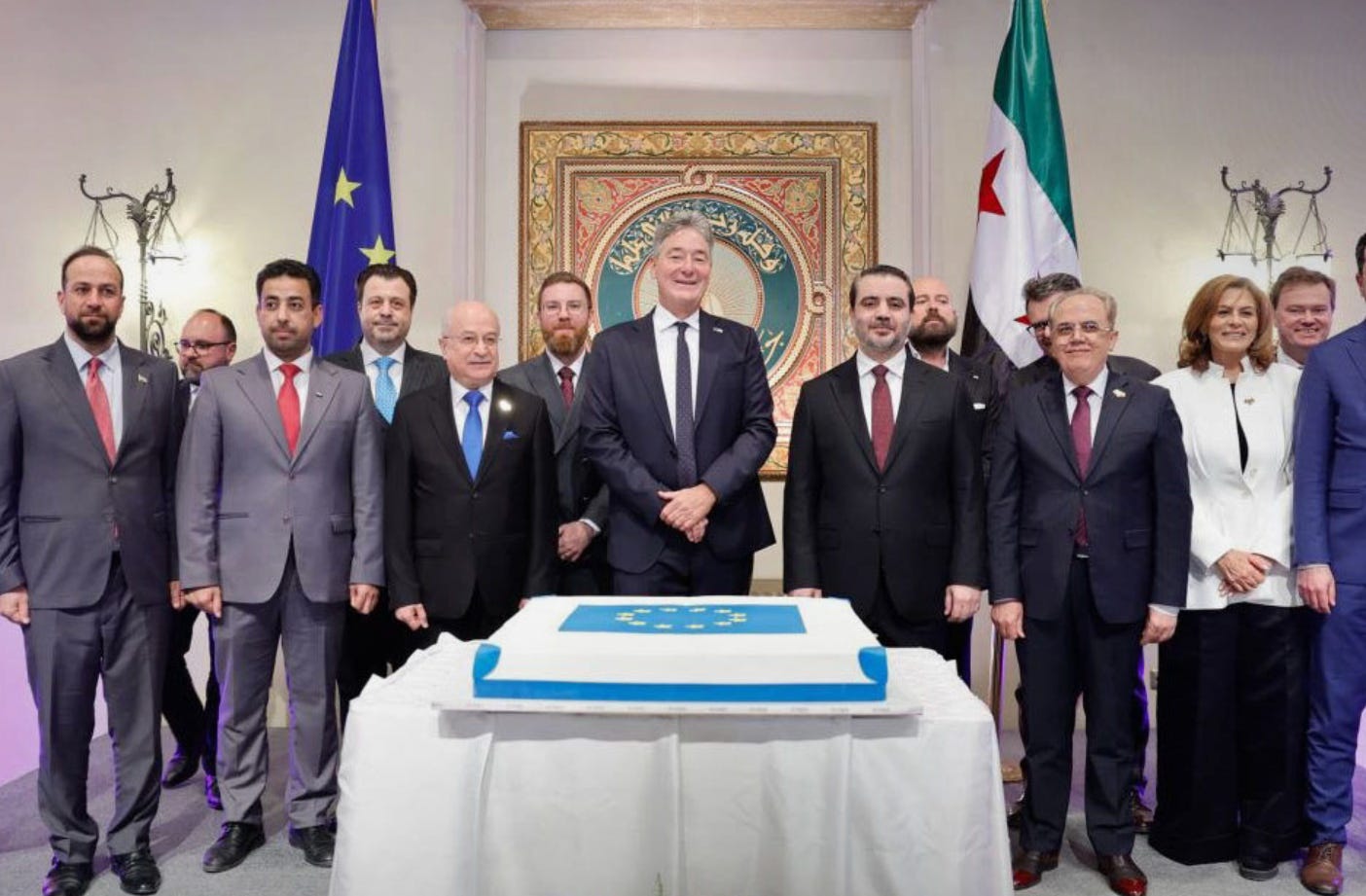
It’s worth stating plainly, because it often gets lost in critique: the EU moved quickly. Within days of Assad’s fall, the High Representative was calling it a “historic moment.” Sanctions on key economic sectors were suspended by February 2025 and fully lifted by May, a five-month turnaround on the EU’s most consequential Syria policy instrument of the past decade. High-level visits resumed almost immediately. The Syria Partnership Coordination Forum was launched in March 2025. A Technical Assistance Hub was agreed to help Syrian ministries navigate EU procedures. By May 2026, the two sides had held their first High-Level Political Dialogue in over fifteen years.
For an institution not exactly known for agility, this was a genuine demonstration of capacity for rapid political repositioning.
The problem is what sits underneath that diplomatic momentum, or rather, what doesn’t. My chapter argues that EU engagement remains instrument-driven rather than strategy-led. There is still no Multi-Annual Indicative Programme for Syria, the basic planning document that anchors EU cooperation with every other country in its neighbourhood. Without it, all EU funding continues to flow through ad hoc annual Special Measures, decided in Brussels rather than negotiated (but still implemented in coordination) with Syrian counterparts.
Then comes the issue of funding. Total EU allocations for Syria across 2025 came to roughly €425 million, a serious sum, but modest against reconstruction costs the World Bank now puts at $216 billion, close to ten times Syria’s projected GDP. More concerning is the trajectory: the provisional 2026-2027 package works out to about €310 million a year, a 26% drop from 2025 levels, with humanitarian funding falling even faster. At the exact moment Syria needs sustained, predictable support, the EU’s own numbers point toward contraction.
Then there are the operational bottlenecks that don’t show up in press releases: procedures that remain complex and risk-averse even when funds are available; a still-limited (…at the time of writing but now incrased) in-country footprint relative to the scale of what’s being asked of the Delegation; and an EU system split across DG ECHO, DG MENA, the Foreign Policy Instruments, the EEAS, and 27 member states pursuing their own bilateral tracks in parallel, sometimes to good effect, but rarely as a coherent whole.
The chapter is careful not to place the burden solely on the EU side. Syria’s institutions are themselves still being built in real time: centralised decision-making running largely through the Ministry of Foreign Affairs, frequent turnover among interlocutors, and administrative capacity that simply has not caught up with the pace of political change. Syrian authorities, for their part, have sometimes prioritised the visibility of high-level meetings over the harder, less photogenic work of turning partnership language into sequenced, bankable projects. This is also understandable given the nature of reconstruction needs, but still. Both sides, in other words, are still learning how to do this after more than a decade in which neither had much practice.
None of this is presented as failure. It’s presented as (hopefully) an accurate diagnosis of a genuinely difficult transition, and the chapter closes with a set of practical recommendations rather than a call for a grand new strategy document: clarify direction by using existing coordination platforms (the Partnership Coordination Forum, the High-Level Dialogue, and eventually the dormant 1978 Cooperation Agreement) more systematically; strengthen the EU’s operational presence on the ground so that commitments can actually be delivered; and begin the gradual shift from humanitarian and stabilisation instruments toward the tools of real economic reintegration (trade facilitation, regulatory cooperation, support for productive sectors) that Syria will need far more than it needs another donor conference.
The core argument, in short: the EU has shown it can move fast when the politics allow it. The open question, the one the rest of this transition will answer, is whether it can convert that reactive flexibility into something durable enough to outlast the initial momentum. At the same time, the question is also whether the Syrian authorities will treat this as a serious long-term partnership rather than a series of visibility wins. The EU can only move as fast as its own institutions allow; Syria’s institutions need to continue to show that they want to move.
Note: Due to the nature of academic work, this piece was submitted in mid-May 2026 but published on July 31, which, given the rapid pace of change in Syria, means some details may no longer reflect the current situation. Readers should treat the analysis as a snapshot of that moment rather than a fully up-to-date account.
The full Policy Study includes chapters on security and civil peace (Rabha Seif Allam and Ammar Kahf) and on the strategic case for a deeper Europe-Syria partnership (Julien Barnes-Dacey).


