

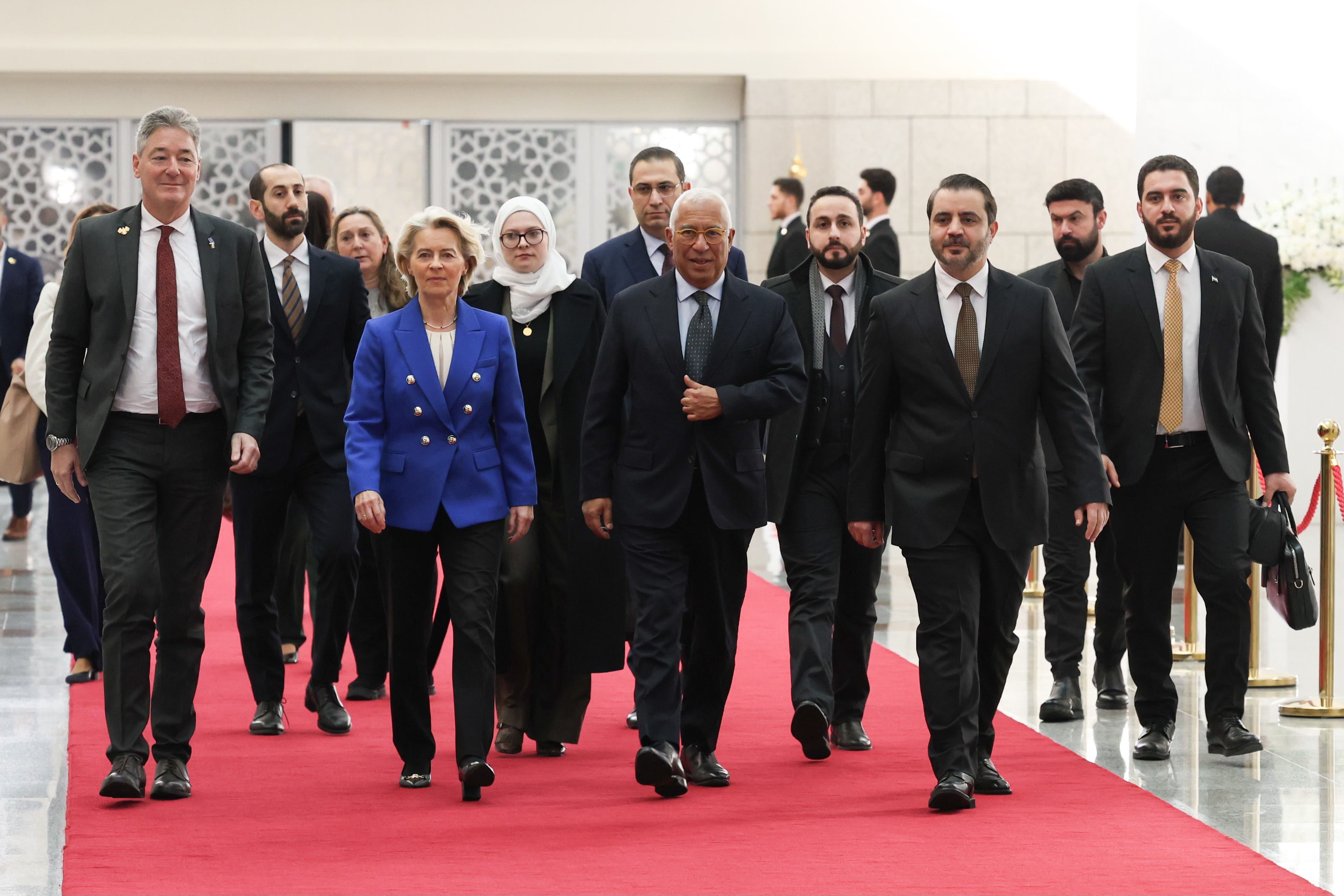
A European delegation sent to Syria to prepare a new development financing package came back with a blunt diagnosis. Funds were available, sectors had been identified, and political willingness existed on both sides. Yet implementation was slow. European procedures were difficult to navigate. Coordination between Syrian planning bodies and implementing agencies was weak. And European instruments struggled to compete with other partners offering cheaper, simpler, and faster financing.
This assessment was not made in 2026. It dates back to 1982. But that is precisely the point: it reads as though it could have been written today. As Europe re-engages with Syria through recovery support, technical assistance, institutional capacity-building, and renewed cooperation frameworks, an old problem is returning. The extent of the European Union’s (EU) willingness to provide support is not the issue. What remains to be understood, however, is whether its instruments can be understood, absorbed, used, and accepted inside Syria’s rebuilding state.
An Old Lesson from the 1980s
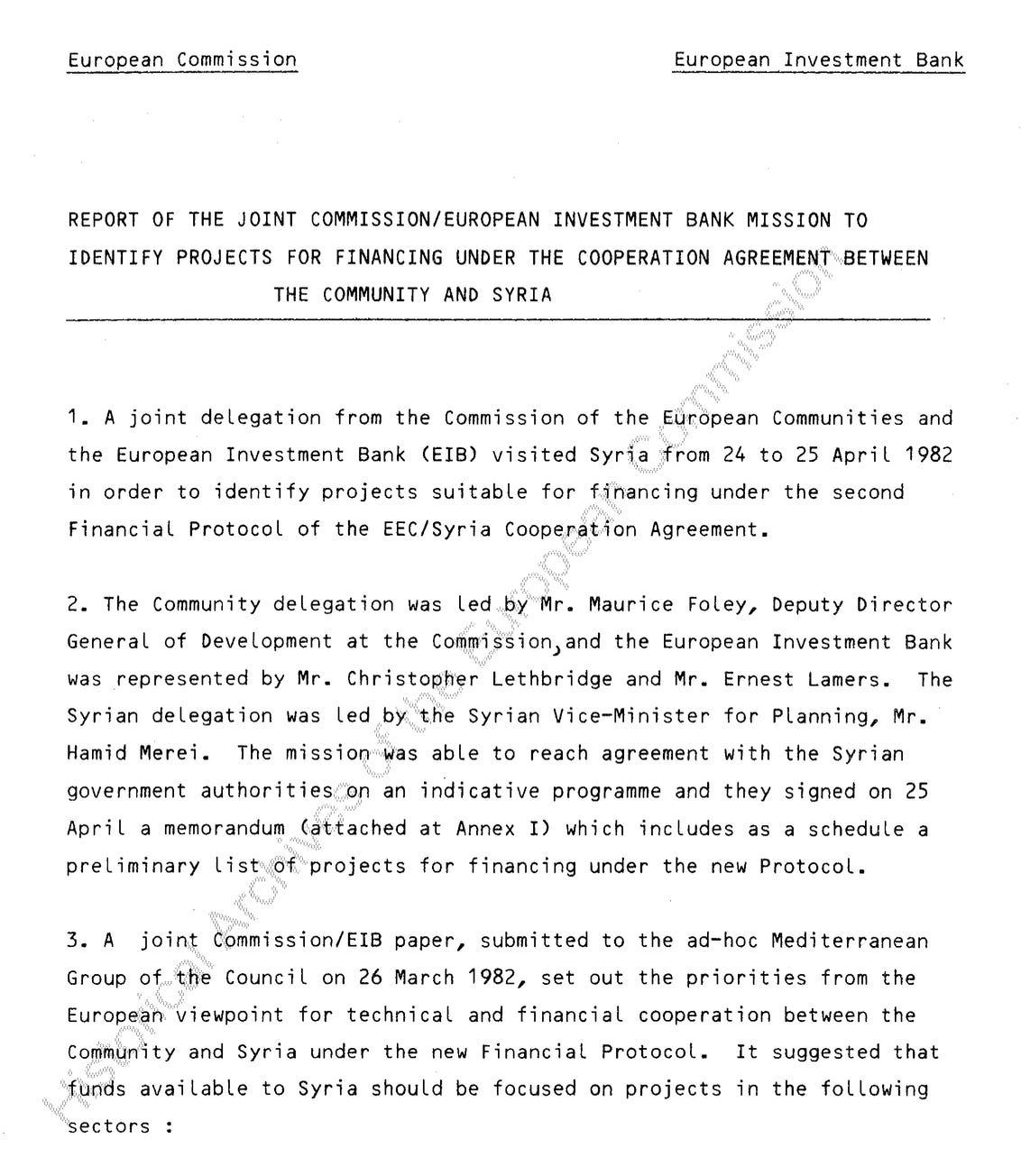
In late April 1982, a joint delegation from the European Commission (EC) and the European Investment Bank (EIB) visited Syria to prepare the second financial protocol under the EEC-Syria cooperation framework. The exercise was classic European development cooperation: identifying sectors, appraising projects, defining indicative allocations, and matching financing instruments to national priorities. Agriculture, irrigation, energy, sewerage, education, telecommunications, and technical assistance all featured prominently. But the same archival record also captured something else.

Even when political willingness existed on both sides, implementation lagged. According to the European mission’s report, by mid-1982, only 20.3% of the grant element of the first financial protocol had actually been disbursed, while EIB loans remained effectively unused.1 Among the reasons, the joint delegation listed Damascus’ weak familiarity with Community procedures, poor coordination between Syrian planning bodies and implementing agencies, and a preference for cheaper or easier financing available elsewhere, such as from the Eastern Bloc (see screen captures below).
These three limitations remain relevant today, nearly half a century later.
As a result, there is a risk that Europeans may once again design instruments that are formally generous but practically difficult for Syria to absorb. The problem is therefore not only financial (Europeans can mobilize huge sums of money) but rather administrative, institutional, and competitive.
The EU has lifted most economic sanctions on Syria while retaining security- and Assad-regime-related measures, and has announced financial support of around €620 million for 2026 and 2027, including humanitarian aid, early recovery support, and bilateral support. Politically, the EU is also moving in the right direction, as shown by the organization of the EU-Syria High-Level Political Dialogue and the full restoration of the EU-Syria Cooperation Agreement.
On this latter point (and though nobody expected anything else), it can be considered that Europe is not reinventing the wheel by building a new relationship with Syria; it is reactivating an older institutional framework… whose tools were already marked by uneven implementation. Given this context, the question today is whether European support can be operationalized under the current conditions to avoid previous pitfalls.
Damascus and the European Learning Curve
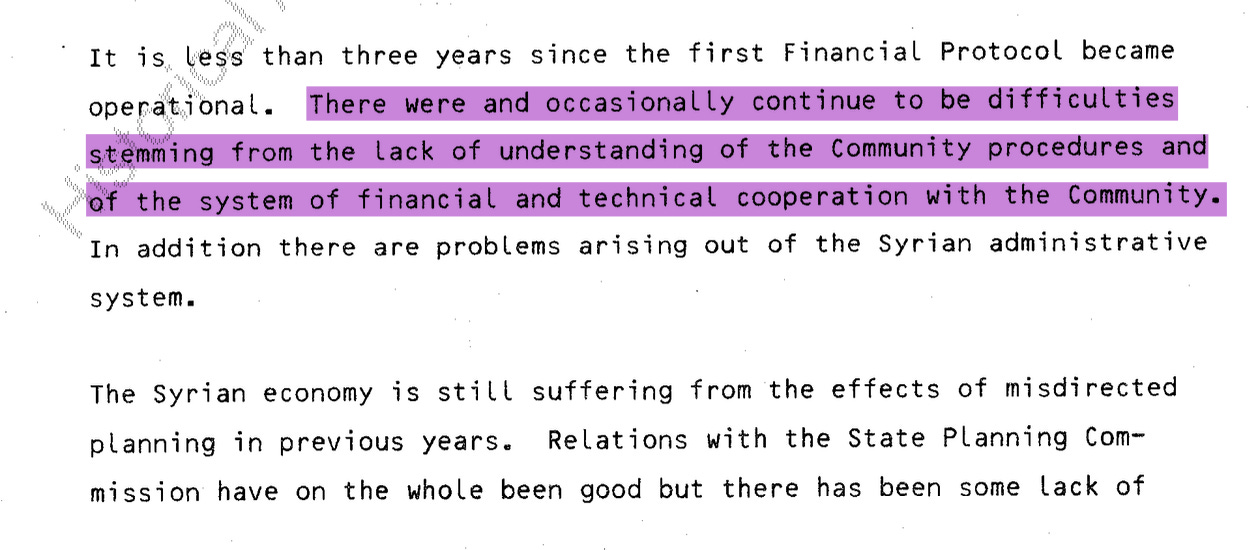
One of the less visible obstacles to EU-Syria cooperation concerns a simple but consequential issue: understanding how European support actually works.
European engagement is often discussed in terms of headline figures, funding envelopes, and political commitments. Yet behind these announcements lies a complex architecture of institutions, instruments, procedures, and funding channels that is not always easy to navigate, even for specialists. European officials acknowledged that EU mechanisms can be difficult to understand from the outside, particularly when different Directorates-General, implementing partners, financing instruments, and decision-making processes operate simultaneously.
This complexity shapes how support is received and absorbed. One EU official recalled that Syrian counterparts frequently referred to the often-cited figure of EUR 37 billion in European support to Syria and the region since 2011 (now EUR 38 billion), yet struggled to understand where this money had gone, through which channels it had been disbursed, and what portion had actually reached activities inside Syria. Explaining the architecture behind the figure reportedly proved difficult even for European officials themselves.2
The challenge is amplified by the current state of Syrian institutions. Following the collapse of the Assad regime, ministries have undergone extensive restructuring; responsibilities remain fluid; staff turnover is high; and many officials are encountering European institutions for the first time. European officials described a situation in which ministries are simultaneously attempting to rebuild internal administrative systems and learn to engage with a complex external donor ecosystem.

That complexity matters more than it may initially appear. European instruments are often presented as self-explanatory: grants, technical assistance, institutional support, trade facilitation, and de-risking mechanisms. In practice, however, none of these are automatically legible from the Syrian side, especially at a moment when the state itself is being rebuilt, responsibilities remain fluid, and technical capacity remains uneven across ministries and agencies.
The issue extends beyond financing. Discussions surrounding trade illustrate a similar pattern. A Syrian official at the Ministry of Economy and Foreign Trade expressed strong interest in expanding access to European markets, including the possible reactivation of trade provisions in existing agreements (prior to the EU-Syria Cooperation Agreement's reactivation). Yet Syria appears to make only limited use of certain preferential trade arrangements already available through European schemes. This suggests that the challenge may not always lie in the absence of instruments, but sometimes in awareness, technical understanding, or the administrative capacity required to use them effectively.
In such a context, slow uptake does not necessarily signal unwillingness. It can also reflect unfamiliarity, fragmentation, institutional transition, or simple administrative overload. The historical record from the early 1980s already pointed to this dynamic. More than four decades later, the risk appears not to have disappeared. The challenge facing European policymakers is therefore not only to mobilize resources, but also to ensure that Syrian institutions are capable of identifying, understanding, accessing, and ultimately absorbing them.
The Coordination Problem
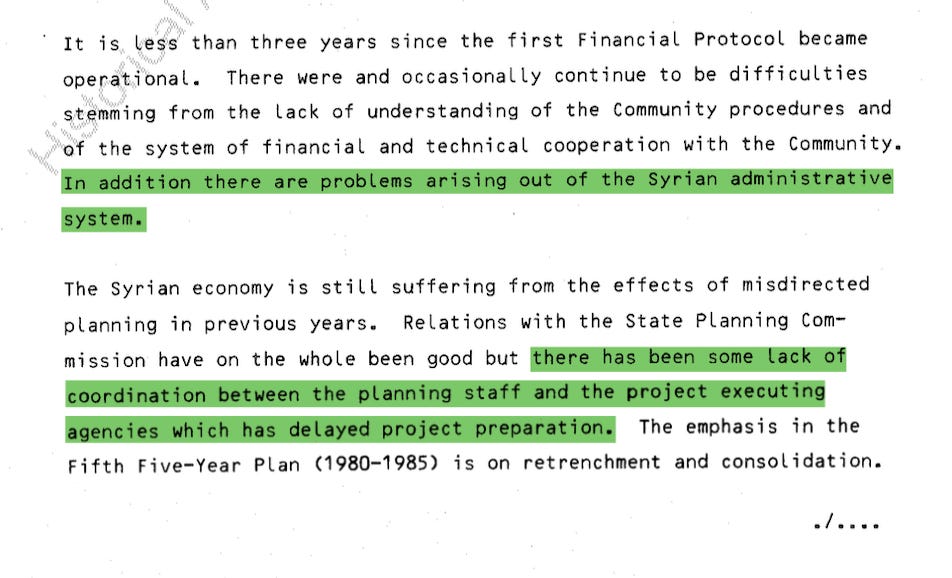
The second limitation concerning coordination between central planning bodies and implementing agencies also remains real today. Here too, the historical parallel is striking. But the problem today is not simply that coordination is absent. In some respects, there may be too much coordination at the center and too little operational ownership further down the chain.
The current system is built around an external engagement model routed through the Ministry of Foreign Affairs, even when projects concern sectoral ministries. Requests to meet with line ministries, discuss technical cooperation, or move forward on specific projects often must be cleared through MOFA first. Mission agendas in Syria often end up being lists of meetings “to be confirmed” until the last moment, with appointments shifting during the visit itself.3 And even when engagement concerns local or sectoral institutions, proposals are repeatedly sent back through MOFA, making the process “hyper long.”4
This centralization is partly understandable. The new authorities face a crowded field of foreign governments, donors, agencies, consultants, and companies seeking access to Syrian institutions. From Damascus’ perspective, some filtering is necessary. But central control does not automatically produce effective coordination. If every sectoral discussion must return to the same political channel, the result can be delay, duplication, and weak ministry-level ownership.
The risk is that planning and implementation become separated. MOFA may control the external interface, but it is not necessarily the institution best placed to define priorities in health, agriculture, public finance, trade facilitation, electricity, or social protection. Coordination can be controlled centrally, but sectoral content still needs to come from the relevant ministries.5 Without that division of labor, European support may be politically approved without being technically prepared.
This matters because EU instruments require prepared counterparts. Financing, technical assistance, trade facilitation, and possible future EIB engagement all depend on project pipelines, data, ministry-level planning capacity, and stable interlocutors. Yet, staff turnover, weak administrative capacity, fragmented authority, and the absence of reliable planning data on the Syrian side are obstacles to implementation.6
In this sense, the current coordination problem is not identical to that of the early 1980s, but it rhymes with it. Then, European officials worried about weak coordination between Syrian planning bodies and implementing agencies. Today, the danger is that centralized political control may again slow the translation of priorities into executable projects. For European support to be absorbed, Syria does not only need a central point of contact. It also needs empowered ministries, clear project ownership, and a functional chain between planning, approval, and implementation.
Aid Is Also Competitive
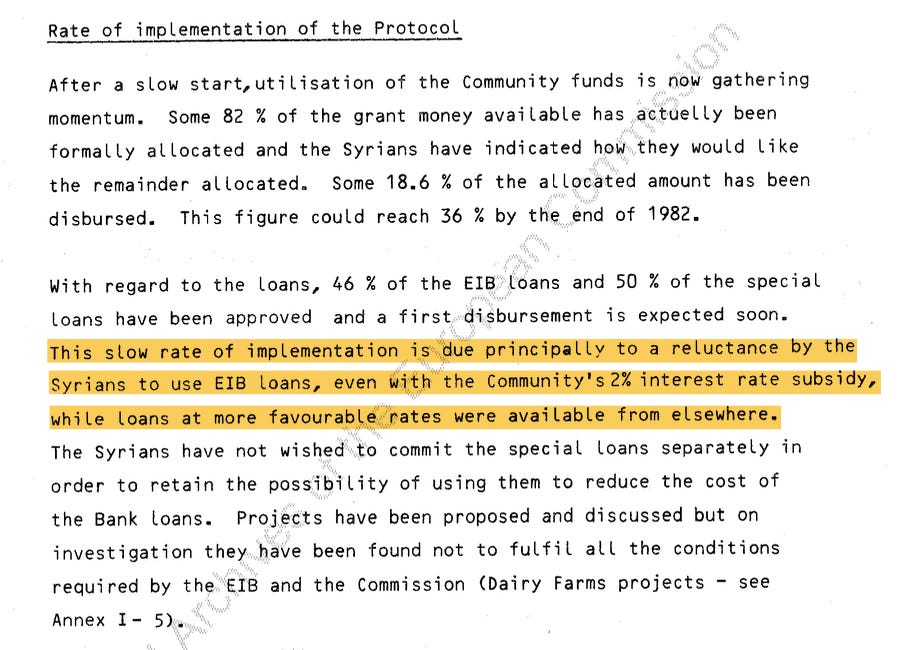
Finally, there is a third limitation: a competitive dimension that European debates often understate. External support is never offered in a vacuum. Syrian authorities compare options, weighing speed, flexibility, visibility, and political cost. The 1982 archives already captured this logic when European officials noted Syria’s reluctance to use EIB loans because more favorable terms could be secured elsewhere. Even if the current Syrian preference is not to take on loans, the underlying point remains valid for support more broadly: when one partner can deliver faster, with fewer procedural burdens and more attractive terms, that partner is likely to gain ground over a slower and more layered European offer, however sound the latter may appear on paper.
The currency file is not a development-aid case in the narrow sense, but it offers a revealing contemporary example of the same operational logic. In March 2025, Syria received a fresh shipment of banknotes from Russia. In May 2025, there were reports that Damascus was considering shifting printing to the UAE and Germany. Yet by August 2025, Syria had finalized a deal with Russia’s Goznak to print the redesigned notes.
The sequence is instructive because when a service is urgently needed and technically straightforward, the decisive factor is often not geopolitical preference but the ability to deliver quickly, concretely, and on terms that local authorities consider more favorable. Several European companies had initially positioned themselves to print the new Syrian Pound; however, the Syrian authorities, citing limited financial resources, asked for extremely favorable terms (essentially printing at production cost, if not for free), which European companies could not align with. Russia’s Goznak could. This is a prime example of a missed opportunity for the EU, which could have offered to print Syria’s new currency for free as part of, let us say, a socio-economic support package. But it was not meant to be.
The same dynamic appears across other sectors. European officials interviewed for this research repeatedly described the EU as procedurally heavy, risk-averse, and slow-moving.7 Accountability requirements, multi-layered approval processes, and the involvement of several institutions and offices often lengthen the time between political commitment and practical delivery. By contrast, other partners can sometimes move more quickly, whether because they operate through simpler administrative systems, face fewer domestic accountability requirements, or are willing to accept higher levels of risk. For Syrian authorities confronted with urgent reconstruction needs, such differences are not abstract bureaucratic details. They shape which offers are pursued and which relationships are prioritized.
The broader lesson is simple. If Europe wants its support to matter, it must not only be available. It must also be intelligible, operationally usable, and competitive with what other partners are prepared to provide.
That does not mean abandoning safeguards or pretending that all external financing should look the same. It means recognizing that effectiveness is partly comparative. A grant or loan facility that arrives too late, requires too many internal steps, or remains too difficult to navigate may be formally available yet practically marginal.
A Few Lessons for Bilateral Engagement
None of this absolves the Syrian side of responsibility. For European support to be absorbed, the Syrian government also needs to clarify who speaks for recovery planning, which ministries own which project pipelines, how priorities are selected, and how implementation will be monitored. A highly centralized administrative chain may help approve large announcements, but it does not automatically produce technically prepared projects, credible procurement systems, or ministry-level ownership. Nor does the broader fragility of a rebuilding state help, especially when institutional contradictions, staff turnover, and uneven administrative capabilities can slow even well-intentioned engagement.
Yet the European side also faces its own challenge. While broad objectives exist—including stabilization, economic recovery, institutional strengthening, and support for an inclusive transition—these goals do not yet amount to a fully coherent framework for engagement. Recent discussions still suggest movement through overlapping instruments, partial initiatives, and ad hoc decisions rather than through a clear hierarchy of priorities. That weakens the Union’s own leverage and makes it harder to match means to ends.
The striking aspect of the 1982 mission reports is how familiar they sound. More than four decades later, Europe and Syria are once again discussing financing, technical assistance, institutional reform, and economic recovery. The obstacles are remarkably similar: a limited understanding of European mechanisms, weak coordination between planning and implementation, and competition from actors who can move faster and more easily.
Political willingness exists on both sides. The question is whether that willingness can be translated into operational cooperation. Europe’s challenge in Syria today is not primarily one of resources. It is one of absorption. Unless both sides address the institutional constraints that have repeatedly undermined cooperation, they risk rediscovering the same limitations that European officials identified nearly half a century ago.

As per European Commission, SEC(82) 1461, Document de travail: Rapports sur les missions de programmation des deuxièmes protocoles financiers en Égypte, Jordanie, au Liban, au Maroc et en Syrie, Archives historiques de la Commission, Collection des documents “SEC”, dossier SEC(82)1461, vol. 1982/0067. 1982.
Interview with EU official #1 in Damascus, April 2026.
Interview with EU official #2 in Brussels, April 2026.
Interview with a French official in Paris, March 2026.
Interview with an EU official #2 in Brussels, April 2026.
Interview with an EU official #1 in Damascus, April 2026.
Interview with EU official #1 in Damascus, April 2026; Interview with EU official #2 in Brussels, April 2026.
What the EU could do,is to give give 30k euros to every Syrian in Europe (to the parents if they are children) and deport them back to Syria,it would help reconstruction,the launching of businesses etc based on the free choices and the autonomy of the Syrian people,and it would get over 1 milion Syrian out of Europe, everyone wins .