

On September 20, 2026, Syria’s People’s Assembly held a hearing with Energy Minister Mohammad al-Bashir after the fuel price increase and the protests it sparked. Across two sessions (Session 1 and Session 2), MPs questioned him on oil, gas, electricity, water, and the governance of the new energy companies. This two-part series is an annotated, timestamped account of that hearing. Part 1 covers the Energy Committee’s prepared questions and the minister’s presentation, organized by theme. Part 2 covers the open-floor exchanges with MPs.
Introduction: what the energy hearing tells us
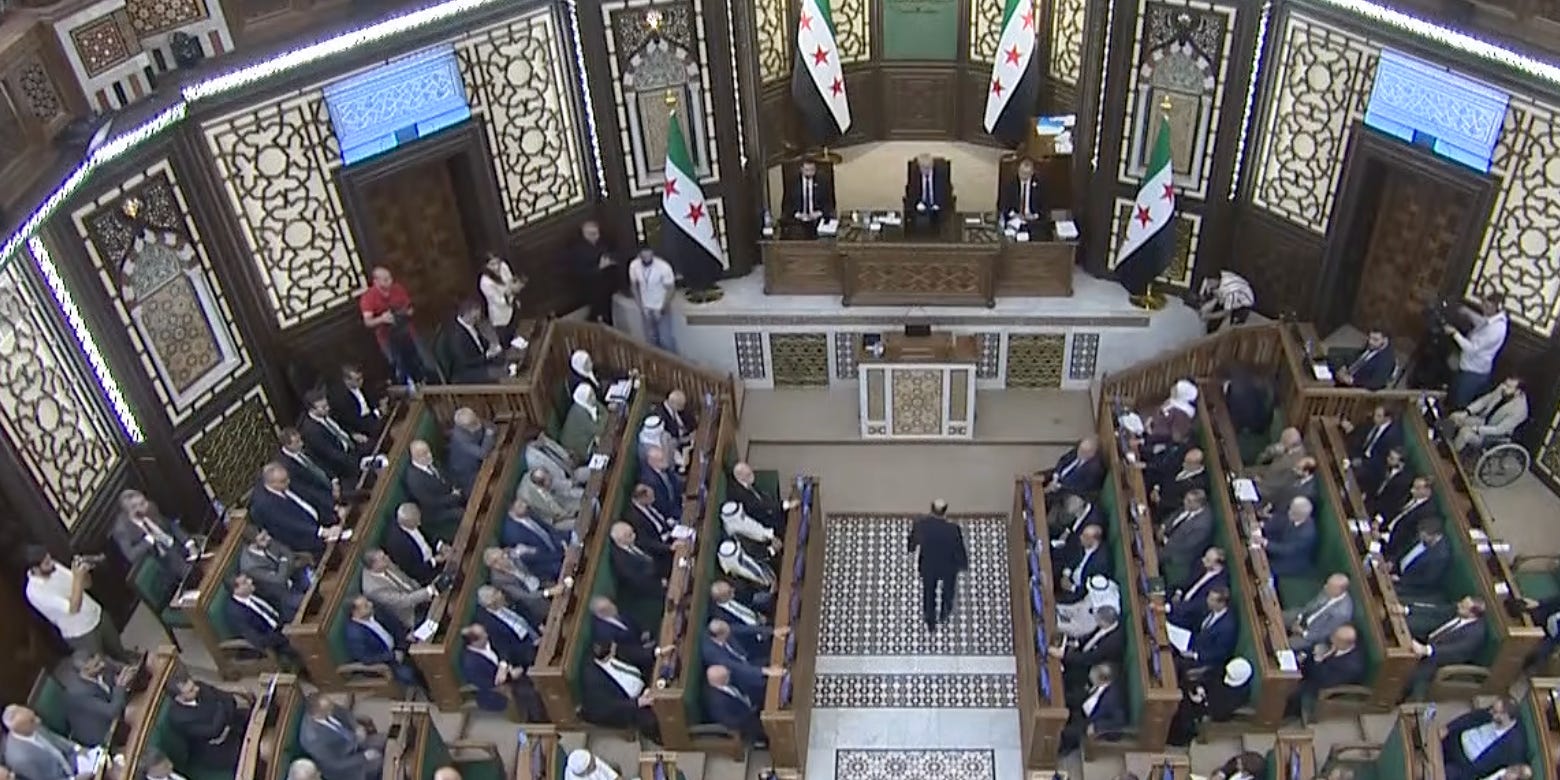
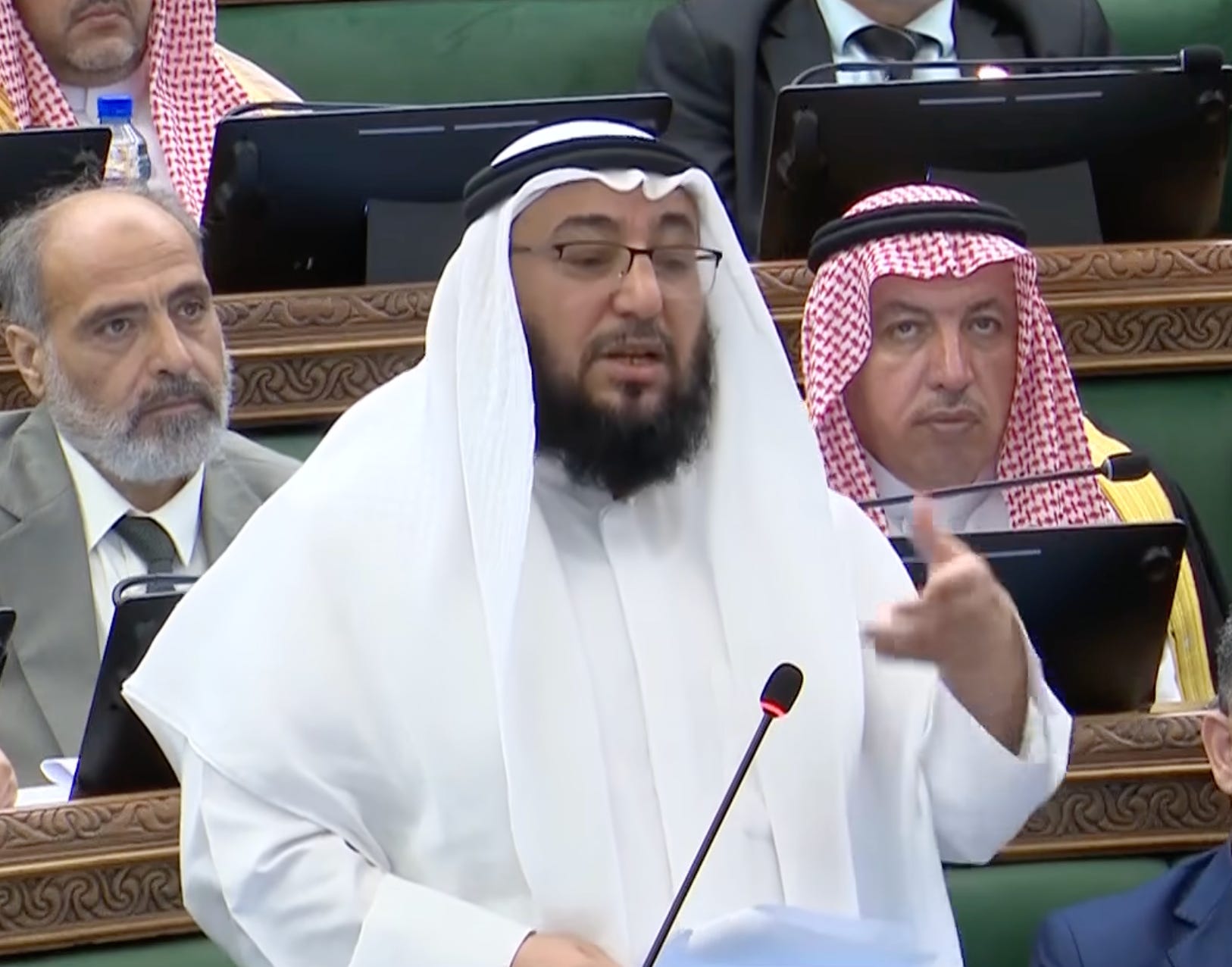
For more than four hours over two sessions, Syria’s new People’s Assembly questioned Energy Minister Mohammad al-Bashir. The fuel price increase and the protests that followed triggered it; though the hearing’s scope was widened to everything his merged ministry now covers: oil, gas, electricity, water and mining. The Parliament’s Energy Committee sent the Minister about 40 written questions in advance, which he answered with a long presentation of figures and timelines before taking questions from the floor.
As noted previously, a Minister sitting before elected representatives, on the record, to explain a politically costly decision and defend his sector’s numbers, is new in Syria. The hearing’s format is therefore the first story, as it tested accountability for the transitional government and the new MPs: would they press the executive on how the decision was made? How would the Minister respond? Whatever one makes of the answers, a precedent has been set, and the committee chair closed by asking for such hearings to become regular. Whether they do will say a lot about how much oversight the new institutions are willing to exercise, and to tolerate.
Overall, the questions were good, well-researched, and sometimes even sensitive, such as when Laith al-Balous asked about Tayba Petroleum. Some questions were grounded in constituencies: a transformer station in al-Rusafa idling 110 wells, broken pumps at Maskanah East, flood risk in Raqqa and Deir Ezzor. Others went straight to governance. MPs asked whether fuel contracts are tendered or awarded directly, in breach of Contracts Law No. 51 of 2004, and invoked a “phobia” of a return to Qaterji- and Hamsho-style intermediaries. They asked whether certain stations are favored in fuel allocations, and demanded a copy of the UrbaCon contract and a live hearing with the head of the Syrian Petroleum Company (SPC).
In reply, the Minister provided a significant amount of figures which now represent the most detailed public account of Syria’s energy balance since the transition, and several deserve a closer look.
Oil production is about 110,000 bpd (107,000–112,000) against a need the Minister now puts at 300,000, so domestic output covers barely more than a third of demand, but refining capacity is only about 150,000 bpd. When the ministry was founded, need was 150,000 bpd, meaning that the two refineries covered it.
The gap is much wider for household gas: LPG demand is 1,300–1,500 tons a day against domestic output of about 100 tons, meaning more than nine-tenths of the cooking gas Syrians use is imported. Daily consumption is about 10,000–11,000 tons of mazout (about 12 million liters) and about 8 million liters of gasoline. Gas output rose to 8.1 mcm/d after part of the Conoco plant came online, reached 8.4–8.5 mcm/d the day before the session, and has touched 9, against 24 mcm/d needed.
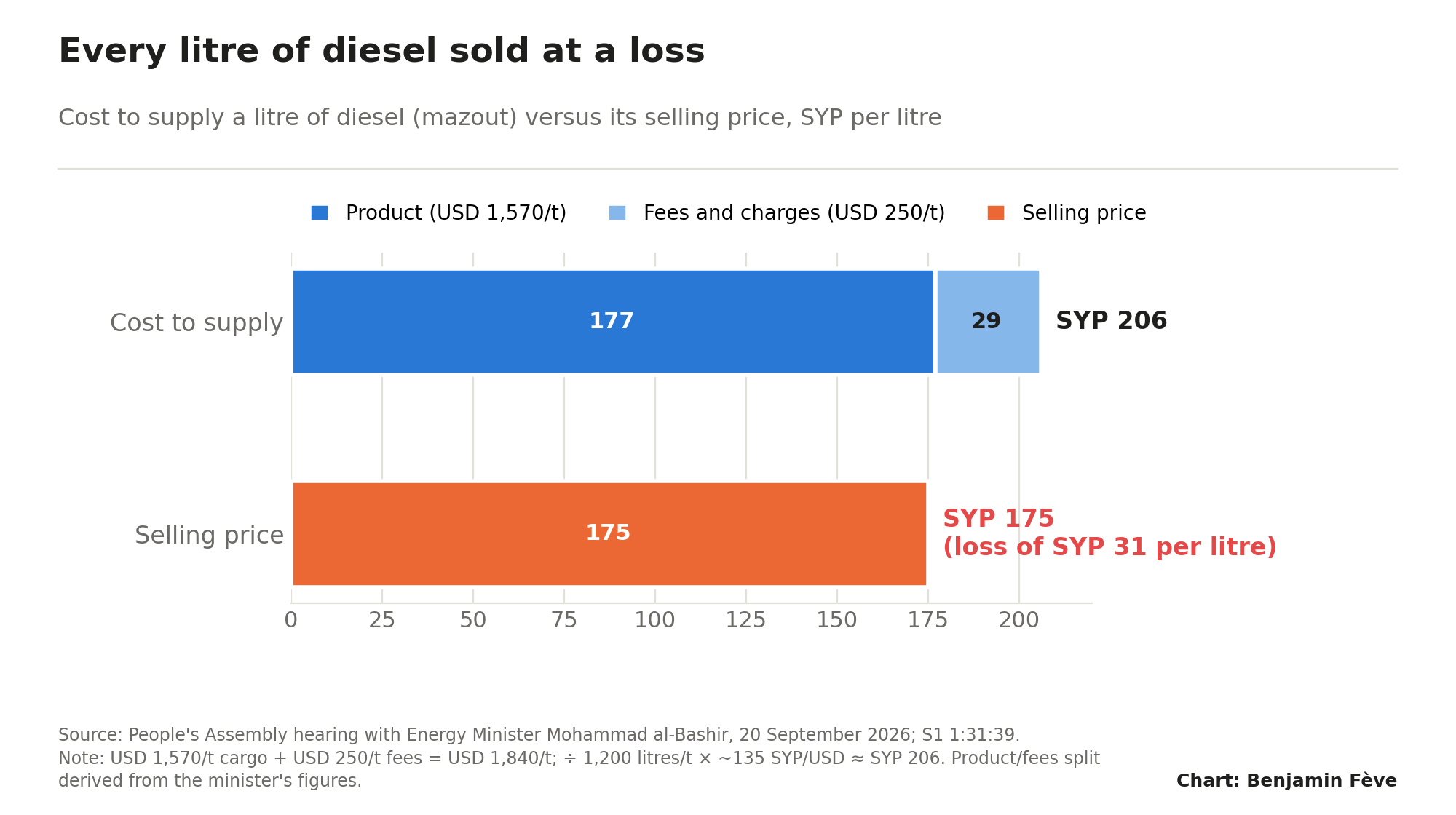
On his own worked example, a liter of mazout costs SYP 206 to supply and sells for SYP 175. This means that at about 12 million liters a day, a SYP 31 loss per liter is about SYP 372 million a day, or roughly USD 2.8 million at 135 SYP/USD, around USD 80 million a month. This is a ceiling, since part of the volume now sells under the cheaper grade, which the Minister says breaks even, and not all diesel is imported at that cost. Still, the order of magnitude explains the price rise better than the “global refining crisis” framing he also leaned on.
The Minister also provided interesting insights on various procurement and contracting procedures, in what can be considered the most transparent bout of public reporting. When asked “where are the tenders?”, the Minister replied that “we are buying diesel at auctions at sea”. The line was meant as a rebuke, but it is also a revealing admission: Syria is buying spot cargoes in a tight market, with no term contracts and little bargaining power. He argued the government-to-government supply deals he wants (with Saudi Arabia, Kuwait, Libya) are still out of reach.
The same emergency logic justifies direct contracting (التراضي): tendering for transformers would leave a neighborhood dark for two months, and an external tender alone takes 50 days. The argument is reasonable for a genuine emergency. The problem is that, more than a year into the transition, the emergency has become the rule… and seems to be a convenient excuse, so is the “we could also go back to 2 hours of electricity per day” rebuttal, which seems a bit of an easy way out of some questions.
Most striking still was his statement that some contracts follow the state’s “political orientation”. Since Chevron and ConocoPhillips carry weight, and an Arab energy Minister had told him that bringing them in “will open the doors to all companies”, the Ministry privileged contracting with them. This is a candid acknowledgment that energy contracts are being awarded partly as signals, privileging American majors so that others follow, but it also makes the transparency questions MPs raised about UrbaCon and other contracts more pressing, not less.
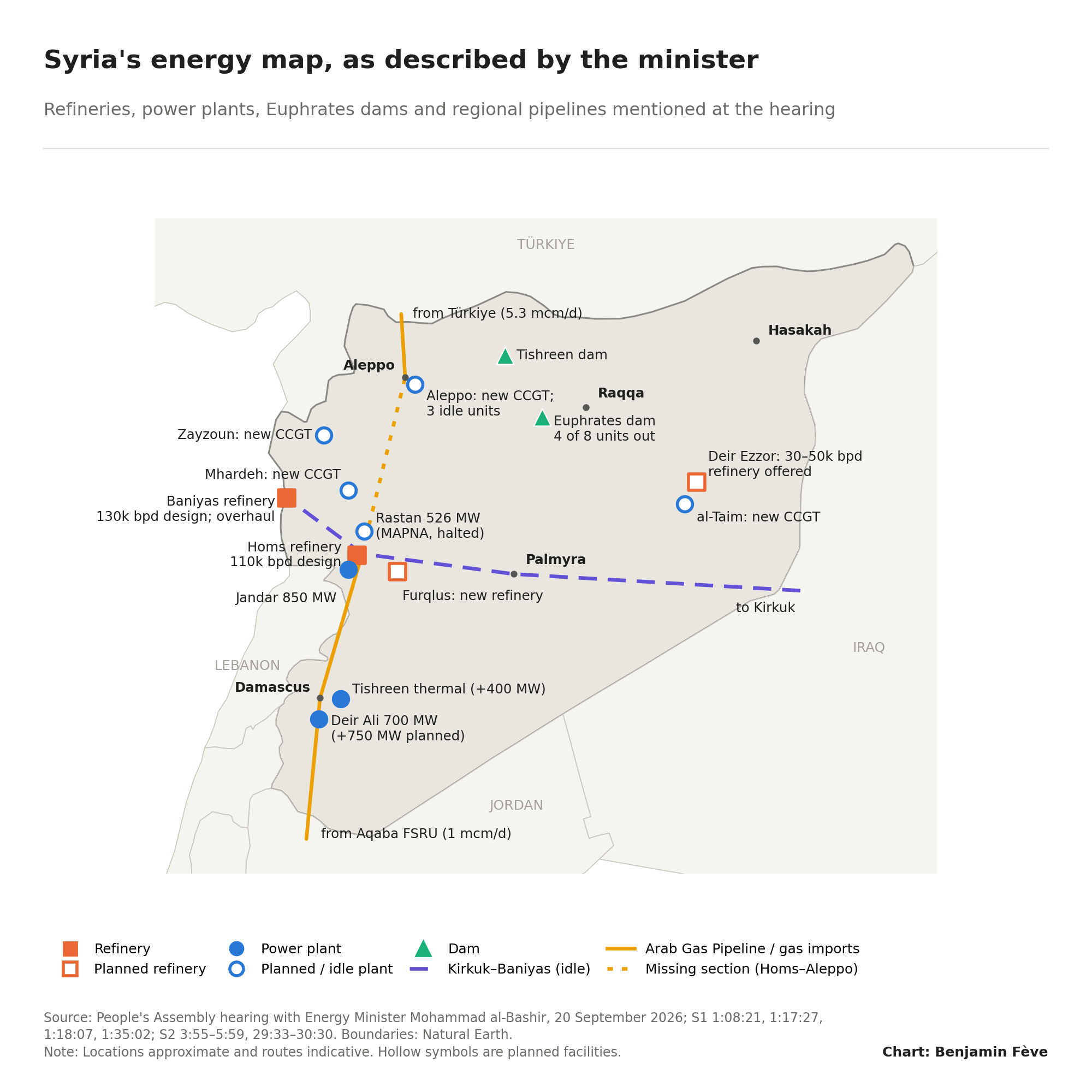
The Minister may also have provided insight into potential cooperation with an Iranian company that previously worked in Syria. Indeed, Iran’s MAPNA Group started the Rastan power plant (526 MW), which halted work after the regime fell, but which the ministry says it is now negotiating with companies to complete it. He did not say whether MAPNA is among them; given the “political orientation” he described, that is worth asking.
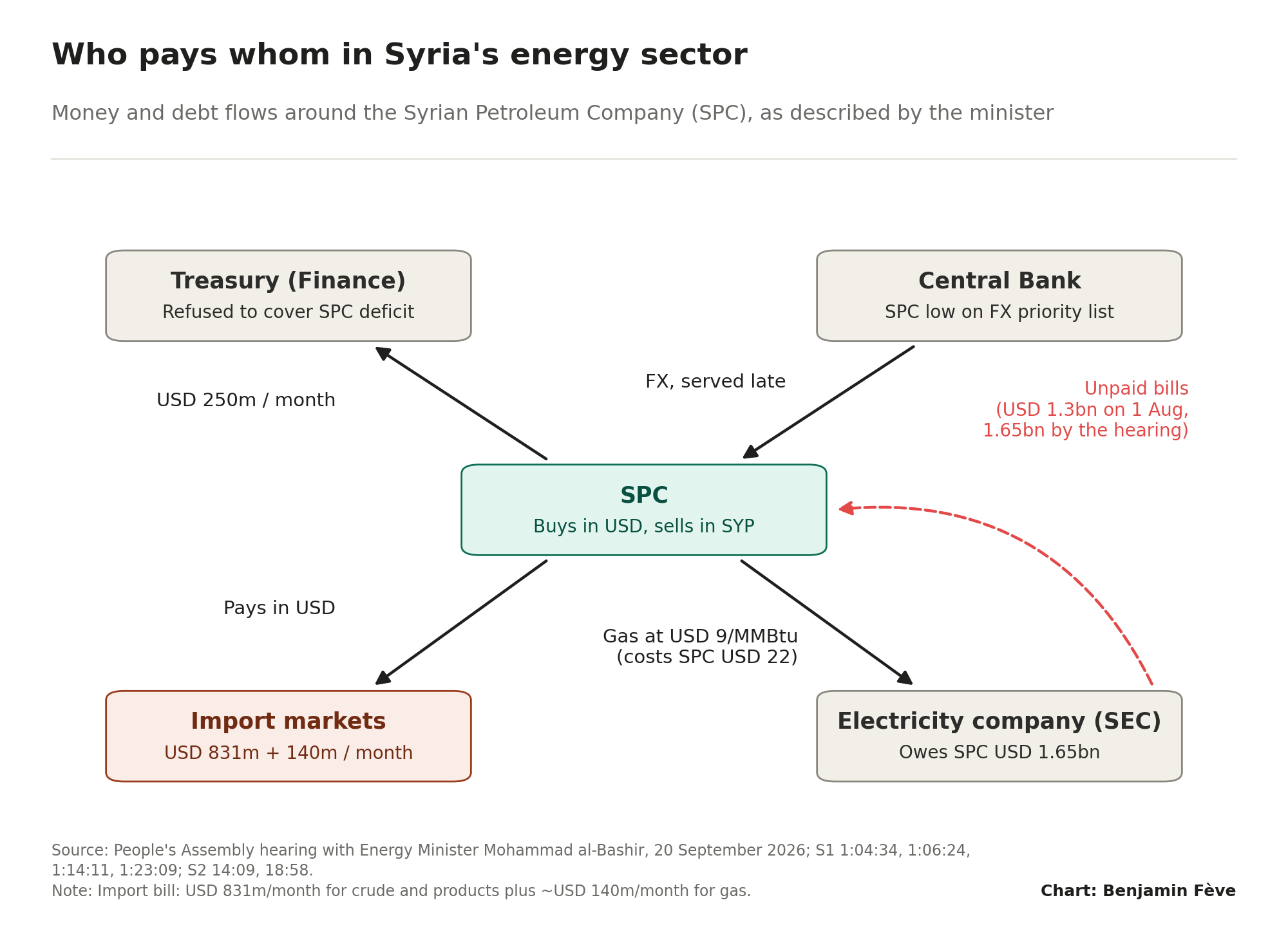
The Minister also highlighted interesting tug-of-war dynamics between his Ministry and the Ministry of Finance, exposing open tension between the two. SPC has been transferring about USD 250 million a month to the treasury since oil came under state control, which the Minister credits with helping fund public-sector wage rises. Last month (August 2026), SPC asked the Ministry of Finance to cover its deficit, though the Ministry said it could not. Minister al-Bashir’s ask then seemed blunt: let SPC keep four or five months of those transfers, equivalent to “a billion dollars”, and it would build reserves, tanks and supply lines. The alternative he described is stark, which some might see as a provocation: either live with fuel crises, or stop buying gas and return to 2–3 hours of power a day, as under the old regime. With industrial and commercial users taking about 40% of power, cutting supply would shut down reopened factories. For scale, the monthly transfer to the treasury is almost a third of the USD 831 million Syria spends each month on crude and products.
Beyond the lack of fuel and money, spare parts are another obstacle, and so are long delivery times. This is especially critical as most substations must be made to order, taking 18 months to two years. Alternative solutions have been utilized, but they are by default limited: Deir Ezzor, which had a single substation at al-Taim, received an unused one moved from elsewhere in Syria. The same lead times explain delays on large solar projects: nine sites have been handed to companies, but they need substations and imported equipment. Gas turbines from Siemens, Ansaldo, GE and Mitsubishi are booked until 2033–35; only UCC’s pre-purchased turbines let Syria expect new plants by 2029.
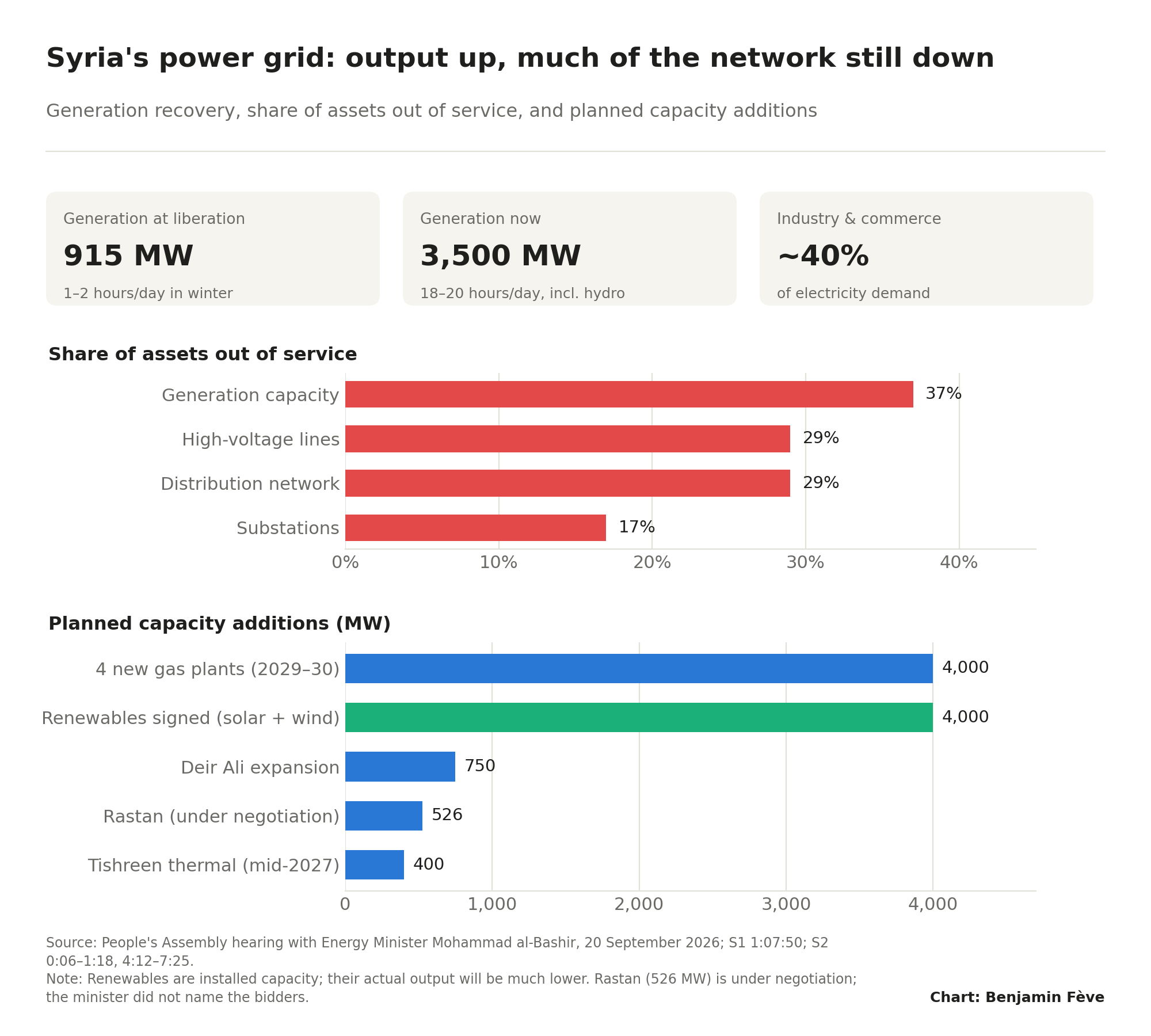
Following oil and gas resources, electricity data was also plentiful, albeit more sobering. Syria has 460 transmission lines at 400, 230 and 66 kV; 29% of high-voltage lines are out of service, as is 29% of distribution network length in war-damaged areas. Of 458 transformer substations, 17% are out of service. Of 12 generation plants, about 37% of capacity is unavailable: Zayzoun and Mhardeh are wholly out, and Aleppo lost all five units, two of which have since been rehabilitated. Even so, generation has risen from 915 MW at liberation, when homes got 1–2 hours a day in winter, to 3,500 MW including hydro, giving 18–20 hours in most governorates and round-the-clock supply to industrial cities. That gain, however, rests on purchased gas the treasury says it can no longer fund.
On renewables, the Minister revealed that about 4,000 MW of renewables have been signed, 2,500 MW solar and 1,500 MW wind, including Wadi al-Rabi’ in Rif Dimashq (200 MW), Furqlus (200 MW), al-Taim in Deir Ezzor (300 MW) and Aleppo (300 MW), with land already handed over (S2 7:02). Set against the roughly 8,000 MW of fossil capacity envisaged for 2030 (S2 7:25), that is about a third of installed capacity, and a smaller share of actual generation. That is close to the 20–30% ceiling the Minister set himself for grid stability, citing last year’s Iberian blackout.
The Minister also provided an overview and various figures on water, thanks to questions by the very active Mahmoud Saleh al-Owais. Inflow from Türkiye rose from about 200–220 m³/s to about 1,000 m³/s, double Syria’s 500 m³/s share under the 1987 agreement, as one MP noted. The Euphrates riverbed was designed for 3,000 m³/s, but encroachments by farming and building mean even 2,000 would cause problems, and the protection zone set in the water law has been widely violated. The Minister also hinted to coordination struggles between Damascus and Ankara, saying that Türkiye gave just one day’s warning before raising releases and that, as a result, too little water became too much water, with no coordination framework to manage either.
As always with such disclosures, however, many additional questions remained unanswered, while others naturally came as interrogations of the disclosure. The most important question is why the SPC remits money to the treasury, yet loses money on every liter of mazout it sells and is owed USD 1.65 billion by the Syrian Electricity Company (SEC), which it supplies with gas at USD 9/MMBtu while paying USD 22.
Finally, the Minister was mostly candid, sometimes strikingly so, on empty warehouses, unpaid tankers waiting at sea and the Central Bank’s FX priorities. But he was also defensive, at times ironic. That edge sharpens considerably in the open-floor exchanges covered in Part 2.
How to read Part 1
Part 1 covers the Energy Committee’s prepared questions and Minister Mohammad al-Bashir’s presentation, which ran through Session 1 and the first 39 minutes of Session 2. Questions are grouped by theme, and each keeps its original number and the name of the MP who asked it.
Sessions and timestamps: S1 is Session 1 (morning) and S2 is Session 2 (afternoon). Each timestamp marks where the point begins in that session’s recording. The committee asked all questions in S1.
The minister’s answers appear in quote blocks headed “Minister al-Bashir”: He answered through a presentation rather than question by question, so his remarks match the questions they address.
Sources: Each claim ends with its source in brackets: session and timestamp. When consecutive claims come from the same passage, a single timestamp follows the last one.
Paraphrase and quotation: Questions and answers are condensed and paraphrased for clarity and length. Only passages in quotation marks are verbatim.
Editorial clarifications: Where the audio was unclear, or a speaker appears to have misspoken, the likely intended meaning is given in square brackets. These are the author’s interpretations, not the speaker’s words, and readers are encouraged to check them against the recording.
Unanswered questions. Questions the presentation did not address are listed at the end.
1. Oil and gas: production, fields and data
Q1.1 and Q1.2 — Abdullah Majeed al-Hajj Abd (S1 2:34, 2:56): Transparent figures on domestic production: number of wells, number of fields, barrels produced per day, and daily consumption of oil, gas, and electricity. Why do official statements keep contradicting each other?
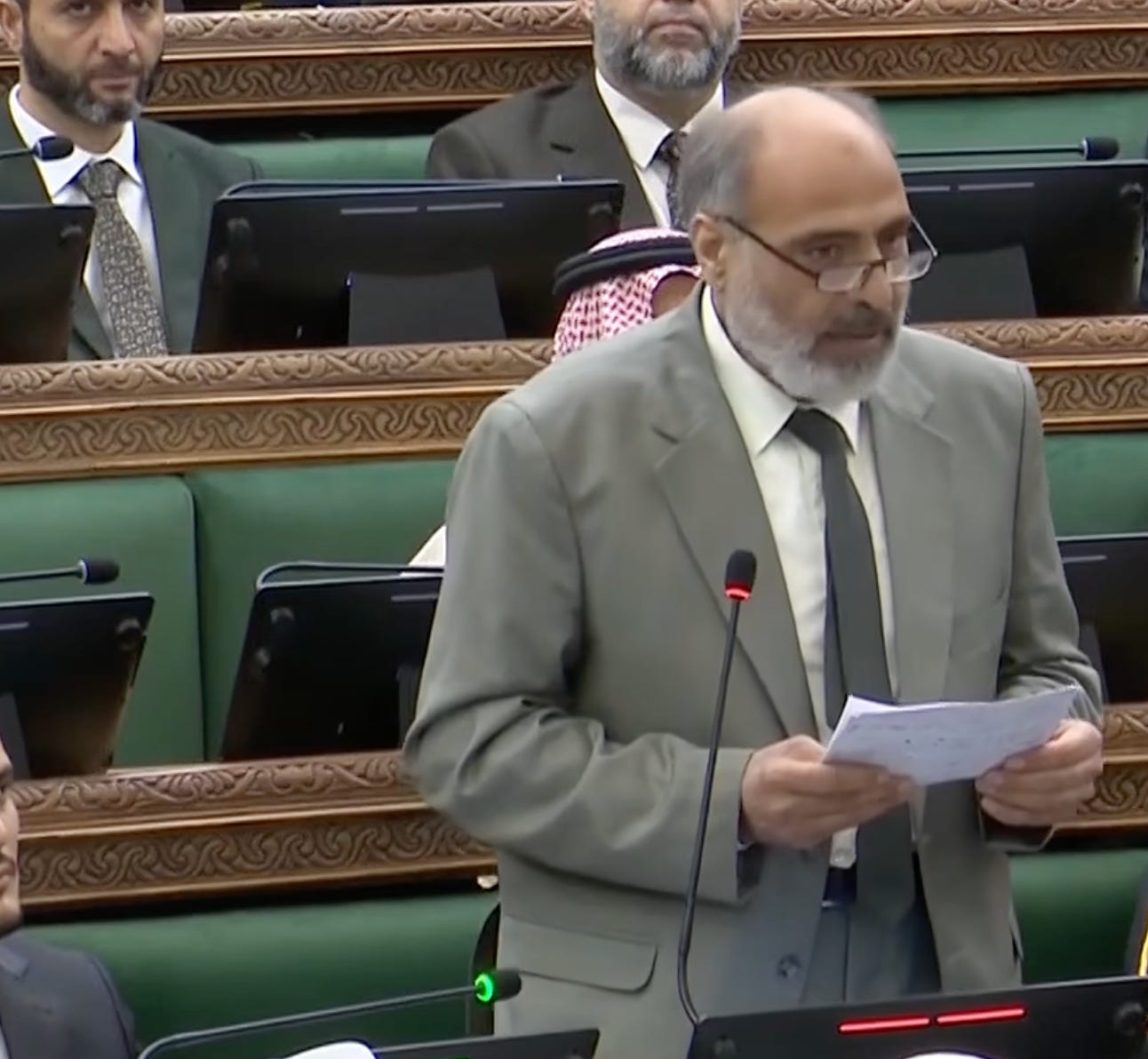
Minister al-Bashir
At liberation, the state held 14 fields west of the Euphrates, about 140 producing wells and 7,000 barrels of oil per day (bpd) (without accounting production in the Northeast), plus about 6 million cubic meters per day (mcm/d) of gas from central-region fields and al-Taim (S1 51:18). In the northeast, the state only really entered the fields around the end of Q1 this year (S1 50:06). It began receiving ready oil fields on January 17, 2026, took over major fields in Raqqa and Deir Ezzor on 18–19 January, and entered Hasakah in March 2026 after the settlement east of the Euphrates (S1 52:40). Oil output then rose briefly to 135,000–140,000 bpd and has settled around 110,000 (107,000–112,000), depending on wells and transport (S1 57:03–58:26). Gas rose to 8.1 mcm/d after part of the Conoco plant came online, reached 8.4–8.5 mcm/d the day before, and had touched 9 (S1 57:03–58:26). Drilling was reactivated: 4,840 meters drilled, two rigs returned to service, 21 wells repaired, 152 wells brought online and 10 new wells drilled (S1 57:03–58:26).

In total, Syria has 78 oil fields and 28 gas fields, with reserves of 2.5 billion barrels of crude and 241 of gas [unit unclear, billion m³?], based on old surveys. A geology committee was formed to commission a new oil and gas survey, a geothermal map and an updated groundwater map; many offers came in, but some raised “security sensitivities” (S1 50:31).
On the “contradictions”, people confuse natural gas for power plants with household LPG. LPG demand is 1,300–1,500 tons/day, domestic output is about 100 tons, and the rest is imported (S1 51:43).
The reduction [from 140,000 bpd to around 100,000 bpd today] came following 70 wells shutting in one area and 172 in another because of heavy water cut, radioactive material, and formation water reaching a stream locals call the “river of death” (S1 53:52). Local notables in the Jarzi Region (منطقة الجرذي) told about 100 cancer cases linked to pollution, burners and bad extraction; the wells are shut for repair and reassessment (S1 53:52). The main challenges are sustaining output and securing crude, chemicals and spares; at liberation all warehouses were empty, with no transformers, valves or pipe (S1 54:35).
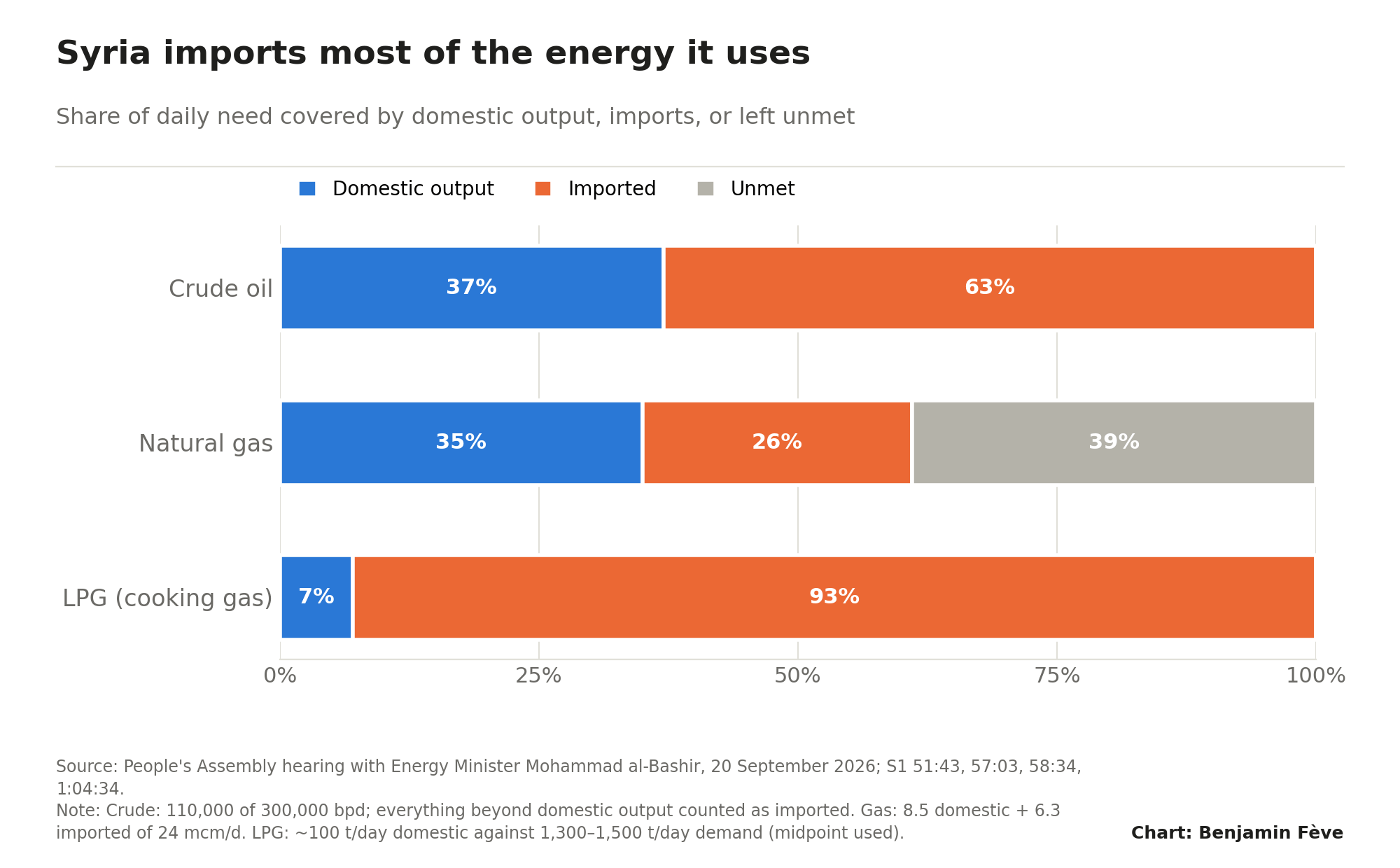
Daily consumption is about 10,000–11,000 tonnes of mazout (about 12 million litres) and about 8 million litres of gasoline [spoken as “6–7 million tonnes” but likely meaning 6,000–7,000 tons]. Power plants and industry use about 8,500 [ton/day] of fuel oil, subsidised at USD 400 per ton against import costs of USD 550–570, and LPG demand is 1,300 tons/day. The rest is imported: crude when Baniyas is running, products while it is down (S1 1:12:49–1:14:11).
2. Demand, refining and the road to self-sufficiency
Q3.2 — Omar Fawaz al-Mohammad (S1 9:50). How many years until self-sufficiency in oil, gas and electricity, and the start of exports? Outline the ministry’s plan.
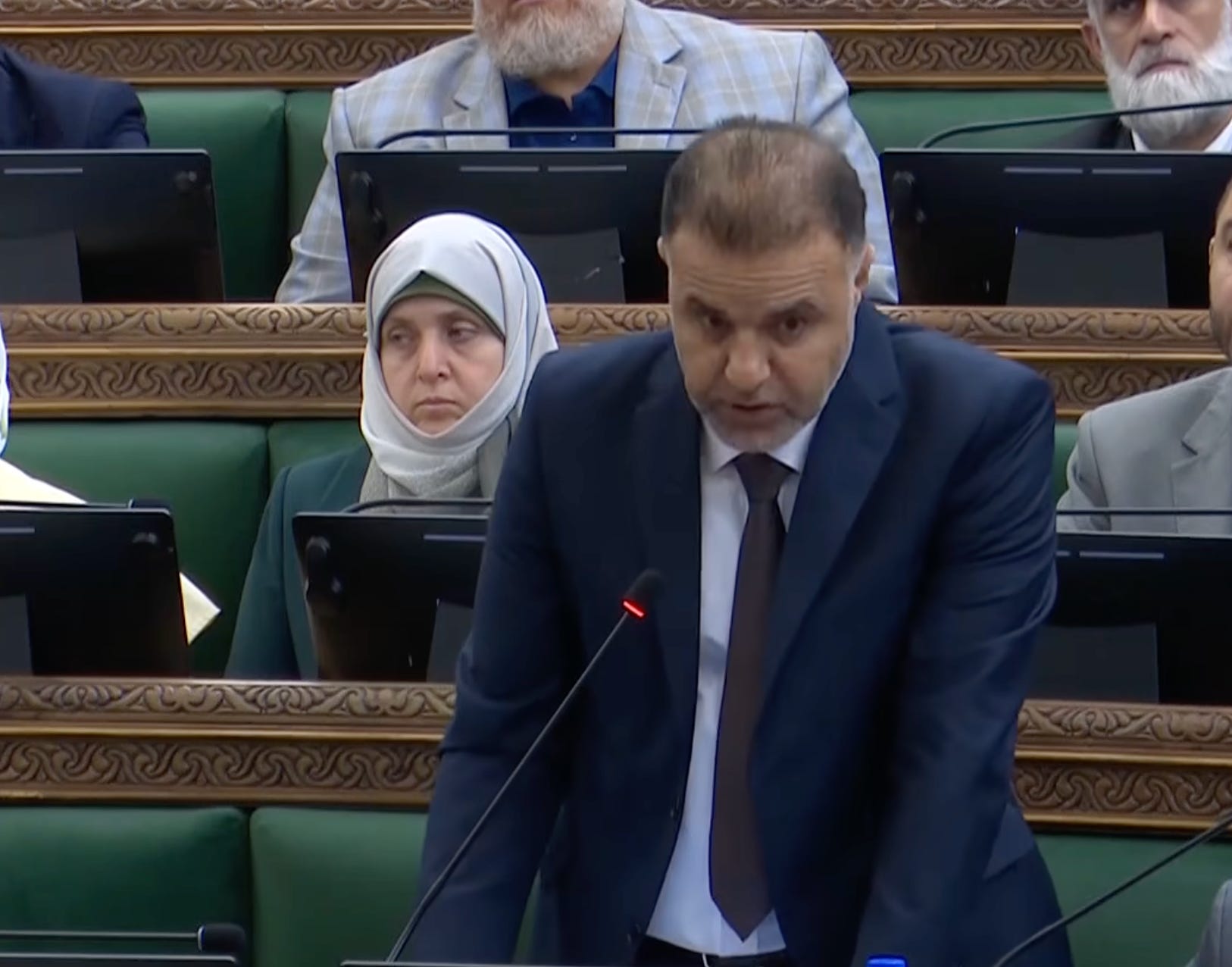
Minister al-Bashir
Syria needs about 300,000 bpd of crude equivalent; when the ministry was founded, need was 150,000 bpd and the two refineries covered it (S1 58:34). Need doubled for three reasons: Hasakah, Deir Ezzor, Raqqa and parts of Aleppo now take products from the ministry; the burners (harraqat/حراقات) that supplied 5–10% of the market were stopped; and demand grew, with Aleppo’s industrial city going from 900 to 1,500 factories and vehicles from 2.5 million (2025) to 3.6 million (S1 59:31). Demand ranges from 270,000–280,000 bpd in spring to 325,000–350,000 bpd in winter (S1 1:00:27).

Refining capacity is about 150,000 bpd in total: Baniyas 90,000–100,000 bpd before the overhaul and Homs 40,000–50,000 bpd. The remaining ~150,000 bpd is imported as diesel and gasoline. With local output of 112,000 bpd at the time of the report, the crude gap is about 200,000 bpd (S1 1:00:52).
Of roughly 100,000–110,000 bpd produced, about 80,000 is heavy crude that Baniyas, designed for light crude, cannot process (S1 1:02:08). About 20,000–25,000 of light crude goes to Baniyas, topped up with about 100,000 bought (130,000 at full capacity); Homs takes about 50,000 of heavy; and the ~30,000 bpd surplus heavy was stored and exported by the shipload (S1 1:02:08). Exports have now stopped: the surplus will go to local “electric” refineries (burner-type units) to make diesel, which are uneconomic and environmentally harmful, which is why such refineries were not in use until now (S1 1:03:06).
The target is oil self-sufficiency by 2028, if nothing unexpected happens, and half of gas needs by end-2030; offshore gas takes about seven years from signing the contract to production (S1 1:33:48). Gas turbines from Siemens, Ansaldo, GE and Mitsubishi are booked until 2033–35, but through the UCC partnership turbines will arrive in 2029, because UCC pre-purchased them (S1 1:34:31).
Exploration blocks are promising: firms that declared force majeure in 2012 are returning, such as Gulfsands, while some have withdrawn (S1 1:35:52).
Q2.1 — Laith Waheed al-Balous (S1 7:14). Could the Baniyas refinery overhaul have been postponed to avoid the price and market impact? What were the real reasons for the delay? Give technical information on the facility. Will the works guarantee a return to full capacity of 135,000 bpd, with stable output?
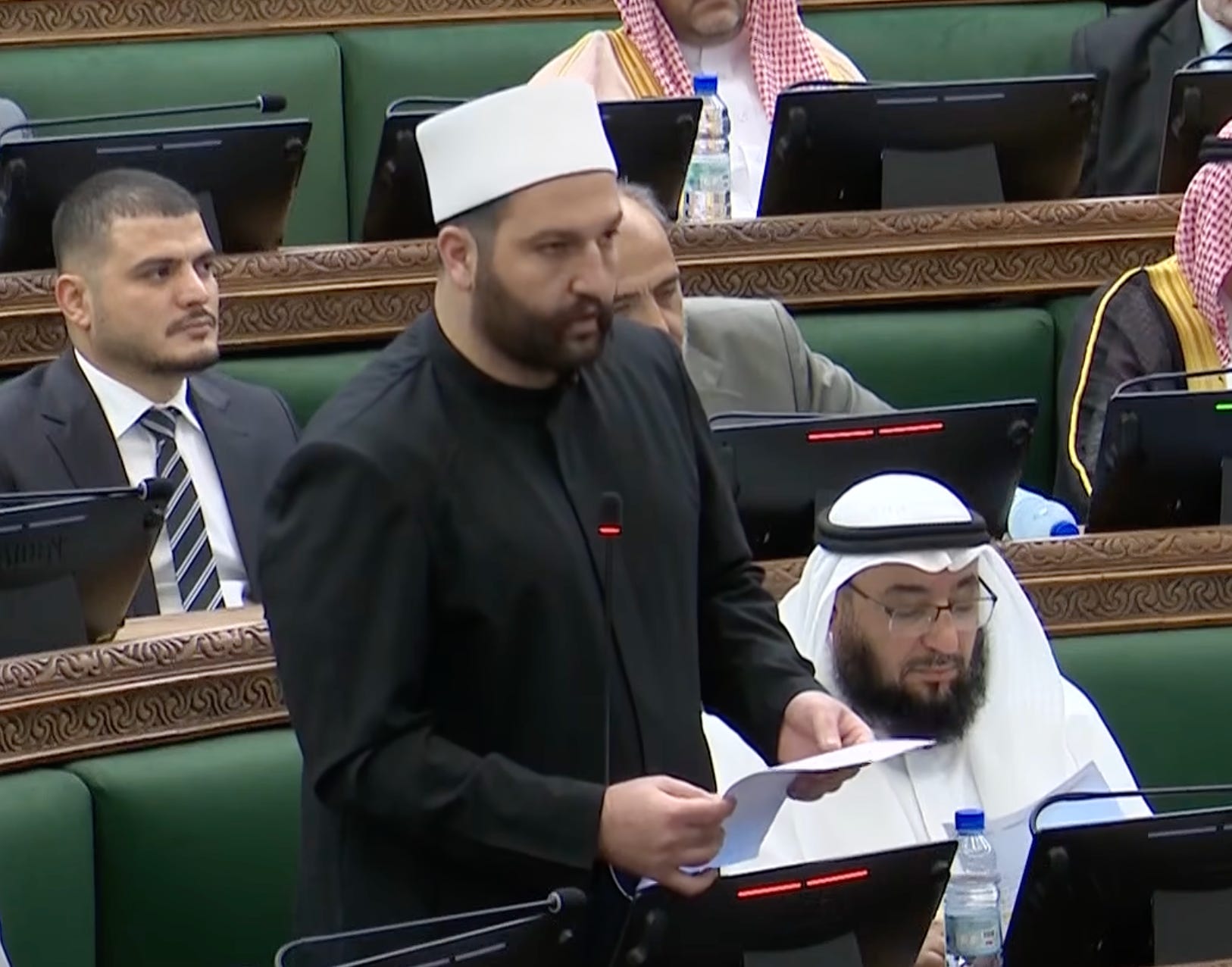
Minister al-Bashir
Baniyas has a design capacity of about 130,000 bpd and Homs 110,000 (S1 1:08:21). Homs currently produces 30,000–40,000 bpd, rising to 50,000 bpd by month-end, and its reformer unit has problems. SPC wanted to close Homs as uneconomic, but the Minister kept it as an energy-security asset able to refine heavy crude until a new refinery is built (S1 1:08:21).
Baniyas’s turnaround had been postponed for years, with repeated shutdowns during the revolution, sanctions, and a lack of spares. Technicians called it “a ticking time bomb” and asked him to sign that he took responsibility for worker and plant safety. The decision to stop was “100% technical”: much equipment is past its design life, and the overhaul will lift output from 90,000 to about 130,000 (S1 1:09:07).
Contracts were signed, and the work should have started in early summer, when turnarounds are done (before winter when demand increases) (S1 1:10:36). It was delayed repeatedly because of Hormuz, the Russia–Ukraine war, and supply chains, until it reached a critical point (S1 1:10:36).
Q6.2 — Mohammad Saeed AbdulQader al-Hasso (S1 15:20). Why not small and medium refineries near the fields, supplying the same governorates, to save transport costs, employ locals and reduce reliance on Baniyas and Homs?
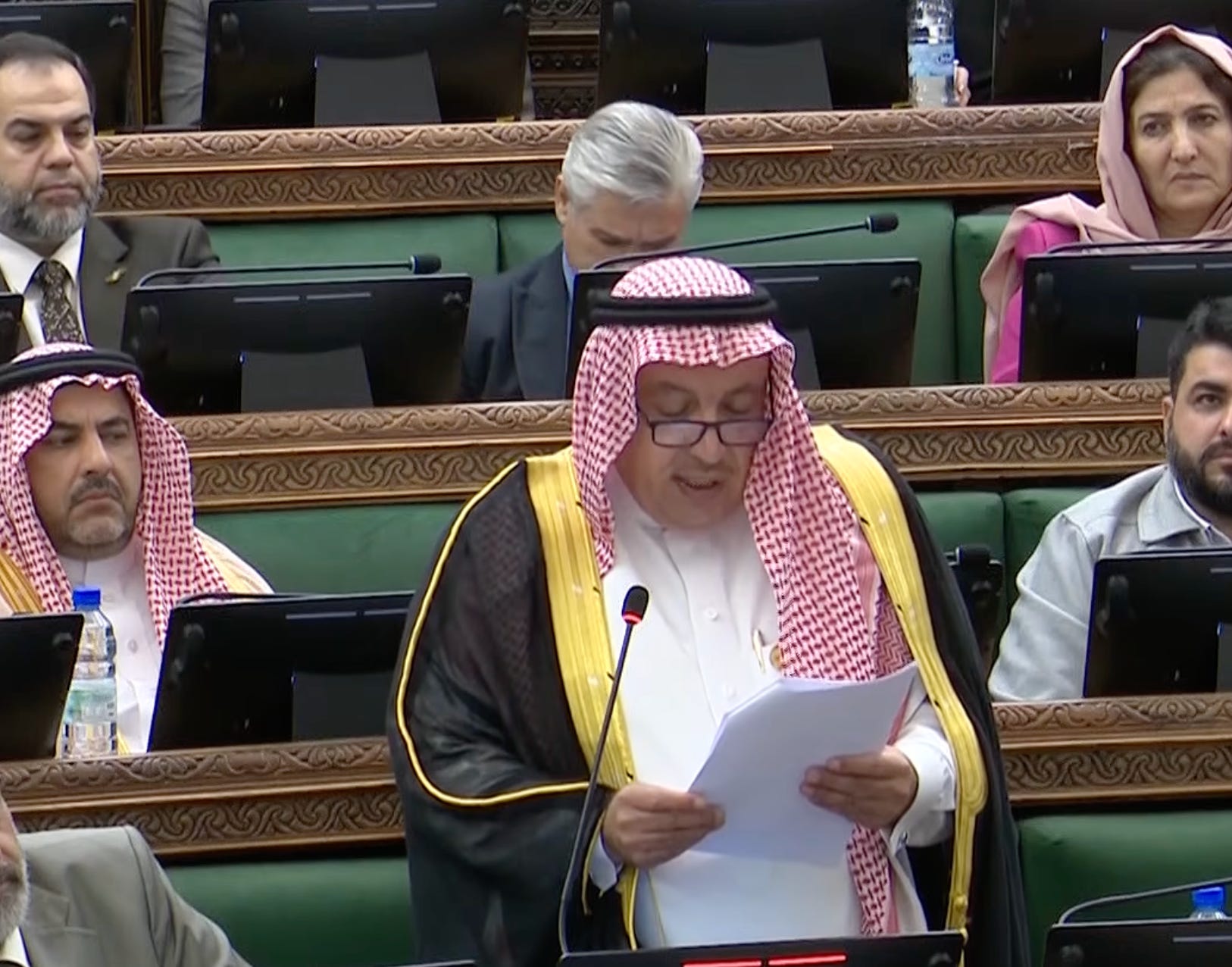
Minister al-Bashir
On Friday, a team abroad was offered a ready-built refinery of 30,000–50,000 bpd, installable in months; it will go to Deir Ezzor (S1 1:35:02). A new refinery for Homs will be built at Furqlus, and a site is being sought in Aleppo. The plan is four or five refineries of about 50,000 bpd each, plus Baniyas (S1 1:35:02).
Transport and storage are being rehabilitated (S1 1:36:21). Bringing the private sector into distribution and storage is “very sensitive” in both electricity and petroleum; it is being studied, and the ministry welcomes consultancy input (S1 1:36:21).
Q3.3 — Omar Fawaz al-Mohammad (S1 10:14). Crude is trucked from the far east to the Homs and Baniyas refineries, and products trucked back east. This adds transport costs, damages roads, and creates traffic hazards. Why not fast-track a refinery in the east?
Q8.4 — Omar Issa al-Hayes (S1 20:44). Why the delay in rehabilitating the Rmeilan–Homs refinery oil line? Is there a maintenance plan, what progress has been made, and are alternative internal lines proposed?
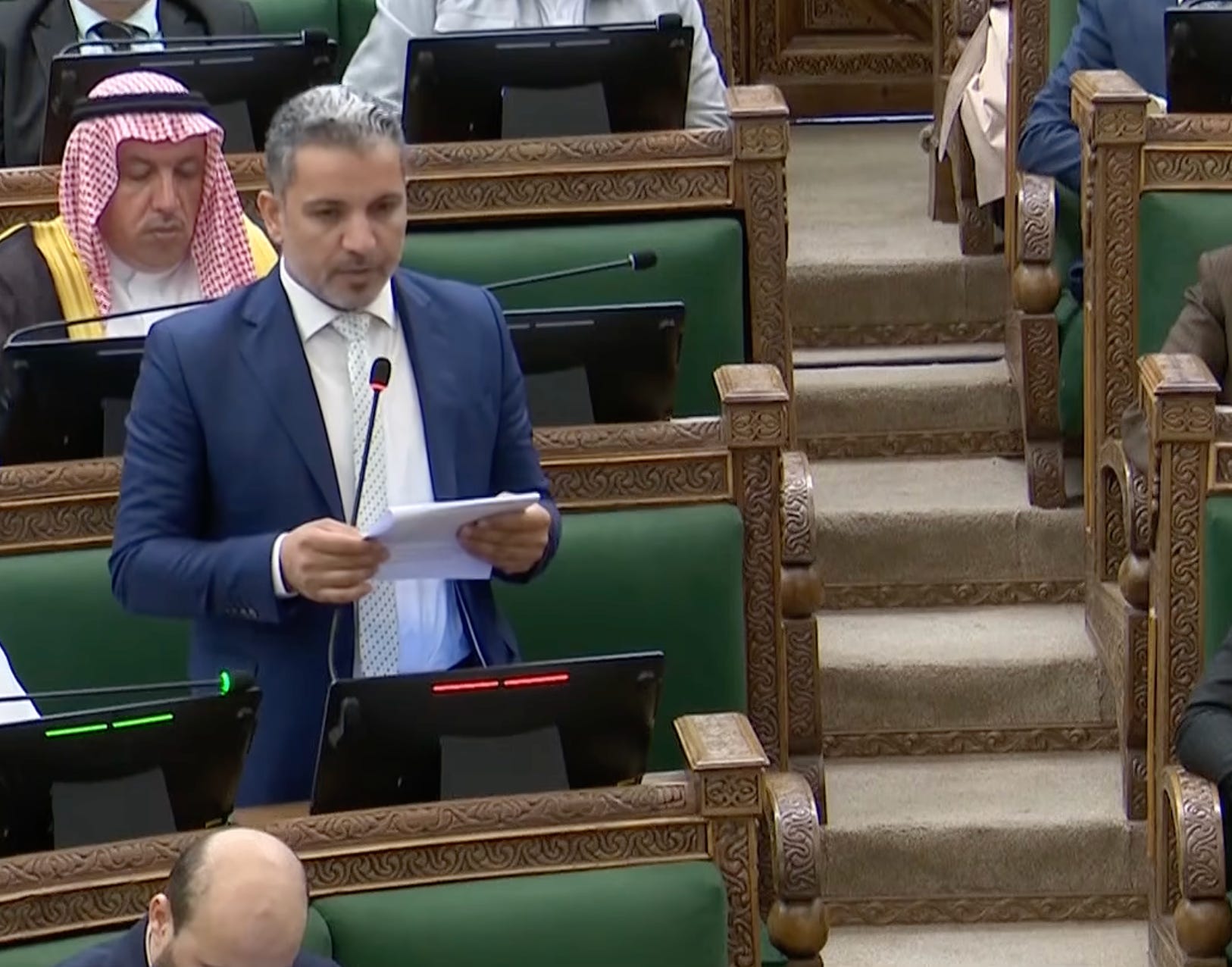
Minister al-Bashir
The Baniyas and Homs refineries were rehabilitated several times, the main pumping groups in Homs were restarted, and many pipes were replaced; details will be sent. Trucking crude is “unhealthy”: it brings theft, oil swapped for water, congestion and road damage (S1 1:19:21–1:20:57).
More than 1,400 illegal taps on the heavy-crude line were removed, and the line is 80% rehabilitated. The end-of-September target slipped by 10–15 days after a minefield was found; demining teams from Defense or the Emergency ministry are needed (S1 1:19:21–1:20:57). Some points were missed and will be answered in writing (S1 1:37:10).
(On the eastern refinery raised in Q3.3, see also the answer to Q6.2 above.)
3. Fuel pricing and diesel grades
Q1.3 — Abdullah Majeed al-Hajj Abd (S1 3:10). What is the actual cost of a liter of gasoline, a liter of diesel, and a gas cylinder?
Q1.7 — Abdullah Majeed al-Hajj Abd (S1 4:34). What formula and criteria does the pricing committee use?
Q8.3 — Omar Issa al-Hayes (S1 20:37). How far does the exchange rate enter the pricing formula, and how is it calculated?
Minister al-Bashir
The price is built from the exchange price on market platforms, an import premium, the product price, customs, profit margins, transport, storage, administrative costs, a renewable-energy fee, and a vehicle-registration fee. “The profit margins are now loss margins” (S1 1:31:43).
For diesel, the last cargo cost was USD 1,570 per ton (now USD 1,590); adding USD 250 in fees gives USD 1,840 per ton. At 1,200 liters per tonne, that is USD 1.53 a liter, or 206 SYP at about 135 SYP per USD. With a selling price of 175, SPC loses SYP 31 per liter (S1 1:31:39).
Q2.3 — Laith Waheed al-Balous (S1 8:10). Details of the fuel pricing committee: composition, mechanism, meeting frequency, how decisions are taken, how costs are calculated.
Minister al-Bashir
A decision formed the pricing committee from the Ministry of Economy, the Central Bank, the Ministry of Finance, [geology?], the Energy Services Administration, and SPC. It proposes pricing policy; details will be provided (S1 1:31:22).
Q1.6 — Abdullah Majeed al-Hajj Abd (S1 4:05). Three diesel grades invite adulteration and corruption: stations can mix the poor grade into the standard one.
Q6.1 — Mohammad Saeed AbdulQader al-Hasso (S1 15:00). Provide data, statistics, and success metrics for the experiment of selling several diesel grades: economic feasibility, fairness of distribution, whether it reaches those entitled.
Minister al-Bashir
Some MPs asked why they didn’t introduce multiple grades from the start. The risk is adulteration: during a four-day gasoline crisis, 172 violations were recorded at stations, and three grades make monitoring much harder. Several countries and companies sought the cheaper 150-SYP grade; when prices rose, no one agreed to export it, and it was secured only afterward. Offering only the improved grade, priced at SYP 115, would have concentrated pressure on it. The price rise is “still a subsidized increase” (S1 1:03:22–1:04:34).
4. Procurement, contracting and partners
Q1.4 — Abdullah Majeed al-Hajj Abd (S1 3:12). Disclose the purchase contracts for oil products. Are they tendered? Governed by competition or monopoly? “We now have a phobia of the Qaterji and Hamsho phenomenon.” Is it recurring?
Minister al-Bashir
The crisis is now a refining crisis as well as a supply one: Russian refineries were struck, and refineries in Kuwait and the Gulf were affected. Brent was USD 103 that morning while diesel stood at USD 1,570 per ton; at that Brent level, diesel would normally be USD 1,050–1,150 per ton (S1 1:10:59–1:12:49).
“Where are the tenders?” someone asked. We are buying diesel at auctions at sea. A Moscow refinery was hit that day, and Cuba (9 million people) went dark the day before. Syria is somewhat cushioned by local output, its sea access, and friendly countries prioritizing it (S1 1:10:59–1:12:49).
Q3.1 — Omar Fawaz al-Mohammad (S1 9:18). SPC’s contracts with local service companies for maintaining wells, lines, and sites: what is the contracting mechanism and legal basis? Is it true they were awarded by direct/negotiated contract (التراضي), which violates Contracts Law No. 51 of 2004?
Minister al-Bashir
Tendering for ten transformers would leave a neighborhood without power for two months, and an external tender alone takes 50 days; so sometimes a justification memo is used to contract directly. For example, contaminated formation water was heading for the Euphrates, flagged by Deir Ezzor governors and in UN photographs, and a company was contracted directly (التراضي) to build tanks and reinject it (S1 55:21–56:14).
Other challenges include decades-old vehicles (the newest in the former electricity ministry dates from 2005), no data or databases, hard financial procedures, and FX allocation from the Central Bank. Moreover, building stocks needs money, FX, and tanks (See Q4.2) (S1 56:14).
Q5.3 — Khaled Jamal al-Khalaf (S1 14:20). Several companies entered joint investments in oil fields, such as HKN, Novaterra, and ConocoPhillips. What are their completion rates and partnership terms? Provide field names and contracts.
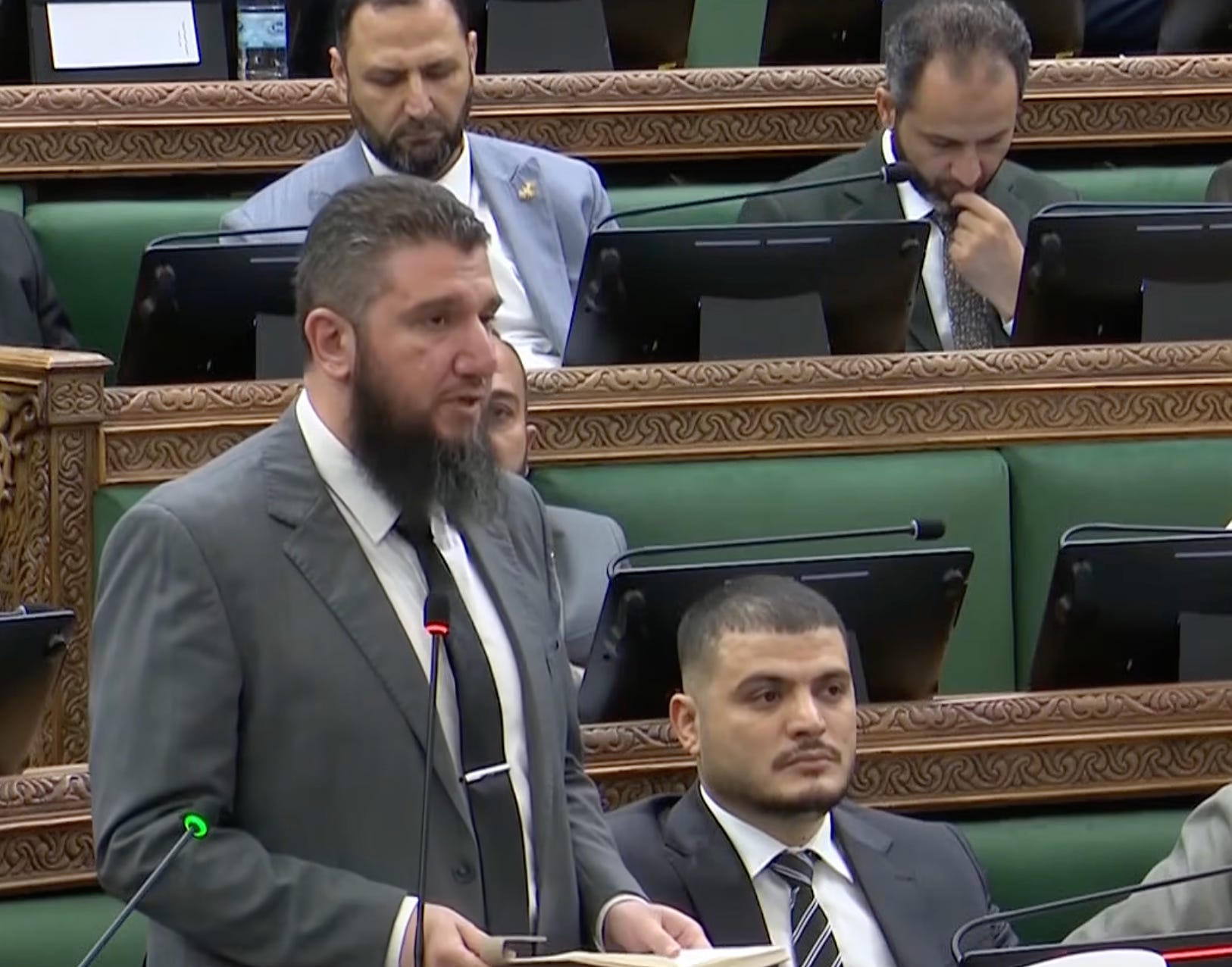
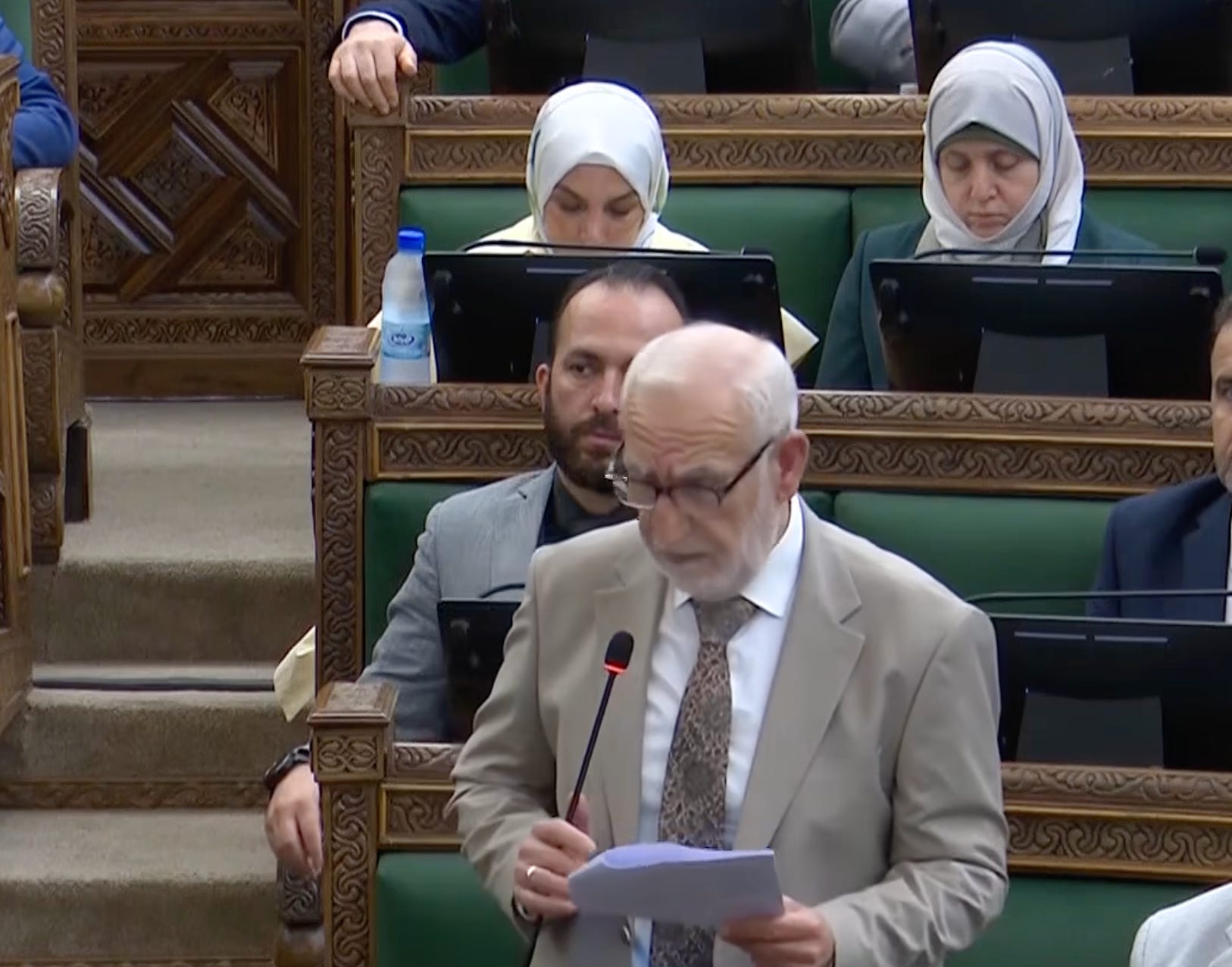
Q7.3 — AbdulKarim Saleh Ukaidi (S1 18:15). Why are energy investments confined to the state or kept secret? “We are surprised by a contract here and an MoU there with various parties.” Would offering them to others give better results?
Minister al-Bashir
Several MoUs for offshore oil and gas exploration have been signed with major companies. Tenders are the main method, but some contracts follow the state’s “political orientation”: Chevron, Eni and ConocoPhillips carry weight, and an Arab energy Minister told him that Chevron and Conoco “will open the doors to all companies”. Contracts must be fair, not exploitative, and the ConocoPhillips MoU is being converted into a contract amid intense negotiations on shares (S1 1:26:56–1:29:34).
Direct contracting (التراضي) is used when products are scarce: if a company offers a product below market, there’s no need to leave people without fuel to run a tender. At first, all crude purchases were tendered; now companies submit price offers, a method the Contracts Law allows, with direct contracting kept for exceptional cases such as government companies (S1 1:26:56–1:29:34).
Partners include ConocoPhillips, Chevron, TotalEnergies, and QatarEnergy, as well as regional firms: ADES [Holding], Kuwait Drilling, and UCC (S1 1:29:10).

5. Supply security: FX, storage, stations and regional pipelines
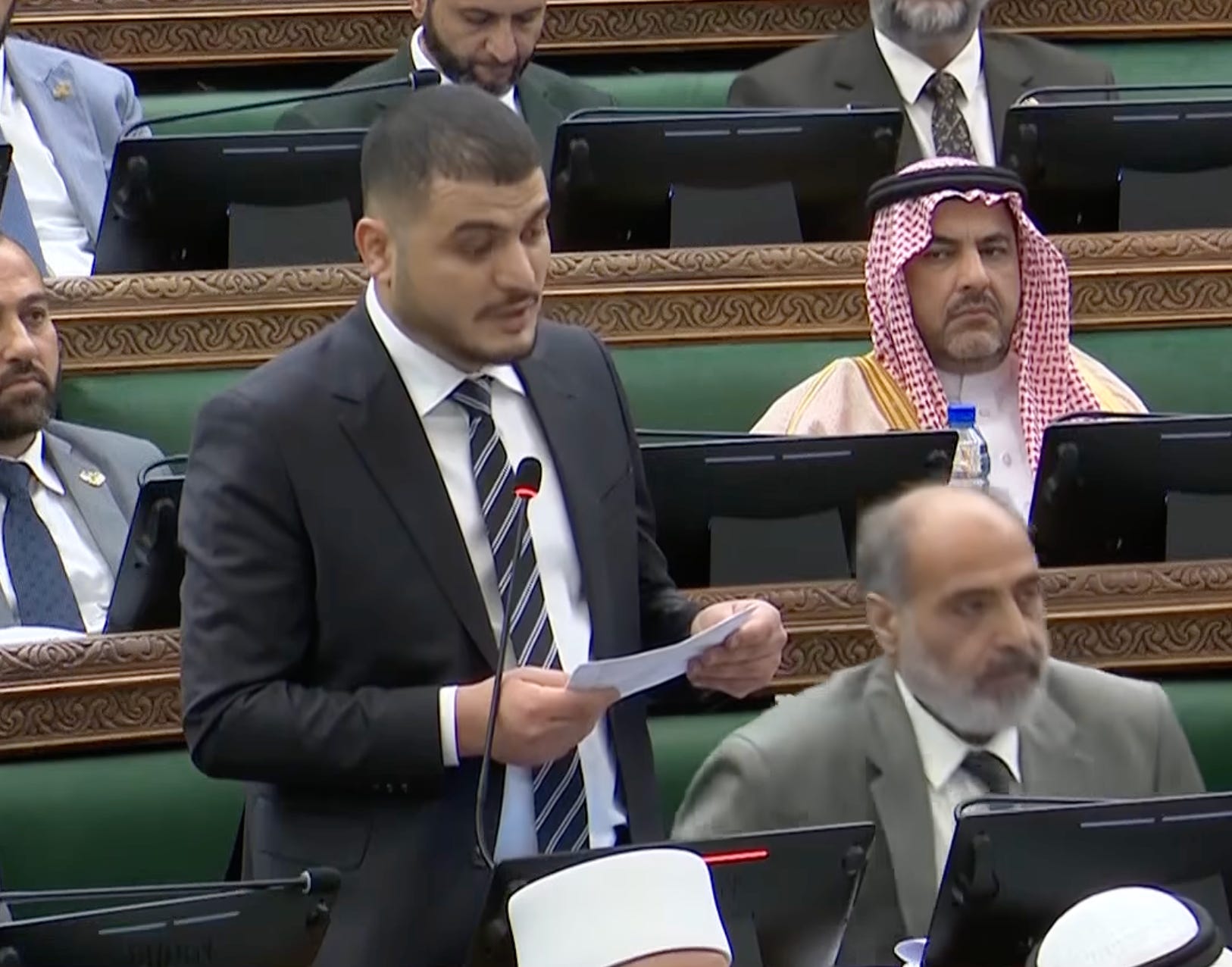
Q4.2 — Mahid SeifEddin Issa (S1 12:10). Energy security: what strategic and emergency plans exist for a sudden supply shortage or production stop? How large is the current strategic stock of products, and how long would it cover the country?
Minister al-Bashir
SPC buys crude and products in dollars but sells in lira, which it deposits at the Central Bank; the Bank’s FX priorities are health, education, defense and interior, so SPC is served late. During the gasoline queues, three gasoline tankers sat at sea, ready to discharge but unpaid (S1 1:14:11–1:16:20).
The norm should be government-to-government supply contracts with Saudi Arabia, Kuwait, Libya, and other producers, for example, 200,000 bpd of crude, or 100,000 bpd of light crude plus diesel and gasoline. Sanctions effects linger, though SWIFT access has been regained. Syria needs USD 831 million a month to buy crude and products (S1 1:14:11–1:16:20).
Homs holds about 102,000 m³ of diesel in tanks in poor condition. A delegation went to South Korea to inspect ready-made tanks, since building new ones takes 1–1.5 years, and reported that they can be bought directly; underground tanks also exist in Deir Ezzor. Effective storage is 312,000 m³ of diesel and 188,000 m³ of gasoline (S1 1:21:44–1:24:44).
Depots at Adra and in rural Aleppo (Khan Touman, Khan al-Asal, Ramousseh) are dilapidated, and Kafr Battikh in Idlib is destroyed (S1 1:21:44–1:24:44). Investment budgets can’t cover everything, because the Ministry of Finance demands SPC’s revenue immediately: USD 250 million a month since the oil came under state control, which helped fund wage rises. “If they left us four or five months, a billion dollars, we’d build reserves, tanks and supply lines” (S1 1:23:09).
Q2.4 & Q2.5 — Laith Waheed al-Balous (S1 8:28). Is there a plan for real-time digital tracking of gasoline and diesel supplied to and sold at stations, to reduce queues and control the market when prices change? What criteria govern allocations to stations? Are some stations favored, for example, Tayba company stations?
Minister al-Bashir
A Petroleum Sector Regulation Department and a services regulation department were created, and new licensing criteria for fuel stations cover safety and service quality. A committee is drafting criteria for EV charging stations, though electricity itself is insufficient (S1 1:16:20–1:17:27).
The Minister gave no direct answer on Tayba stations.
Q4.3 & Q4.4 — Mahid SeifEddin Issa (S1 12:33). How can Syria maximize the benefit from Iraqi oil crossing its territory: transit, refining, storage, export via Syrian ports? Are there actual talks with Iraq? Kirkuk–Baniyas pipeline: is there a rehabilitation plan and a technical-economic study (works needed, duration, operating capacity, revenues for Syria)? He asks for answers with numbers and timelines.
Minister al-Bashir
A section of the Arab Gas Pipeline between Homs and Aleppo is missing; price offers were requested, and completion, costing about USD 250 million from SPC’s own budget, is under way (S1 1:17:27).
Kirkuk–Baniyas is old, low-capacity and idle since the Iraq war; a technical study says it needs full replacement. A company consortium signed an MoU with Iraq, and Syria signed one with the consortium. Iraq is first, since Syria is only a transit country, and Iraq’s prime Minister recently urged the companies to speed up (S1 1:18:07).
Syria will be a party to the contracts. No tender is needed because the same consortium builds from Kirkuk to Baniyas. Syria will earn transit fees and may seek priority to buy oil from the line, local labor, and stations (S1 1:18:07).
6. Governance: the ministry and SPC
Q5.1 — Khaled Jamal al-Khalaf (S1 13:36). There is much talk of SPC covering up corruption, extravagance and waste of public money. Provide a complete database on SPC: founding, structure, rights and powers. He requests a live hearing with SPC’s head before the Energy Committee.
Minister al-Bashir
The merger responded to bureaucracy and overlapping powers between oil, electricity and water; other countries merge these files, some with the economy ministry. Before the merger, investment attraction was weak and decisions poorly aligned (S1 43:31). The ministry was created under [Presidential] Decree No. 150 of 2025, and its institutions were restructured into holding economic entities (S1 44:44).
Three companies were created: the SPC [via Presidential Decree No. 189 of 2025], the SEC [via Presidential Decree No. 45 of 2026] and the SMC [via Presidential Decree No. 44 of 2026], all public holding companies and 100% state-owned. “Some thought we went towards privatizing the energy sector: no.” After years of stability and a capital valuation, some shares could be floated on local or international markets, as with Aramco’s roughly 4% float (S1 44:52).
A new General Establishment for Drinking Water and Sewerage in Damascus now oversees water companies in each governorate; previously, each governorate’s establishment reported directly to the Minister (S1 45:48). The subordinate bodies are the support directorates, the Renewable Energy Support Fund, the General Establishment of Geology, the General Authority for Water Resources (dams, irrigation canals, pumping stations), the General Establishment of the Euphrates Dam, and the water establishment (S1 46:29).
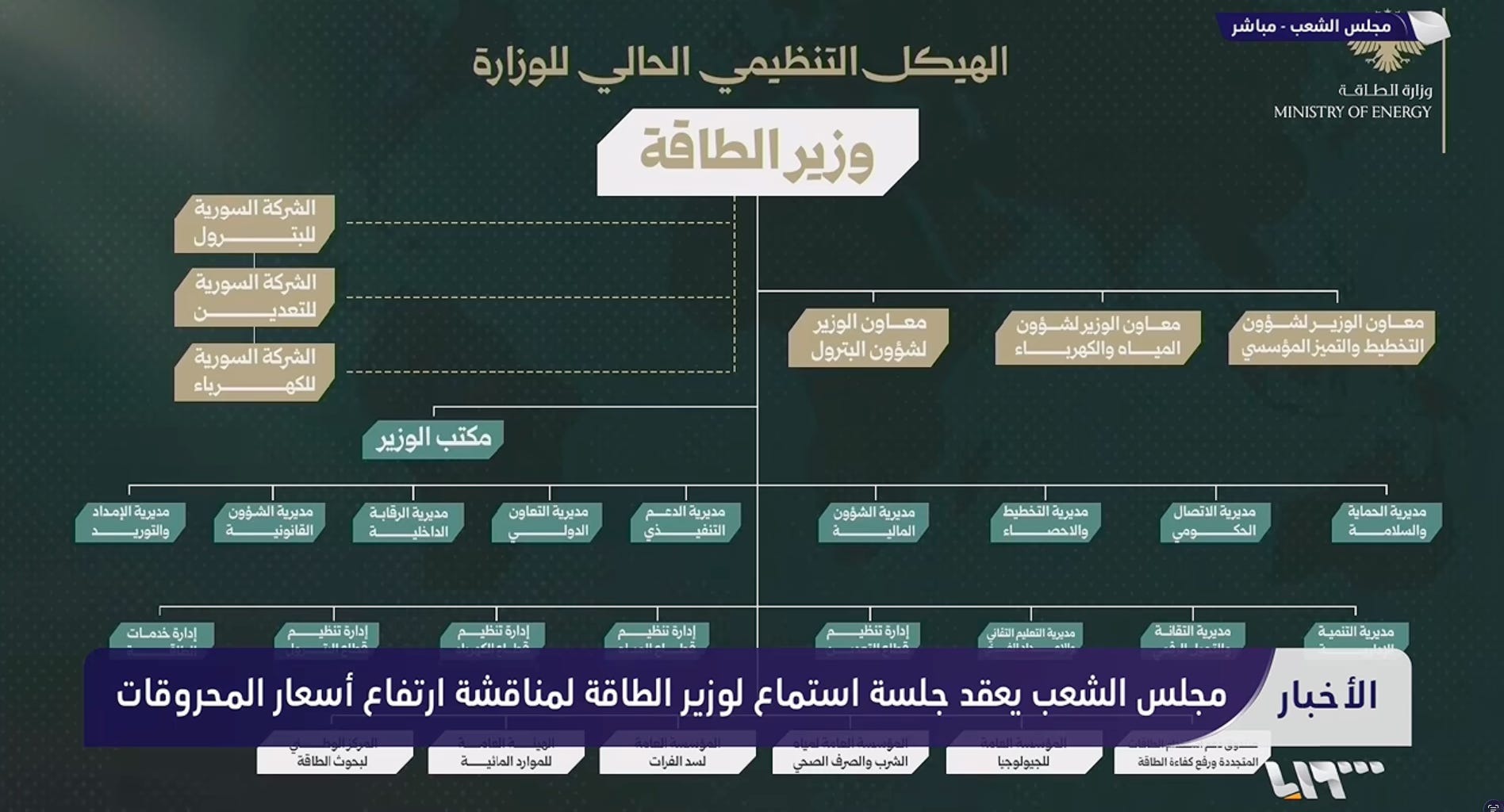
The three companies [SPC, SEC, SMC] are linked (مرتبطة), not subordinate (تابعة). They have their own administrative and financial systems, are not subject to the ministry’s law or the Basic Employees Law, and their boards were appointed by presidential decree (S1 46:58). The boards are drafting statutes and financial regulations, but none has yet been adopted. SPC’s statute is with the General Secretariat for a decree: it was returned with comments, amended, resubmitted, and is “under issuance”, with electricity and mining to follow (S1 47:31).
The ministry’s digital transformation covers an official website, an “Energy Portal”, automated transactions, linked entities and databases (S1 48:03).
7. Electricity: grid, generation, private sector and renewables
Q7.4 — AbdulKarim Saleh Ukaidi (S1 18:40). What is the status and completion rate of maintenance at thermal and hydro plants, and when will maximum capacity be reached?
Minister al-Bashir
Syria has 460 transmission lines at 400, 230 and 66 kV, and 29% of high-voltage lines are out of service, as is 29% of distribution network length in war-damaged villages and towns (S2 0:06). Of 458 transformer substations, 17% are out of service (S2 0:38). Of 12 generation plants, about 37% of capacity is unavailable: Zayzoun and Mhardeh are wholly out, and Aleppo lost all five units, two since rehabilitated (S2 0:46).
At liberation, generation was 915 MW, giving 1–2 hours of supply a day in winter and 4–5 in spring. It is now 3,500 MW including hydro, giving 18–20 hours in most governorates and 24-hour supply to industrial cities. “We multiplied generation three and a half times” (S2 1:18).

Spare parts are scarce, and most substations must be made to order, taking 18 months to two years. Deir Ezzor, which had a single substation at al-Taim, got an unused substation moved from elsewhere in Syria. The same lead times explain delays on large solar projects: nine sites have been handed to companies, but they need substations and imported equipment (S2 2:34–4:12).
Rehabilitation raised Jandar from 200 to 850 MW, brought Deir Ali to 700 MW after maintenance of an idle unit, and returned one 100 MW unit at Mhardeh after about ten years offline (S2 3:55). Deir Ali will gain a new 750 MW unit (S2 4:12). A USD 98 million contract was signed for two 200 MW units at Tishreen thermal, the first due in Q1 next year and the second in Q2, giving 400 MW by mid-year (S2 4:20).
Rastan (526 MW) was started by the [Iranian] company MAPNA [Group], which stopped after the revolution’s victory; negotiations are under way to complete it (S2 4:43). Price offers for Aleppo’s three idle units went to a Turkish company for USD 115 million. A cheaper bid was rejected on technical grounds because it would lose about 10 MW per unit in efficiency, which the law allows [rejecting a cheaper bid contract]; the contract is expected by year-end (S2 4:58).
Demand will roughly double by 2030, and existing plants are old and inefficient, so the ministry signed a contract for four new combined-cycle gas plants. They are in Aleppo (al-Tarifawi), Zayzoun (replacing the destroyed plant), Hama (Mhardeh) and Deir Ezzor (al-Taim), a governorate with no plant of its own beyond a very small one at al-Suwaidiyah near Hasakah. Together they total 4,000 MW, three ready in 2029 and one in 2030 (S2 5:59).
Transmission towers are all imported (S2 9:08). When Idlib and rural Aleppo were fed from Türkiye, a storm felled four towers in Türkiye and the area went 18 days without power (S2 9:08). About 7–8% of transmission lines have been rehabilitated, including the Türkiye interconnector, which is in progress, and the Jordan interconnector, financed by the World Bank and under execution (S2 9:54). Completed works include 156 km of high-voltage lines (8 km at 400 kV, 16 km at 230 kV, 132 km at 66 kV), seven substations, and rehabilitation of the Aleppo 400 kV substation (S2 10:11).
Q7.1 — AbdulKarim Saleh Ukaidi (S1 16:39). Involve the national private sector in production, transport, and distribution, with incentives, with the state only regulating. Specifically, private alternative-energy generation: what incentives exist, and is the price the ministry pays solar producers adequate, especially in industrial zones?
Minister al-Bashir
The aim is eventually to bring private companies into distribution, but the legislative framework isn’t ready, and the electricity law is being amended. Private distributors would add a profit margin borne by the state or citizens, so this has been postponed until the transmission company recovers (S2 10:36).
A Saudi company was contracted for a national control center and SCADA system, costing about USD 60 million (S2 11:09). Losses are high because of old plants and substations, network losses, illegal connections and theft (S2 11:39). Distribution works have replaced 784km of medium- and low-voltage lines and equipped or replaced 861 transformer centers (S2 11:59).
Q9.3 — Khaled Arafat Aarabi (S1 22:53). Brief Parliament on studies and plans for new dams, and for exploiting rivers and wind as alternatives to fossil fuels.
Q10.12 — Mahmoud Saleh al-Owais (S1 36:26). Hybrid and electric energy: the world is moving away from oil; over 30% of Jordan’s vehicles are electric [as stated]. What steps will the ministry take on infrastructure, draft laws, coordination with other ministries, public awareness, and customs cuts?
Minister al-Bashir
About 4,000 MW of renewables have been signed: 2,500 MW solar and 1,500 MW wind. Examples include Wadi al-Rabi’ in Rif Dimashq (200 MW), Furqlus (200 MW), al-Taim in Deir Ezzor (300 MW) and Aleppo (300 MW), with land already handed over (S2 7:02).
A private firm was contracted to study Syria’s energy mix across wind, geothermal, solar and fossil sources. Its draft result is 2,500 MW of solar and 1,500 MW of wind, plus about 8,000 MW of fossil generation by 2030, including UCC’s plants (S2 7:25).
Renewables are part of the solution but should not exceed 20–30% of generation for grid stability. He cites last year’s Spain–Portugal blackout as the risk of exceeding that share (S2 7:48).
8. Gas costs, the electricity tariff, smart meters and the budget
Q7.6 — AbdulKarim Saleh Ukaidi (S1 19:05). How will higher fuel and gas costs affect future electricity prices?
Q9.1 — Khaled Arafat Aarabi (S1 21:46). Gas arriving via Türkiye (he calls it “European gas”): stations are out of service, reception is irregular, metering is lacking. What has been done?
Minister al-Bashir
Syria needs 24 mcm/d of gas, produces about 8.5 and buys about 6.3: 5.3 from Azerbaijan via Türkiye, and 1 mcm via a Floating Storage Regasification Unit (FSRU) at Aqaba, piped through the Arab Gas Pipeline to Deir Ali. This costs about USD 140 million a month. About half (3.2 mcm) was a Qatari grant that ended in August, so the country now buys all gas. The Ministry of Finance has not budgeted the full gas bill, so purchases may be cut by 2–3 mcm/d, reducing supply hours (S1 1:04:34–1:08:12).
SPC had been transferring about USD 250 million a month to the treasury; last month it asked the Ministry of Finance to cover its deficit, but the Ministry said it could not. The options are to live with fuel crises, or to stop buying gas and return to 2–3 hours of power as under the old regime, when 6 mcm produced about 950 MW and 1–2 hours in winter (S1 1:06:24). Industrial and commercial users take about 40% of power, so cutting supply would close reopened factories and reverse growth (S1 1:07:50).
Under the old system, 6 mcm/d of domestic gas generated about 950 MW with no purchases; when industrial cities and tourism and commercial users demanded power, the ministry started buying gas at about USD 140 million a month (S2 13:18). SPC buys the gas and supplies the SEC, which should generate, collect and pay SPC (S2 14:09). SPC’s receivable from SEC stood at USD 1.65 billion “as of yesterday”, because collections fall short through plant and network losses, theft and the high cost of gas (S2 14:09).
The tariff aims to sustain gas purchases with a financial return and to reduce load (S2 15:06). When the Qatari grant came, supply rose from 2 to about 8 hours, and longer continuous supply overloaded transformers and lines, which had “no time to cool”, so explosions multiplied. The tariff was also a technical measure to curb consumption (S2 15:06).
Q7.7 — AbdulKarim Saleh Ukaidi (S1 19:13). Subsidize the first electricity block above 300 kWh (per billing cycle), or halve it, or create a middle block, giving three tiers (low-income, middle, others).
Minister al-Bashir
The tariff emerged from dozens of workshops and three meetings with governors, with options narrowing from four tiers to three, then two. The first block is 300 kWh per two-month cycle, or 150 kWh a month, priced at 4.5 US cents/kWh, for a bill of about USD 6.5 a month. Engineers measured that 150 kWh covers lighting, a fridge and a washing machine for a limited-income family, though not heating (S2 16:24). Heating and water heating fall in the second block; a third subsidized block would mean going back to three or four hours of supply (S2 17:51).
An MP visited and told him, “you got Damascus to 20 hours, but it’s expensive”; he replied that price is what got it there. The easy option was to burn only domestic gas for two hours of power a day, as before, when, the MP said, people “used blankets” (S2 18:07).
The second block costs 11 cents, compared with SEC’s 18 cents. SPC transfers gas to SEC at USD 9/MMBtu while buying it at USD 22/MMBtu today (S2 18:58). Syria will therefore cut gas purchases by 2 mcm/d, reducing service, because SEC’s deficit to SPC is USD 1.65 billion (S2 19:41).
In the first billing cycle after the rise, collection reached 72% in Damascus and 76% in Aleppo, with Tartous similar and some governorates much lower; the cycle stays open until year-end (S2 19:47). Good collection means more gas and better service (S2 19:47).
At today’s prices, even industrial and commercial power is subsidized, though both were at break-even when set. Subsidy rates are 75% on the first block, 42% on the second, 30% on “golden lines” exempt from rationing, and 26% on industrial and high-voltage users such as smelters, so overall electricity subsidy runs from 26% to 75% (S2 21:02).
The goals are to rehabilitate lines and substations, raise generation, add renewables, and continue tariff reform. The tariff might suit SEC once self-sufficiency is reached, but with purchased gas at world prices it is “very burdensome”, and cutting gas purchases is “the only solution” for now (S2 21:52). Some want 4–6 hours of power, but reopened factories can’t be told there is no power: “no going back”. He has asked the Ministry of Finance for more FX for gas and fuel oil (S2 22:25).
Q7.5 — AbdulKarim Saleh Ukaidi (S1 18:47). What is the plan and timeline for smart electricity and water meters?
Minister al-Bashir
A contract was signed with a Saudi meter company; supply has started, and pilot meters are installed. This year, 300,000 meters will go into Damascus and Idlib, with all governorates from early next year, plus a control center. The meters will run on cards, Wi-Fi or telecom networks, easing top-up and billing and cutting losses (S2 12:15–13:10).
Separately, bids for smart water and electricity meters were awarded to a Chinese company; delegations went to China twice, and the contract, for about 6 million smart meters of each type, is in its final stages (S2 28:18).
Q8.1 — Omar Issa al-Hayes (S1 20:10). Detailed 2026 budget for the Ministry of Energy: revenues, expenditure and deficits since its adoption after the one-twelfth provisional budgets.
Minister al-Bashir
Detailed budgets for all companies, covering investment, current spending, surplus, income and losses, will be provided. “Electricity has declared a loss of USD 1.65 billion to date; on August 1 it was USD 1.3 billion” (S2 23:30).
In mining, the vision is to move into processing industries such as phosphate and silica rather than exporting raw ore. Geological activity so far: 1,302 field trips, 2,700 tests, 1,400 licenses, 93 industrial licenses and 190 investment contracts (S2 24:20).
9. Water, dams and irrigation
Q1.8 — Abdullah Majeed al-Hajj Abd (S1 4:49). Euphrates Dam: only four of eight turbines work; the other four are out of service.
Q10.9 — Mahmoud Saleh al-Owais (S1 31:09). Halabiyeh–Zalabiyeh dam on the Euphrates: power, water and agriculture. These projects could go to investment or into the budget.
Minister al-Bashir
Syria has 164 dams with a total capacity of 19.03 billion m³, the largest being the Euphrates and Tishreen dams, plus other dams providing irrigation for about 18 [thousand?] km of irrigation networks and 285 pumping stations (S2 29:33).
The Euphrates Dam has eight units, four of which are out of service. Technical studies for two are ready and included in the Euphrates Dam establishment’s investment plan; if the 2027 budget is approved, rehabilitation of those two will begin. Tishreen Dam has six units: one was out and has returned, with some technical problems (S2 30:30).
A fourth Euphrates dam, Halabiyeh–Zalabiyeh, is under study and will be offered for investment. It is a regulating rather than storage dam, generating about 75 MW from three units and supporting irrigation and land reclamation (S2 30:06). It would irrigate 30,000 ha, produce 78 MW and benefit about 87,000 families (”about 60,000 people” [as spoken]) (S2 34:47).
Q10.1, Q10.3 & Q10.4 — Mahmoud Saleh al-Owais (S1 25:03). Syria wastes about 90% of its water potential; 60–70% of arable land is not farmed. Syria’s Euphrates share is 500 m³/s under the 1987 agreement, but only about 200 m³/s arrived in recent years. After four years of drought, last winter’s rains turned the river into a burden.
Last winter’s flood crisis was managed only with warnings and media statements, with no prior plan. The Euphrates now carries 1,200 m³/s in summer; in winter it could reach 2,000–2,500, risking dam failure and floods in Raqqa and Deir Ezzor, destroying crops, homes, and bridges. Flash floods in the Badia also destroyed bridges. What measures (not plans) has the ministry taken?
What coordination or agreement exists with Türkiye on flows? Last year’s releases were unilateral, hence the surprise.
Minister al-Bashir
Inflow from Türkiye rose from about 200–220 m³/s to about 1,000 m³/s (S2 31:16). The riverbed was designed for 3,000 m³/s, but encroachments by farming and building mean even 2,000 would cause problems; the water law defines a 3,000 m³/s protection zone that people have violated (S2 31:16).
Last time, dams were refilled after severe depletion that had stopped some plants; once refilled, Türkiye gave one day’s warning that it would increase releases. Releases had to rise, and in Raqqa the al-Rashid bridge would have been lost. Earthen causeway bridges worsened the crisis by holding water back; with the al-Siyasi, al-Rashid, and al-Mayadin bridges restored, the problem should ease (S2 32:21).
Q10.5 — Mahmoud Saleh al-Owais (S1 28:39). Have irrigation and land-reclamation canals been dredged, and how many km? Have the Badia dams been repaired?
Minister al-Bashir
Since the start of the year, 1,974 km of irrigation canals have been dredged round the clock, after the old regime left them uncleaned for 15 years; this absorbed heavy rains without floods (S2 33:21). The al-Sayha dam between Aleppo and Idlib was a collection dam built by locals, not the water authority, but the ministry took responsibility and is working with the Emergency Ministry on the damage (S2 33:51).
Water points and drinking-water samples are being monitored. Four dams are being completed, and two or three more are in the 2027 plan (S2 34:22).
Q10.7 & Q10.8 — Mahmoud Saleh al-Owais (S1 29:40). Strategic projects: artificial reservoirs, smart canals, and modern irrigation (as in Saudi Arabia, Türkiye, India) could cover over 1 million ha. The “Euphrates Renaissance” idea to revive the Khabour: a 30-year tragedy, whole villages emptied by drought. What is the plan?
The 2006 Tigris diversion project: the Tigris runs about 50 km inside Syria and goes unused, despite having a higher flow than the Euphrates. It could irrigate all of Hasakah and revive the Khabour.
Minister al-Bashir
Under international law, Syria has an unused share of the Tigris. The Tigris–Khabour diversion would irrigate about 215,000 ha, 150,000 of them new and 65,000 formerly irrigated from the Khabour, at a cost of USD 2 billion. It is branded the “Green Renaissance” for Hasakah and Deir Ezzor (S2 34:55).
Q10.10 — Mahmoud Saleh al-Owais (S1 31:44). Sewage flows into rivers and lakes, especially in the east, where river water is undrinkable. Treatment plants would yield methane, fertilizer, and about 700 million m³ of reusable water from three plants, for fodder and afforestation. (He mentions an Agriculture Ministry deal with a Saudi company (”3,000 or 300,000 ha, I don’t remember”)).
Minister al-Bashir
Syria has 5,700 water sources, about 65,000 km of networks and 123 wastewater treatment plants, yet most sewage goes untreated into rivers, lakes and the sea. Treatment plants are a priority for agricultural water and pollution control (S2 24:57). In the investment budget, he has requested at least five wastewater treatment plants per governorate, since sewage flows into the sea in Latakia and Tartous, the Euphrates in Deir Ezzor, and the Orontes in Idlib and Hama; he asks MPs to prioritize them when voting on the budget (S1 1:23:53).
The Adra plant is being rehabilitated. Aleppo’s Ramousseh plant costs USD 400 million and is being marketed to the World Bank and others, or may be financed by a loan, because the Ministry of Finance says it cannot allocate that sum (S2 25:46). Waste is huge: “a cubic meter of water costs 7 old lira, i.e. 0.007 SYP” under the tariff, so people waste it, with rooftop tanks overflowing and cars washed (S2 26:02).
Works include maintaining 6,000 pumps and 1,462 generating sets; drilling 38 new wells; rehabilitating 1,051 wells, 110 elevated tanks, and 206 pumping and treatment stations; and installing 416 solar systems, 406 of them at water pumping stations. On networks, 10,000 rehabilitations or replacements, 11,000 repairs, and 126,000 violations were recorded, plus 92 lines exempted from rationing and 136 transformer centers for water stations (S2 27:10).
Service was restored to about 2.3 million people through the Wadi Marwan, al-Jarrouh, Alouk (Hasakah), and Maarat al-Numan projects, which had been idle for 12–13 years (S2 27:52). Sixteen wastewater plants were built, and more than 2,686 km of sewer lines were replaced. Partnerships include Ain al-Zarqa in Idlib, whose system serves 80% of the governorate, agreed with the World Bank and humanitarian partners; an upper Orontes project; and the Adra treatment plant, with about 2.2 million beneficiaries, in execution (S2 28:43).
Q10.11 — Mahmoud Saleh al-Owais (S1 33:13). Euphrates-to-Hisyah water project (phosphate plant, industrial city), announced on the 30th of last month: he supports it but questions it. It runs 410 km at an initial USD 571 million; he expects USD 1–1.5 billion, citing Jordan’s Aqaba–Amman carrier at over USD 3.5 billion. It needs protection and maintenance and takes water from Raqqa’s and Deir Ezzor’s share. Alternatives: desalination near Baniyas (110–120 km away, USD 500–600 million), a line from Lake Quttinah (80 km, under USD 100 million), or local wells (about 1,200 meters deep, about USD 2 million, lasting 10–15 years). He asks for a neutral committee to compare options before bids close on 30/9.
Minister al-Bashir
The USD 571–572 million cost of Euphrates–Hisyah is accurate for 3 m³/s; converting it to agriculture would need 12 m³/s and about USD 1.5 billion. It draws from Lake Assad, not from Deir Ezzor’s or Raqqa’s share: 3 m³/s against about 1,000 m³/s of flow. It mainly serves industry and drinking water, supplying Palmyra, a branch back to Deir Ezzor for livestock, and a branch to Hisyah for the industrial city, the phosphate mines, and the Furqlus refinery site. The ministry posts offers on its platforms, and companies are enquiring (S2 35:56).
The “national carrier” would capture freshwater along the coast, from the al-Sinn river, submarine springs, and groundwater, and pump it to the Qutayfah reservoirs, then by gravity to Damascus, Daraa, Suwayda, Quneitra, and Rif Dimashq. A study contract has been signed, but the project has not yet been studied, with an initial estimate of about USD 9 billion. It would reduce Ain al-Fijeh from 40 m³/s to about 1.5 m³/s. Some desalination may be included, but desalination costs about USD 0.50/m³, or 37 cents in the best case he has seen (S2 37:24).
Unanswered questions
Sixteen of the committee’s questions received no answer in the presentation. All were asked in Session 1.
Abdullah Majeed al-Hajj Abd
Q1.5 (S1 3:46): What justified the sudden price rise, “as if it was planned overnight”? We woke up to prices up “insanely”.
Q1.9 (S1 5:05): Maskanah East pumping station (Japanese-built): only two of six motors work. Its irrigation network (17,700 ha) is worn out, and nobody responds.
Q1.10 (S1 5:39): Rusafa transformer station (his constituency) is down, idling about 110 wells (he first says 120); only 10 run on diesel. It also feeds al-Safih, al-Mamlaha and al-Wahhab. When will it be repaired?
Laith Waheed al-Balous
Q2.2 (S1 7:45): Why not announce a public subsidy policy for fuel and electricity that targets the neediest, as a transitional measure until living standards improve?
Omar Fawaz al-Mohammad
Q3.4 (S1 10:59): Request a circular obliging ministries to ration and cut back in civilian and military sectors, cancel open personal fuel cards, and apply strict monitoring.
Mahid SeifEddin Issa
Q4.1 (S1 11:51): How long will the latest price increase last? Given the protests, will the ministry set clear criteria for any future increase or decrease?
Khaled Jamal al-Khalaf
Q5.2 (S1 13:59): Is there a plan to install high-accuracy meters from the fields through to shipping, refineries, and ports, to reconcile figures and prevent manipulation?
Q5.4 (S1 14:38): Are all oil and gas fields fully under Syrian government control?
Mohammad Saeed AbdulQader al-Hasso
Q6.3 (S1 15:40): Create a stabilization fund that intervenes when prices exceed a threshold and brings them back down.
Q6.4 (S1 15:56): What is the estimated percentage of energy waste, both governmental (motorcades, events, displays) and by citizens (unpaid bills, grid theft)?
AbdulKarim Saleh Ukaidi
Q7.2 (S1 17:33): Public debate over contracts such as UrbaCon’s: what are the company’s obligations, and what is the legal basis? Provide Parliament with a full copy of that contract and others.
Omar Issa al-Hayes
Q8.2 (S1 20:25): Is importing crude or products overland from the Gulf possible and economically feasible?
Khaled Arafat Aarabi
Q9.2 (S1 22:24): The decision to close the oil secondary schools: postpone it two years so first- and second-year students can finish.
Q9.4 (S1 23:23): Does the pricing committee distinguish between products by their impact on citizens? Diesel hits people in many ways; gasoline less so.
Mahmoud Saleh al-Owais
Q10.2 (S1 26:26): Modern irrigation networks are lacking. Farming stops 2–5 km from rivers and lakes; beyond that, it is rain-fed. No state drip systems; much Badia land is unused.
Q10.6 (S1 29:02): Proposal: a spillway into Badia depressions like Egypt’s Toshka, with at least three candidate storage areas.
Partly answered
Q2.5 (S1 8:44), Laith Waheed al-Balous: the point on Tayba company stations got no direct answer (see section 5).
The Syria Dispatch is an independent publication covering Syria’s economy, politics, and society, founded and edited by Benjamin Fève.
Subscribe to receive future issues, research, and analysis directly.
Comment. Questions, corrections, or disagreements with the analysis above are welcome! Please feel free to leave a comment or reach out directly.
Looking for research, analysis, or advisory support on Syria? Benjamin Fève provides independent consulting on Syria’s political economy, reconstruction, and economic governance — including research design, briefings, interviews, and tailored analysis for organizations, investors, and policymakers. Get in touch to discuss a project.