

On September 20, 2026, Syria’s People’s Assembly held a hearing with Energy Minister Mohammad al-Bashir after the fuel price increase and the protests it sparked. Across two sessions (Session 1 and Session 2), MPs questioned him on oil, gas, electricity, water, and the governance of the new energy companies. This two-part series is an annotated, timestamped account of that hearing. Part 1 covered the Energy Committee’s prepared questions and the minister’s presentation. Part 2 covers the open-floor exchanges with MPs, organized by theme. In case you missed it, read PART 1.

Introduction: what the open floor tells us
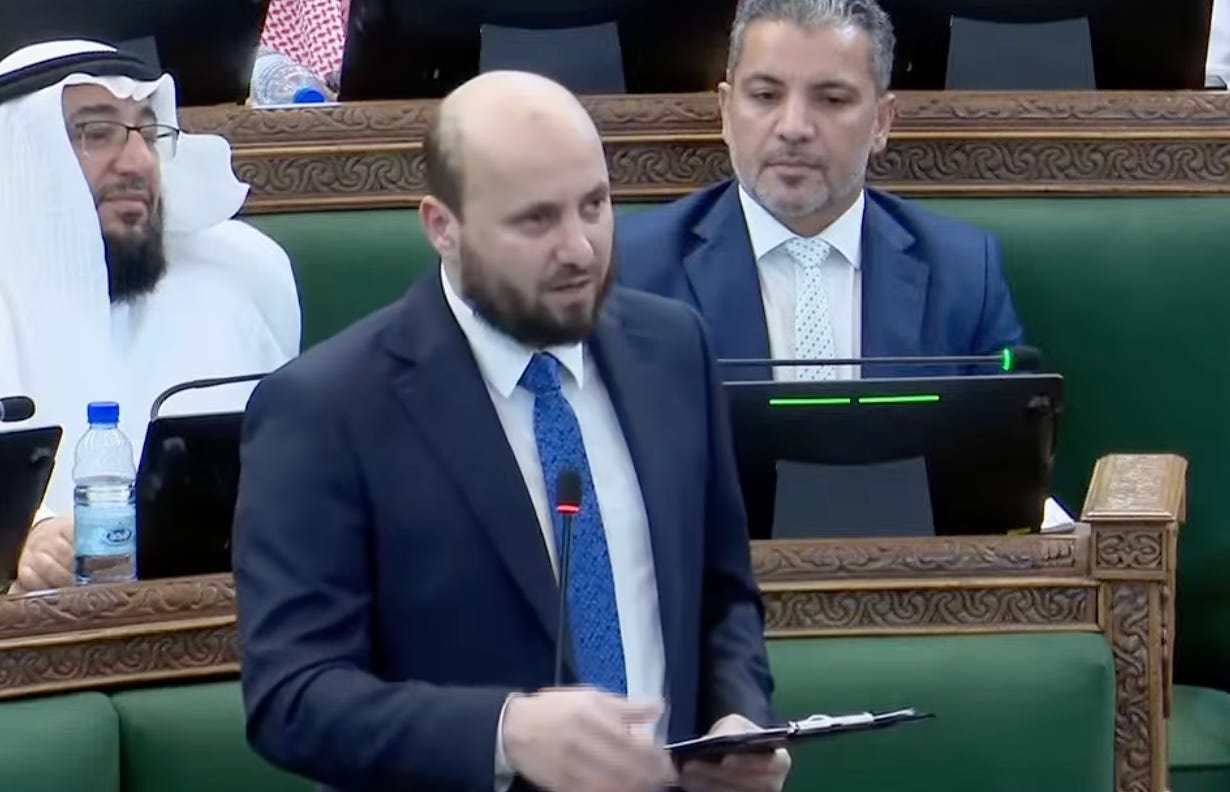
If Part 1 was the minister’s presentation, Part 2 is where Parliament talked back: once the presentation ended, 87 MPs registered to speak, and the Speaker limited each to one question and one minute, grouped them in batches of about five, then handed the floor back to the minister. The rules were broken constantly. Many of the “questions” were statements or proposals, and the minister, to his credit, responded to most of them anyway. Unlike in Part 1, opening the floor to so many MPs produced exchanges that were more often than not political, less technical and, overall, much closer to what Syrians were saying in the streets.
Living costs gave the MPs their strongest arguments, with one noting that a 200-liter barrel of diesel at the third-tier price now costs about 2.3 million old SYP (about USD 170), roughly a public employee’s monthly salary, and that transport and food prices had risen 30–60%. Another asked how a family earning USD 250–300 a month is supposed to heat its home. A third called the rise an inflationary shortcut to closing the budget deficit, “a tax the poor pay to the rich”, and warned that multiple fuel prices have always meant black markets.
In reply, the minister held to a doctrine he repeated throughout the afternoon: the Syrian Petroleum Company (SPC) and the Syrian Electricity Company (SEC) are “economic entities” that run on profit and loss, and support for farmers, bakeries, transport or vulnerable households belongs to the ministries in charge of those sectors, to the Ministry of Finance and to the Ministry of Social Affairs and Labor. “We feed the treasury, not the other way round,” al-Bashir said. He came back to this so often that he ended up explaining how subsidies are meant to work in the new system, arguing that “supporting agriculture, bread, industry and vulnerable groups is not the Energy Ministry’s job alone.”
If the Ministry of Agriculture wants cheaper diesel for farmers, it buys at the set price and covers the difference with money agreed with the Ministry of Finance, and the same goes for the Ministry of Transport and bus lines. The Ministry of Energy sells at the price the pricing committee sets; who gets help, and who pays for it, is decided elsewhere.
In a transition to a market economy, that logic is defensible, but the hearing showed that nobody else seemed to own the safety net either. An MP reported that the Minister of Social Affairs said she learned of the price rise like any citizen, even though her lists of households needing support were ready, and the minister answered that the data were incomplete.
Along the way, the hearing gave a fair picture of how little the state pays its own workers, and how much of a problem that has become. When the burners in the east were shut down, the workers’ names were recorded and they were promised jobs at SPC, but many turned them down: SPC is still on the civil-service pay scale, and the jobs paid USD 100–110 a month. Engineers at the Euphrates Dam earn about USD 120. The minister said he found only 11 engineers at the dam, all in their fifties and sixties, while HKN, Conoco and other private operators hire away the younger ones. A new pay system has to wait for SPC’s statute, and with SEC’s losses of USD 1.65 billion, there is no money for raises yet.
Compared with Part 1, where the minister was mostly candid, the open floor showed a more combative side of him, and at times a much wittier one. To MPs complaining about the price rise, he offered a deal: a smart card with 50 liters per family, and a black market at USD 2–2.5 a liter for the rest, “as in many countries”. “If Parliament agrees, write it and send it, and I’ll adopt it immediately.” It was not the only time he handed the problem back to Parliament. Asked why Raqqa’s energy directors come from outside the governorate, he asked whether any law requires otherwise, and promised to comply if Parliament passes one.
While the line works in Parliament, it is too easy a way out: presidential decrees have reached into almost every corner of economic policy since the transition, and the government does not need a letter from Parliament to bring back the smart card or to appoint local directors. The current system is a policy choice, and the minister both acknowledged and defended it.
His wit showed again when an MP asked about SPC’s assets and oversight, and the minister suggested that MPs would understand how such institutions work “if the brothers took a little trouble to read the decrees”. He brushed off rooftop solar feed-in as the idea of people who call themselves “a PhD or an expert”, “sitting on the sofa, under the air conditioner”, which anyone who follows Syrian debates online will find hard to disagree with entirely. Less defensible was his explanation for hiring no women in petrochemical engineering: field jobs, he said, are “unsuitable” for them. So was his argument that fuel is only about 2% of production costs, and that a 30% rise should therefore not push prices up 30%, a claim the MPs’ own figures contradicted.
Several of his arguments deserve a fair hearing, starting with why price rises are not announced in advance: doing so, he said, invites hoarding, and before one change, daily gasoline orders from stations fell from 7,000 to 1,000 tons as everyone waited. The problem is real, but it does not explain why the ministry rejected a proposal for a fixed, published monthly pricing cycle with a transparent formula, which is how many countries avoid both surprise and speculation.
The minister was also convincing on priorities: much of the infrastructure is past its design life, from plants and substations to breakers and valves, so the first job is the 29% of the network that is out of service, and replacing old equipment that still works comes later, after an inventory. That answer came in response to one of the day’s most technical questions, on the switching life of ring main units, and it was not the only one. MPs came with figures on solar buyback tariffs, GPS tracking on Homs buses and the monitoring of burner refineries. Some of them were plainly well informed, or well supported, which is good news for the hearings to come.
The open floor also produced the hearing’s most important governance disclosures, starting with the minister’s confirmation that Taaziz, Golkon and Star Petronova, firms that hold SPC contracts, belong to the same owner or owners, and that the Central Authority for Supervision and Inspection (CASI) had flagged problems in their contracts. He explained that Taaziz won a direct contract to reinject polluted formation water because it was the only firm operating on both sides of the Euphrates. He defended SPC’s termination of 42 contract workers who celebrated a CASI corruption case, saying they had threatened their director, while the USD 28 million case itself went unaddressed.
He also expanded a contract with burner-type “refineries” in Hasakah from about 17,000 to 35,000 barrels a day without explaining how costs and volumes are monitored. And he revealed that Green Energy, the private-looking company that distributes electricity in Idlib at higher prices than elsewhere, is owned by the Sovereign Fund and registered with the Ministry of Economy. That raises questions nobody asked: why the Sovereign Fund is running electricity distribution in one governorate, and whether other companies set up in Idlib under the Salvation Government were folded into the fund the same way.
As in Part 1, much went unanswered, and the most important gap was raised by an MP almost in passing: if every energy activity loses money, how does SPC still transfer USD 250 million a month to the treasury? The question got no reply.
Still, Parliament now holds a public record of commitments: smart meters, a monthly stock target, Baniyas back online by November, a Social Affairs representative on the pricing committee and written answers to every question left open. The Speaker adjourned until October 18. Whether those answers arrive, and whether both sides are better prepared for the next hearing, is the real test of the precedent set on September 20.
How to read Part 2
Part 2 covers the open floor, which ran from 39:49 to the end of Session 2 (3:20:04). MPs spoke in batches of about five, then the minister answered the batch. Questions are grouped here by theme, with the name of the MP who asked each one.
Sessions and timestamps: all exchanges in this part took place in Session 2 (S2). Each timestamp marks where the point begins in that session’s recording.
Minister’s answers: these appear under the header “Minister al-Bashir”. Because he answered several MPs at once, his remarks are matched to the questions they address. Where he answered the same theme in several rounds, his replies are combined.
Sources: each claim ends with its source in parentheses: session and timestamp. When consecutive claims come from the same passage, a single timestamp follows the last one.
Paraphrase and quotation: questions and answers are condensed and paraphrased for clarity and length. Only passages in quotation marks are verbatim.
Editorial clarifications: where the audio was unclear, or a speaker appears to have misspoken, the likely intended meaning is given in square brackets. These are the author’s interpretations, not the speaker’s words. Additional information, when necessary, is also added in square brackets.
Currency: unless noted, SYP refers to the new lira, which the minister converts at about SYP 135 per USD. Figures in old lira are marked “old SYP”.
Unanswered questions: questions the minister did not answer, or answered only in part, are listed at the end, grouped by MP.
1. The price rise, protests and consultation
Nour Mohammad Mouayad Jandali (S2 41:35). Protests in at least eight governorates pushed the government, within days, to an emergency package: three diesel price tiers and restarting some local refineries to supply subsidized fuel for heating and farming. What has the ministry learned? Does it have an institutional mechanism to assess a decision's social impact before taking it? Will it commit that any future energy price change is preceded by a published study of its economic and social cost, and a mechanism to protect those most affected?
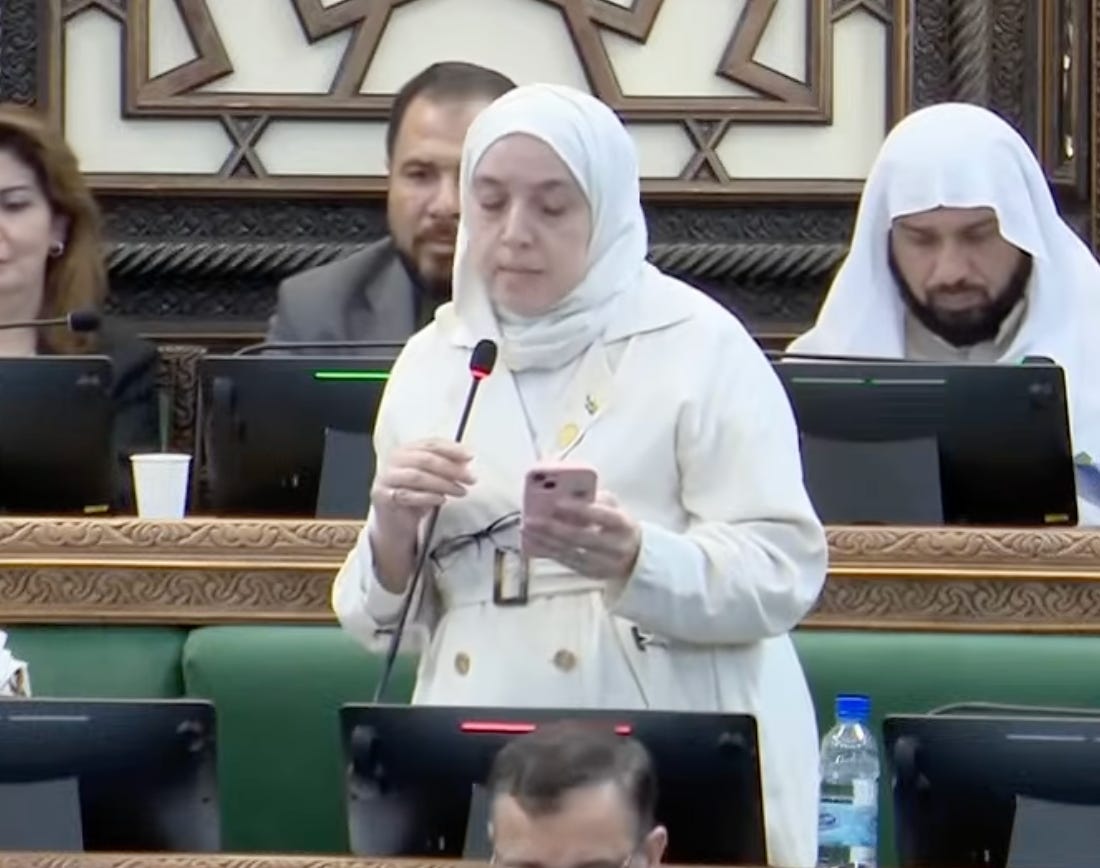
Ibrahim Abdallah al-Abdallah (S2 2:32:12). The year began with promises that “we don’t import a liter of diesel or gasoline”. Then the Jazira [the northeast] returned to the state, followed by a fuel shortage and a sudden price rise. The state could have temporarily financed the deficit, which he estimates at USD 150–200 million a month. Why do solutions always fall on the citizen?
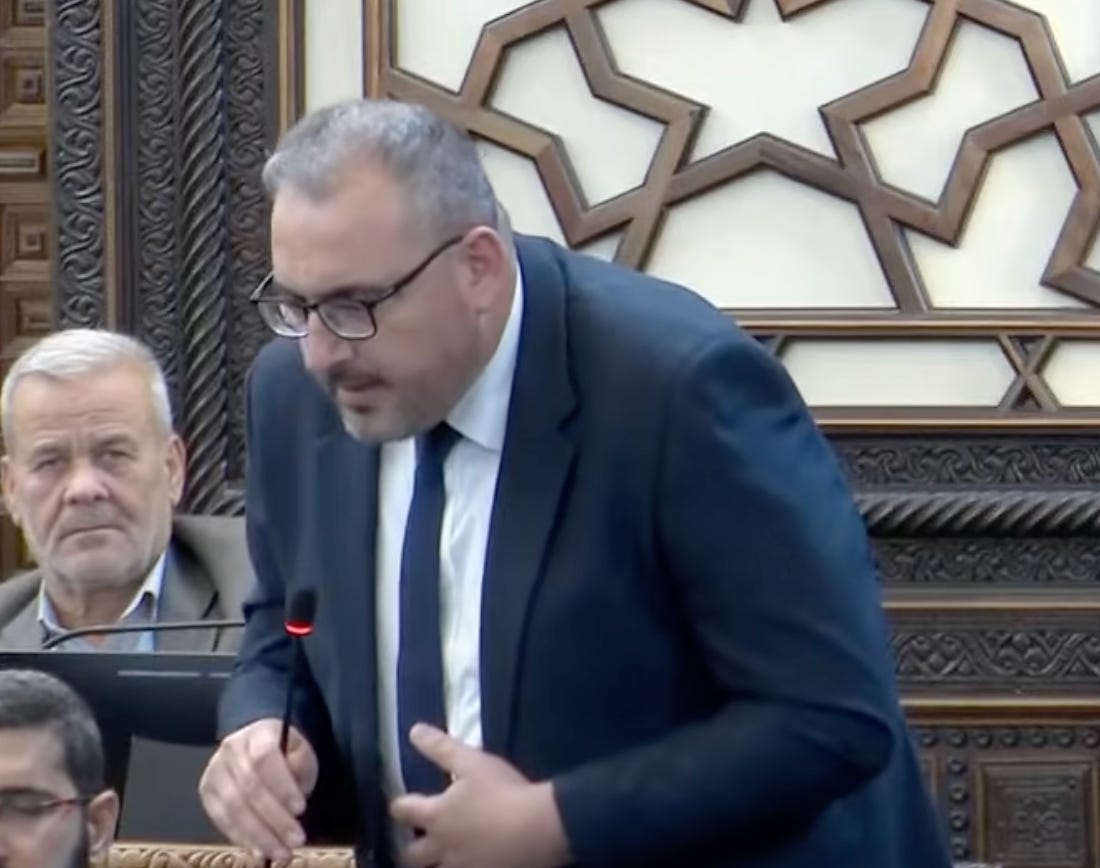

Minister al-Bashir
The ministry understands the hardship that pushed people to protest, and that diesel feeds into transport, bread, and much else. But the price path was “imposed on us”: SPC had reached a point where it could no longer afford to buy products. The choice was to supply fuel at cost, about SYP 206 a liter, or to return to crises, queues and the smart card (S2 49:39).
“If Parliament agrees, write it and send it, and I’ll adopt it immediately”: a smart card with 50 liters per family, and a black market at USD 2–2.5 a liter for the rest, “as in many countries”. Transport and production costs would then rise further; “this is from experience”. The chosen path only reduces SPC’s losses, and all prices are still subsidized (S2 50:43–51:56).
On the “no imports” promise: at one stage, need was 150,000 bpd, met by refining imported crude at Baniyas without importing products, because Hasakah and the area east of the Euphrates were not yet supplied and there were fewer cars. Syria then started importing about 1,000 tons of products a day, then more, as need rose to 300,000 bpd (S2 2:40:32).
Radwan Mohammad Sbeinati (S2 1:27:41). Citizens are always surprised by price rises and feel they bear the crisis alone, which leads to protests that harm the state. He proposes a reserve fund, fed by revenues such as transit fees on Iraqi shipments to the coast, to protect vulnerable groups.
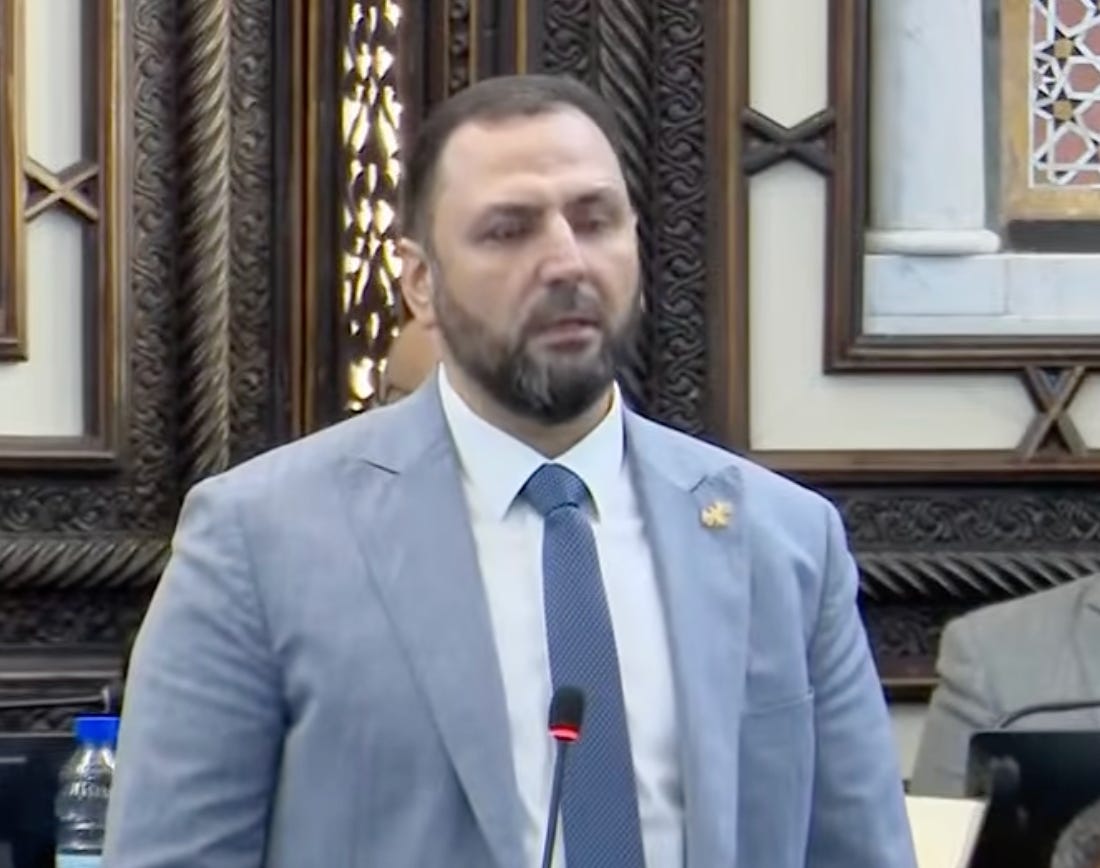
Mahmoud Kamel Mustafa (S2 2:57:13), on behalf of the Social Affairs and Labor Committee. He makes two requests. First, a published monthly pricing cycle on a fixed date, with its method and components (import price, exchange rate, transport, storage, distribution), 72 hours’ notice, and no mid-cycle changes except announced exceptions. Second, institutional consultation before decisions, with chambers of industry and agriculture, the farmers’ union, labor unions and transport representatives, plus a written impact report submitted to Parliament. Will the ministry commit to a monthly cycle with automatic reductions, and when will the first bulletin appear?
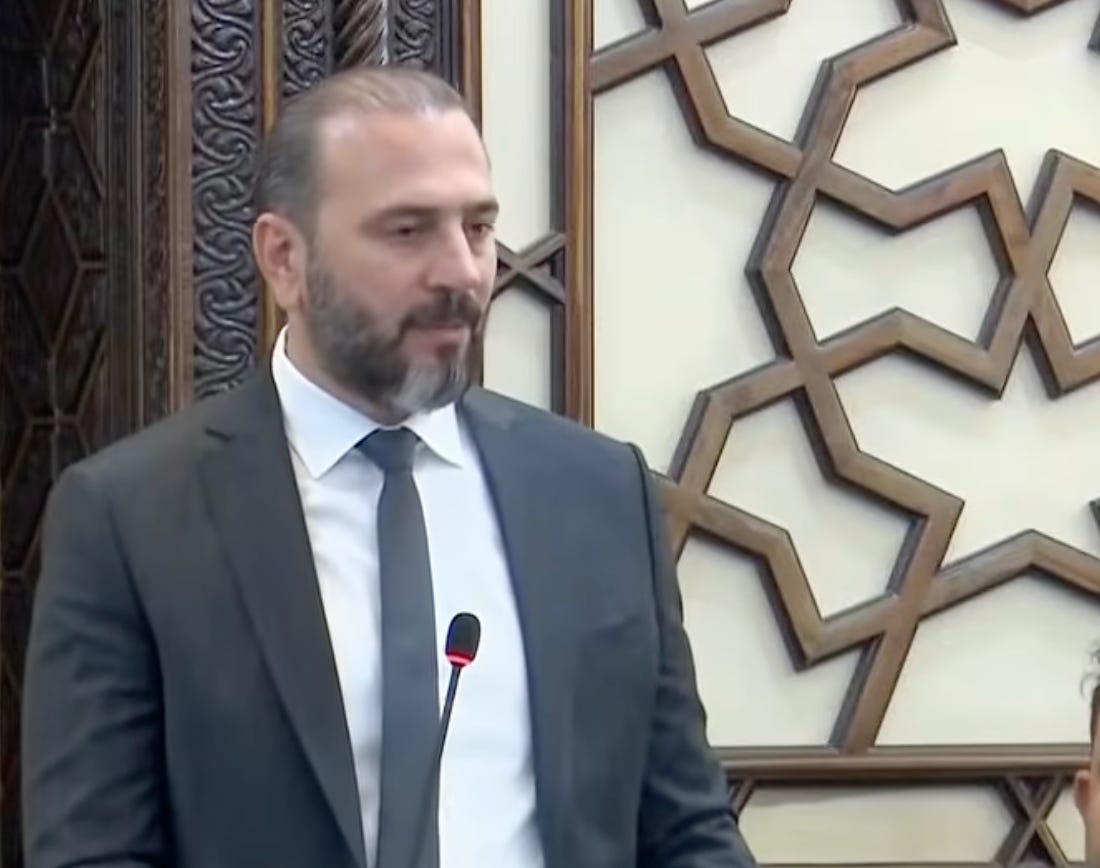
Minister al-Bashir
On the topic of warning before price increases, he says that announcing prices in advance is “a huge door to crises and corruption”. If people know diesel will rise from 125 to 150 or 160, they hoard, and large traders store a million liters to resell during the shortage they create. Before one price change, daily gasoline orders from stations fell from 7,000 to 1,000 tons, and even motorists stopped refueling. “Announcing these things creates crises we can do without” (S2 1:33:20).
Institutional consultation already exists: a pricing committee drawn from several ministries, a fuel meeting held under the Presidency and the General Secretariat, and impact assessments through governors and Social Affairs directorates. But increases cannot be publicized in advance (S2 3:01:40). “We didn’t raise prices on a whim, to lower them at will.” The crisis is global and will only ease when the global crisis does (S2 3:02:11).
AbdulRazzaq Saad al-Awad (S2 1:30:08). The minister keeps focusing on factories and their owners, although his own career began in humanitarian work. He proposes that a representative of the Ministry of Social Affairs and Labor sit on the pricing committee, since some always profit from crises.
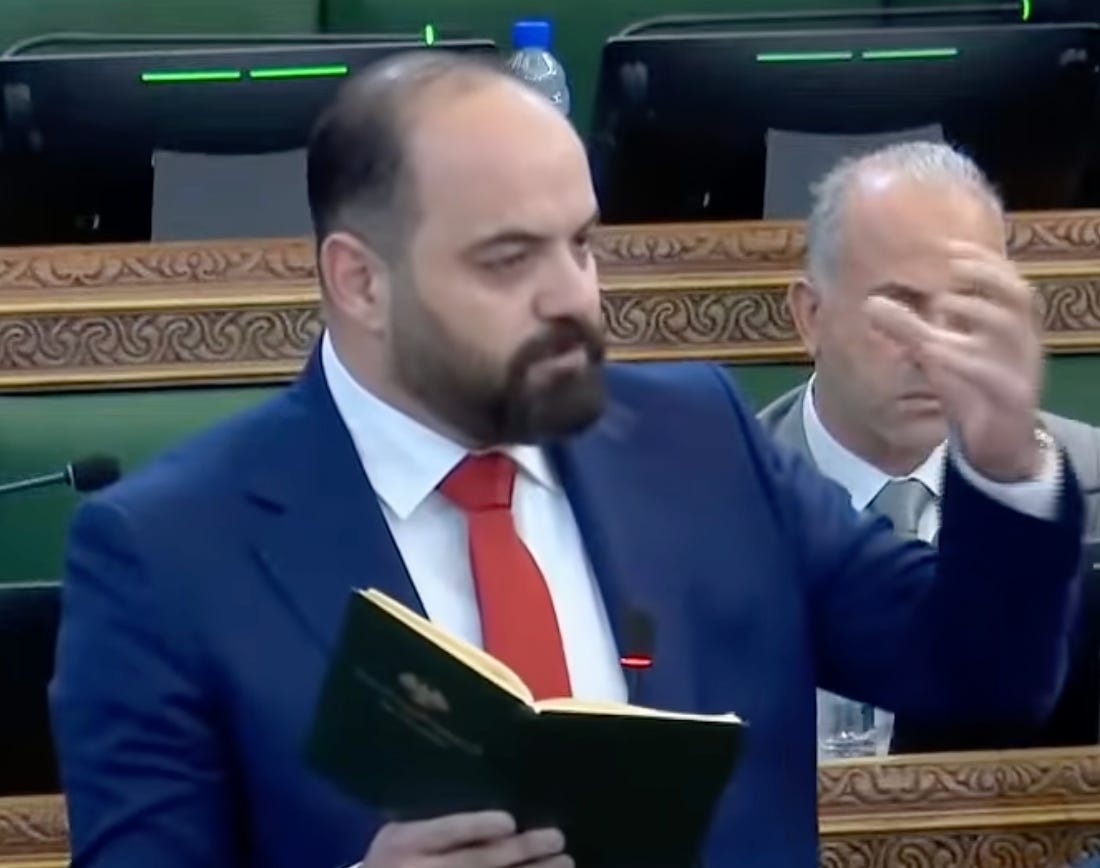
Tariq Khaled al-Madani (S2 1:52:22). Is there a government body that assesses the economic impact of energy price changes on productive sectors and living standards, and can Parliament see its study? He also recommends a ministry spokesperson giving weekly or fortnightly briefings.
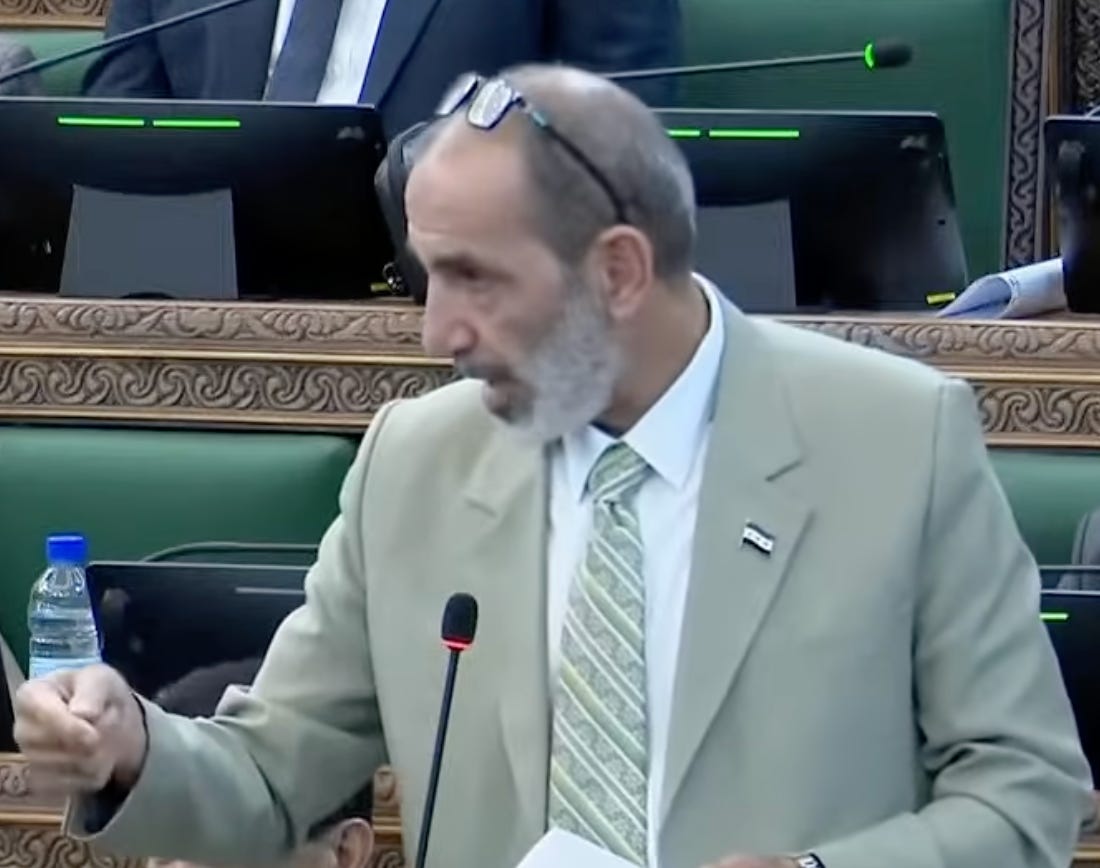
Mohammad Fadi Ahmad al-Halabi (S2 1:53:10). One Social Affairs representative on the committee is not enough. “On Thursday, the Minister of Social Affairs told us she learned of the price rise like any citizen, that her lists of households needing support were ready, and that nobody contacted her.” How does he explain this gap in government coordination?
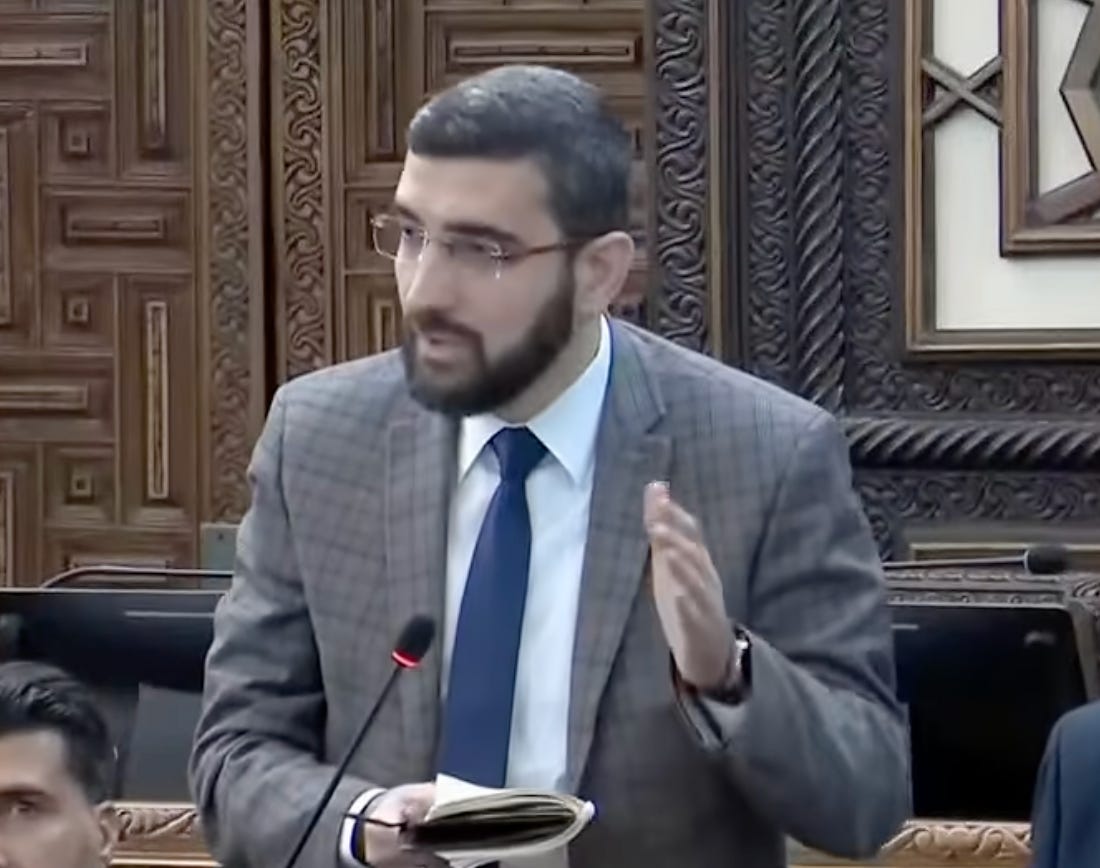
AbdulQader Mohammad Khoja (S2 2:09:03). What social calculation underlies the new prices, and was Social Affairs consulted? With average incomes of USD 250–300 a month, how does a family heat its home, especially if it is not on Social Affairs’ lists? He calls for fuel to be subsidized from the Sovereign Fund, which “exists for crises”, and asks why Syria does not buy on forward contracts when prices are low.
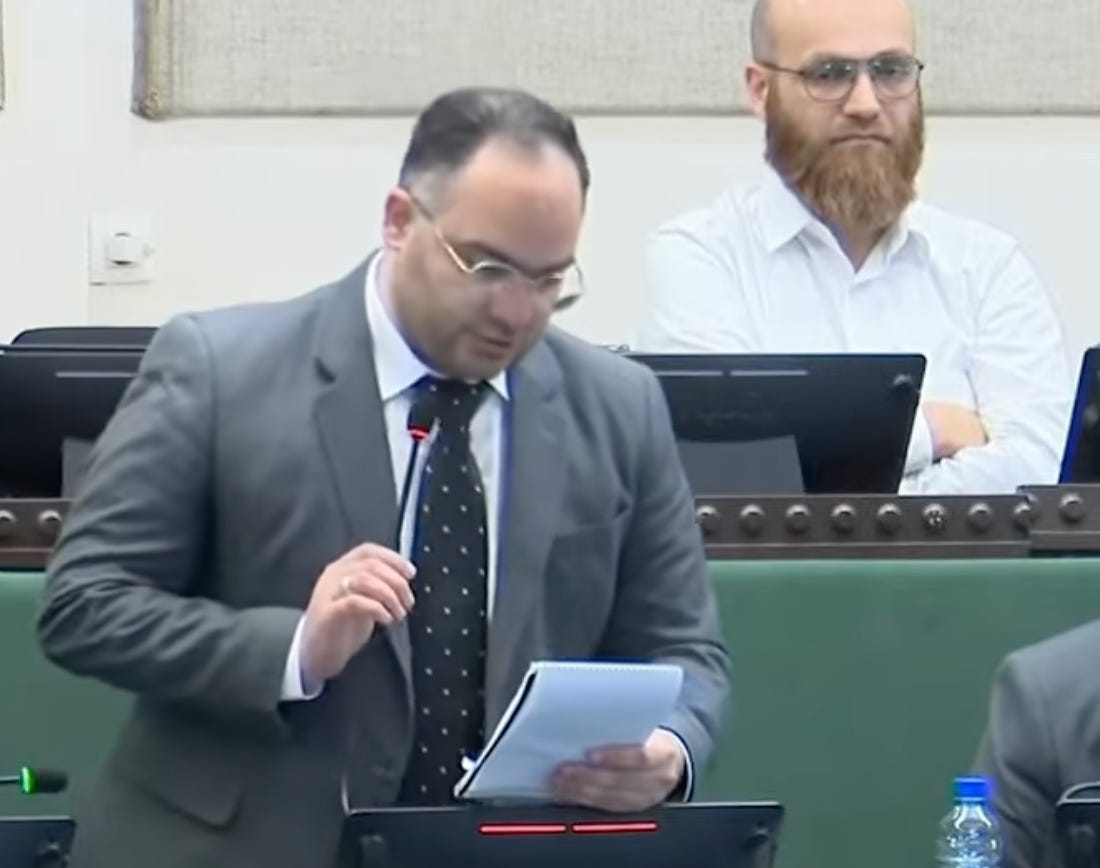
Minister al-Bashir
The suggestion to add a Ministry of Social Affairs and Labor representative is good. He says he has played that role himself: SPC has been losing money for four months, Economy and Finance members of the committee pushed for increases, and he held back hoping the crisis would ease. He will ask Social Affairs for a permanent representative (S2 1:35:12). The transition from a socialist to a market economy will hurt some people, and vulnerable groups will be supported through Social Affairs, including on electricity. On winter heating fuel, “we are able to cover this need” (S2 1:36:06).
Energy’s remit is electricity, water, and oil, through profit-and-loss economic entities. That does not mean acting at citizens’ expense, and Social Affairs has a role (S2 1:54:13). When the electricity tariff changed, he asked the Minister of Social Affairs and Labor for beneficiary data, but it was not ready. As of the day before, Social Affairs directorates in the governorates had still not completed their data on vulnerable households (S2 1:54:48).
Economy Ministry representatives on the pricing committee study impacts from all angles (S2 1:58:26). A “crisis committee”, including representatives of the Ministries of Economy and Finance and the Central Bank, also exists, and it met before the decision was taken (S2 2:05:10). It saw the rise as “a necessary evil”: the losses to SPC and the treasury had become unbearable (S2 2:15:03).
On forward contracts: “We’re ready. If anyone has companies that will sell on deferred terms or reserve product for us now, bring them” (S2 2:13:54). On the Sovereign Fund, he skipped the point deliberately: “It isn’t ours.” He will “take support from any ministry, from the Sovereign Fund, from Economy, from Finance” so as not to raise prices (S2 2:22:37).
On media, the ministry does communicate through its communications and media directors and state television, but official media are “documentary rather than interactive”; he will work on it (S2 1:58:34).
Nawar Eliyas Najmeh (S2 2:11:23). The oil deficit has been inherited from the previous regime, and raising fuel prices is the easiest way to close the budget and oil deficits, but it is inflationary, threatens the economy, and is out of line with wages. “Inflation is a tax the poor pay to the rich.” Multiple fuel price hikes have failed before, bringing black markets and tampering with specifications. With a budget deficit of 30%, and 40% of revenues coming from inflationary customs revenue, raising prices is “extremely dangerous”. But given that the government hates subsidies, and so do economists, the state should tax the rich more to fund the deficit, instead of raising prices.
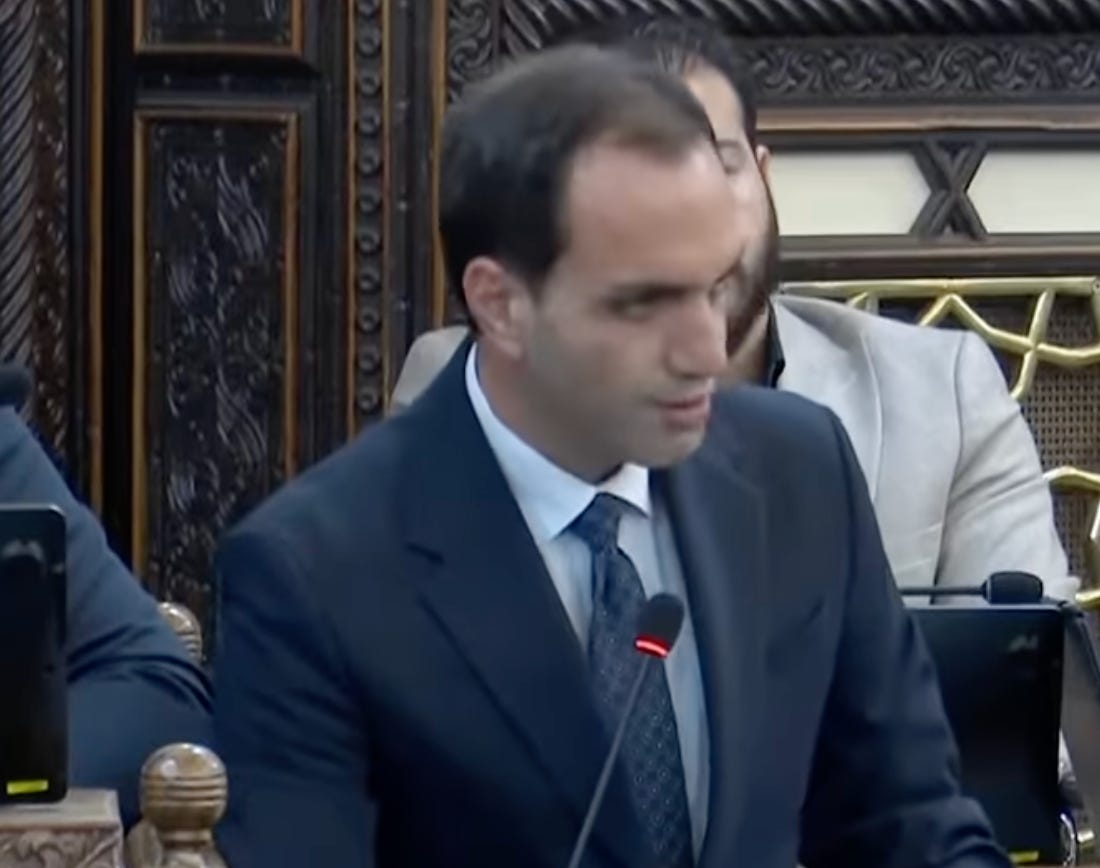
Mohammad Walid al-Bakir (S2 2:34:38). He supports Nawar Eliyas Najmeh: it would have been better to keep diesel unchanged, given its links to agriculture and transport, and make a modest, studied rise on gasoline.
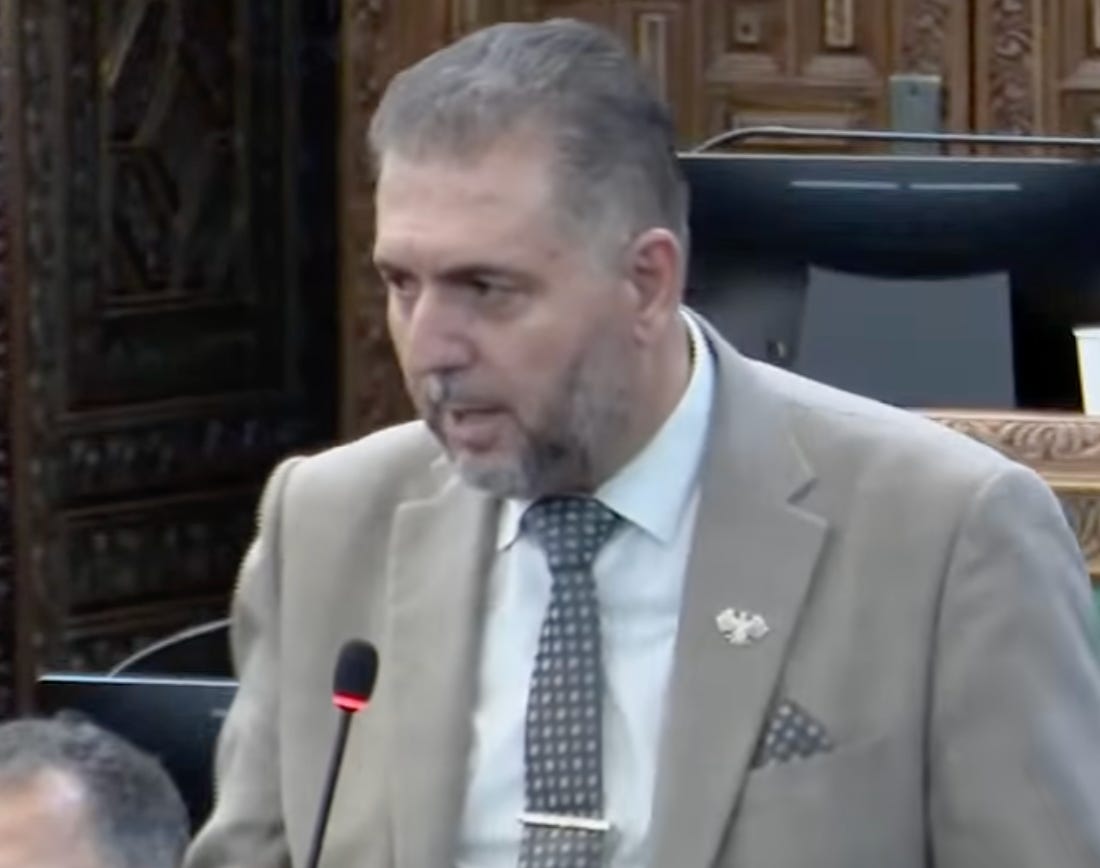
Minister al-Bashir
[No direct answer to either point. Replying to Najmeh’s round as a whole, the minister said the rise was sensitive and would have effects, but that the crisis committee, including Economy, Finance and the Central Bank, saw it as “a necessary evil” given SPC’s and the treasury’s losses (S2 2:15:03). He did not address taxing higher incomes, or raising gasoline instead of diesel.]
Amin Bashir al-Bashir (S2 1:25:36). Why does gasoline cost USD 1.34 a liter in Lebanon but USD 1.52 in Syria, according to the presentation? Given external shocks such as the Gulf war and the Strait [of Hormuz], what is the ministry’s policy for not passing them on to citizens?
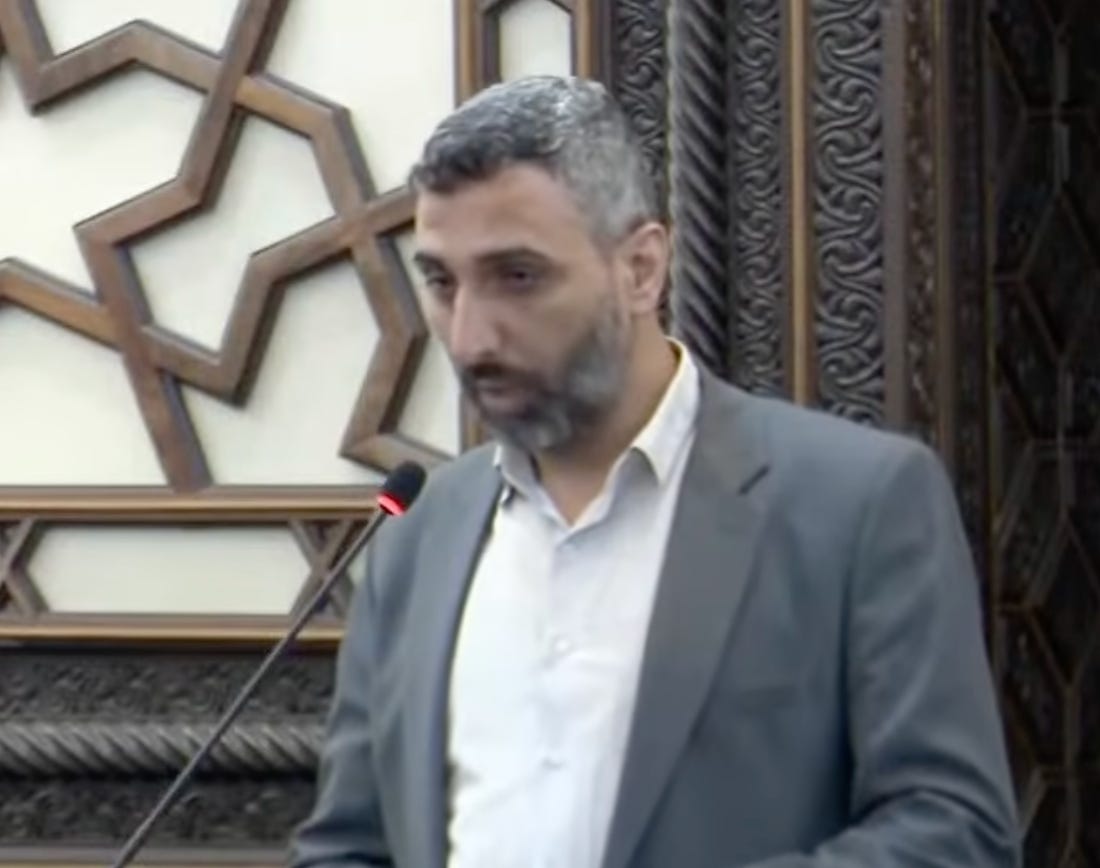
Minister al-Bashir
Gasoline in Lebanon costs USD 1.58, or SYP 213, so it is not cheaper; diesel in Lebanon is more expensive than in Syria. The MP’s figure must be multiplied by 135 to convert to lira (S2 1:31:48).
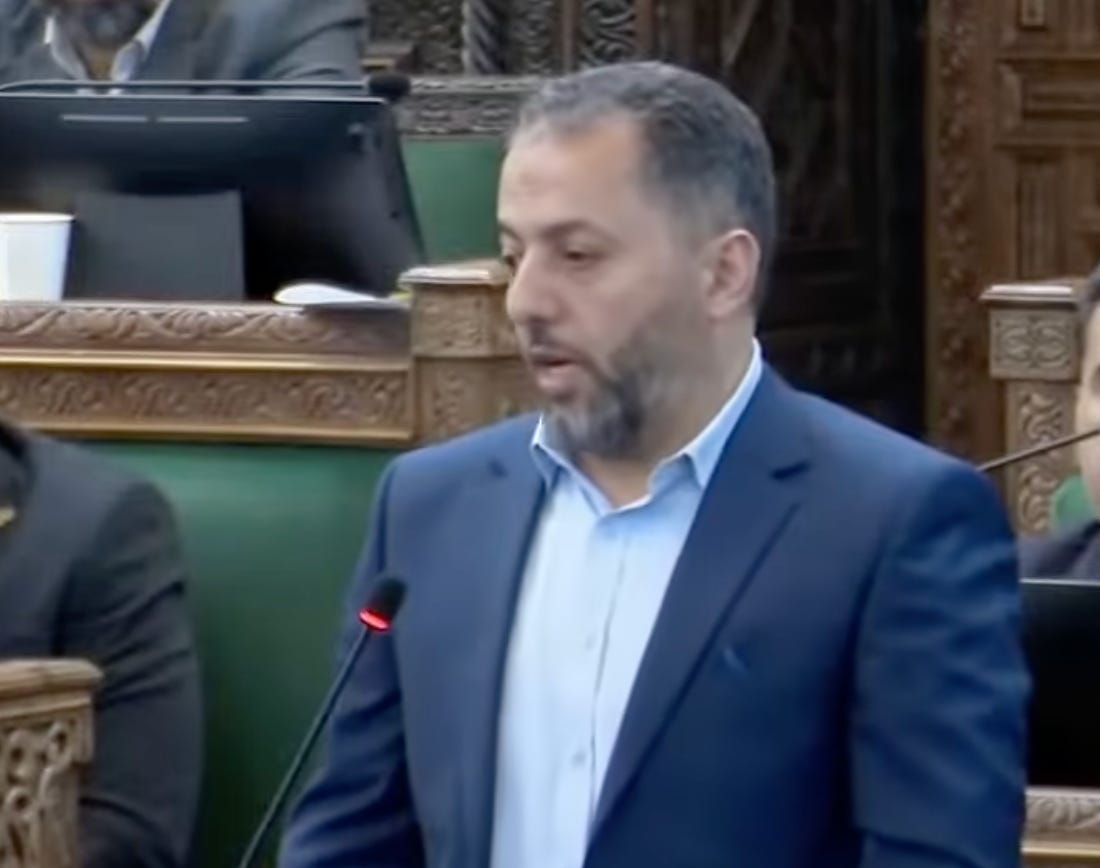
Tariq Mohammad al-Dhiyab (S2 2:10:53). Does the ministry see these hearings as protocol, or as a real spur to act? Does it expect more crises?
Minister al-Bashir
The hearing is important for showing the sector’s challenges and plans, gaining Parliament’s help on legislation, and hearing citizens’ concerns more closely. “A very positive session” (S2 2:37:02).
2. Subsidies, diesel grades, burners and distribution
Fajr Fawzi al-Ahmad (S2 42:48). “The minister spoke to us in numbers; we speak in pain.” Global price rises may match incomes elsewhere, but not in Syria. Is there a plan to help the poor with winter heating fuel? The burners (harraqat/حراقات) in Deir Ezzor were stopped, leaving those who worked there without jobs. Power was also cut to farmers’ cooperatives, wrecking the summer season.
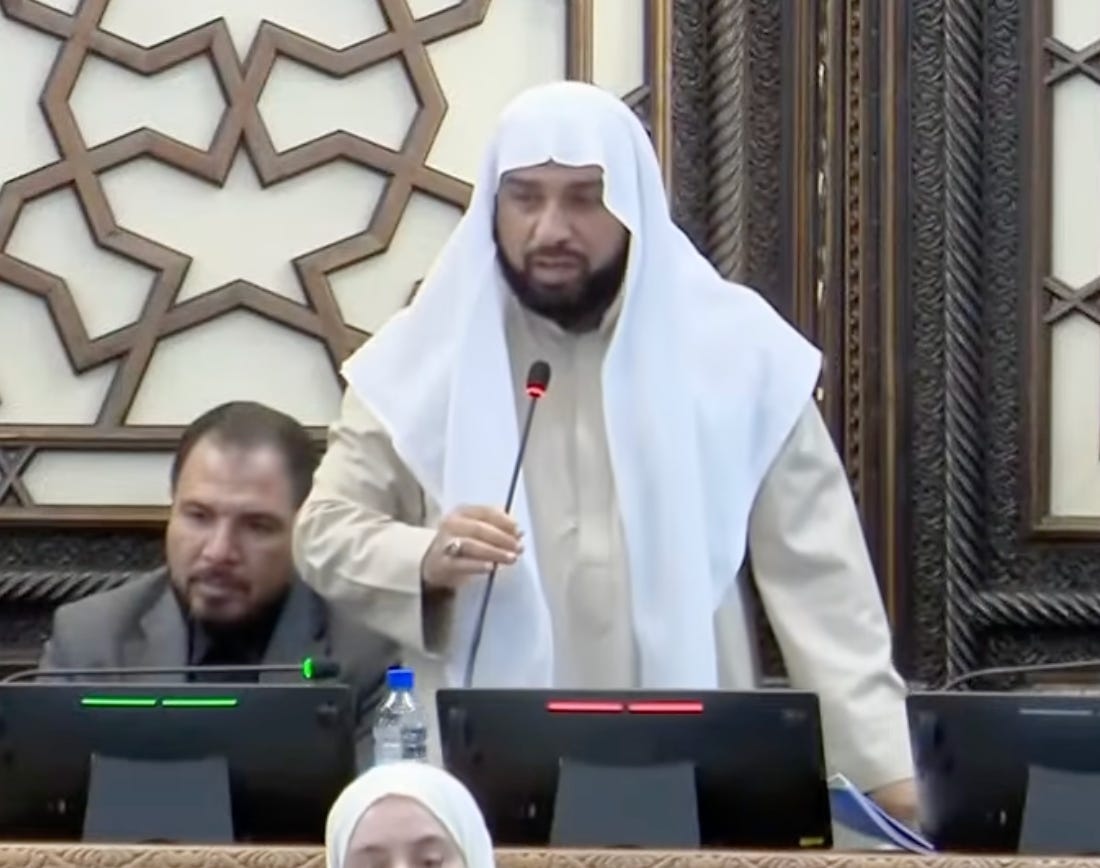
Mahmoud Madi al-Ali (S2 1:47:12). The hearing was called over the fuel price rise, yet the discussion drifted to future projects. The third diesel tier now costs 11,500 old SYP (new 115 SYP) a liter, so a 200-liter barrel costs 2.3 million old SYP (new 23,000 SYP): “an employee buys one barrel with his salary”. Transport and food prices have risen 30–60%, and farmers in Hasakah can no longer afford to plow. The third tier should not be priced this way, since it is local crude run through burners.
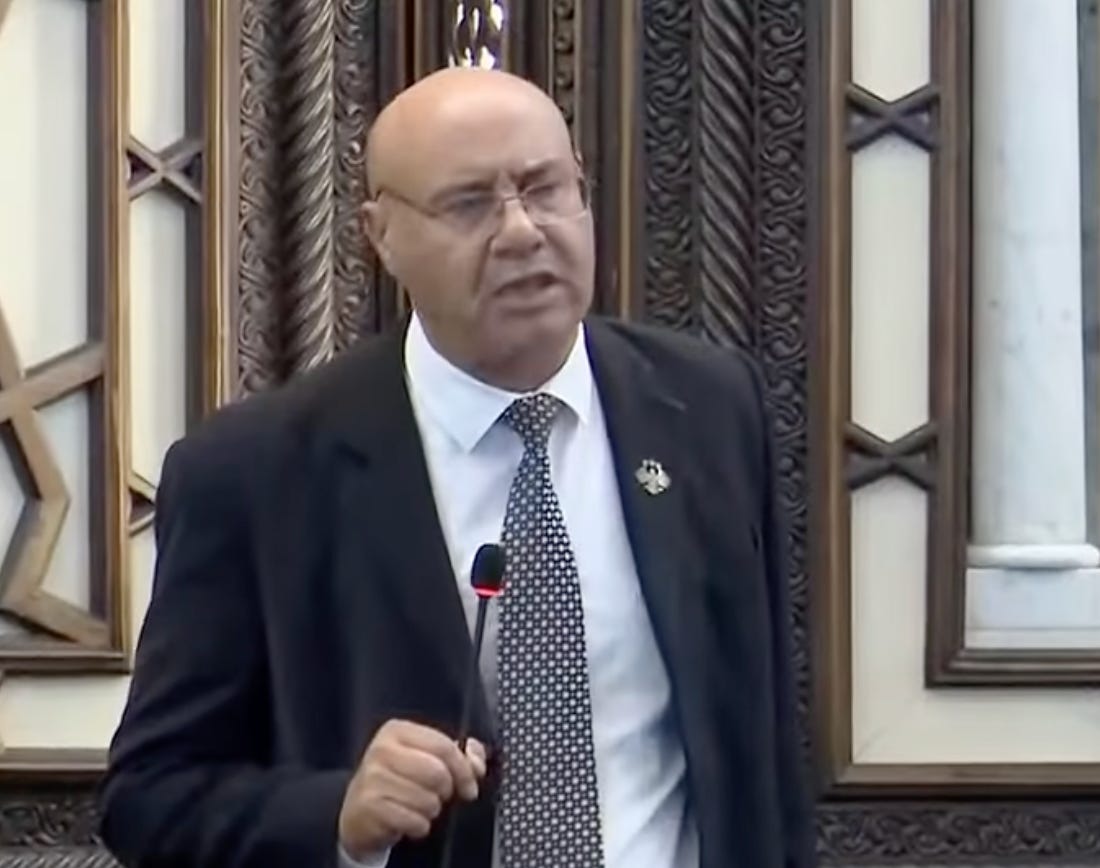
Osama Mahmoud al-Naous (S2 2:46:23). If the subsidized fuel at 115 comes from primitive burners, that implies a price of about USD 200 a barrel. In al-Bab, the Tarhin burners sold a barrel for USD 70, from domestic crude. Why the gap?

Minister al-Bashir
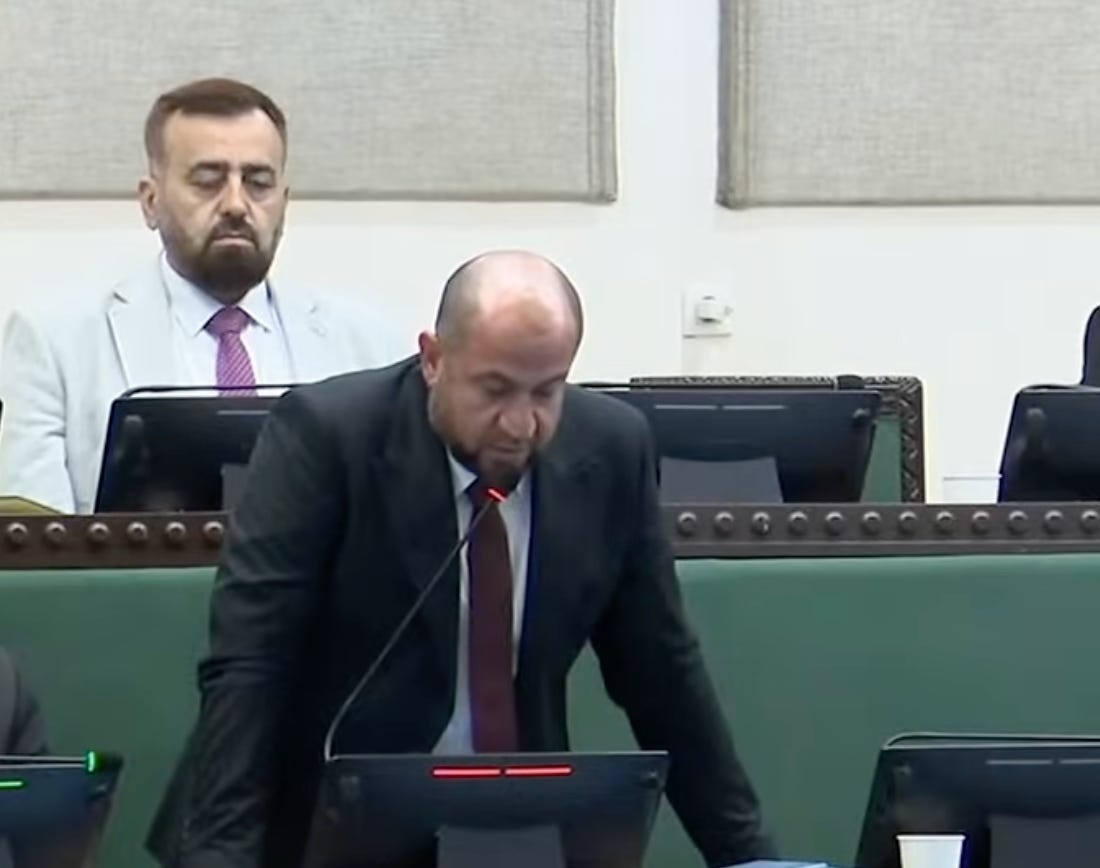
Returning to burners is regrettable: many people in the east developed cancer because of them and because of bad production practices. “Today we have stopped 30,000 bpd of production for people’s health”: wells whose formation water erodes land, reaches groundwater or rivers, or forms radioactive oil lakes are shut until they are repaired, even at a loss to SPC (S2 51:56–52:42).
The new third grade comes from “semi-electric” burners with lower carbon emissions and runs under SPC’s management from input to output. It is sold only through designated stations to prevent a black market and blending. “There will be adulteration”, so the Energy Services Administration and SPC will take daily samples at all stations (S2 52:42–53:37). After the new prices were announced, a “brotherly country” supplied cheaper, lower-quality diesel, which made the SYP 150 grade possible at no profit and no loss. The improved grade is for heating (S2 53:37–54:04).
When the burners were stopped, all workers’ names were recorded and they were promised SPC jobs. But SPC salaries remain on the civil-service scale, and many burner workers refused jobs paying USD 100–110 a month (S2 54:12–55:17).
The Tarhin price of USD 70 reflected crude at about USD 67 a barrel at the time; the day before the hearing, crude was USD 104 (S2 2:50:18).
Israa Zuhair al-Mashhour (S2 59:36). Subsidized farm diesel is useful, but agriculture’s problem is wider. Does the ministry, with the Agriculture Ministry, have an integrated water-and-energy plan for farming? It would map real needs by area, crop, and water source; prioritize irrigation projects; rehabilitate pumping stations; electrify pumping or use alternative energy; and set out funding and a timeline, rather than relying on seasonal fixes.
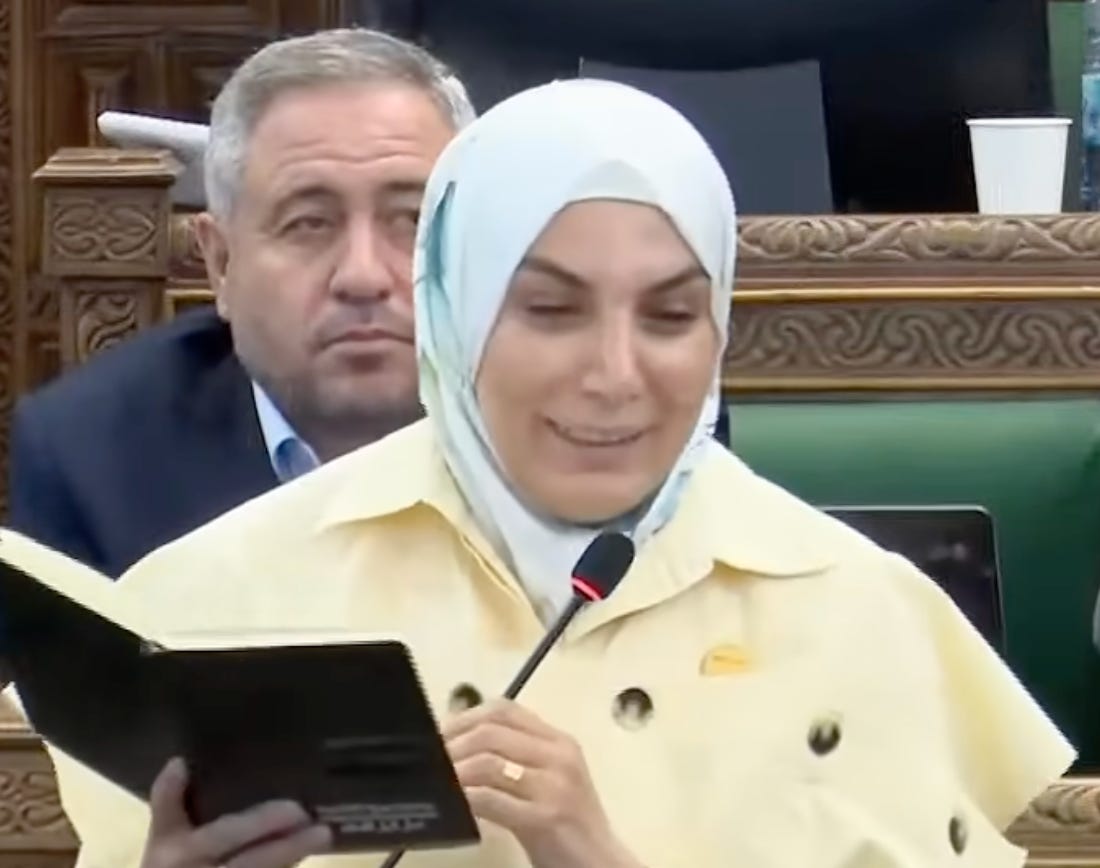

Salem Mohammad al-Ahmad (S2 1:06:39). In this difficult transition, how will the ministry ensure that the energy sector bears the cost of recovery without shifting it to citizens? He asks for a published transitional energy plan, with targets and dates for what will change this year.
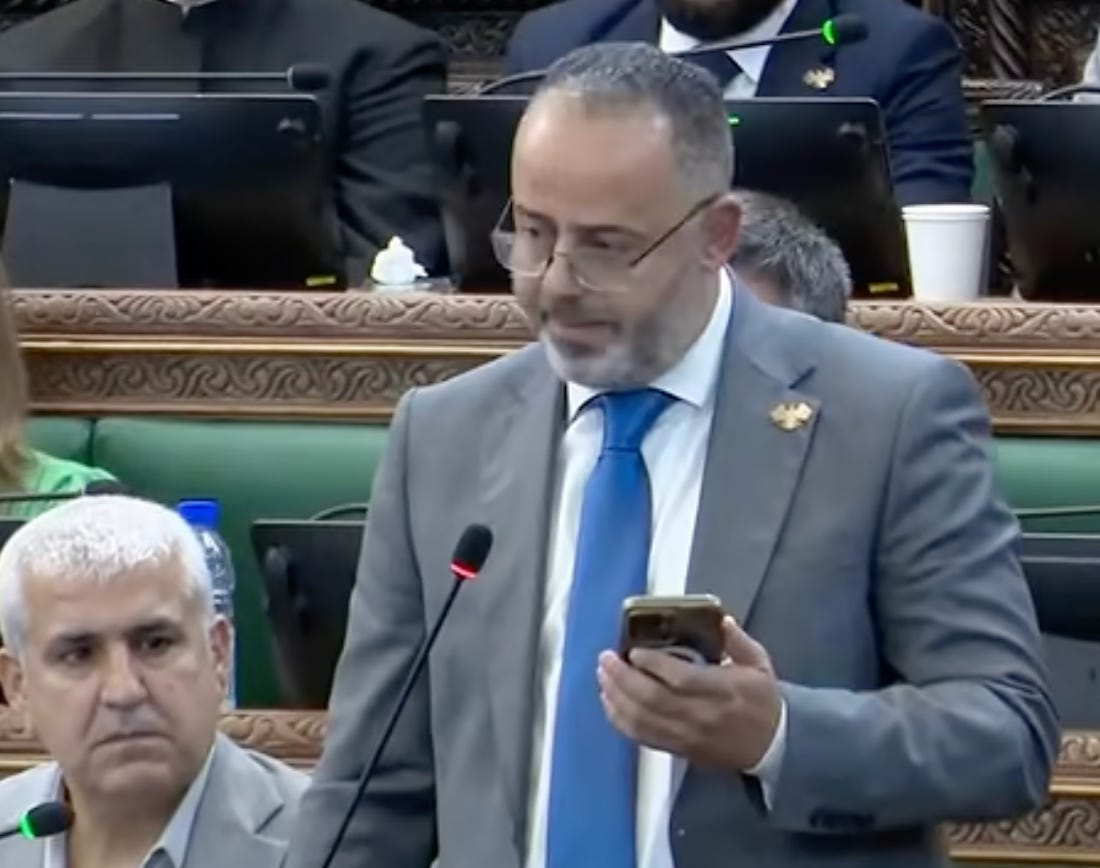
Minister al-Bashir
Supporting agriculture, bread, industry and vulnerable groups is not the Energy Ministry’s job alone. It needs an integrated plan, and the Higher Council for Economic Development is working on it. Energy does its share, for example by selling fuel oil to industry at USD 400 a ton instead of USD 570–600 (S2 1:07:33). The move to a market economy means some things will eventually no longer be subsidized. Diesel sold cheaply to bakeries ended up on the black market, so support was switched to flour, which is easier to monitor (S2 1:08:22).
The presentation already showed large subsidies on electricity and on diesel and fuel oil for industry (S2 1:11:19). Each ministry should support its own sector: Agriculture should buy diesel at the set price and subsidize farmers. In Turkey, diesel cost about USD 2 the day before, and the oil company does not subsidize farmers; fuel revenue goes to Finance, which funds Agriculture. Energy can supply subsidized products to vulnerable households in coordination with Social Affairs, NGOs and charities (S2 1:55:11–1:56:31).
Hanan Ibrahim al-Balkhi (S2 1:15:44). Real support is measured by whether those entitled can actually get subsidized fuel. What mechanism identifies beneficiaries, sets fair quantities, ensures transparent distribution, and prevents leakage to the black market?
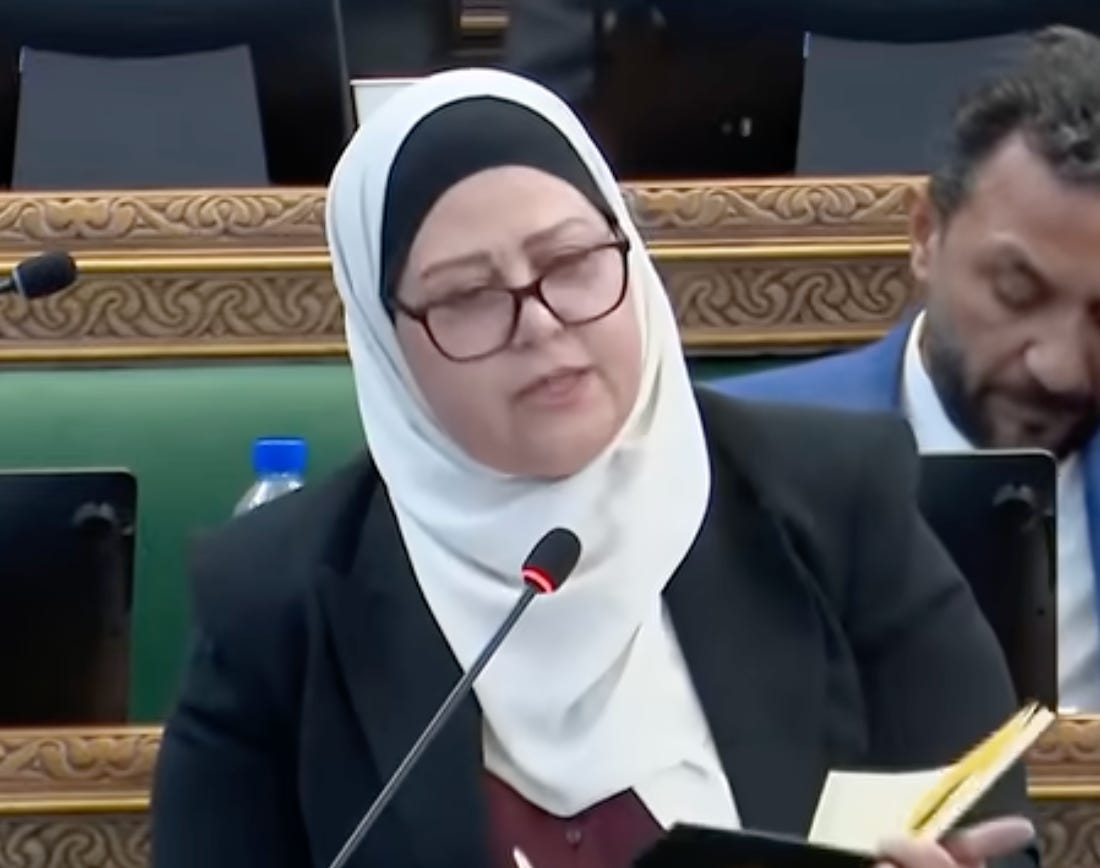
Faraj Rakan al-Uqda (S2 3:08:49). Multiple diesel grades may create a deeper crisis: quantities are hard to monitor, parallel markets will appear for cheaper grades, and some areas will not be covered. He proposes direct cash support for the neediest, a single price, and strict control instead. Sector committees should be consulted before prices change, and the Trade ministry’s supply directorates should issue new price lists immediately.
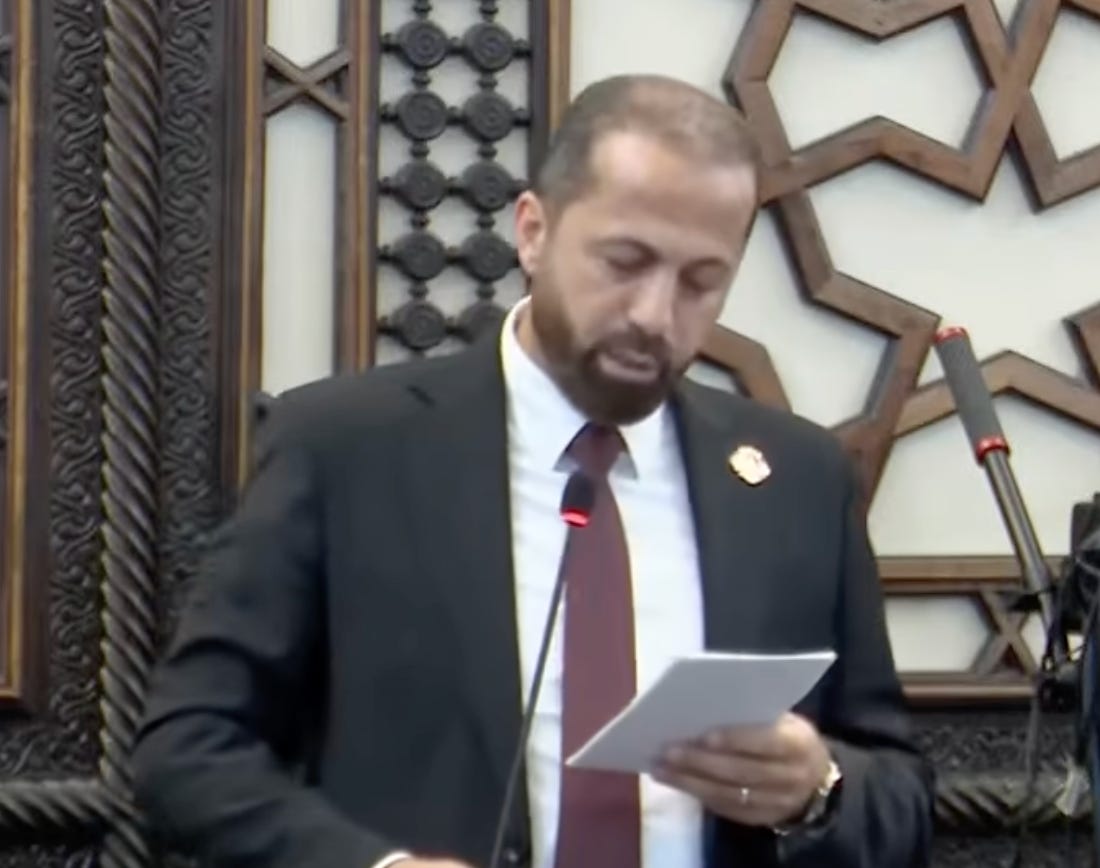
Minister al-Bashir
He asked Social Affairs for a digital beneficiary database when the electricity tariff changed, but it was not ready (“like other institutions, no data”). With governors, distribution will run through Social Affairs directorates, SADCOP branches and the Energy Services Administration. Designated stations will serve named lists, digitally stamped (S2 1:20:19). Distribution to those entitled will go through committees in each governorate (S2 1:45:43).
Production from the burners was increased from the Saturday before the hearing. Committees in each governorate, combining Social Affairs, the governor, SADCOP and the Energy Services Administration, will choose stations for the second and third grades; the first grade will be sold at all stations (S2 3:04:36). Cash support for heating, electricity or food is not the ministry’s responsibility (S2 3:17:30).
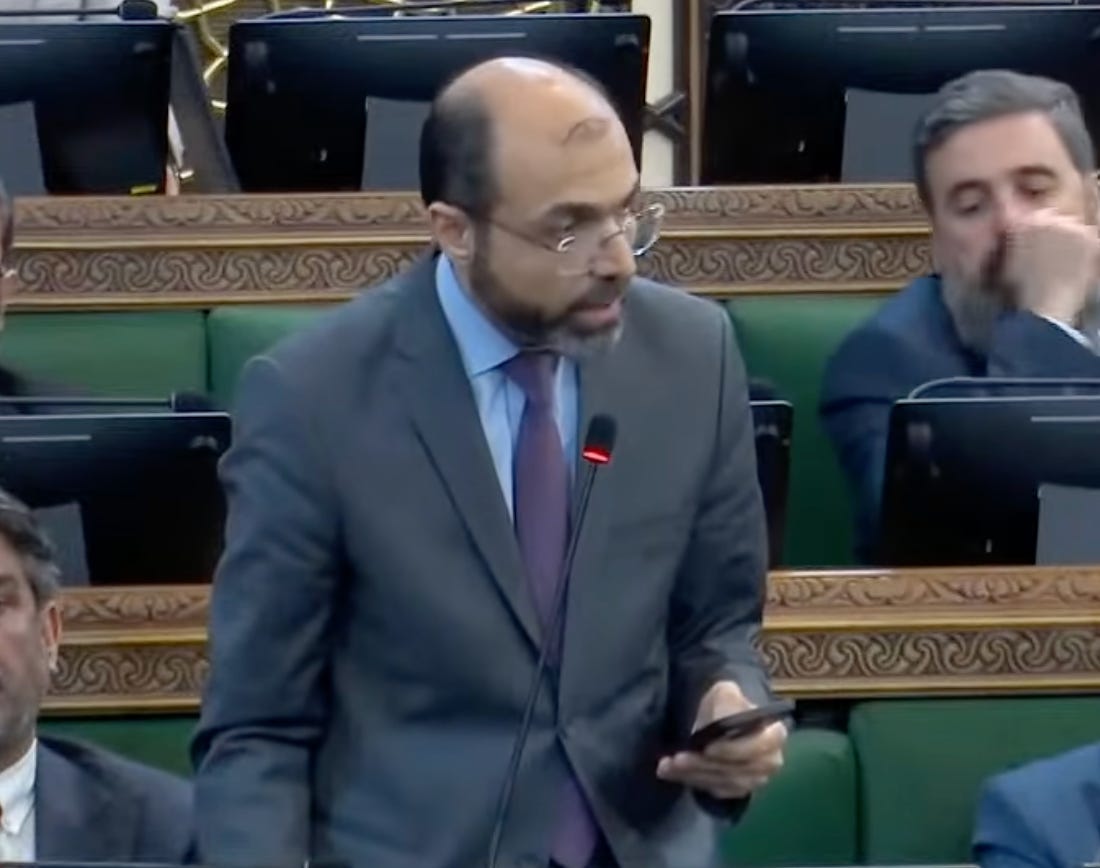
Mohammad Saadi Mohammad Hisham Sukkarieh (S2 2:53:14). The “electric refineries” of 35,000 bpd mentioned in the presentation: when will they start? Will they be contracted directly or tendered, and what are the qualification criteria? Is the electricity infrastructure ready for them? How are operating costs calculated, and who monitors crude in and products out?
Minister al-Bashir
These units already operated in Hasakah under an existing contract, supplying subsidized fuel to residents without grid power who depended on generators. The contract is being expanded from about 17,000 bpd to 35,000 bpd, the burners’ full capacity. Homs refinery will rise to 45,000–50,000 bpd within days, and the surplus heavy crude will go to the burners (S2 3:00:11–3:01:15).
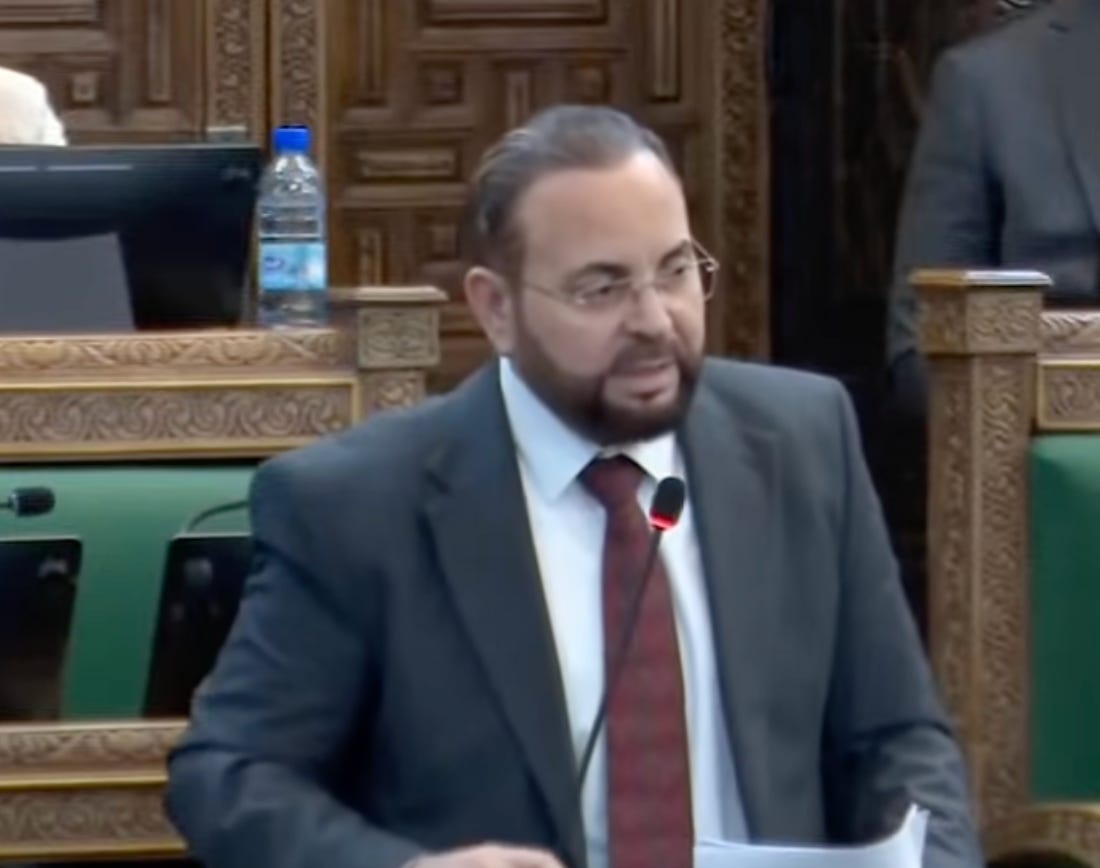
Hamza Jassem Qabalan (S2 2:54:12). Homs fuel committees say there is no daily, monthly, or annual fuel report. Using manual checks, they cut the water sector’s diesel from 900,000 to 500,000 liters a month. Homs public transport takes 3.3 million liters a month for 3,600 buses, all fitted with GPS that may not be active. Regular reporting would curb public-sector waste.
Minister al-Bashir
A private company used to run GPS on government vehicles; a ministry team of IT engineers now runs it. All ministries’ vehicle fuel use is tracked, and reports are held at the ministry (S2 3:01:15).
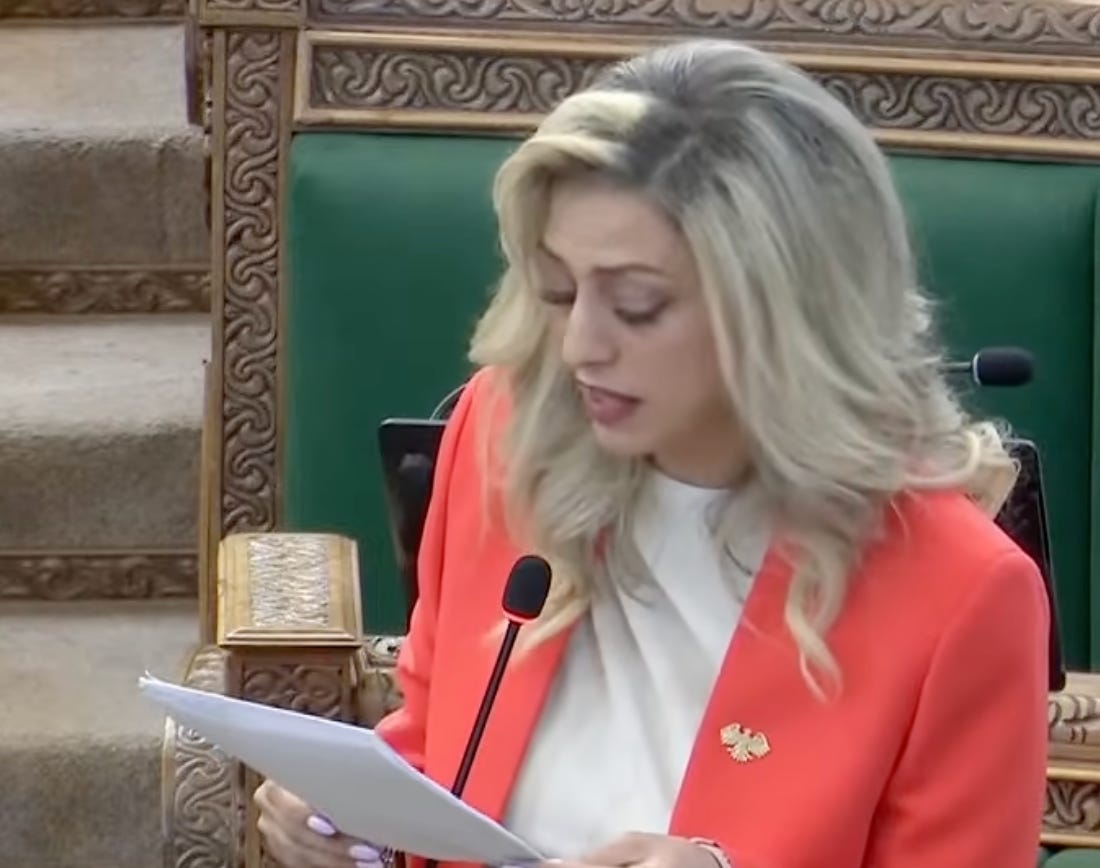
Madonna Suhail Bishara (S2 2:46:57). Instead of subsidizing diesel generally, could the state subsidize transport for those with no alternative, such as school and university students and employees commuting from rural areas, with enough diesel allocated to the lines that serve them?
Minister al-Bashir
The same logic applies as for industry and agriculture: the Transport ministry can request subsidized fuel, and Finance covers the difference. The fear is corruption, with a bus owner selling half of his 100 liters because it is cheap. GPS could help, but Transport should organize it (S2 2:51:45).
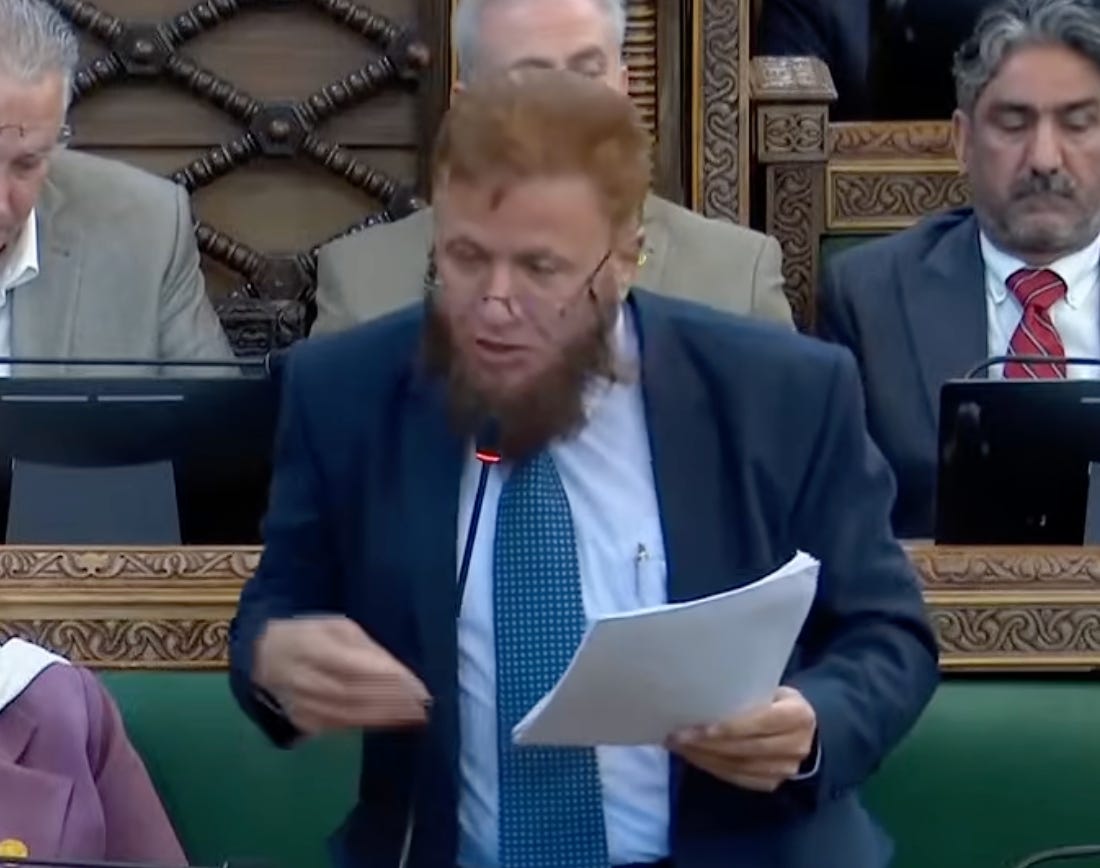
Ahmad Mohammad al-Shalash (S2 2:16:42). The rise triggered price chaos, with everyone raising prices at will. Were these effects anticipated, and coordinated with other bodies? If the chaos continues, MPs may have to question the ministers concerned, especially for the east, where all transport depends on fuel.
Minister al-Bashir
The relevant bodies were told of a rise of about 30%; the Trade Ministry needs to control traders. Fuel is one input among many, about 2% of production costs, so prices should rise about 2%, not 30% (S2 2:23:08).
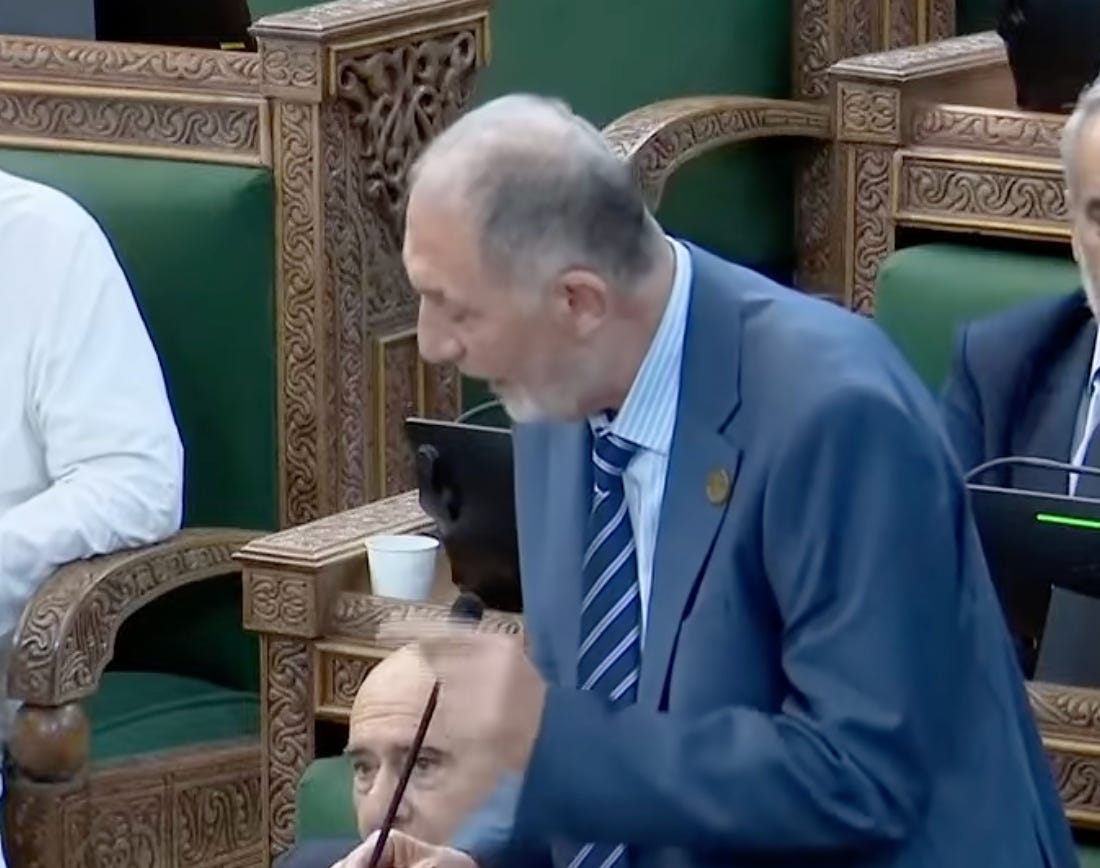
Jamal AbdulRahman Mkayyes (S2 2:10:36). Reduce the mandatory storage requirement for fuel stations from 20% to 10%.
Minister al-Bashir
Syria has about 2,450 licensed stations, with 1,800 operating. Licensed stations that are closed have been told to open or lose their license, and a licensing platform has been launched. As stations multiply, the reserve requirement could be revisited; by international standards, Syria could hold twice as many stations (S2 2:14:28).
3. Electricity: tariff, supply and regional grievances
Electricity Tariffs
Mohammad Basel MuhiEddin Haylam (S2 1:03:20). “I am not speaking with emotional or populist rhetoric”: he asks the Syrian President to make a gesture and suspend the electricity price rise until incomes improve. In his own survey of two Damascus neighborhoods, 60% of the people he asked had not paid their bills, against the 70% collection rate the minister cited. “His income is a million [old SYP] and his electricity bill a million or a million and a half. How does he live?”
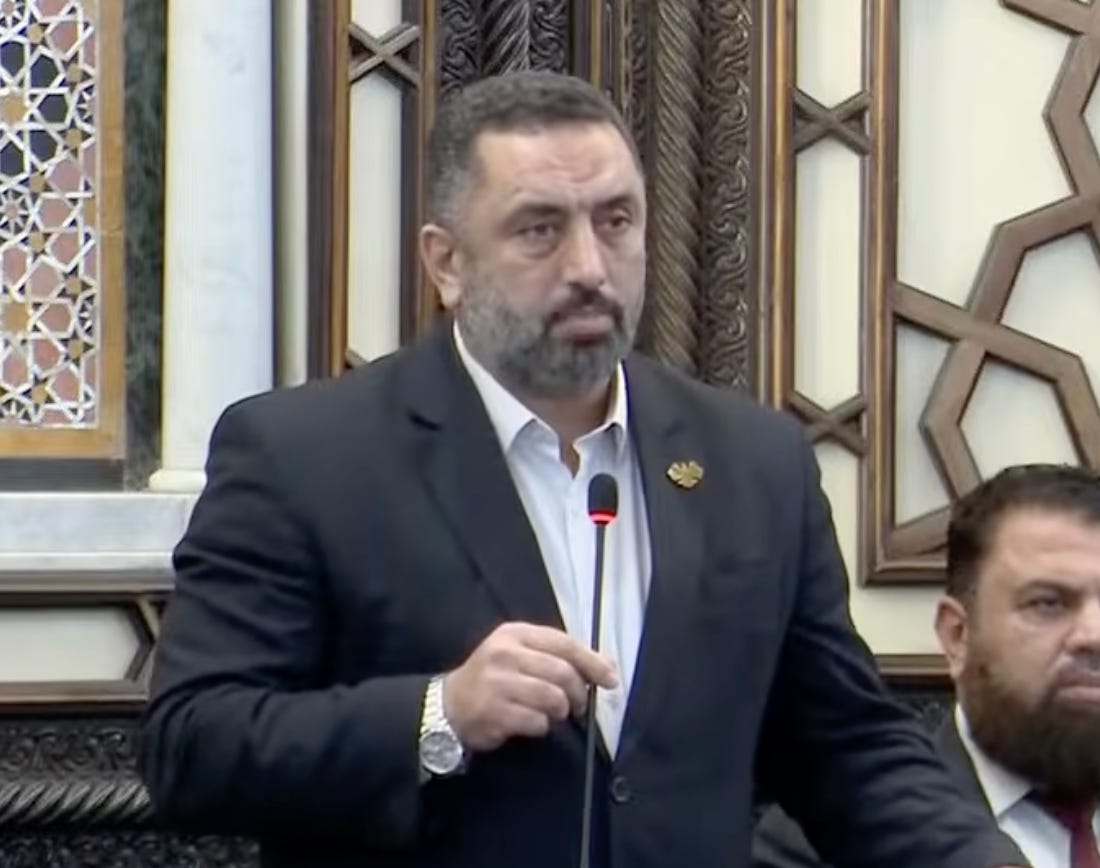
Aref AbdulMajid Razzouk (S2 1:16:12). On behalf of colleagues: raise the first electricity block to 250 kWh, and read meters regularly, because late readings push bills into higher tiers.
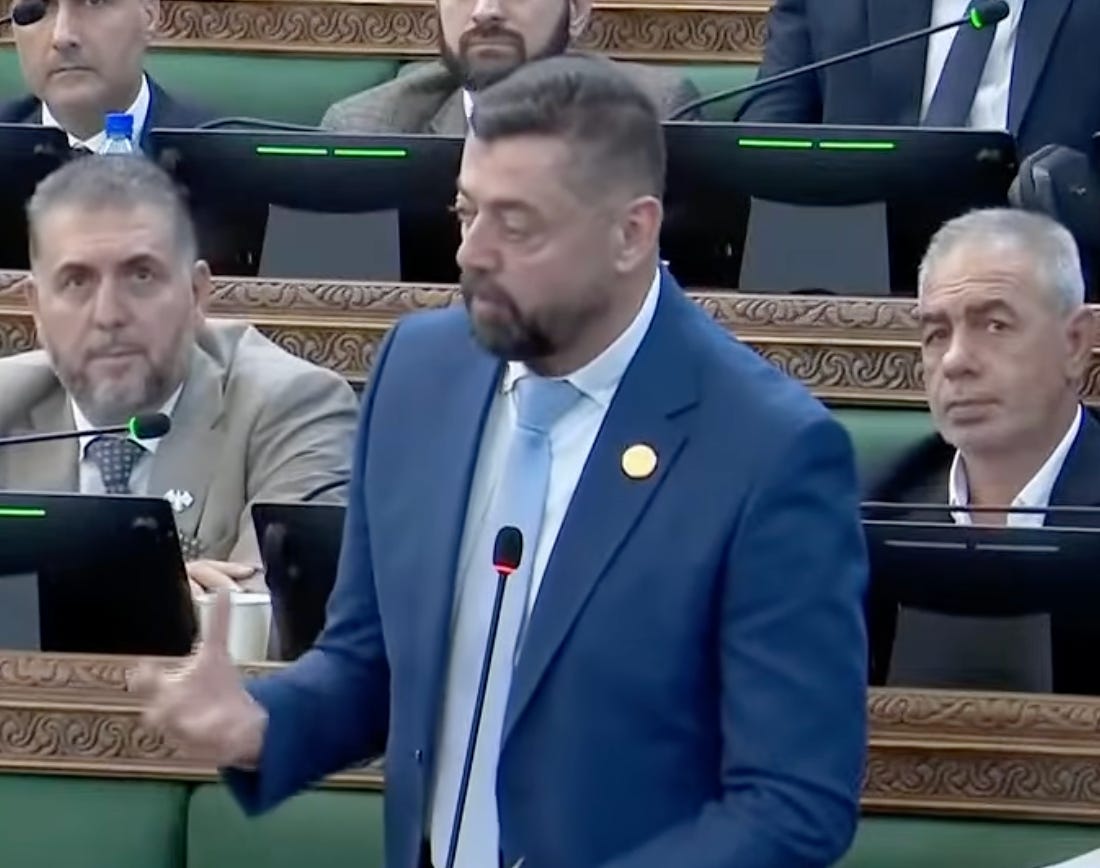
Jamal AbdulRahman Mkayyes (S2 2:10:12). “You are an honest man”: he asks the President, from the floor of Parliament, to suspend the electricity price rise for two years, until the country recovers.
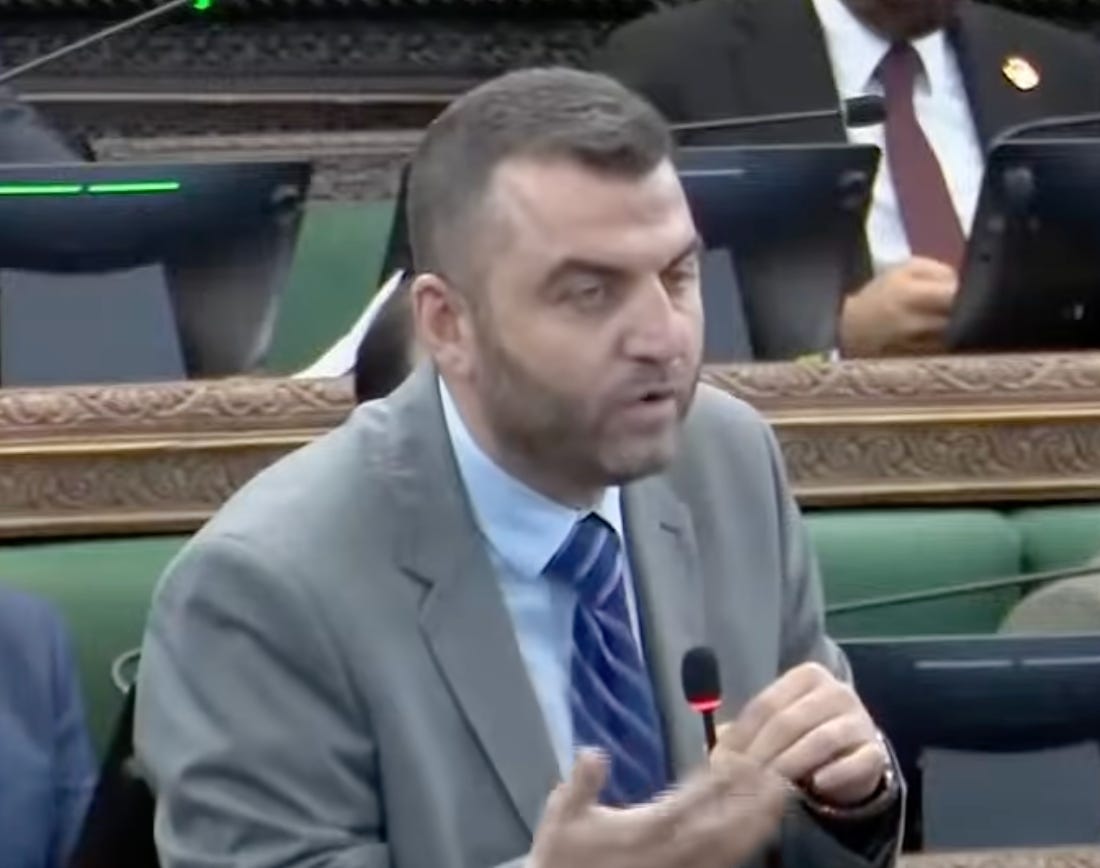
Mohammad Wisam Mohammad SalahEddin Zaghloul (S2 2:00:26). The 150 kWh basic block excludes water heating and heating, while diesel has also become more expensive. A family needs at least 5 liters of diesel a day, or 150 liters a month, which limited incomes cannot afford, and more than 150 kWh. He proposes letting households with solar systems export their surplus to the national grid.
Minister al-Bashir
Suspension or a deeper subsidy is only possible if the Ministry of Finance pays for the gas. Without that money, purchases stop and service falls, hurting industry and development as well as households. That is why there is a protected block: about USD 6.5 a month for 150 kWh (S2 1:09:55). The message on suspension goes to the President (S2 2:14:19).
On rooftop feed-in (on-grid solar system): “sometimes someone comes along who calls himself a PhD or an expert”, “sitting on the sofa, under the air conditioner”, proposing ideas to become a trend. Technically, Syria is not ready: meters are not bidirectional, and neither transformers, networks nor load studies are prepared, especially with heavy rationing. Jordanian and Turkish ministers told him on-grid causes technical problems even where it is licensed (S2 2:05:56–2:07:17).
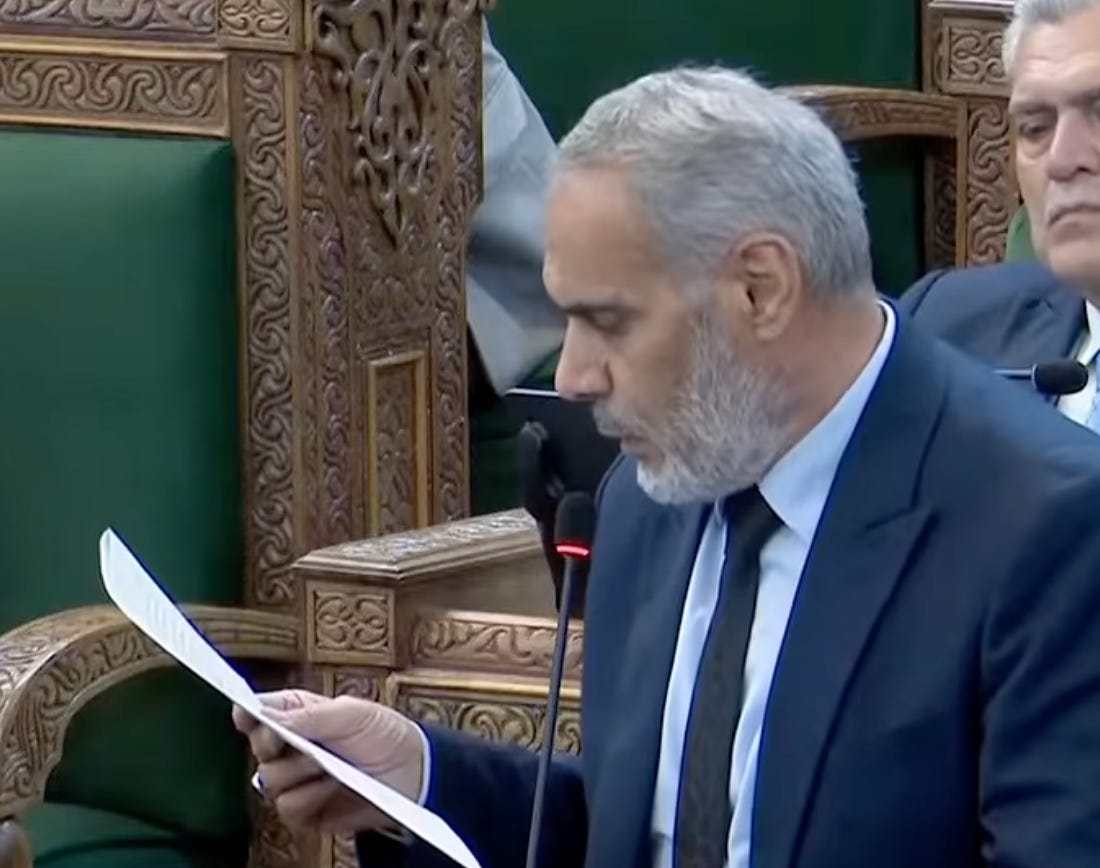
Mustafa Mahmoud Saqr (S2 2:55:17). SEC buys surplus power from factories at 2 euro cents (about 2.3 US cents) per kWh but sells at 14 cents, about six times more; elsewhere, the gap is at most three times. SEC used to buy any surplus, but now only above 200 kVA. Many industrialists, including in Adra industrial city, installed solar systems hoping to sell their surplus.

Minister al-Bashir
Some industrialists installed large solar systems mainly to sell power to SEC rather than use it themselves. The grid can no longer absorb renewables at that scale, given the 20–30% ceiling; hence the pricing (S2 3:14:56).
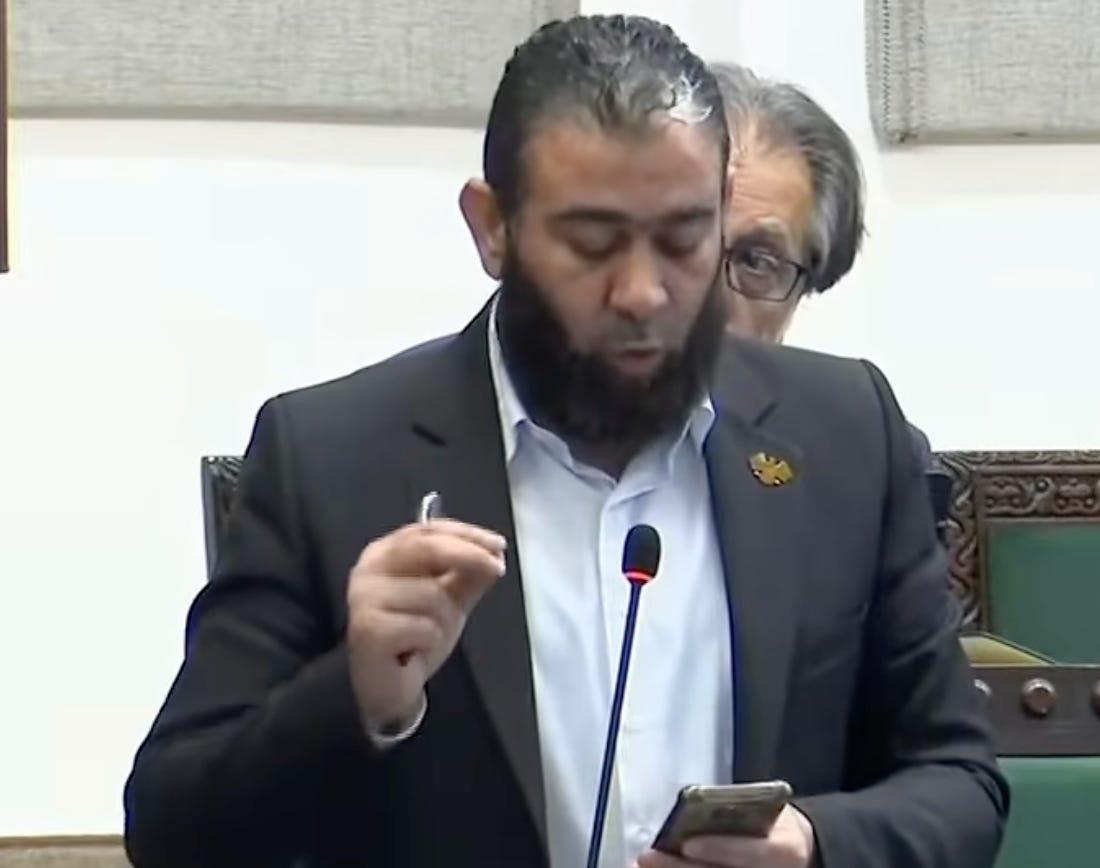
Nizar Mohammad al-Shayeb (S2 2:58:28). As long as connections are uncontrolled, new equipment will fail within days. Why the delay in smart meters? Why not distribute them early and free, reach 95% collection, and then revisit the tariff?
Minister al-Bashir
The electricity meter tender was external, which legally requires 50 days. It drew 52 bids of about 3,000 pages each, in English, that committees read “day and night”; then came an objection period and a delegation to China to qualify the firms. The commercial bid was suspiciously low, so a second delegation went. Water meters were installed faster, from about four or five months ago, because they were bought by direct contract with a Saudi meter company, financed by the Saudi Development Fund on long installments, at no cost to citizens. The electricity meter contract is not yet signed because of technical qualification details (S2 3:02:49–3:04:29).
Regional Supply of Electricity
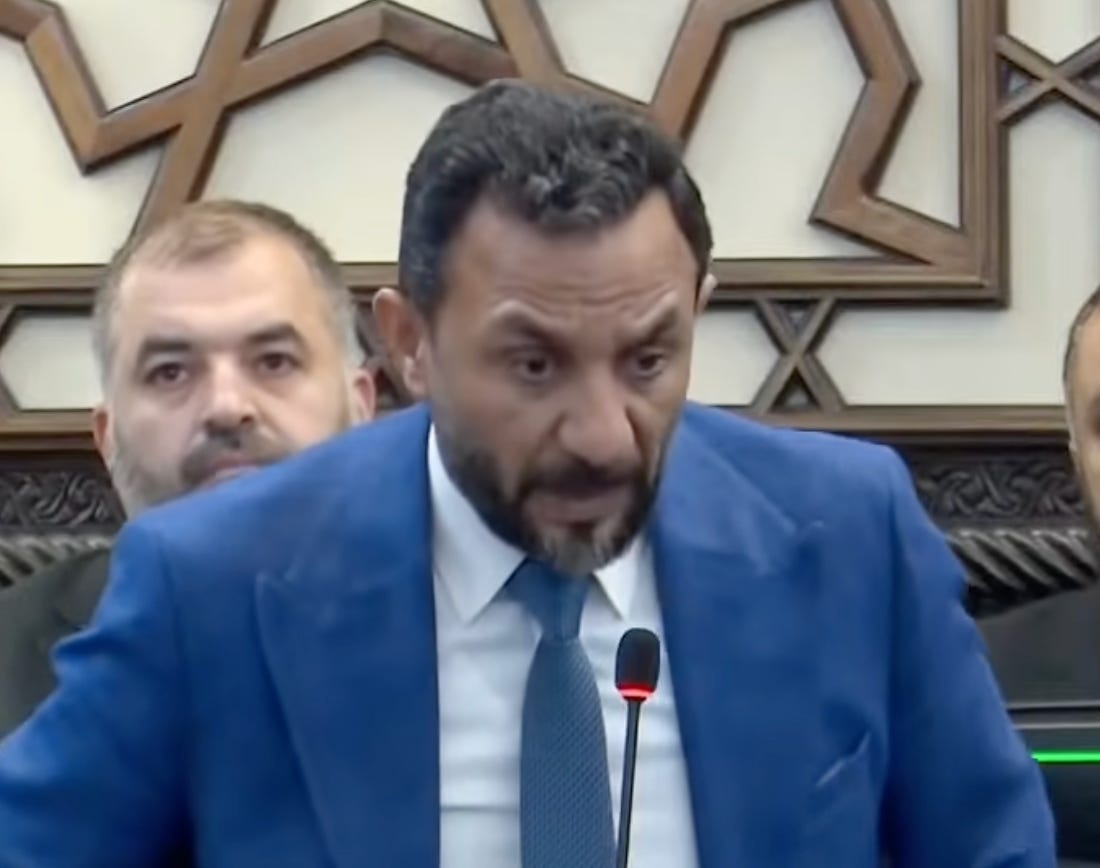
Ahmad Mahmoud al-Khalaf al-Shalash (S2 44:26). Ring main units (SF6 or vacuum, from ABB, Siemens or Schneider) have a design life of 25 years or 13,000 operations. At four switchings a day since 2011, their life is already exhausted. Has there been a field survey, a needs assessment, and a budget?
Minister al-Bashir
Much of the infrastructure is past its design life: plants, substations, breakers and valves. The priority is the 29% of the network that is out of service. Replacing aging equipment that still works is phase two, after an inventory (S2 55:57–57:10).
Ahmad Mohammad Hassan al-Omar (S2 1:39:37). No institution has kept to the Constitutional Declaration as Parliament has. The ministry should honor the social-justice goals in its own presentation: Raqqa’s allocation of power from the Euphrates Dam was cut from 120 MW to 70 MW four months ago.
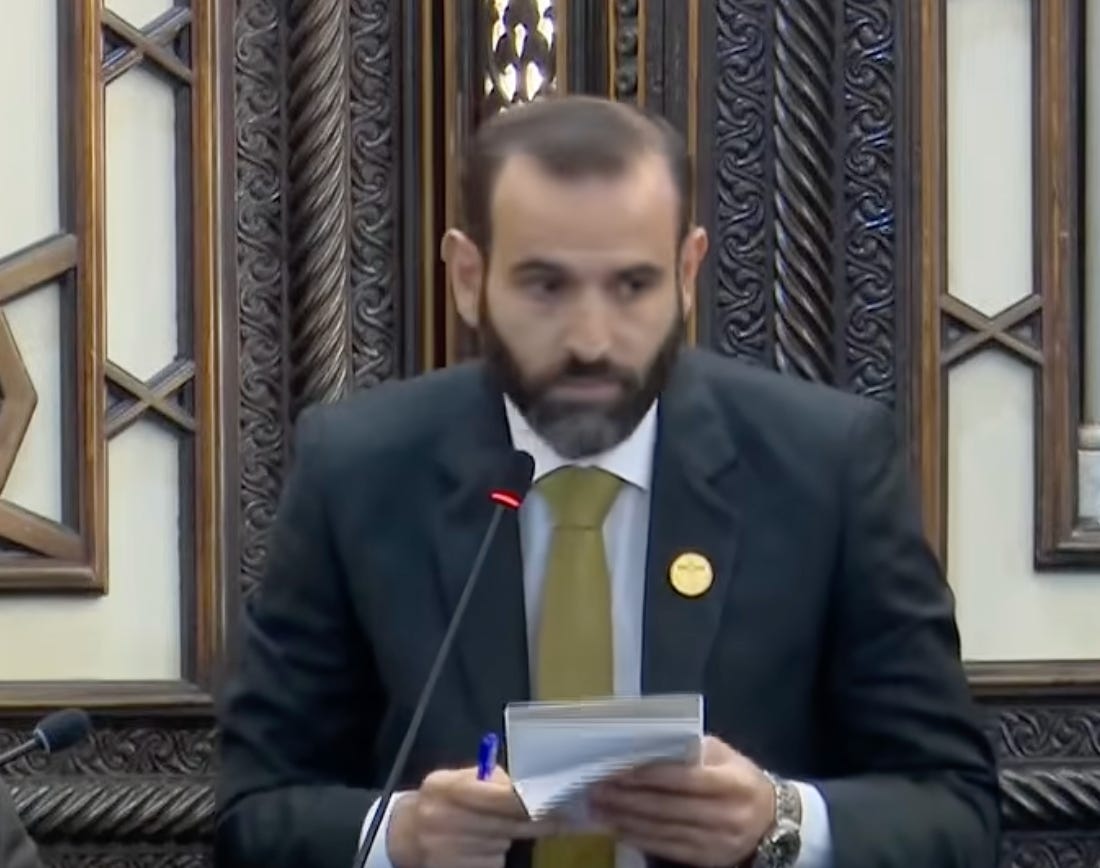
Ahmad Idris al-Taan (S2 2:20:31). Three transmission lines between the Tishreen Dam, “which we call the Manbij Dam”, and Aleppo could add about 200 MW if repaired. One of the dam’s two transformers is out of service; repairing it would add another 100 MW.
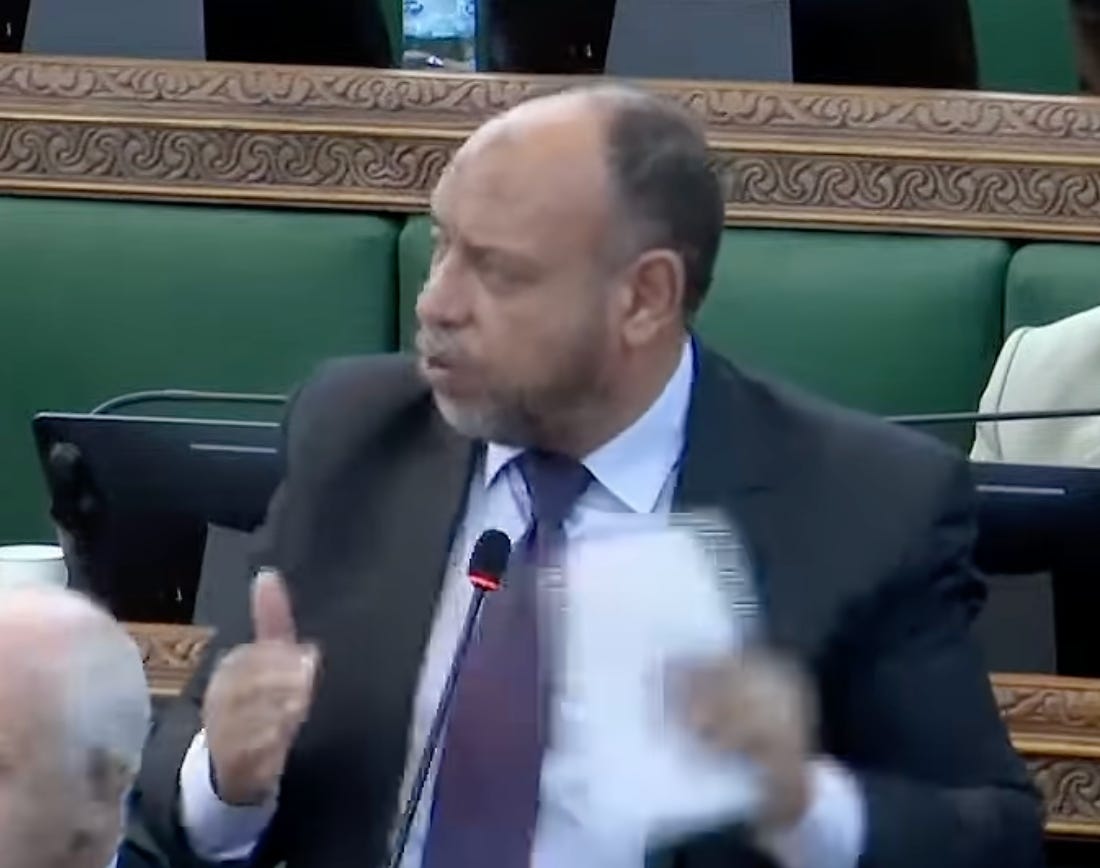
Alwan Ayed al-Ali (S2 1:40:09). Hasakah’s two plants at al-Suwaidiyah are in very poor condition and meet less than 10% of the governorate’s needs. He proposes a new 450 MW combined-cycle plant. What is the plan for the high-voltage lines that link Hasakah to the national grid?
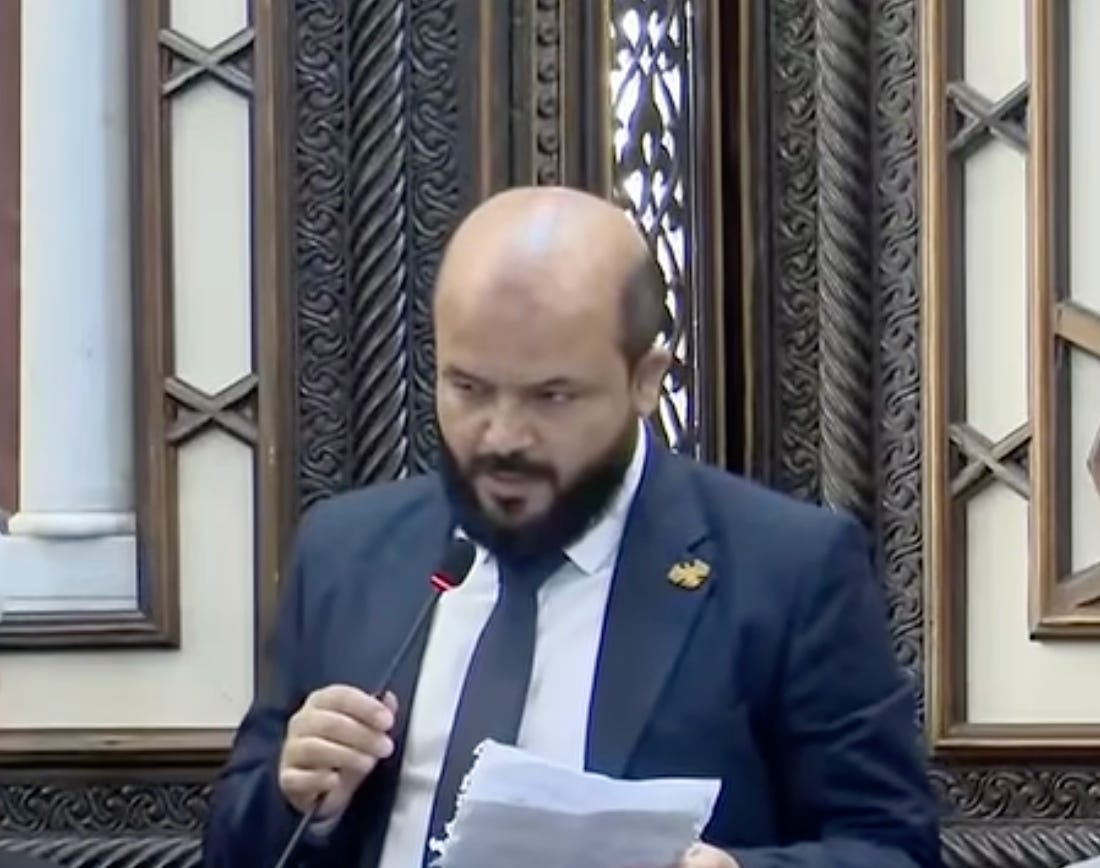
Gabriel Moushe Gawrieh (S2 2:02:57). Qamishli and Hasakah have long suffered severe power shortages, covered by generator subscriptions (“amperes”) or solar panels. After the latest rise, many canceled their subscriptions, choosing bread over light. The two cities now get about two hours of power a day, while Rmeilan and other towns get reasonable hours. He proposes rehabilitating the al-Suwaidiyah gas turbines and adding new ones.
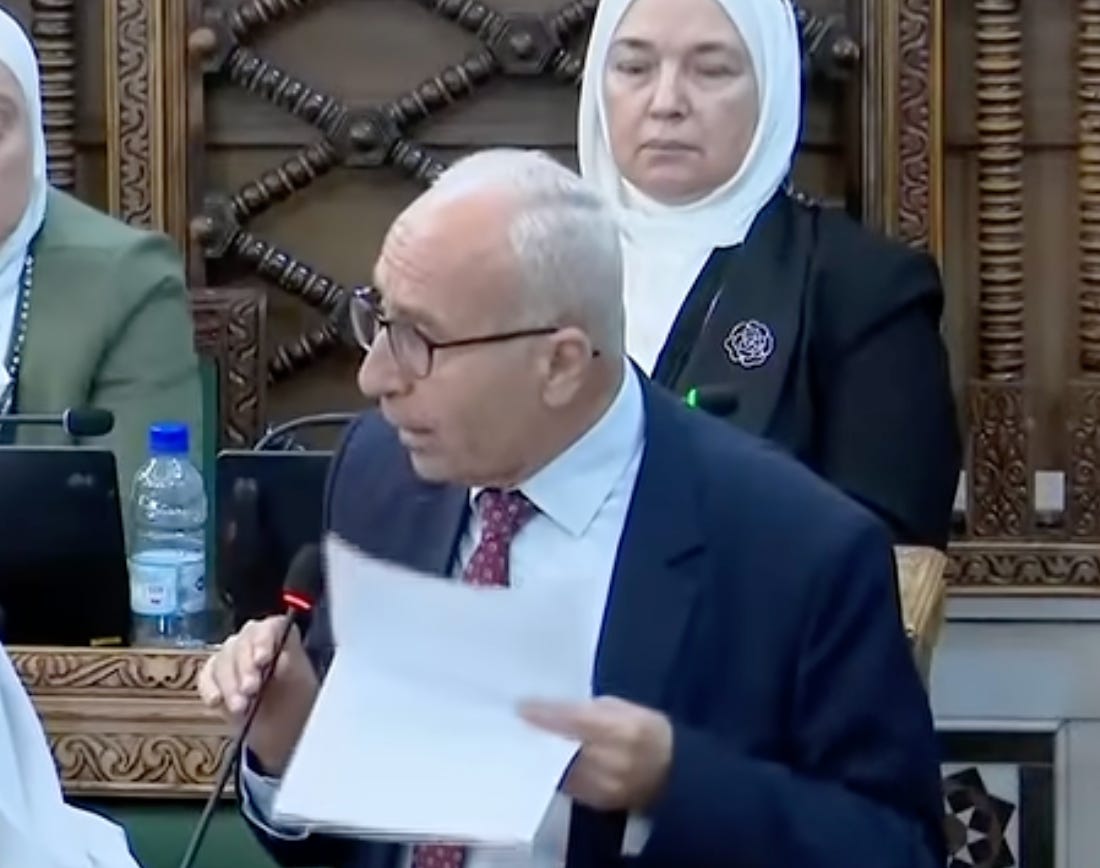
Minister al-Bashir
Al-Suwaidiyah works, but at low efficiency, like other plants (S2 1:45:52). Hasakah is currently cut off from the grid. Lines are being restored from the dams to Hasakah and from Hasakah to Deir Ezzor to close the loop, but it takes time (S2 1:46:00). Work on the transmission line continues; on water, the Alouk station now reaches 80% of Hasakah’s homes (S2 2:08:23).
Osama Mahmoud al-Naous (S2 2:45:37). The presentation said water costs 7 lira. In the al-Bab area, home to more than a million people, residents pay the equivalent of 2,700 [old SYP] (new SYP 27) per cubic meter of water and about 1,800 [old SYP] (new SYP 18) for electricity, with no tiers. He demands immediate equalization: “We are part of the Syrian Arab Republic, not another country.”
HussamEddin AbdulRazzaq Dbeis (S2 3:10:42). Why do Idlib residents pay more for electricity than other governorates? Who is Green Energy, what is its legal and investment framework, and what are its contracts with the Turkish side? What will be done to close the price gap, and when? Why must water and cleaning bills be paid before a meter can be topped up, and what legal basis allows a private electricity company to collect fees for services it does not provide?
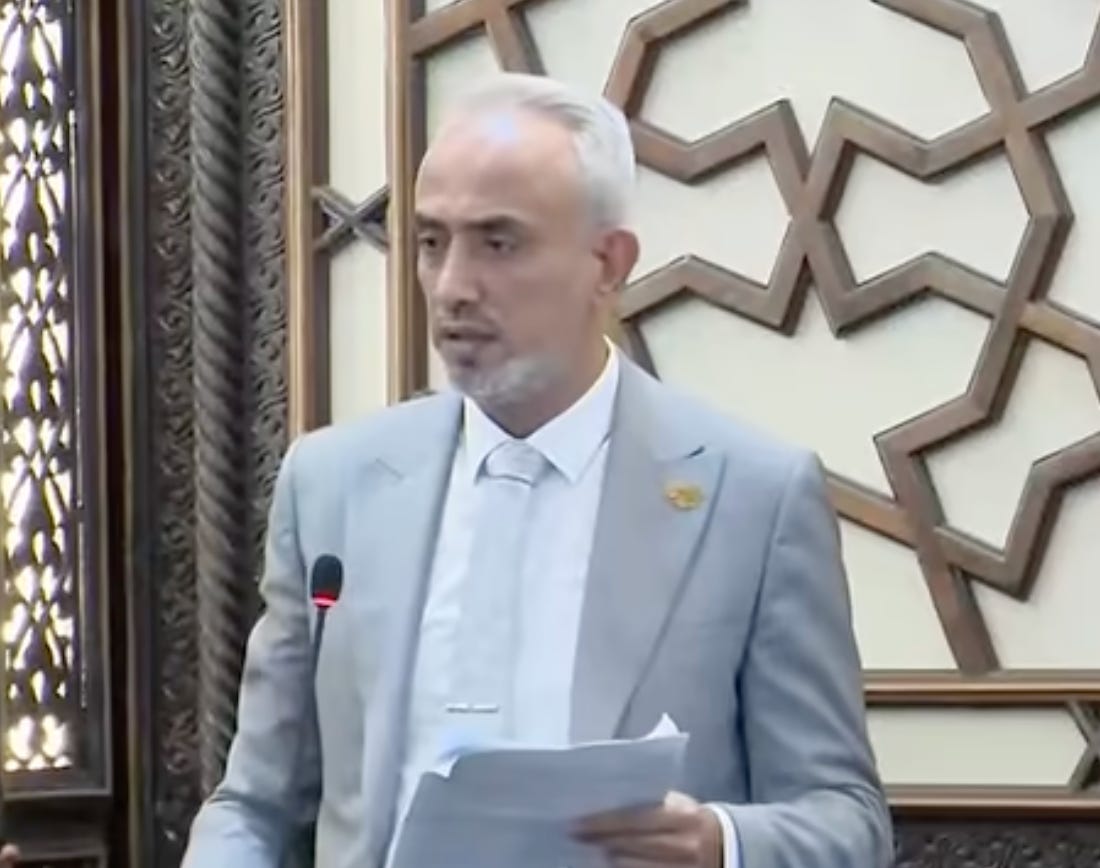
Minister al-Bashir
“It is their right”: electricity in Idlib and northern rural Aleppo is more expensive than elsewhere. It matches the second tier, but there is no subsidized first block. A future session will study electricity and water tariffs there. Because private companies buy the power, cutting prices needs Finance to cover the loss (S2 2:49:22–2:50:18).
Green Energy is a known, registered company, “owned by the Sovereign Fund”: a government company, registered with the Economy Ministry (S2 3:18:14).
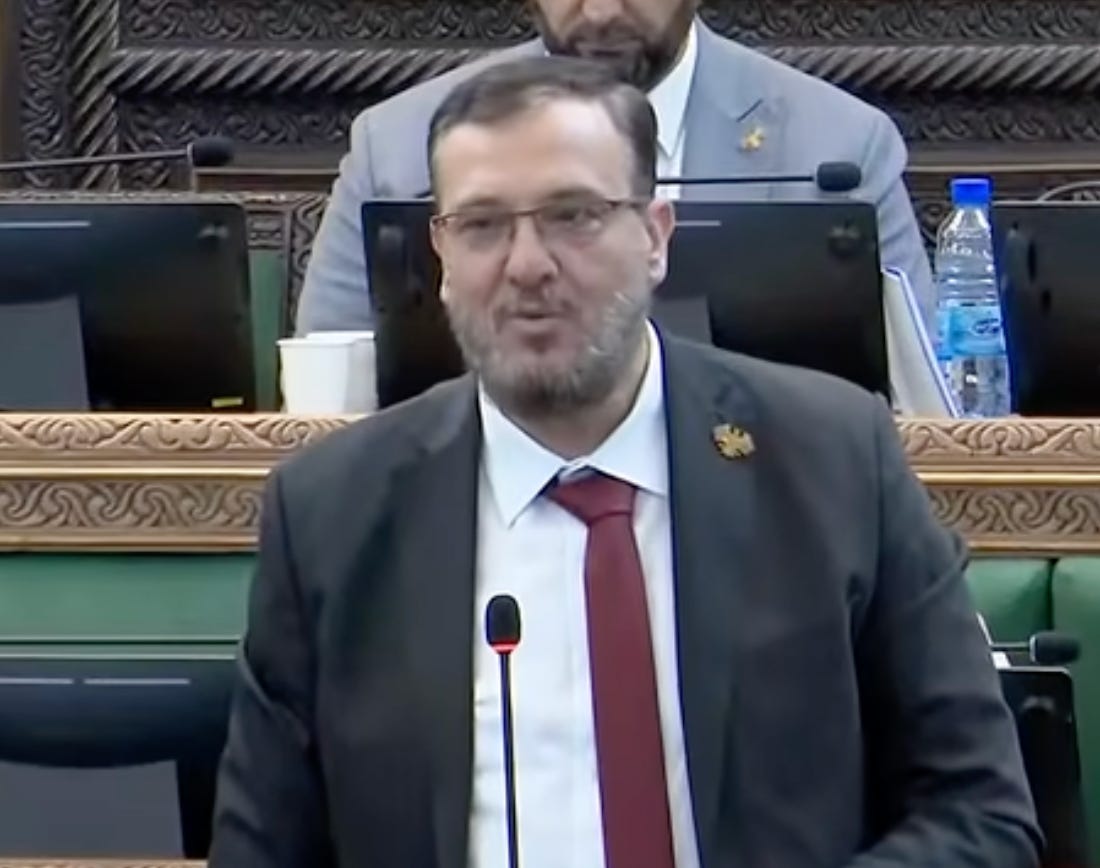
Mohammad Yasser Dalwan (S2 3:13:28). Two years after liberation, Douma, a town that gave more than 30,000 martyrs, is still in darkness. The electricity establishment puts the network shortfall at 70%.
Minister al-Bashir
He will check the 2027 plans and needs for Douma so that it is prioritized (S2 3:18:53).
Ibrahim Khalil al-Taleb (S2 1:01:27). Solar investors in Idlib from the Salvation Government era have waited four years for the electricity company to honor its commitments, even after mediation by Aleppo Mufti Ibrahim Shasho. They ask the minister to form a committee under his supervision.
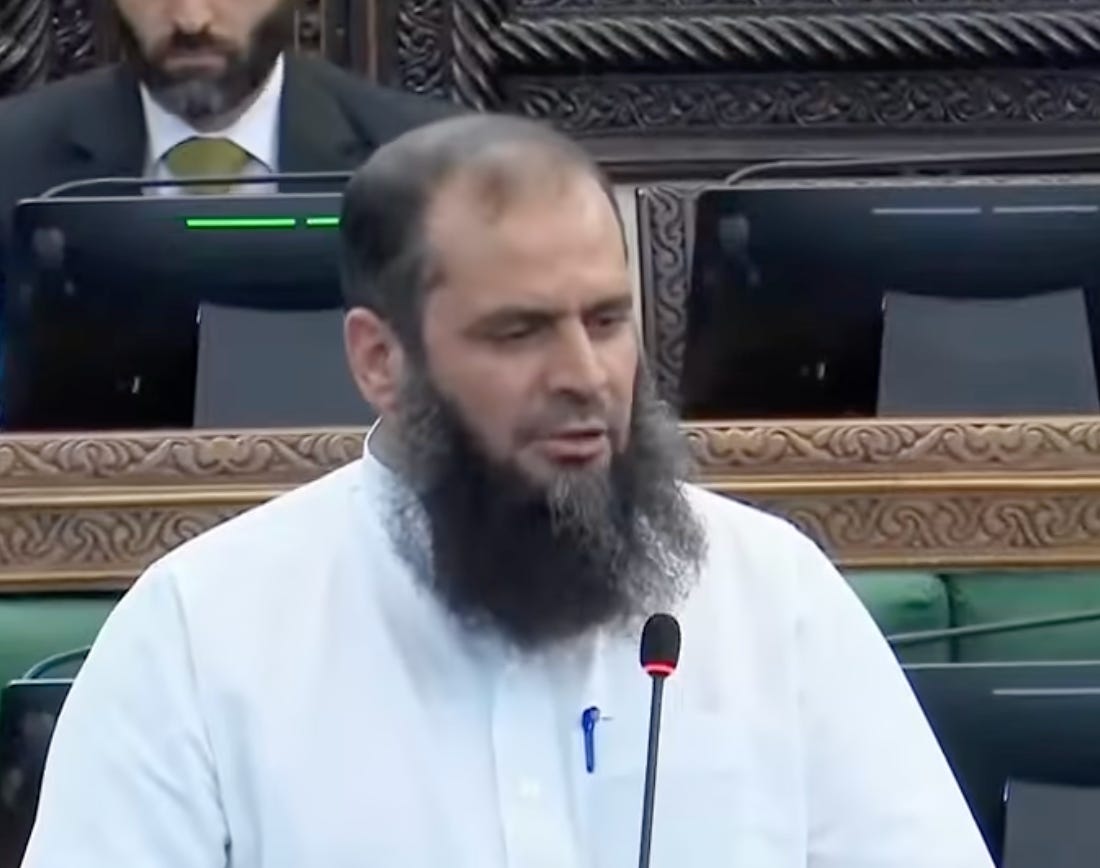
Lara Fathi Qadid (S2 1:02:43). What administrative facilitation will the ministry offer solar-farm investors, especially in setting the price per kWh?
Minister al-Bashir
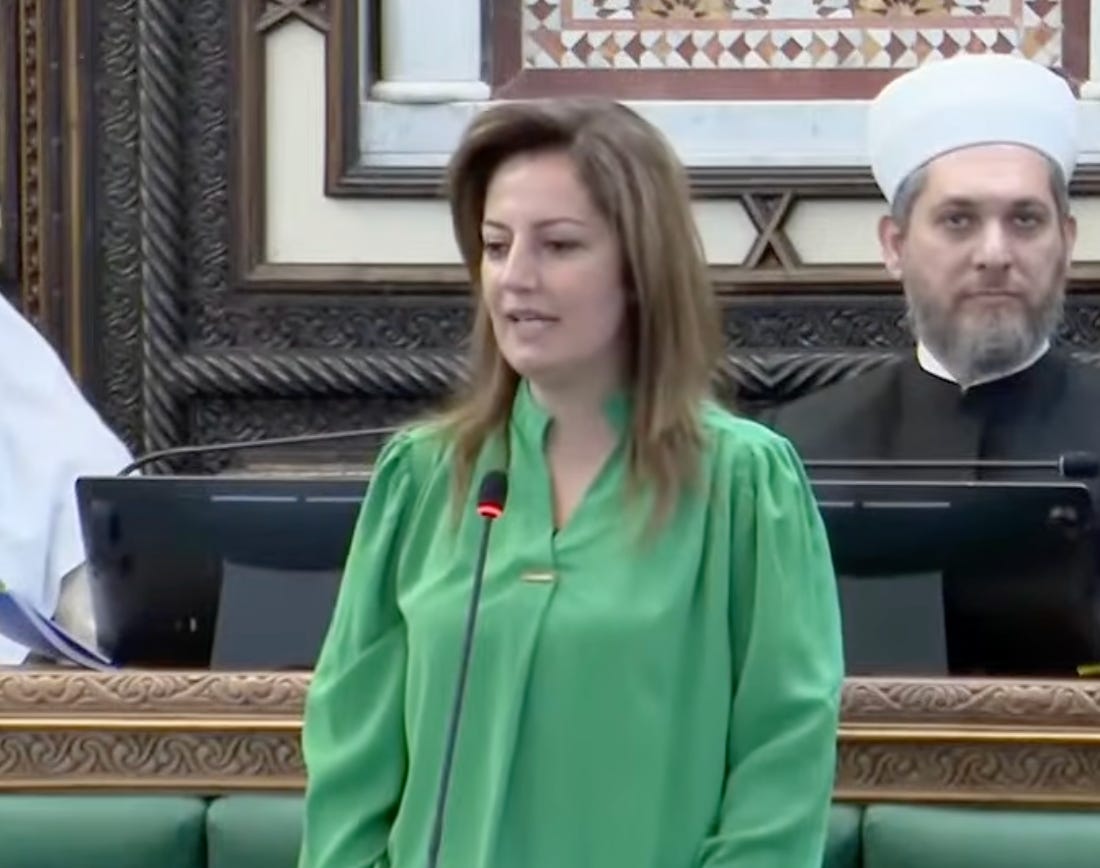
He will follow up on the Idlib solar case with the company (S2 1:09:16). The ministry has signed contracts for 2,500 MW of solar and about 1,500 MW of wind, which is enough as a share of the energy mix (S2 1:09:31).
4. Governance: dismissals, salaries, contracts and transparency
The 42 employees, dismissals, corruption, and CASI
Yasser Mahmoud al-Shahhadeh (S2 1:16:55). What about the dismissal, by Youssef al-Qablawi [SPC’s chief executive], of 42 employees in SPC’s Central Region administration for supporting and celebrating the efforts of the Central Authority for Supervision and Inspection (CASI) to catch corrupt officials?
Minister al-Bashir
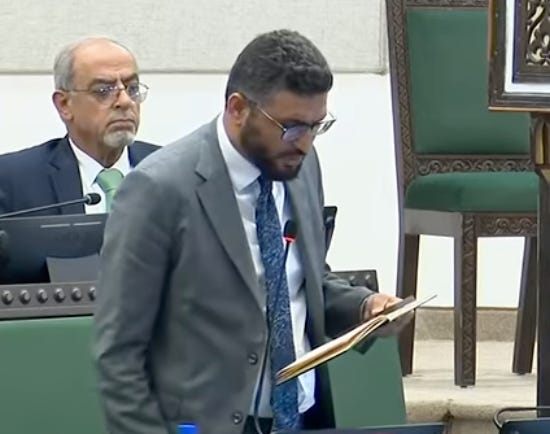
“It is not a dismissal”: these were temporary, seasonal contracts, which a director can legally end (S2 1:21:32). Not everything on social media is true; he cites a claim that Brent had fallen to USD 80, with people asking why prices were not cut, when it stood at USD 104 (S2 1:21:57).
A complaint reached the ministry the previous week and was referred to the Internal Audit Directorate. According to SPC, the employees threatened the Central Region management to approve a celebration of a corruption case that is not yet proven and still under investigation, entering by force. “The issue is not the celebration; it is threatening the director.” Internal Audit will report, and legal action will follow (S2 1:22:27–1:23:15).
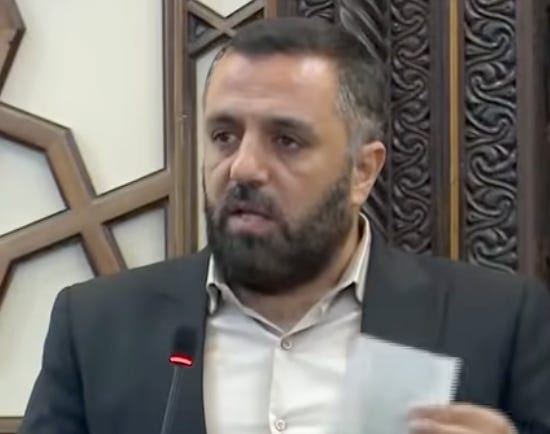
Qutaiba Ahmad al-Issa (S2 1:28:52). The suspended employees are contract workers, but most were originally dismissed for supporting the revolution, so they have been “wronged twice”: instead of being made permanent, they were given contracts and then suspended for celebrating the exposure of a corruption case “that became public knowledge”. Who bore responsibility for the USD 28 million case? The story that they forced their director to approve a celebration “is not logical at all”: anyone able to force the director would not have needed his approval.
Minister al-Bashir
A committee will examine whether SPC Central Region’s justification holds. If it does not, they will punish whoever acted wrongly. “If an employee is wronged even 1%, we will lift the injustice” (S2 1:34:32–1:35:12).
Contracts and Companies
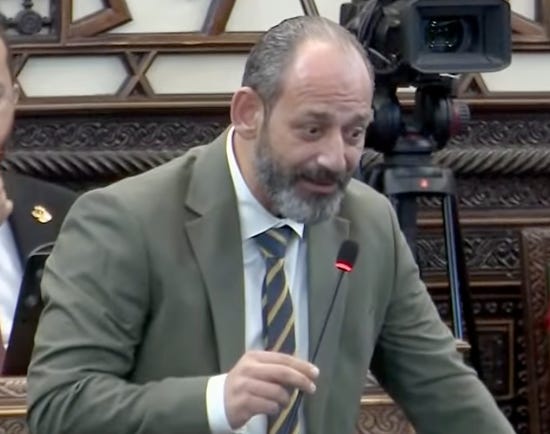
AbdulAziz AbdulQader Moughribi (S2 3:08:10). After the price rise, there was wide debate about three companies, Golkon, Taaziz, and Star Petronova, said to share one owner or to have overlapping owners. Is this true?
Minister al-Bashir
“Yes, they are companies licensed to one person or several people with a single owner.” CASI raised problems in some of their contracts: some unjustified, some needing control (S2 3:16:16). One example: polluted formation water from the al-Taim field was heading for the Euphrates and nearly contaminated it, so SPC urgently contracted Taaziz to collect it and reinject it into wells. Before integrating the areas east of the Euphrates, Taaziz was the only company working both west of the river and in Autonomous Administration areas. It was among the qualified firms and was awarded the contract directly (التراضي). Part of the work was carried out, with technical problems now being followed up with CASI (S2 3:16:41–3:17:30).
Aref AbdulMajid Razzouk (S2 1:16:12). Direct contracting (التراضي) is “firefighting”. Why not do a strategic needs assessment and purchase frameworks so equipment is ready when a transformer fails?
Minister al-Bashir
The reasons for direct contracting were already explained in the presentation [Part 1] (S2 1:21:22).
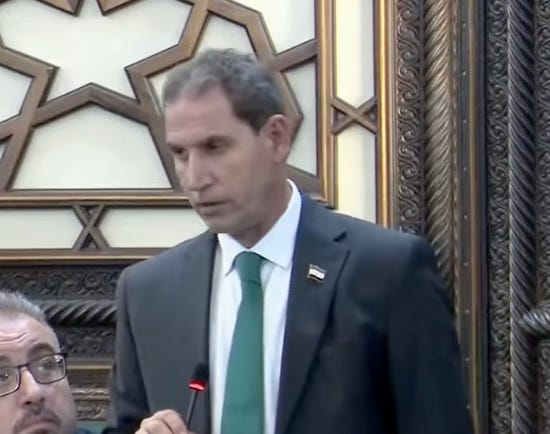
Ahmad Mohammad al-Hariri (S2 2:52:42). “Corruption eats development.” Information points to two lines smuggling oil from a field in the Rmeilan area to northern Iraq. He asks that this be treated as a formal report to the minister and to CASI.
Minister al-Bashir
An old line existed before the integration of the east, and it has stopped. If corrupt people restarted it, that needs checking, but he doubts it: production and refinery receipts are measured and match (S2 2:59:46).
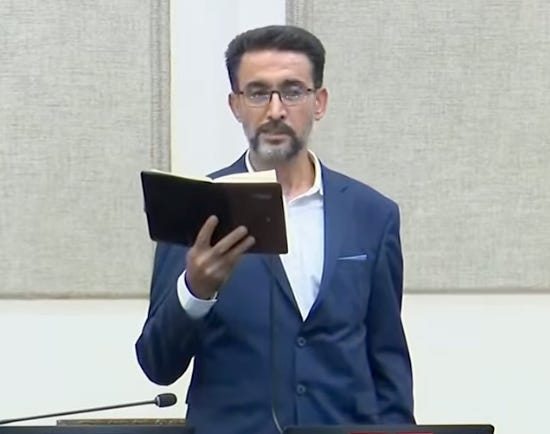
Jaafar al-Sadeq AbdulLatif Tahhan (S2 2:47:31). Have SPC’s assets been inventoried, revalued, and handed to the holding company? What are its oversight mechanisms and its human-resources policy?
Minister al-Bashir
“If the brothers took a little trouble to read the decrees”: two decrees, one establishing SPC and one forming its board, set out its tasks, budget and relationship with the ministry “clearly and in detail” (S2 2:50:46).
Salaries and Austerity
Nizar AbdulRazzaq Rashdan (S2 2:19:05). The minister says SPC engineers earn about USD 120 a month, but SPC’s director has said otherwise.
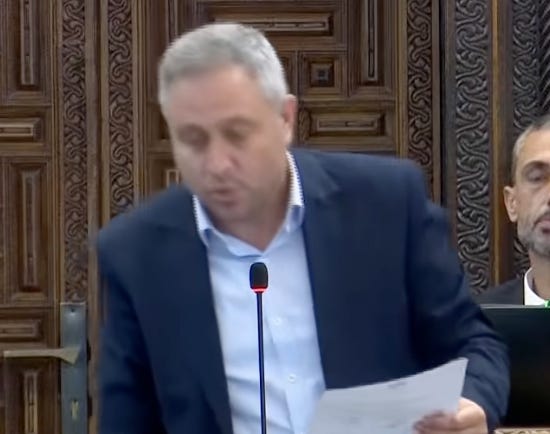
Khaled Ahmad al-Salloum (S2 3:06:55). SPC chief Youssef al-Qablawi went on the media to talk about high salaries, yet salaries turn out to be under the Basic Employees Law. He should have distinguished between advisers and employees. “This is the sixth hour you’ve been answering.” The problem of the people is simple: “I want money”.
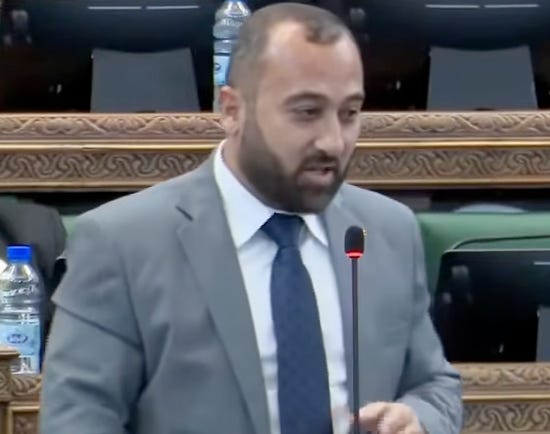

Minister al-Bashir
SPC, SEC and the Ministry are still paid under the Basic Employees Law, with no sectoral pay rise for energy. Euphrates Dam engineers earn about USD 120 a month, 1.5–1.7 million old SYP. A new wage system awaits SPC’s statute; only some experts have better-paid contracts (S2 54:12–55:09). He has raised energy-sector pay with the Presidency, Finance, and the General Secretariat, and the President ordered a study. Not all ministries received the 550% sectoral raises (S2 55:25).
Some engineers and oil experts from abroad are on expert contracts under Law 53, as used in the north [Idlib]. Engineers are leaving as HKN, Conoco and UCC hire them, so as chairman of SPC’s board he asked for a proposal on bonuses, and some bonuses and perks are paid. The chief executive’s figure of USD 4,000 for some experts is “a vision”, not an adopted wage system. The ministry’s central experts include the head of electricity-sector regulation, recruited from Ireland with a PhD in renewables, on an expert contract. With SEC losing USD 1.65 billion, there is no capacity to raise pay yet (S2 2:25:22–2:27:31).
On the “I want money” point: all the ministry’s policies aim at good incomes, jobs, and real development. The transition will be hard (S2 3:15:44).
Mohammad Yasser AbdulKarim al-Hamidi al-Hamad (S2 2:21:10). According to the half-year report, administrative spending is 28% of the 2026 budget, and wages and compensation are 36%, against 5.5% administrative spending in Germany. He says this pays for officials’ luxury: large cars, with “the least minister having three or more”. He supports ending subsidies and pricing at market levels, but asks why officials face no austerity: cut administrative spending to 6%, reduce SPC salaries to a reasonable level, and use the savings to support poor families.
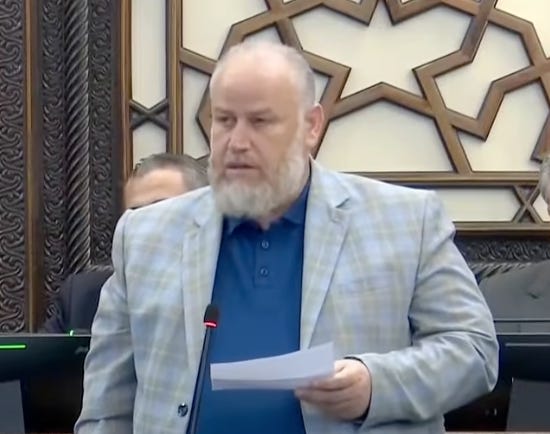

Hussam Adnan Hamdan (S2 2:30:46). Any government austerity plan should be public. The motorcades of ministers and officials “provoke the street”.
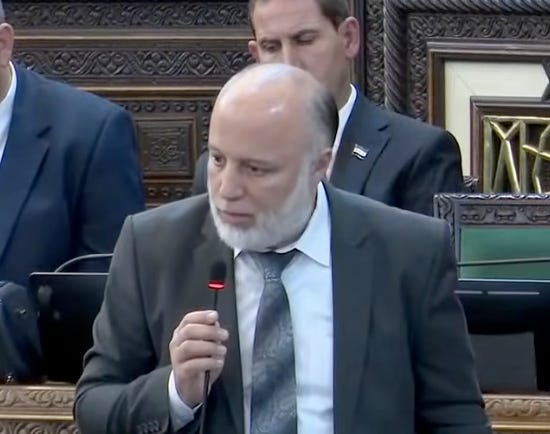
Minister al-Bashir
Ministry salaries are transparent: “request the table from Finance, nothing is hidden”. SEC’s head, Omar Shaqrouq, told him engineers are leaving. At the Euphrates Dam establishment, he found 11 engineers, all in their fifties and sixties; young people will not come at these salaries (S2 2:28:53–2:29:48). He supports austerity and has written internally to cut fuel spending and non-essential work, but the three diesel grades need about ten field inspection rounds instead of one or two to stop fraud. “Our administrative spending, salaries, cars: an open book” (S2 2:29:48–2:30:46).
Social media exaggerates motorcades. At the opening of the Alouk water station in Hasakah, he traveled in two cars, his own and one for security and media. About 200 cars arrived, carrying local officials, MPs, the Red Cross, UNICEF, security, the governorate, the Autonomous Administration and a presidential envoy, and it looked like a motorcade. Many ministers are “wronged” this way. Austerity and lower administrative spending are still needed (S2 2:38:03–2:40:18).
Recruitment and the Raqqa Directors
Akram Maddah al-Assaf (S2 1:49:11). Recruitment rounds for petrochemical engineering graduates since liberation have taken very few people relative to the number of graduates. More seriously, “zero women were accepted”, which he calls a constitutional violation. If the ministry will not hire women engineers, why does the state admit them to the degree? He proposes a national training and skills program with the Education and Higher Education ministries.
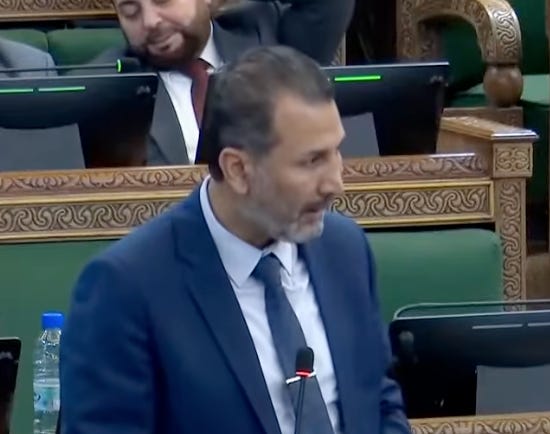
Minister al-Bashir
Some recruitment rounds are for field jobs at oil wells in remote areas, “unsuitable for women”. “I worked at the Conoco and Tuwaynan plants: not one woman was there”; staff lived in desert caravans during construction. Some administrative posts are sometimes women-only, and the ministry’s central office is staffed by women, including petroleum engineers and economists. It depends on the post (S2 1:56:31–1:57:24). A national program or fund is a good idea; MPs can submit proposals through the Speaker (S2 1:57:24).
Ahmad Mahmoud al-Khalaf al-Shalash (S2 45:39). In Raqqa, the electricity directorate is run by someone from outside the city after the previous director was removed; the water resources director, the SADCOP director (a veterinary graduate), and the Euphrates Dam director are also outsiders. “What do you say to the people of Raqqa?”
Minister al-Bashir
Is there a law requiring directors to come from the governorate? If Parliament legislates it, he will comply. His deputy minister for planning and institutional excellence, Ibrahim al-Adhan, is from Raqqa, and he himself lived in Raqqa and Deir Ezzor while working at the Tuwaynan and Conoco gas plants (S2 57:10–57:58).
Marwan Ahmad al-Nazhan (S2 1:59:09). On behalf of oil engineers and experts, he proposes an energy crisis-management group (Energy, Finance, Transport and Economy), given Finance’s slowness and tankers held at sea. It would handle government austerity, waste and smuggling, output, subsidy and price reform, anti-corruption and accountability, and publish a simple periodic bulletin on production, consumption, imports, deficit, losses and savings. He also asks for priority hiring of eastern residents in the oil sector.
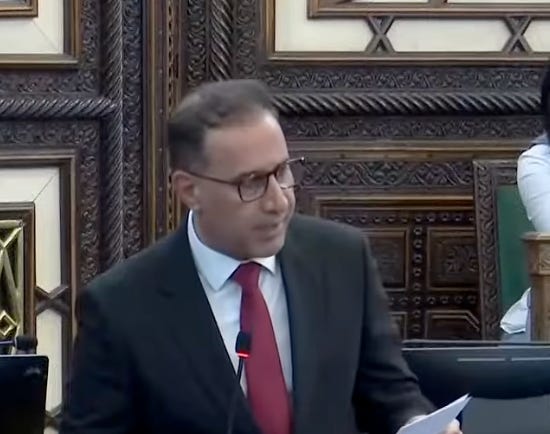
Minister al-Bashir
Part of this work is already done by the pricing committee, and a crisis committee with Economy and Finance exists (S2 2:05:10). Hiring eastern residents is a priority: most workers in the eastern oil and gas fields are local, though not all (S2 2:05:40).
Strategy, Transparency, and Structure
Tamam Mohammad al-Ludaimi (S2 2:42:55). Strategic plans need goals broken into SMART objectives, a timeline, and delivery steps, all published on the ministry’s website: a baseline, the plan, what was done after six months, and explanations for what was not. This would ease public anger.
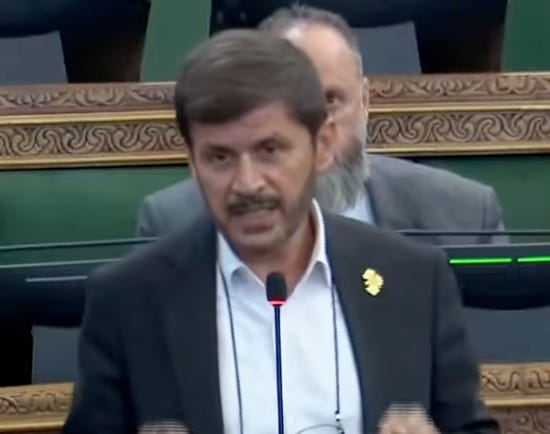
Minister al-Bashir
The ministry is new. The Energy Services Portal and the official website have been launched but are still in a trial phase. He accepts the recommendation to publish the plans there (S2 2:48:20).
Mohammad Walid al-Bakir (S2 2:34:38). He calls for separating the merged ministries, each of which needs full attention, and asks the Speaker to move water to the Agriculture and Food Security Committee.
Minister al-Bashir
Separating ministries is a legislative matter for the President and Parliament. Models vary: Germany combines economy and energy, plus industry and trade (S2 2:41:35).
5. Oil: production targets, the east, and pollution
Need, Production, and 1 million Barrels Per Day Target
Yasser Mahmoud al-Shahhadeh (S2 1:17:18). The presentation says Syria needs 300,000 bpd. Earlier ministry statements called that the market’s need; today it is described as 150,000 bpd for the market plus 150,000 bpd for the refineries. What is the total need?
Ahmad Omar Zaidan (S2 2:12:44). The statements contradict each other: the minister says the need is 300,000 bpd, while SPC’s head has said 800,000 bpd by 2030, then one million. With the infrastructure dilapidated, how can Syria produce 1 million bpd within three years?
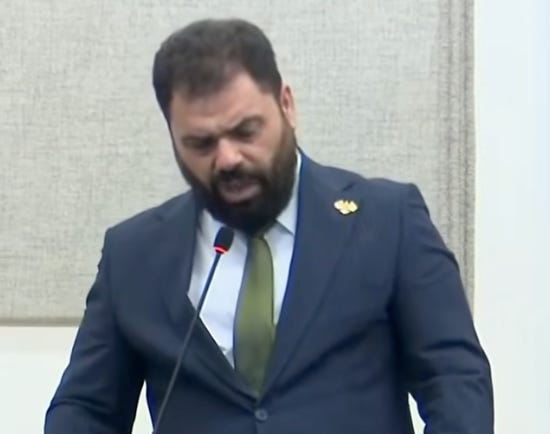

Minister al-Bashir
Need is 300,000 bpd of crude, but refining capacity is 150,000 bpd. With Baniyas running, Syria buys about 100,000 bpd for Baniyas, plus local crude for Homs, for a total of 150,000 bpd refined. The other 150,000 bpd is imported as products. A refined barrel yields only about half diesel and gasoline; the rest is fuel oil, kerosene, naphtha and losses (S2 1:23:15).
Everything is dilapidated: generation, transmission, oil and gas pipelines, gas plants, SADCOP filling plants and refineries, and it needs “enormous funding”. MPs contradict themselves by asking both for subsidized fuel and power and for repairs. “We feed the treasury, not the other way round. I am an economic, investment entity under Syrian law, not an administrative body that takes money” (S2 1:24:00).
Statements are taken out of context or out of date. Need today is 300,000 bpd. If SPC’s chief executive says 1 million bpd by 2030 or 2031, then about 700,000 bpd would be exported, with domestic need perhaps rising to 400,000–500,000 bpd. “Production and need aren’t linked: surplus we export, shortfall we import” (S2 2:15:49).
Oil Revenue and the East
Alwan Ayed al-Ali (S2 1:40:09). Will any oil revenue go to developing the eastern region? What is the ministry’s relationship with HKN and Gulfsands?
Fajr Fawzi al-Ahmad (S2 42:48). Deir Ezzor needs an oncology hospital: of “100 cases in Syria, 51 are in Deir Ezzor” [as stated], with the small village of al-Jurdi carrying a heavy share. The east also needs a bacteriological laboratory.
Minister al-Bashir
Oil revenue for the east was discussed with the Presidency, the General Secretariat and Finance. The outcome: revenues go to Finance, which budgets them. The ministry can flag needs, such as an oncology hospital, but the Health ministry would build it. The ministry wanted to build the al-Siyasi bridge in Deir Ezzor, since the earthen bridge used to truck oil across had gone, but the government said that was the Housing ministry’s job. Some community contributions are possible, but not strategic projects (S2 1:43:57).
HKN operates under a production-sharing contract, like any investor. Gulfsands had an earlier contract but declared force majeure in 2012. It applied to return; its contract was redrafted, and it will take back its block and continue production and development (S2 1:46:28).
Pollution in the East and on the Coast
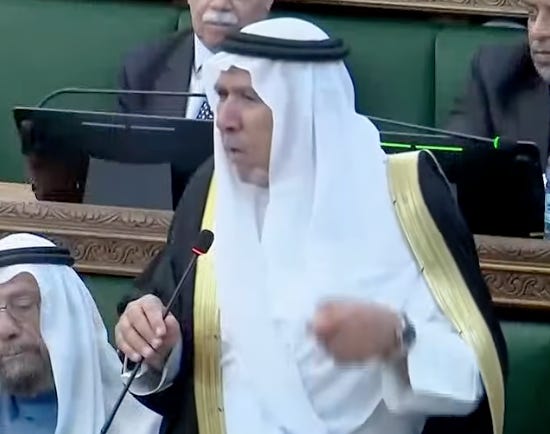
Rami Shaher al-Saleh (S2 1:12:06). “Everything is clear; now it’s execution.” He proposes an operations room in Deir Ezzor. The Euphrates is so polluted that “whenever you taste it you need a doctor”, and oil residues and formation water from the al-Taim field flow into it. The Khabour, with 220 km of contiguous villages from its mouth to Hasakah, has been dry for 45–50 years, and only a diversion from the Tigris can save it.
Minister al-Bashir
The Tigris diversion is a priority. The Halabiyeh–Zalabiyeh dam and the Tigris–Khabour project will soon be offered for investment (S2 1:19:55). [On formation water, see the 30,000 bpd of wells shut for health reasons in section 2 (S2 52:12), and the Taaziz contract to reinject al-Taim’s formation water in section 4 (S2 3:16:16).]
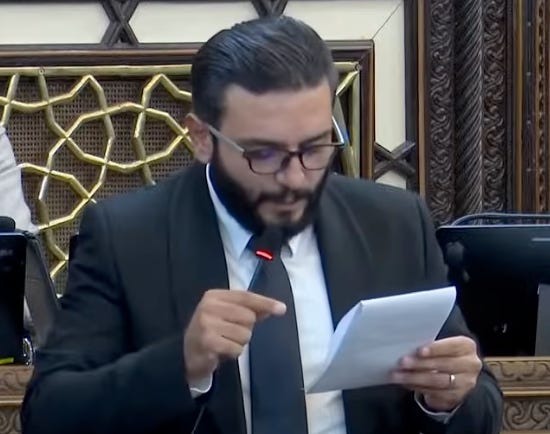
Amjad Akram Ali (S2 1:36:30). Baniyas and al-Qadmous suffer a “double pain” from the thermal power plant, the refinery, and the Syrian Company for Oil Transport: heavy pollution and disease. The plants need filters, and the area needs compensation. Part of the refinery’s revenue used to fund development in affected areas, and this should be reinstated, or the state could give directly, for example through lower electricity tariffs for areas that host generation. Al-Qadmous, a mountain area where bread arrives by helicopter in snow, is among the most vulnerable.
Minister al-Bashir
Strategic facilities are spread across Syria: the Tishreen, Nasiriyah and Deir Ali plants in Rural Damascus, Mhardeh, Jandar, the Homs and Baniyas refineries, Aleppo, the dams in Raqqa, oil in Deir Ezzor, and the Furqlus, Hayyan and Ebla gas fields. Many areas are affected. The ministry is working on Baniyas’s recent heavy emissions and on securing gas to reduce fuel-oil firing (S2 1:42:21). Every region asks for priority, Raqqa for the dam, Baniyas for its plant, Homs for Jandar: “These resources belong to the Syrian state” (S2 1:43:35).
Storage and Baniyas
Ahmad Mahmoud al-Khalaf al-Shalash (S2 47:19). Energy faces “a resource crisis and a resource-management crisis”. When SPC withdrew, the shock fell on Syrians, though shock-absorbing policies were possible, such as stockpiling when oil was cheap. On Baniyas: did no maintenance team recommend the overhaul earlier, and could an alternative refinery not have been secured first?
Minister al-Bashir
Liquidity does not cover current purchases, let alone stocks. Tanks are being rehabilitated and price offers requested, and the private sector has been invited to bid to store and distribute products in return for a share of profits. The target is at least one month of stock, “our zero point”, especially for winter, when waves stop tankers from berthing. Global availability and prices remain obstacles: “we buy at auction” (S2 57:58).
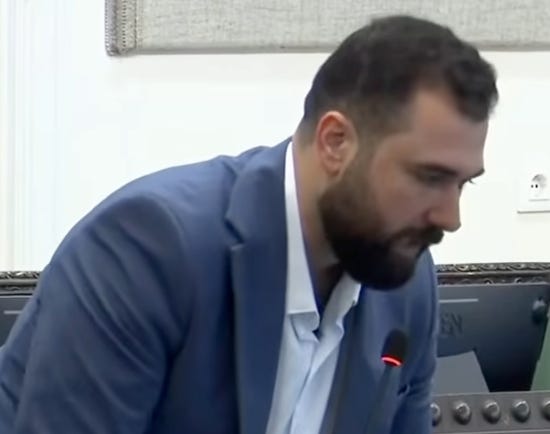
Bishr NajmEddin al-Hawi (S2 2:17:59). What is the timeline for Baniyas, and will prices fall directly afterward?
Minister al-Bashir
At the end of October, the units that produce diesel restart. At the end of November, the reformer and distillation units will be ready to produce gasoline. Prices may fall if crude stays at this level or lower; if Brent returns to USD 130–140, they will not (S2 2:24:17).
Oil Secondary Schools (Vocational Training)
Minister al-Bashir
[Answering a committee question from Session 1 that he had missed.] The oil secondary schools were closed: they added little value, most students were not interested, and graduates were unsuitable. The oil institutes remain. The Education ministry agreed in advance to absorb all students into general or industrial secondary schools (S2 1:41:23).
6. Water, irrigation and dams
Damascus, the Barada and the Coast
Mohammad Basel MuhiEddin Haylam (S2 1:05:22). The former regime diverted sewage into the Barada River and blocked its flow with concrete. It also had a contract with a neighboring country to export Barada spring water. He asks for a review.
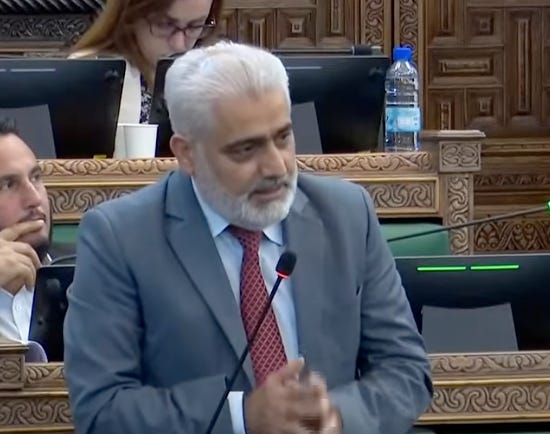
Imad Ali al-Ashrafani (S2 1:51:31). When will water extraction from the Zabadani plain end? It has dried up the Barada and lowered groundwater, threatening the whole plain. He asks for a fast alternative before an environmental disaster.
Minister al-Bashir
The “national carrier” from the coast aims to end Damascus’s reliance on springs such as Ain al-Fijeh, so that the Barada can recover. “Nobody is taking it outside Syria”: all of it goes to Damascus, and the 1.5 m³/s from Ain al-Fijeh and the Barada spring is not enough for Damascus and Rural Damascus (S2 1:10:49).
The drought is severe. Ain al-Fijeh has fallen from 40 to 1.5 m³/s [as stated]; many springs are dry, and the Yarmouk basin has dried out because of random wells. The tactical fix is to stop random drilling, close wells, and regulate extraction; the strategic fix is the coast-to-Damascus carrier (S2 1:57:41).
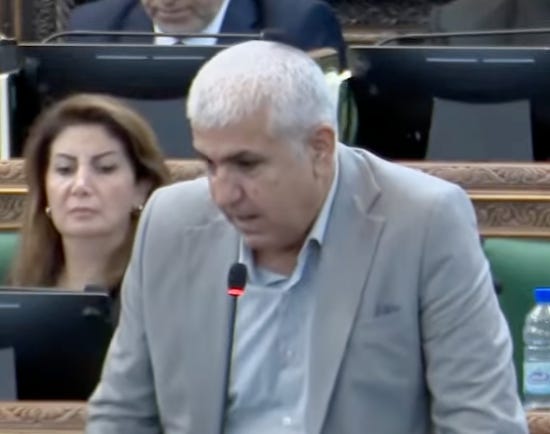
Issa Mohammad Ibrahim (S2 2:02:05). The coast itself has suffered severe thirst: many villages get water for one hour every 10 to 20 days, and Latakia City has had shortages. “A project that solves one problem creates another.”
Minister al-Bashir
The carrier will not take the coast’s share. It will capture wasted river surplus, submarine freshwater springs and groundwater, with desalination if shortages arise. A project recently opened in Latakia now provides excellent, continuous water. Neglected mountain villages will be reached under a plan to bring power and water to every home (S2 2:07:17).
The Euphrates Basin: Raqqa, Manbij and Rural Aleppo
Ahmad Qaddour al-Afdal (S2 1:17:48). Raqqa’s Euphrates irrigation projects cover 103,000 hectares in five sectors. Under the former de facto authorities, irrigation infrastructure was ruined, with canals and drains destroyed or blocked and secondary salinity rising. Farmers in Raqqa and Deir Ezzor have not yet returned to farming.
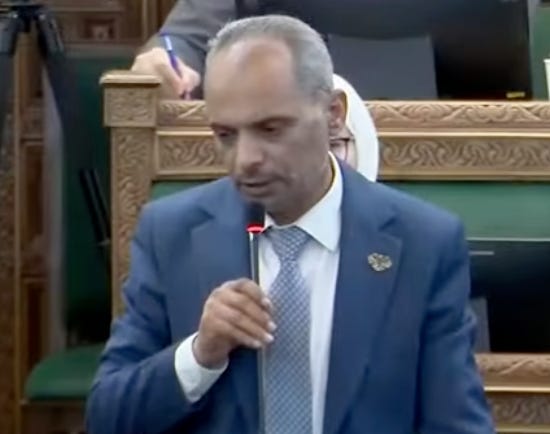
Ibrahim Khalil al-Taleb (S2 1:02:26). Dozens of villages near the Euphrates around Manbij lack drinking and irrigation water, and many districts of the city get no water.
Khalil Issa al-Kanou (S2 2:44:50). The minister listed many projects, but none in Raqqa, not even a water station. North of Raqqa, around Tell Abyad and al-Zaydi east of Suluk, dozens or hundreds of villages have been abandoned for lack of water, because the al-Hisha pumping station on a Euphrates irrigation canal is broken. It only needs maintenance.
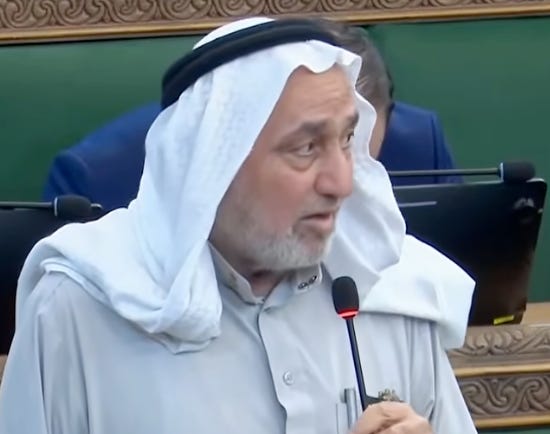
Miqdam Ali al-Jashaam (S2 3:05:10). Water waste is the biggest issue. Lake Assad is 90 km long, yet in al-Jurniyyeh district, 70,000 hectares and 140 villages within 3 to 20 km of it are thirsty. A project has been ready since 2007, and the area’s 2 million olive trees all depend on wells. It needs only about four pumping stations, far cheaper than the Euphrates–Hisyah project.
Minister al-Bashir
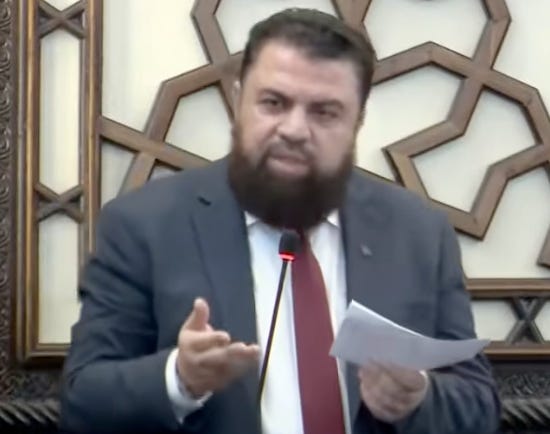
Many projects in Raqqa were not named for lack of time, such as al-Rusafa, the al-Jurniyyeh plains and a previously bombed pumping station (al-Balikh). All are in the 2027 investment plan (S2 2:48:42). The al-Jurniyyeh and al-Rusafa projects are in the 2027 budget (S2 3:15:29).
Muayyad Sameh Ahmad Qabtour (S2 1:26:10). The north and north-east of rural Aleppo are fertile plains with poor groundwater. A pre-2011 Irrigation Ministry project would have brought Euphrates water to them; the area is near Azaz and Jarabulus, so it would be cheap.
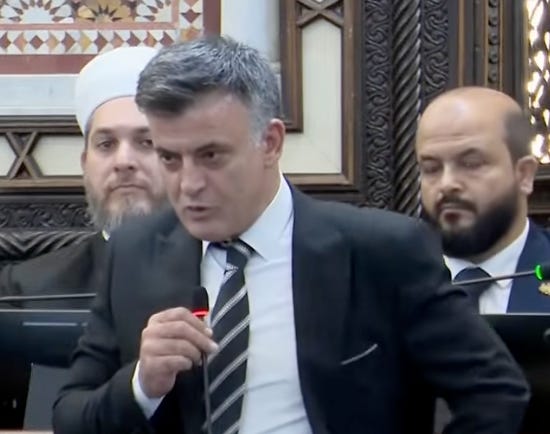
Mohammad Fawwaz al-Mahalli (S2 1:38:50). Rural Aleppo faces severe water scarcity, and some villages have no government water at all. The al-Bab irrigation project has been stopped for years, and Aleppo’s water resources directorate will not let farmers drill new wells or clean old ones. “Where are people supposed to go?”
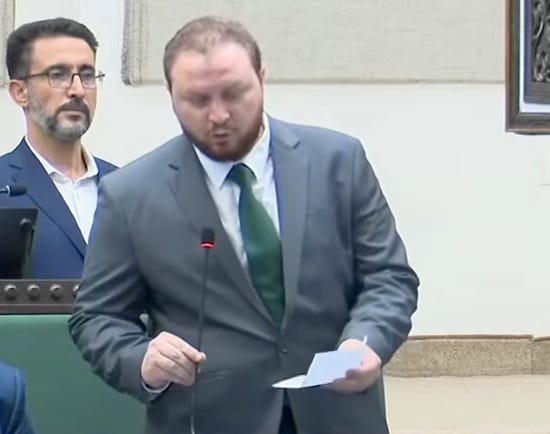
Jaafar al-Sadeq AbdulLatif Tahhan (S2 2:48:03). Is Azaz included in forthcoming irrigation plans, given its soil and moisture?
AbdulKarim Ahmad Barakat (S2 2:36:15). A canal carrying Euphrates water from Aleppo to its western countryside and Idlib stopped at the village of al-Sheikh Ali at the start of the revolution. It matters greatly to farmers. What is the timeline for completion?
Minister al-Bashir
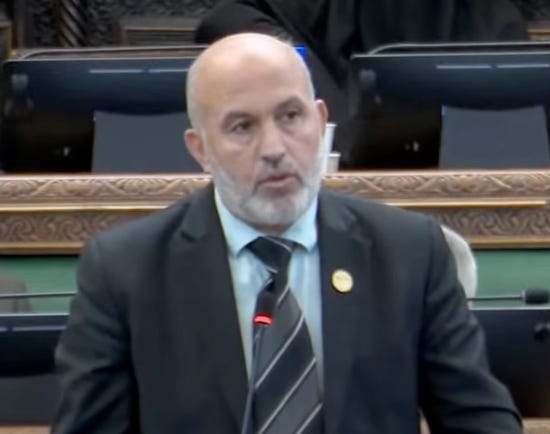
The Tadef–al-Bab project will be implemented, and other areas in the land-reclamation plan will follow in phases. With 70% of the land arable, it cannot all be done at once, “especially while people demand that electricity, oil and bread all run at a loss” (S2 1:32:36). The Tadef–al-Bab study has been approved, and the project is at the contract-signing stage (S2 1:45:05).
On Azaz, he will check at the next water session which projects have been studied and can be prioritized (S2 2:51:22). On the Aleppo–Idlib canal, he will follow up (S2 2:42:16).
Groundwater and the South
Ahmad Idris al-Taan (S2 2:19:40). “We raised electricity, we raised fuel, and we banned drilling wells in thirsty villages”: three steps “strangling the citizen”. Dozens of villages in rural Aleppo have no water and must drill. “The state will rise, but the citizen will die.”
Minister al-Bashir
Syria faces a groundwater crisis. Daraa alone has about 50,000 random wells, according to an initial count, which lowered the water table and caused drought. Opening drilling in every basin would dry them up, and Daraa already has a drinking-water crisis (S2 2:27:49).

Nizar AbdulRazzaq Rashdan (S2 2:19:22). Repairing the earthen dams in Quneitra would help the Yarmouk basin in Daraa.
Mohammad Ibrahim al-Zoubi (S2 3:10:01). He praises the minister and the Daraa governor for their work on water in the south, and asks for a solution in western Daraa, near the border with Palestine, so that people can stay there.
Minister al-Bashir
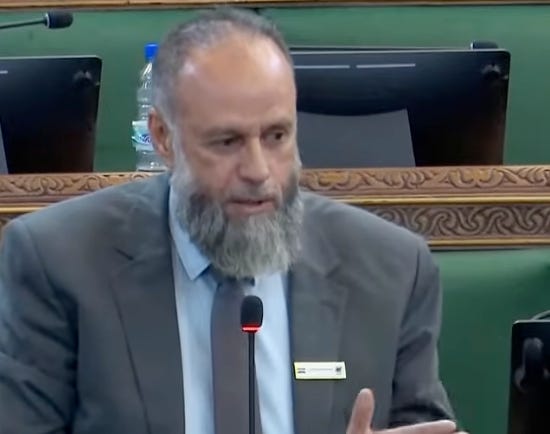
Western Daraa has one of the worst water shortages. When the governor and the water resources director visited one area, locals closed their wells and the spring rose markedly. A well census and a control plan are under way (S2 3:17:46). [The Quneitra dams were not addressed.]
Al-Ghab
AbdulFattah Hassan Obeid (S2 2:33:36). According to the Ghab Development Authority, 500 million m³ of water flows to the Mediterranean, and the plain’s three dams (Afamia, Qastoun and Zayzoun) need repair. The crisis cost 8,600 tons of wheat and flooded 40,000 dunums, while in summer the plain is a desert. Is there an urgent plan for this winter?
Minister al-Bashir
The al-Ghab dams are among the studied projects in the investment budgets. If Finance approves, work starts; if they are deferred, they remain a priority (S2 2:42:33).
7. Industry, transport and alternative energy
Bishr NajmEddin al-Hawi (S2 2:17:59). In Aleppo, industrial production costs were high even before the rise, mainly because of fuel and electricity. Is there a plan with the Ministry of [Economy and] Industry? Could the private sector import fuel itself?
Minister al-Bashir
Industry is already subsidized. It buys fuel oil at USD 400 a ton, while a private importer would pay about USD 600. Electricity costs SEC 18 cents per kWh, but industry pays 14 (S2 2:23:47).
Hussam Adnan Hamdan (S2 2:30:46). The price rise came at the start of winter and of the school year. Since the government cannot lower prices, could it grant tax and customs exemptions on alternative energy, such as panels and batteries, so that families can buy a few panels and draw less from the grid? Could the Transport and Energy ministries also work together to replace worn-out diesel minibuses, which are “humiliating” for passengers, with efficient ones?
Mohammad Yasser Dalwan (S2 3:12:00). “Between the hammer of the state and the anvil of the people.” He proposes targeted, temporary support and an emergency customs exemption for alternative-energy kits such as lithium batteries. Customs duties have risen from USD 30 to USD 120 a ton, and on some items from USD 100 to USD 600–700.
Minister al-Bashir
Exemptions fall under the Land Ports and Customs Authority. The ministry will write to request them, and a multi-agency committee decides (S2 2:37:42). Customs is not Energy’s remit; the ministry will ask the authority for exemptions on solar panels and batteries (S2 3:18:44).
On transport, the ministry is working on vehicles, with new rules for licensing electric vehicles once adequate infrastructure is in place (S2 2:40:18).
Maher Abdul Wahab Alloush (S2 1:37:33). The energy crisis may last, so the ministry should think strategically. Renewables “are not the solution in Syria”. The presentation cited 38 billion tons of oil shale, about six times oil reserves; at 0.5–0.6 barrels per ton, that would be about 20 billion barrels [his estimate]. Estonia gets about 90% of its power from shale, and Jordan has done well with it. Syria’s deposits lie in the north, near Khanasser, and in Daraa. Oil shale should become a strategic energy-security project.
Minister al-Bashir
Oil shale is important. It has been studied and discussed with Jordan. It produces costlier energy than oil, but it is an energy-security option alongside geothermal, wind and solar (S2 1:45:14).
Unanswered questions, grouped by MP
Under the Speaker’s ruling, questions left open should come back as written answers at a later sitting. The Energy Committee chair, Iqbal Mohammad Mansour, said remaining questions would be compiled and sent to the minister (S2 3:14:08). Listed in the order the MPs spoke.
A. Not answered
Fajr Fawzi al-Ahmad
Why was power cut to farmers’ cooperatives, wrecking the summer season? (S2 42:48)
A bacteriological laboratory for the east. (S2 42:48)
Ahmad Mahmoud al-Khalaf al-Shalash
Did no maintenance team recommend the Baniyas overhaul earlier, and could an alternative refinery not have been secured first? (S2 47:19)
Ibrahim Khalil al-Taleb
Drinking and irrigation water for villages around Manbij and the city's districts. (S2 1:02:26)
Rami Shaher al-Saleh
An operations room in Deir Ezzor. (S2 1:12:06)
Aref AbdulMajid Razzouk
Raise the first electricity block to 250 kWh. (S2 1:16:12)
Read meters regularly, since late readings push bills into higher tiers. (S2 1:16:12)
Ahmad Qaddour al-Afdal
Rehabilitating Raqqa’s ruined irrigation canals and drains (103,000 hectares). (S2 1:17:48)
Qutaiba Ahmad al-Issa
Who bore responsibility for the USD 28 million corruption case? (S2 1:28:52)
Amjad Akram Ali
Reinstate a share of refinery revenue for affected areas, or lower electricity tariffs where power is generated. (S2 1:36:30)
Ahmad Mohammad Hassan al-Omar
Why was Raqqa’s allocation from the Euphrates Dam cut from 120 MW to 70 MW? (S2 1:39:37)
Alwan Ayed al-Ali
A new 450 MW combined-cycle plant for Hasakah. (S2 1:40:09)
Ahmad Idris al-Taan
Repair the three Tishreen (Manbij) Dam–Aleppo lines (about 200 MW) and the idle transformer (about 100 MW). (S2 2:20:31)
Nizar AbdulRazzaq Rashdan
Repair Quneitra’s earthen dams to help the Yarmouk basin. (S2 2:19:22)
Mohammad Yasser AbdulKarim al-Hamidi al-Hamad
Administrative spending at 28% of the 2026 budget, and cutting it to 6%. (S2 2:21:10)
Nawar Eliyas Najmeh
Tax higher incomes to fund the deficit instead of raising fuel prices, given the inflationary risk and the reliance on customs revenue. (S2 2:11:23)
Mohammad Walid al-Bakir
Keep diesel unchanged and make a modest, studied rise on gasoline instead. (S2 2:34:38)
Ibrahim Abdallah al-Abdallah
Why not finance the USD 150–200 million monthly deficit temporarily instead of raising prices? (S2 2:32:12)
AbdulFattah Hassan Obeid
How does SPC pay Finance USD 250 million a month while every energy activity loses money? (S2 2:33:36)
Khalil Issa al-Kanou
Repairing the al-Hisha pumping station north of Raqqa. (S2 2:44:50)
Jaafar al-Sadeq AbdulLatif Tahhan
SPC’s asset inventory and revaluation, oversight mechanisms and HR policy. The minister referred MPs to SPC’s founding decrees. (S2 2:47:31)
Mahmoud Kamel Mustafa
A published monthly pricing cycle with 72 hours’ notice, an automatic reduction mechanism and an impact report to Parliament. Refused on hoarding grounds (S2 3:01:40). (S2 2:57:13)
B. Partly answered
Nour Mohammad Mouayad Jandali
A mechanism to assess social impact before decisions, and published studies before future price changes. The pricing committee and governors are consulted, but advance publication was refused (S2 1:33:20, 3:01:40). (S2 41:35)
Israa Zuhair al-Mashhour
An integrated water-and-energy plan for agriculture. Referred to the Higher Council for Economic Development (S2 1:07:33). (S2 59:36)
Lara Fathi Qadid
Facilitation and the kWh price for solar-farm investors. Only the 2,500 MW solar and 1,500 MW wind contracts were mentioned (S2 1:09:31). (S2 1:02:43)
Salem Mohammad al-Ahmad
A published transitional energy plan with targets and dates. The minister pointed to existing subsidies (S2 1:11:19). (S2 1:06:39)
Muayyad Sameh Ahmad Qabtour
Regulating fuel stations that sprang up in formerly liberated areas. Only general station licensing was addressed (S2 2:14:28). (S2 1:26:10)
Mohammad Fawwaz al-Mahalli
Letting farmers drill or clean wells. The ban was defended on groundwater grounds (S2 2:27:49). (S2 1:38:50)
Mohammad Saadi Mohammad Hisham Sukkarieh
Burner “refineries”: operating costs, qualification criteria, and who monitors crude in and products out. Only the expansion of the existing Hasakah contract to 35,000 bpd was explained (S2 3:00:11). (S2 2:53:14)
Osama Mahmoud al-Naous
Equalizing electricity and water tariffs in al-Bab. Acknowledged as “their right” and deferred to a future session (S2 2:49:22). (S2 2:45:37)
Faraj Rakan al-Uqda
Direct cash support for the neediest instead of multiple diesel grades. Cash support is not the ministry’s remit (S2 3:17:30). (S2 3:08:49)
HussamEddin AbdulRazzaq Dbeis
Green Energy’s contracts with the Turkish side, and why water and cleaning bills must be paid before a meter can be topped up. Only Green Energy’s ownership was explained (S2 3:18:14). (S2 3:10:42)
Mohammad Yasser Dalwan
The rise in customs duties on alternative-energy equipment. An exemption request will go to the customs authority, but the increases themselves were not addressed (S2 3:18:44). (S2 3:12:00)
The Syria Dispatch is an independent publication covering Syria’s economy, politics, and society, founded and edited by Benjamin Fève.
Subscribe to receive future issues, research, and analysis directly.
Comment. Questions, corrections, or disagreements with the analysis above are welcome! Please feel free to leave a comment or reach out directly.
Looking for research, analysis, or advisory support on Syria? Benjamin Fève provides independent consulting on Syria’s political economy, reconstruction, and economic governance — including research design, briefings, interviews, and tailored analysis for organizations, investors, and policymakers. Get in touch to discuss a project.