

This article is part of the September 2026 edition of the Syria Monthly Economic Digest. Click here to explore the full edition.
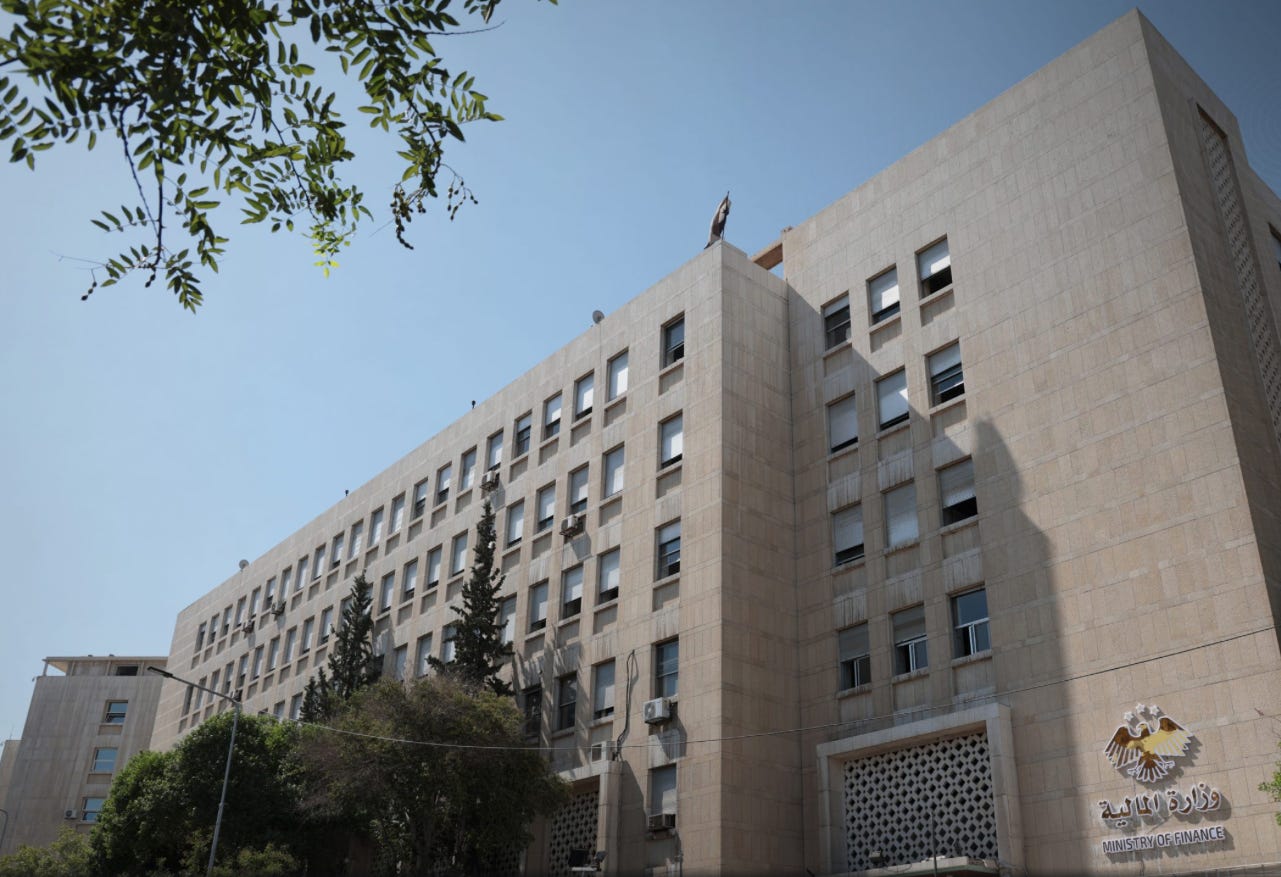
Key Developments: On September 28, the Presidency’s General Secretariat directed public bodies to cut non-essential spending and review investment projects, at the Ministry of Finance's request. Secretary-General Abdul Rahman al-Aama signed Circular No. 41/15/B on September 23, 2026, invoking the Financial Basic Law (Legislative Decree No. 54 of 2006). It requires prior ministerial approval for travel and official missions, and cuts spending on conferences, hospitality, printing, subscriptions, and telecommunications to the minimum. It freezes purchases of furniture, office equipment, and administrative vehicles. New or renewed leases are barred where a usable state-owned alternative exists, non-urgent maintenance and office renovation are deferred, and external studies and consultancies are scaled back. Petrol and diesel allocations for government vehicles are cut by 30%, except for collective transport and vehicles allocated 70 liters or less per month, and the Ministry of Energy will report monthly on fuel consumption. Salaries and wages are exempt from the cuts, along with spending on health, education, water, energy, security, public safety and essential maintenance. Finance Minister Mohammad Yisr Barnieh attributed the measures to higher energy and transport costs tied to regional developments.
The circular also orders an urgent review of all approved investment projects, sorting them into three tiers:
Priority projects continue within existing appropriations: those linked to essential services, public safety, asset protection or critical infrastructure, those whose suspension would cause actual harm, and those that raise revenue or output, cut costs or save foreign currency.
Postponable projects, whose delay would not substantially affect services or economic activity, have new spending and commitments temporarily suspended.
Non-priority projects have new spending and commitments stopped, with the Ministry of Finance reclaiming the resulting uncommitted appropriations.
Exceptions may be granted for commitments made before the circular, projects at an advanced stage, externally financed projects that would lose their funding if stopped, and projects with a documented direct return.
Splitting projects or reclassifying spending to get around the rules is prohibited. Entities may not redeploy the savings; the ministry will pool them and propose reallocating them. Public entities have 15 days to report halted spending and expected savings to the ministry, which will report periodically to the Presidency.
That same day, Barnieh said the 2027 budget would be completed in October and that he expects its deficit to be lower than this year’s USD 1.8 billion, the figure projected in the 2026 budget. At an Arab Monetary Fund workshop in Abu Dhabi the following day, he said the 2027 budget would include a medium-term fiscal framework for the first time.
Why It Matters: The 2026 budget was the first full-year budget prepared by the new authorities, and it marked a deliberate shift, with the IMF attributing the small 2025 surplus mainly to spending restraint. The 2026 budget then planned spending of USD 10.5 billion, more than three times the USD 3.4 billion spent in 2025, against revenue of USD 8.7 billion. The resulting deficit of about USD 1.8 billion, some 5% of GDP, was to be financed mainly through bonds and sukuk, with some returns from the sovereign fund. The budget was, in effect, a bet that revenue would materialize quickly enough to fund a much larger state. That revenue was expected to come from oil and gas, which should provide around 28% of receipts, and from one-off items such as the second mobile license.
As The Syria Dispatch noted last month, the first half of the year showed that the budget is under strain, with the deficit reaching 56% of its annual allowance in six months. The minister had already lowered full-year revenue expectations to close to USD 8 billion, and the ministry warned that spending would accelerate as the wage increase took full effect. At that pace, the deficit was on course to overshoot by several hundred million dollars, with no sukuk yet issued and no domestic market able to absorb one. The September circular is effectively the government’s acknowledgment of that trajectory, and best read as a commitment to hold the line at the budgeted figure.
Choosing to cut spending deserves credit, because fiscally stretched, fragile, and post-conflict states typically fall back on two forms of financing that require no one’s agreement. The first is arrears to suppliers, which the IMF describes as “forced financing”, while the second is debt monetization, which the IMF counts as a standard feature of fragile states. The current government has so far avoided the second, a break with the former regime’s practice.
Yet whether Syria is also avoiding arrears is harder to establish because the budget is kept on a cash basis (Article 5b of the Financial Basic Law), meaning deferred payments to contractors would not show in the reported deficit, and the ministry has not disclosed how it financed the first-half gap.
What can be said is that the ministry published mid-year execution data that made the problem visible and proposed corrective measures within weeks. It protected wages and core services, and attached deadlines and reporting lines to the process. The measures also start in the right place: administrative spending had executed 65% of its annual allocation in the first half, the fastest of any category.
The circular also relies on a tool that the Financial Basic Law provides for exactly this situation:
Article 7(a) requires the budget to be prepared with regard to the balance between expenditure and revenue, a principle loose enough to accommodate the 2026 budget’s planned deficit.
Article 7(b) allows the suspension of certain expenditure commitments, on the Finance Minister’s proposal, when needed to preserve that balance. The circular explicitly invokes this provision.
The law vests the Article 7(b) power in the Council of Ministers. Under the Constitutional Declaration, however, the president is also head of government, and the Presidency’s General Secretariat exercises the power. The ministry’s 2025 draft of a new Financial Basic Law would formalize the General Secretariat’s role in the budget process, but a year on, the government is still operating under the 2006 text.
It should be noted that the Financial Basic Law also sets the timetable for the 2027 budget to meet:
Article 13: The draft must reach the legislature at least two months before the fiscal year begins, which leaves until the end of October.
Article 6: If the budget is not approved by January 1, spending reverts to monthly one-twelfths of the previous year’s appropriations, as happened in the throughout 2025.
Article 16: Any supplementary appropriations require legislative approval in the same way as the budget.
Article 32: The closing accounts must ultimately be approved by law.
While the People’s Assembly only convened in July after the 2026 budget was issued, the 2027 budget is therefore set to be the first to go through that full process.
Back to the 2026 fiscal year, the limits of the exercise are clear. Savings on travel, hospitality, furniture, and fuel are modest compared with a wage bill that made up 36% of first-half spending and will depend on compliance, largely self-reported by the ministries concerned. As a result, most of the adjustment is therefore likely to fall on public investment, which already accounted for about USD 1 billion, or 28%, of first-half spending, and it is the part of the budget most directly tied to reconstruction. The exemption for externally financed projects will relatively protect donor- and loan-funded work. The flagship Gulf-backed investments are largely privately financed and sit outside the budget; their exposure lies instead in the sovereign guarantees the minister says will be used sparingly.
Three disclosures would make the exercise more credible: the list of projects in each tier, a numerical savings target, and how the remaining deficit is being financed, a gap already noted in last month’s edition. The minister also stated that wage increases were financed from real resources rather than deficit financing, which sits uneasily with the ministry’s own attribution of the first-half deficit primarily to wages. The 2027 budget will show whether the lesson has been absorbed, depending on whether it rests on the conservative revenue estimates the IMF has called for rather than the assumptions that produced this year’s overshoot.
Continue Reading the September 2026 Syria Monthly Economic Digest


Explore Previous Editions
Browse every edition of the Syria Monthly Economic Digest, featuring monthly analysis of Syria’s political economy, governance, reconstruction, and regional developments.
Never Miss an Issue
Receive the Syria Monthly Economic Digest, along with original research, expert interviews, and in-depth analysis on Syria’s political economy, governance, and reconstruction—delivered directly to your inbox.