

This article is part of the September 2026 edition of the Syria Monthly Economic Digest. Click here to explore the full edition.
Key Developments: On September 16, the Ministry of Finance launched Syria’s first syndicated bank financing under an Islamic structure. It brings together the state-owned Commercial Bank of Syria and two private lenders, Al Baraka Bank Syria and QNB Syria, to fund the Al-Mujtahid–Bab Musalla tunnel and the final phase of the “Qasioun Journey” project in Damascus. The facility reportedly carries a sovereign guarantee, and while its value, tenor, profit rate, and the split between the three banks were not disclosed, The Syria Dispatch learned from two sources in Damascus that the loan amounts to USD 25 million, split roughly equally among the three banks.
The agreement was signed in the presence of Finance Minister Mohammad Yisr Barnieh, Central Bank Governor Mohammad Safwat Raslan, and the Governor of Damascus, as Barnieh described the facility as the first of its kind. He said it could open the way to financing larger projects for the public sector, economic institutions, and governorates through bank facilities and sukuk, two months after the first sovereign sukuk was floated. Damascus Governor Maher Marwan Idlibi said the two-kilometer tunnel linking west and east Damascus should take two to two-and-a-half years to build instead of the ten years foreseen under conventional planning. He also said that the Qasioun project is scheduled to open in summer 2027, and that the financing had been reviewed by the Supreme Fatwa Council and the participating banks, with limited profits and easier repayment terms.

Other banks also moved toward a return to lending during the month as, on September 17, the board of the state-owned Industrial Bank, chaired by Barnieh, approved its 2027 lending plans and discussed a joint facility with other banks to finance new production lines for damaged industrial facilities. Two days earlier, the private Cham Bank had signed a memorandum to finance purchases of housing units in Damascus’s Marota City, reportedly the first home-purchase financing announced by a Syrian bank since the fall of the former regime. It did not disclose amounts or terms.
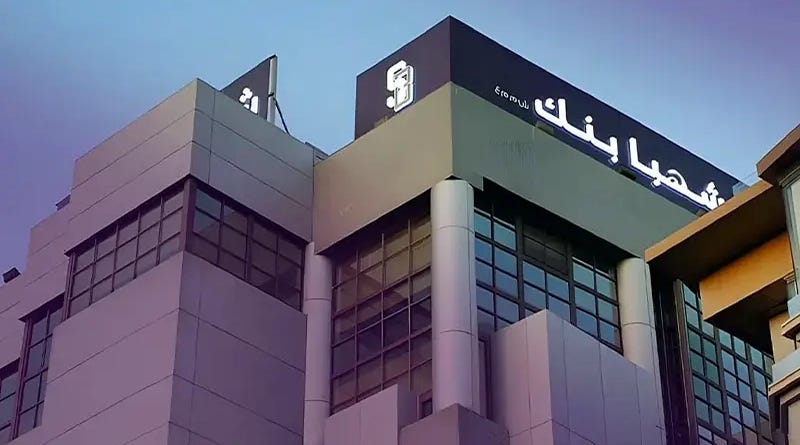
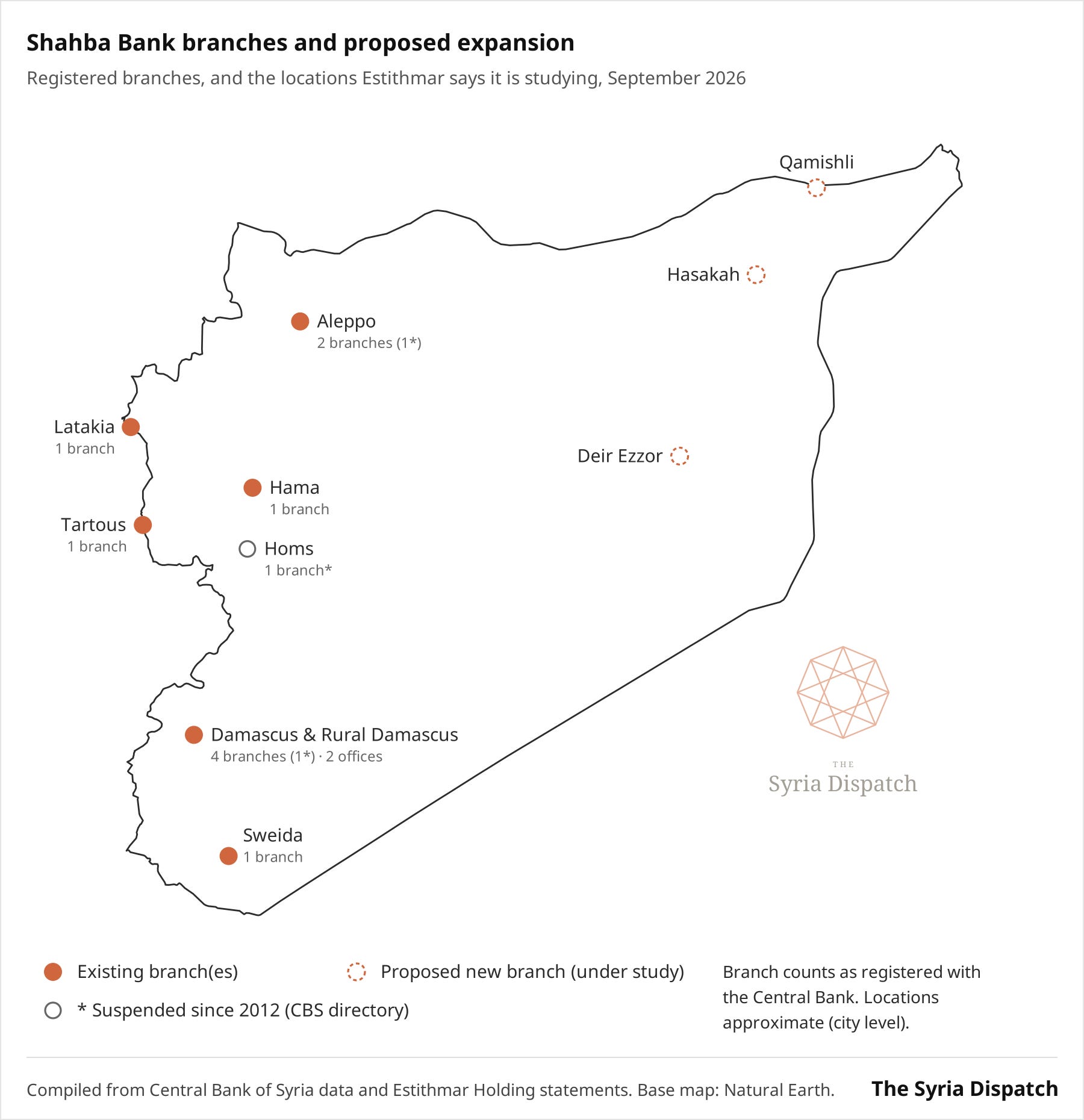
On September 17, Qatar-listed Estithmar Holding announced it had completed the transfer of a 48.68% stake in Shahba Bank, formerly Byblos Bank Syria, from Banque Bemo Saudi Fransi and Ahli Trust Bank to its subsidiary Masaref Holding. Reuters had reported in January that Estithmar would take a 60% majority. The agreement signed on April 26 covered 49%. The company, chaired by Syrian-Qatari businessman Moutaz al-Khayyat, said it would work with the bank’s board on several proposals:
a capital increase
new branches in underserved areas such as Deir Ezzor, Hasakah, and Qamishli
digital upgrades
trade-finance and SME products
All of these remain subject to feasibility studies and Central Bank approval. Raslan welcomed the investment, provided it meets legal, regulatory, and governance requirements.
On September 27, Raslan said he expected foreign capital for new Islamic and conventional banks to exceed USD 1 billion, in a sector that currently counts six state-owned and 15 private banks. The licensing criteria he listed include applicants’ experience, reputation, and solvency, plus a strategic banking partner holding at least 10% of the new bank. He said foreign investors may keep up to 60% of paid-up capital in foreign currency and freely transfer profits. He added that Jordanian banks had applied to enter the market, and that the Central Bank plans to require international transfer providers to pay remittances exclusively in foreign currency. Raslan also called exiting the FATF grey list the top priority. These statements came two weeks after the Central Bank launched the first locally issued, internationally accepted payment card following its reconnection to Mastercard, and a month after Saudi Arabia agreed to set up a joint bank with Syria.
On September 21, on the sidelines of the Arab Regional Conference on Supporting Development and Investment in Syria in Amman, Raslan discussed with Union of Arab Banks Secretary-General Wissam Fattouh the possible creation of a Syrian banking association. It would serve as an umbrella body coordinating banks operating in the country. The two also discussed the advice the Union could offer on drafting banking laws and regulations. Earlier that day, Raslan met representatives of Al-Ahli Bank, Bank al Etihad, the Commercial Bank, and BLOM Bank, with several Syrian private banks in attendance. The Union had announced in February 2025 a project to restructure Syria’s banking sector with European partners. A week later, on September 29, it was reported that five private banks had not yet published their 2025 financial statements. The Central Bank attributed the delay to its approvals not yet being issued.
The reasons ranged from placements in Lebanon and full provisioning to plans to address capital erosion, board reshuffles, and the appointment of external auditors. Three banks had also not published their 2024 statements. The provisioning stems from a September 2025 Central Bank directive requiring banks to fully recognize their exposure to Lebanon, then estimated at over USD 1.6 billion.
Why It Matters: Syria’s budget ran a deficit of about USD 1 billion in the first half of 2026, so it makes sense, against that backdrop, for the state to pool bank resources behind a sovereign guarantee rather than tie infrastructure to whatever the annual budget can allocate. If it works, the model could be extended to larger projects for the public sector, economic institutions, and governorates, as Barnieh suggested.
The size of the facility, however, says as much about the banks as about the project. Three banks, the largest of the country, including the state-owned Commercial Bank of Syria and the Syrian arm of Qatar National Bank, had to come together to provide USD 25 million, or roughly USD 8 million each, suggesting that few Syrian banks, if any, can carry an exposure of that size on their own. For comparison, the country’s 14 listed commercial banks (which published their 2024 financial accounts) held about USD 4.9 billion in deposits combined at the end of 2024.
The constraint is capital rather than liquidity, since a bank’s exposure to a single borrower is capped as a share of its own funds, and those funds have been eroded by fifteen years of depreciation. Law No. 3 of 2010 set the minimum capital for a conventional bank at SYP 10 billion and for an Islamic bank at SYP 15 billion, about USD 215 million and USD 320 million at the time. Today the same amounts, (new) SYP 100 million and 150 million, are worth around USD 0.7 million and USD 1.1 million. As a result, given that lending capacity is quite thin, a sovereign-guaranteed loan to a governorate will look more attractive to a bank than a riskier loan to a factory, which could crowd out private-sector financing. This is what we have already warned of regarding the issuance of Sukuk, or Islamic government securities.

This is why the Shahba transaction matters beyond the bank itself, given that Estithmar’s stake is the first foreign equity investment in the sector since the fall of the former regime. Given the sector’s small size, the capital increase is what it needs most among Estithmar’s proposals. Small, thinly capitalized banks that cannot lend at scale are one of the main things holding back Syria’s banking system.
Bankers who spoke to The Syria Dispatch said existing shareholders and strategic partners have so far been reluctant to put in fresh capital. Many of those partners are Lebanese banks still dealing with their own crisis, and the sellers in this case reportedly planned to use the proceeds to recapitalize their own banks rather than Shahba. If Estithmar follows through, one well-capitalized competitor could push others to do the same, but peer pressure alone is unlikely to be enough, though.
The Central Bank would also need to update the minimum capital requirement with a clear compliance timeline, as the 2010 law did when it gave banks three years. Otherwise, the sector risks splitting in two: new entrants, if Raslan’s USD 1 billion materializes, would arrive with fresh capital, while incumbents would remain undercapitalized after absorbing their Lebanon losses, and five of them still have not published 2025 accounts. (On the Central Bank’s strategy under Raslan READ here.)

The banking association should be read in the same light, and its value will depend on the legal framework around it. Syrian banking regulation is currently spread across several texts, including Law No. 28 of 2001 on private banks, Law No. 23 of 2002 (Basic Monetary Law) on the Central Bank and the monetary system, and Law No. 35 of 2005 on Islamic banks. A comprehensive banking law would be the natural place to define what an association can and cannot do.
According to the same bankers speaking to The Syria Dispatch, private banks barely communicate with each other today, apart from meetings convened by the Central Bank and informal contacts between executives. Nobody wants a cartel, and Lebanon shows what happens when a banking association becomes a lobby.
In 2022, a minister described the Association of Banks in Lebanon’s opposition to sharing losses as a threat to the IMF deal. Syria’s more immediate risk, however, is the bad apple. Exiting the FATF grey list is the Central Bank’s stated priority, and correspondent banks judge the sector as a whole. A single opaque or non-compliant bank therefore raises costs for every other bank. A forum with a clear mandate agreed with the Central Bank could do several things:
agree common compliance and disclosure standards
pool training and anti-money-laundering tools
coordinate with correspondent banks
put peer pressure on laggards
Pricing and competition would stay outside its remit, under Central Bank oversight.
Continue Reading the September 2026 Syria Monthly Economic Digest


Explore Previous Editions
Browse every edition of the Syria Monthly Economic Digest, featuring monthly analysis of Syria’s political economy, governance, reconstruction, and regional developments.
Never Miss an Issue
Receive the Syria Monthly Economic Digest, along with original research, expert interviews, and in-depth analysis on Syria’s political economy, governance, and reconstruction—delivered directly to your inbox.