

This article is part of the September 2026 edition of the Syria Monthly Economic Digest. Click here to explore the full edition.
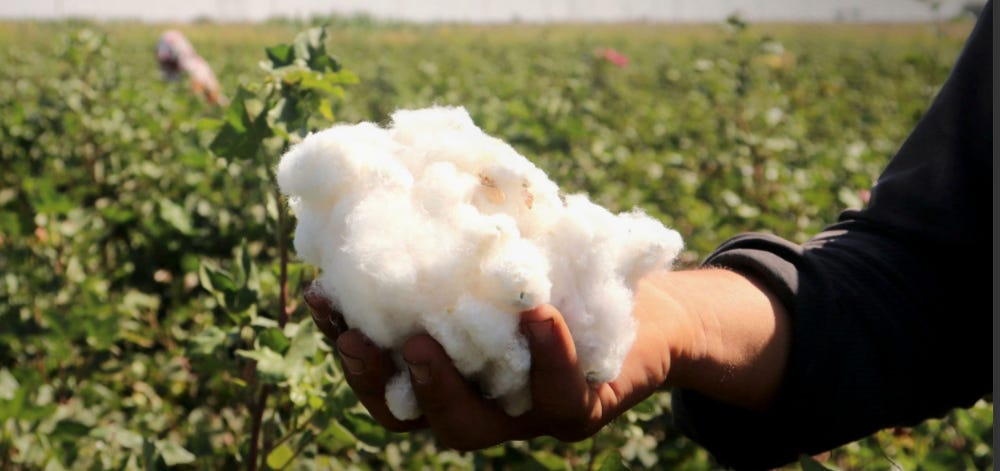
Key Developments: Cotton picking began in rural Raqqa in mid-September and in southern Hasakah on September 16, with the rest of Hasakah governorate following within about ten days. Hasakah’s deputy agriculture director, Ezzeddin al-Hasso, described the crop as in good condition with limited pest damage. Mohammad Maari, head of the Ministry of Agriculture’s Cotton Office, said early indicators in Raqqa pointed to good production.
Raqqa farmers, by contrast, reported weak yields, often no more than 300 kg per dunum (3,000 kg per hectare); though it should be noted that such a yield, would be in line with or slightly above recent years, based on Syrian government figures (see chart below), but well under pre-2012 figures. Ministry data put the planted area at 26,593 hectares (25,810 last season) and expected output at 79,467 tons (69,587), figures that fall well short of the 50,000 hectares and 150,000 tons Maari announced as the plan in April.
Hasakah planted 11,898 hectares against a 7,300-hectare plan, for an estimated 45,000 tons. Deir Ezzor went the other way: it produced 4,500 tons on 2,300 hectares in 2025, but farmers’ union head Hamad Abboud al-Khader said cotton had almost disappeared there this season. He cited production costs, fuel and electricity prices, and delays in paying farmers’ dues.
There seems to be confusion on whether a purchase price has been set. On August 4, the Ministry of Agriculture announced a purchase price for this season’s cotton of (new) SYP 85 per kg (USD 0.61 per kg; USD 610 per ton) against an estimated production cost of SYP 71 per kg (USD 0.51 per kg; USD 510 per ton), split between the Agricultural Production Support Fund providing SYP 30 and the General Establishment for Cotton Ginning and Marketing providing the remaining SYP 55. On September 18, however, Raqqa farmers complained that no price had yet been set, while two days after, Maari said one would be issued “in the coming period.”
Raqqa farmers demanded a price covering their costs, which some put at no less than USD 900 per ton, citing fertilizer at USD 800 per ton and picking labor at USD 150 per ton. By the end of September, private traders were offering no more than USD 700 per ton, while a farmer put circulating prices at USD 750–850, levels he said would not cover his costs. A Raqqa cotton ginner added that some cotton had sold at USD 650–700 per ton. He complained that exports via Turkey were blocked because Turkey requires a fumigation agent that Syria bars from import.
It should be noted that the recent increase in the price of fuel might have a devastating impact on the cotton season, given that diesel rose 40% to SYP 175 per liter on September 13, triggering road-blocking protests across farming areas of Hasakah, Raqqa, and Deir Ezzor and leading to localized fuel shortages.

Hasakah farmers said fuel shortages forced them to cut irrigations and that they had received no direct support, which Maari had acknowledged in April was limited to subsidized seed. Water shortages also added pressure, as Raqqa farmer said the network water never reached his land, forcing 13 diesel-pumped irrigations as a barrel of diesel rose from USD 100 to USD 300 over the season.
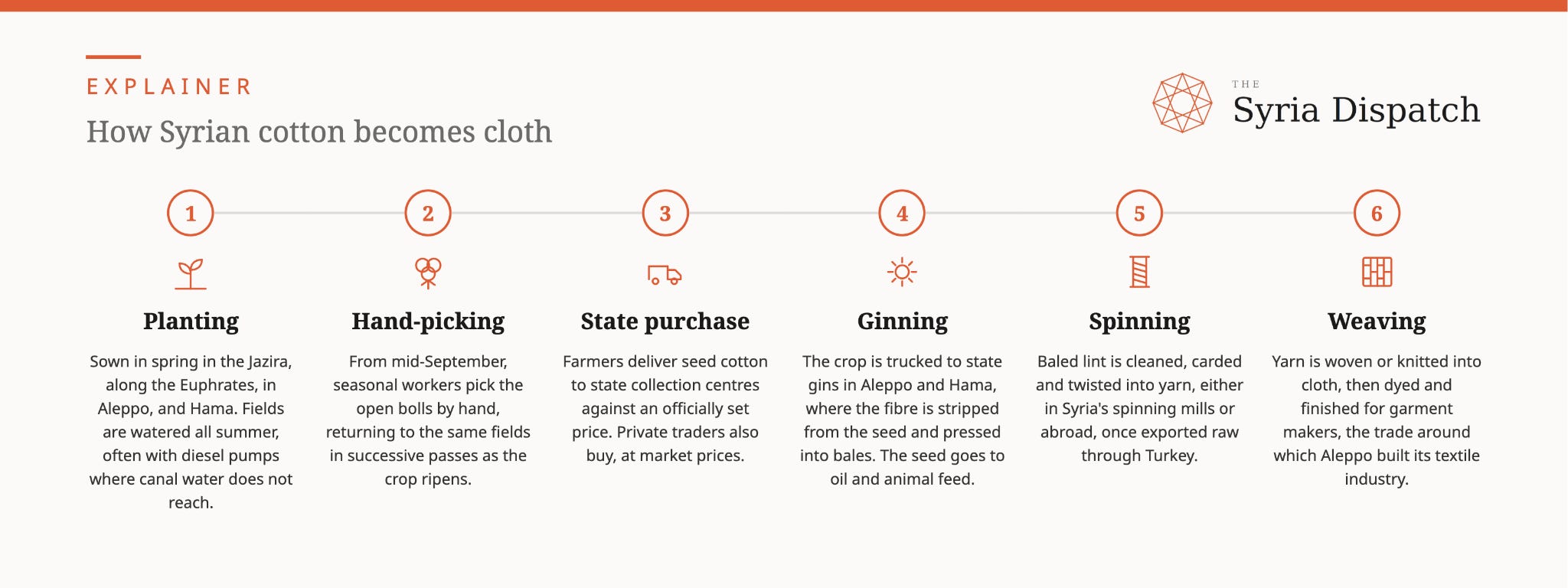
On marketing, an agricultural official said the state was ready to receive the crop against Directorate of Agriculture certificates and to truck it at its own expense to gins in Aleppo and Hama. Hasakah farmers, pointing to the wheat season, said knowing who will buy the crop and how quickly they will be paid matters as much as the price.

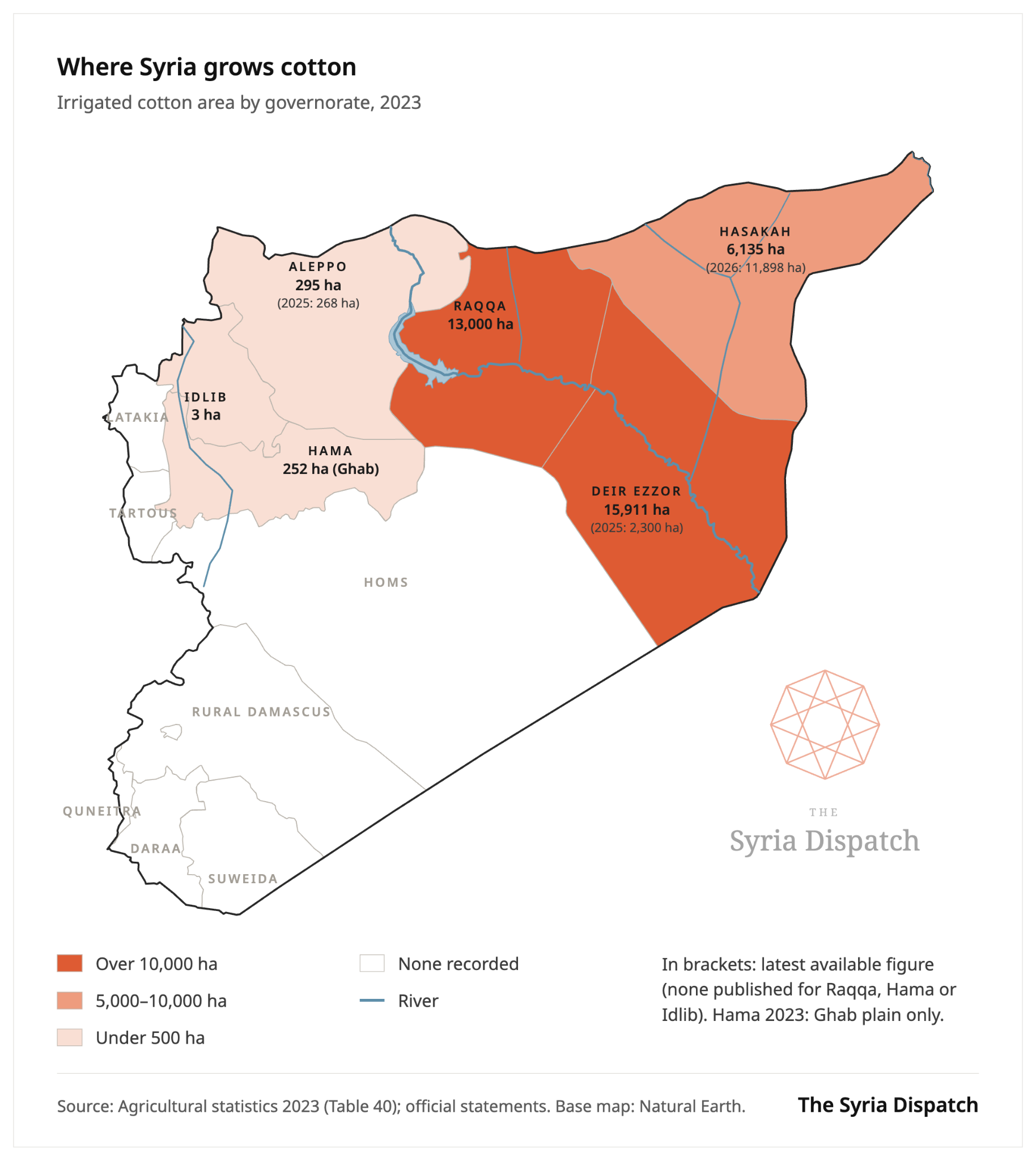
Why It Matters: Cotton was long Syria’s “white gold”. Around 2000, it was the country’s most important export after oil, and the industry reportedly employed about half a million people. It fed a textile sector whose public-sector exports alone were worth about USD 195 million in 2010, and which President Ahmad al-Sharaa presented in July, at the opening of NASTEX 2026, as a way out of poverty. Even on the ministry’s own estimate, this season’s crop is barely an eighth of the 671,700 tons harvested in 2011 (see table). It is also well short of the roughly 250,000 tons of raw cotton that the country’s mills need. Because almost all of the crop is now grown in Raqqa, Deir Ezzor, and Hasakah (see map), every hectare taken out of cotton costs picking, trucking, and ginning work, and farm income in the east.
The confusion over the price looks at least as much like a problem of integrating the northeast as a fiscal one, as Damascus is extending its institutions into the northeast, as it did with the oil sector in August. Until recently, cotton growers there dealt with the Autonomous Administration, which set its own price in dollars (USD 800 per ton in 2023) without committing to buy the crop. They now face a ministry price in Syrian pounds that, six weeks after it was announced, had apparently not reached Raqqa farmers or had not convinced them.
Financially, the price level is part of the problem, too, given that at around USD 610 per ton, it is below what private traders are offering and well below the USD 900 that farmers say they need. As a result, the state’s offer to truck the crop to the gins in Aleppo and Hama at its own expense counts for little if growers sell elsewhere. With exports through Turkey blocked, however, private buyers have few outlets beyond Syria’s own mills. Farmers are left choosing between a state price that does not cover their costs and a private market that may weaken as the harvest comes in. The wheat season, in which dues remained unpaid months after delivery, gives them little reason to trust the state buyer even at a comparable price.
Finally, while higher fuel prices might affect this season to some extent, they will weigh even more on the next one. The September diesel increase came at the end of an irrigation season farmers had already paid for, but it will now feed fully into next spring’s planting decisions, along with higher electricity prices for pumping and fertilizer and labor priced in dollars. Deir Ezzor, where the crop has almost disappeared, shows how quickly growers abandon cotton once margins vanish, and Hasakah, which planted well beyond its plan, shows they come back when the numbers work. Planted area has been stuck at around 26,000 hectares for two years, and the 50,000-hectare plan is out of reach.
Continue Reading the September 2026 Syria Monthly Economic Digest


Explore Previous Editions
Browse every edition of the Syria Monthly Economic Digest, featuring monthly analysis of Syria’s political economy, governance, reconstruction, and regional developments.
Never Miss an Issue
Receive the Syria Monthly Economic Digest, along with original research, expert interviews, and in-depth analysis on Syria’s political economy, governance, and reconstruction—delivered directly to your inbox.