

Editor’s Note
Welcome to the September 2026 edition of the Syria Monthly Economic Digest.
We opened the August 2026 issue by noting that “policy [is] moving faster than both the government’s ability to deliver and the people’s ability to adopt it.” This month’s issue looks at who pays for that speed (spoiler alert: the people), and at how it is affecting production, both agricultural and industrial.
On September 13, diesel rose by 40%, and protests spread from Hasakah, Deir Ezzor, and Raqqa to the Aleppo countryside and Hama, in what was described as the most widespread unrest since Assad’s fall. The government’s arithmetic is hard to dispute given that fuel was being sold at a loss, the Qatari gas grant had ended, and the Syrian Petroleum Company could no longer fund both its imports and the Treasury. The end of cheap energy, however, is now showing up across the productive economy, and this edition follows it sector by sector. Omran has stopped producing clinker because energy makes up more than two-thirds of its costs, and now grinds imported clinker instead. A cotton grower in Raqqa saw a barrel of diesel triple in price over the season, and wheat farmers are heading into planting with costlier fuel, no seed price, and no seasonal loan decision.
For farmers, input costs are only part of the calculation, and months of delayed wheat payments are starting to change what gets planted. In Deir Ezzor, where cotton has almost disappeared, the farmers’ union cited late payments, along with fuel and electricity costs. Hasakah growers say that knowing who will buy the crop, and how quickly they will be paid, matters as much as the price itself, while some wheat farmers are weighing other uses for their land. Farmers’ leverage peaks before delivery and vanishes once the grain is in the silo, and many may draw that lesson next season.
That raises a broader question about what Syria should be growing, especially given that the country uses two billion cubic meters more water a year than nature replaces, with agriculture accounting for around 88% of it, and wheat and cotton remaining the thirstiest crops on the map. The drive for self-sufficiency in both was one of the Ba’athist policies that drained the country’s aquifers. With energy now priced closer to cost and growers already reconsidering, there may be an opening to steer agriculture toward higher-value, less water-intensive crops, rather than to rebuild the old crop map.
The state is also looking for new ways to pay its bills, which are racking up faster than expected (as covered last month). Then, faced with a widening deficit, the Presidency chose to cut spending rather than accumulate arrears or print money, which deserves credit. Syria’s first syndicated bank loan, USD 25 million split among three of its largest banks, shows both the model’s promise and its limits: banks with too little capital to lend at scale. A Qatari stake in Shahba Bank, the sector’s first foreign equity investment since the fall of the former regime, points to the remedy.
There were also signs of recovery, if only by proxy. Cement consumption is back near its pre-war peak, one of the most reliable indications that rebuilding is actually happening, even if, for now, most of it relies on imported clinker. Politically, the EU restored its ambassador in Damascus, and Kaja Kallas’s visit opened talks on a new partnership, though EU development funding has held flat. At home, the People’s Assembly held its first hearing with the energy minister, and the 2027 budget is set to be the first to go through the full legislative process. Both are early but real steps toward the kind of scrutiny that makes hard decisions easier to explain.
As always, thanks for reading.
In This Month’s Issue


Explore Previous Editions
Browse every edition of the Syria Monthly Economic Digest, featuring monthly analysis of Syria’s political economy, governance, reconstruction, and regional developments.
Share This Issue
If you found this edition useful, please consider sharing it with colleagues or forwarding it to anyone interested in Syria’s political and economic developments.
Never Miss an Issue
Receive the Syria Monthly Economic Digest, along with original research, expert interviews, and in-depth analysis on Syria’s political economy, governance, and reconstruction—delivered directly to your inbox.
About the Syria Monthly Economic Digest
The Syria Monthly Economic Digest is a monthly publication by The Syria Dispatch that tracks the political and economic developments shaping Syria’s transition.
Each edition focuses on the developments that we believe matter most over the past month—not every headline, but the ones that reveal something important about where the country is heading. These may include policy decisions, investment announcements, energy and infrastructure projects, banking and monetary reforms, trade and reconstruction, property rights disputes, public services, and the evolving relationship between the Syrian state, society, and external actors.
The format is straightforward. Each article begins with a summary of what happened, followed by a “Why It Matters” section that provides additional context, background, and analysis.
The digest is written for readers who want a structured, analytical overview of Syria’s transition, including policymakers, researchers, journalists, diplomats, development practitioners, investors, civil society actors, and anyone interested in the country’s political economy.
It is not intended to be exhaustive, nor does it replace daily news coverage. Instead, it offers a monthly snapshot of the developments that we believe deserve closer attention and a better understanding of how they fit into Syria’s broader transition.
If you have comments, corrections, suggestions, or would like to collaborate, we would be delighted to hear from you.
Also Published This Month
In the Research & Analysis Section

In the Interviews Section

Quotes and Media Appearances
What a new Black Sea grain crisis means for the Middle East — The New Arab (Christopher Solomon, September 2, 2026)
Syria’s Fuel Price Protests Test the Limits of Post-Assad Dissent — New Lines Magazine (Anagha Subhash Nair, September 16, 2026)
En Syrie, l’augmentation du prix des carburants attise la colère sociale : « Au fond, les gens n’attendaient qu’un événement pour exprimer leur colère » — Le Monde (Nissim Gasteli, September 17, 2026)
La grogne sociale se répand dans le monde face à la flambée des prix du diesel et du fioul — RFI (September 17, 2026)
UAE investors are pouring bns in Syria — but the bottlenecks aren’t far behind — EnterpriseAM (September 18, 2026)
‘People can’t take it any more’: Syrian government cuts diesel prices after protests over fuel costs — The National (Nada Atallah, Ahmad Fallaha, September 18, 2026)
Gulf Eyes Syrian Trade Corridor to North Africa — Global Finance (Chloé Domat, September 22, 2026)
Syria's economic reckoning: The greatest test yet for al-Sharaa — The New Arab (Cian Ward, September 24, 2026)
Fuel and food costs put Syria’s beloved makdous tradition out of reach — Arab News (Anan Tello, September 25, 2026)
من المحروقات إلى القمح: نقص السيولة يضغط على اقتصاد سوريا — Al-Quds Al-Arabi (Menhal Barish, September 26, 2026)
Events
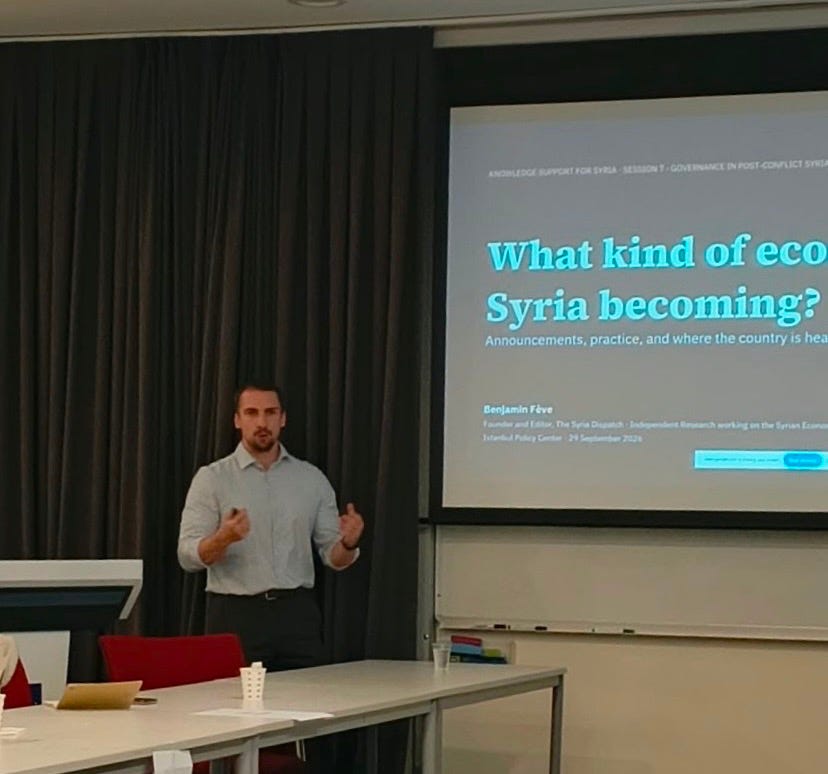
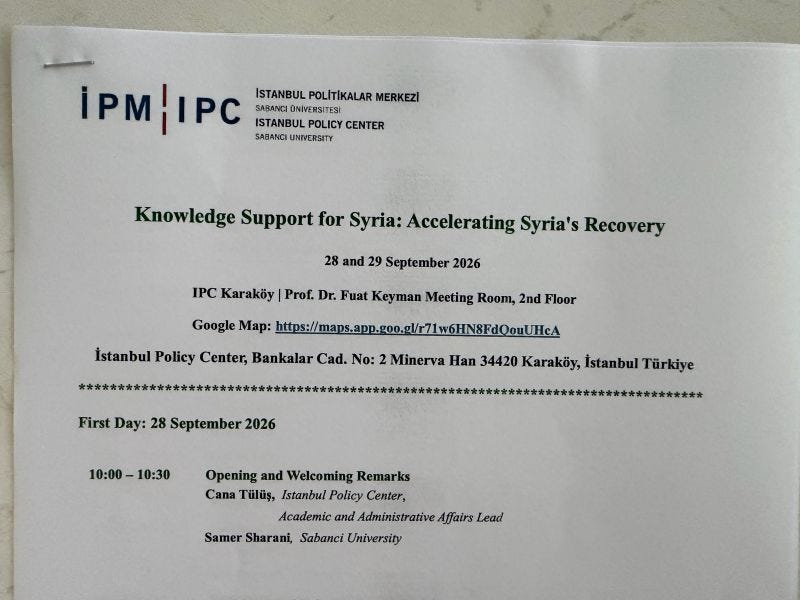
The Syria Dispatch took part in a two-day workshop at the Istanbul Policy Center on September 28–29, 2026. The presentation focused on the liberalization of the Syrian economy, arguing that it is liberalizing from the wrong end: cutting subsidies and opening imports before building safety nets or slimming down the state, with all the consequences this is likely to have going forward.
We are grateful to Samer Sharani for organizing the event and to the Istanbul Policy Center for hosting it.
Top