

This article is part of the September 2026 edition of the Syria Monthly Economic Digest. Click here to explore the full edition.
Key Developments: At a Ministry of Energy seminar during the Damascus International Fair on September 2, Obada Mobayed, director of Water Sector Regulation at the ministry, said Syria consumes around 18 billion cubic meters of water a year against 16 billion in renewable resources. The two-billion-cubic-meter gap is covered mainly by groundwater and lake reserves. Agriculture accounts for around 88% of use, and dam reservoirs remain below 50% in the south and below 20% in Daraa and Quneitra despite last winter’s rainfall.
Energy Minister Mohammad al-Bashir told the People’s Assembly on September 20 that the flow of Ain al-Fijeh, Damascus’s main spring, had fallen from 40 cubic meters per second (m³/s) historically to around 1.5 m³/s. He said random drilling had dried out the Yarmouk basin, with an initial count of some 50,000 such wells in Daraa. Daraa Governor Anwar Taha al-Zoubi had given a similar figure on September 7, adding that 76 unlicensed drilling rigs had been seized since the fall of the regime. The governorate’s 16 dams, with a combined capacity of 92.5 million cubic meters, held less than 4 million in 2025, down from 65 million five years earlier. The governorate set a September 16 deadline before sealing illegal wells. A draft water law with deterrent penalties is with the General Secretariat of the Presidency.
The price of water depends heavily on whether a household is connected. Al-Bashir said piped water costs around (old) SYP 7 per cubic meter, and acknowledged that tariffs do not cover production costs. That is the 6–15 m³ tier set in August 2014, which the September 2023 increase left untouched, and works out to (new) SYP 0.07 (USD 0.0005). Tanker water in Daraa costs around USD 5 per 1,000 liters. Off the network, tanker water reached (old) SYP 300,000 (new SYP 3,000; USD 21.7) per load in Daraa’s Tal Shehab. In Shahba, Sweida, an 11-day power cut halted pumping and pushed the price of a tanker to around (old) SYP 600,000 (new SYP 6,000; USD 43.5). The governorate blamed that outage on attacks on the grid.
In the al-Bab area, MP Osama al-Nous said residents pay the equivalent of (old) SYP 2,700 per cubic meter (new SYP 27, USD 0.20) to private suppliers, and demanded equal treatment with the rest of the country. Al-Bashir promised a future review of tariffs in Idlib and northern rural Aleppo.
On repairs, the minister said service had been restored to 2.3 million people, 1,051 wells had been rehabilitated, and five wastewater treatment plants were planned. Most of the country’s wastewater still flows untreated into rivers, lakes, and the sea. Rehabilitating Aleppo’s treatment plant alone is estimated at USD 400 million, for which the ministry is seeking international financing.
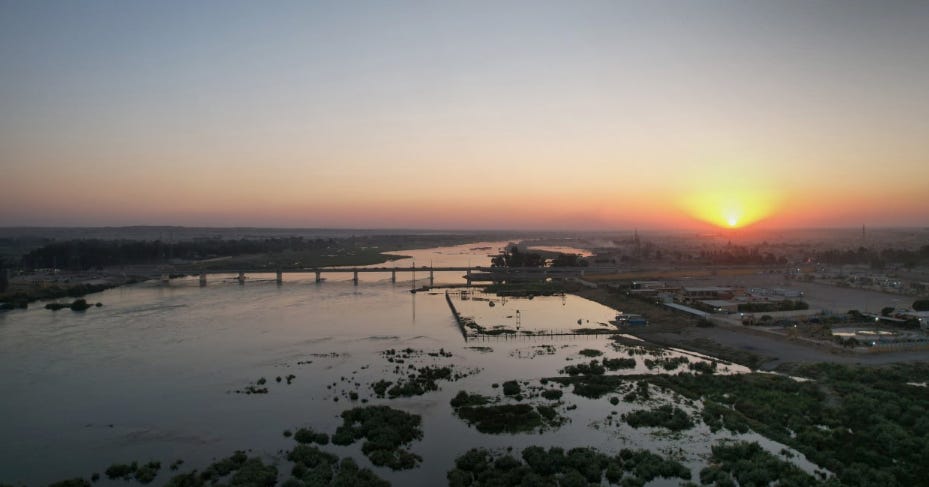
On the Euphrates, al-Bashir said inflows from Turkey had risen from around 200 to around 1,000 cubic meters per second. Haitham Bakour, director general of the General Establishment of the Euphrates Dam, put them at around 1,200 m³/s. The minister said Turkey gave one day’s notice before raising releases earlier this year. He also said that encroachments on the riverbed mean 2,000 m³/s would cause problems, although the channel was designed for 3,000. The ministry opened spillway gate No. 6 at the Euphrates Dam, the first time in over 30 years, and scheduled releases of 1,200 m³/s until mid-October. By September 28, 11 water stations in Deir Ezzor had gone out of service, after floods in May and August had already affected around 50 stations in Raqqa and Deir Ezzor.
The longer-term pipeline is large but mostly at the study stage:
Tigris–Khabour transfer: Designed to irrigate some 215,000 hectares, which al-Bashir costed at USD 2 billion and said would be offered for investment alongside the Halabiyeh–Zalabiyeh dam.
Euphrates–Hisyah carrier: Priced at USD 571–572 million for 3 m³/s of mainly industrial and drinking water.
“National carrier”: Would pump coastal freshwater to Damascus; its initial estimate stands at around USD 9 billion, with only a study contract signed.
Desalination and transmission study. On September 7, ACWA and the Water Transmission Company signed a technical services agreement with the ministry and Germany’s Fichtner.
Why It Matters: Water scarcity in Syria is not new, and Marwa Daoudy’s The Origins of the Syrian Conflict argues that it was primarily the product of policy rather than climate. The Ba’athist drive for food self-sufficiency put wheat and cotton under irrigation, so between 2001 and 2010, 70% of public investment in agriculture went to irrigation. Cheap diesel and nominal water fees made pumping groundwater almost free, and by 2009, unlicensed wells (around 108,000) outnumbered licensed ones (102,000), despite repeated bans and amnesty-style licensing campaigns. The Khabour, overdrawn to around three times its basin’s safe yield, fell from 60 m³/s to zero in 2001. When the drought of the late 2000s hit, the 2008 lifting of fuel subsidies tripled diesel prices just as farmers in the northeast most needed to pump. Daoudy’s broader point is that drought became a human-security crisis because of who was exposed to it and how the state had managed water beforehand.
The same lens fits today, because the burden of scarcity falls very unevenly, as a household connected to the public network pays (new) SYP 0.07 per cubic meter for its first 15 cubic meters (+/- USD 0.0005), a tier set in 2014 and left untouched by the 2023 increase. A household in western Daraa buying from a tanker pays around USD 5 for the same cubic meter, roughly 10,000 times more, in a region where monthly salaries run between USD 75 and 150. The tariff subsidy reaches those already connected, while those with broken networks, those whose pumps depend on an unreliable grid, as in Suweida, or those in areas served by private suppliers, as in al-Bab, pay market prices. Any move toward cost-based pricing, which the ministry is reportedly considering, will need to start from that gap. Otherwise, it risks raising bills for the connected while doing nothing for those outside the network.
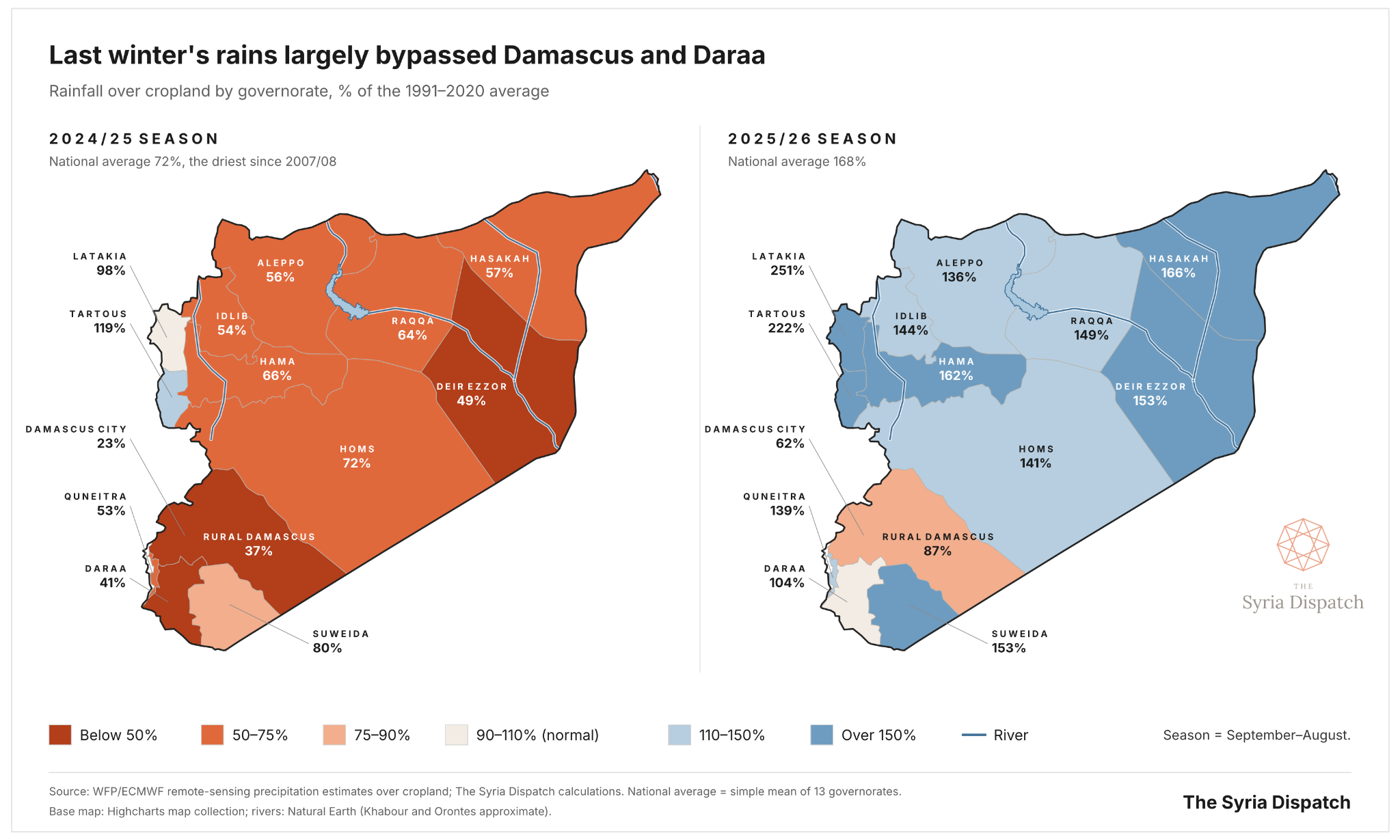
Agriculture is where the volumes are, and it remains the economy’s main exposure to drought. The 2024/25 season was the driest since 2007/08, at around 72% of the 1991–2020 average across the country’s cropland (The Syria Dispatch calculations based on FAO data). Last winter’s rains were well above normal in the north, east, and coast, but only around normal in Daraa and below it in Rural Damascus. Daraa’s reservoirs remain below 20% after a roughly average season, which suggests the binding constraint in the south is now groundwater extraction rather than rainfall. With agriculture using around 88% of the country’s water, irrigation efficiency is the obvious lever. The framing matters, however. Mobayed suggested that better irrigation could double the irrigated area to one million hectares with the same quantity of water. In a country already drawing two billion cubic meters a year beyond its renewable resources, efficiency gains spent on expanding cultivation would leave the deficit, and the aquifers, where they are.
As springs and reservoirs fail, farmers drill, and each new well lowers the water table for its neighbors, leading to, for example, groundwater levels in parts of Daraa dropping by five to 10 meters.
Interestingly, unlike the 2000s, diesel costs acted as a rough brake on pumping, which is why the 2008 price shock hit farmers so hard. Today, solar-powered pumps have accelerated extraction by bringing the marginal cost of pumping close to zero, and the latest fuel price increases (see “Fuel Price Hike Triggers Nationwide Protests as Damascus Turns Back to Local Refineries”) will only strengthen that shift. Sealing wells is the governorate’s answer, but many wells supply drinking water to whole communities, and some cost their owners tens of thousands of dollars. Enforcement without an alternative supply will be resisted, as it was under the previous regime. That regime’s bans and licensing campaigns failed because it lacked monitoring capacity in the countryside.

A better water policy would look less like the project pipeline the ministry presented to Parliament and more like basin management. The Tigris–Khabour transfer, costing USD 2 billion, is the same scheme for which Russia’s Stroytransgaz signed a USD 2 billion contract in 2014 that was never executed. The coast-to-Damascus carrier stands at around USD 9 billion with only a study contract signed. Both depend on finding investors for projects whose returns rest on water priced at almost nothing today.
Cheaper measures would deliver sooner: metering wells and charging for abstraction; a water law that distinguishes a farmer’s livelihood well from commercial over-pumping; a tariff with a protected lifeline tier; and repairs to networks that lose water before it reaches anyone.
The Euphrates adds a final irony. The 1987 protocol with Turkey guaranteed a minimum of 500 m³/s only “until the final allocation” among the riparians, which has never come. This autumn, Syria is releasing around 1,200 m³/s that it cannot store, after Turkey gave one day’s notice, while the south runs dry. Without a flow agreement and without the means to move or store surplus water, the country remains exposed to both drought and flood from the same river.
Continue Reading the September 2026 Syria Monthly Economic Digest


Explore Previous Editions
Browse every edition of the Syria Monthly Economic Digest, featuring monthly analysis of Syria’s political economy, governance, reconstruction, and regional developments.
Never Miss an Issue
Receive the Syria Monthly Economic Digest, along with original research, expert interviews, and in-depth analysis on Syria’s political economy, governance, and reconstruction—delivered directly to your inbox.