

This article is part of the September 2026 edition of the Syria Monthly Economic Digest. Click here to explore the full edition.
Key Developments: On September 12, the Permanent Committee for Determining the Prices of Petroleum Products and Mineral Resources, established under Decision No. 844 of 2026, issued a “temporary” price bulletin effective the next day, raising diesel from (new) SYP 125 to SYP 175 per liter, 95-octane gasoline from SYP 152 to SYP 195, and 90-octane gasoline from SYP 147 to SYP 185. The previous prices had themselves been set only on September 4, through a daily bulletin rather than a formal decision, after a summer of repeated adjustments. The latest hike more than doubled the cumulative increase since February for diesel and raised it to about 86% for 95-octane gasoline, compared with roughly 44% for Brent.
The Ministry of Energy attributed the rise to the global cost of refined products, with diesel near USD 1,400 per ton, and to a comprehensive two-month overhaul of the Baniyas refinery, which Minister of Energy Mohammad al-Bashir later said would lift its capacity to around 130,000 barrels per day. The ministry put imports at around 60% of daily diesel supply and domestic crude output at about 100,000 barrels per day against needs of around 300,000, while official estimates of demand that week ranged up to 350,000. The ministry also reported that the Syrian Petroleum Company (SPC) was owed USD 1.7 billion by the Syrian Electricity Company for 2026. At the parliamentary hearing on the price increase, Bashir said that a Qatari grant covering about half of Syria’s imported gas for power generation had ended in August, leaving the ministry buying all of it at around USD 140 million a month. Because the Ministry of Finance had not budgeted the full bill, gas purchases would be cut by 2–3 million cubic meters a day, reducing electricity supply hours.
Protests began on September 13, the day the new prices took effect, in Markada and across the Hasakah, Deir Ezzor, and Raqqa countryside, where demonstrators blocked crude tankers heading to the interior, echoing the June unrest in Qamishli. They spread to Azaz and al-Bab in the Aleppo countryside and to Hama, Khan Sheikhoun, and Maarat al-Numan, in what was described as the most widespread unrest since Assad’s fall.
On September 17, after meeting President Ahmad al-Sharaa, Bashir announced three diesel grades: (new) SYP 115 per liter for heating, agriculture, and eligible groups; SYP 150 for transport, heavy machinery, and some productive uses, secured with unnamed “brotherly countries”; and SYP 175 for standard diesel, which he said costs SYP 206 per liter at a diesel price he put at USD 1,590 per ton. Standard diesel would be sold at all stations, the SYP 150 grade at 80–85% of them, and the SYP 115 grade at around 15%, selected by committees in each governorate. Bashir explained that the ministry had delayed raising prices until SPC’s losses ended its transfers to the Treasury, and the Ministry of Finance pressed for revenue.
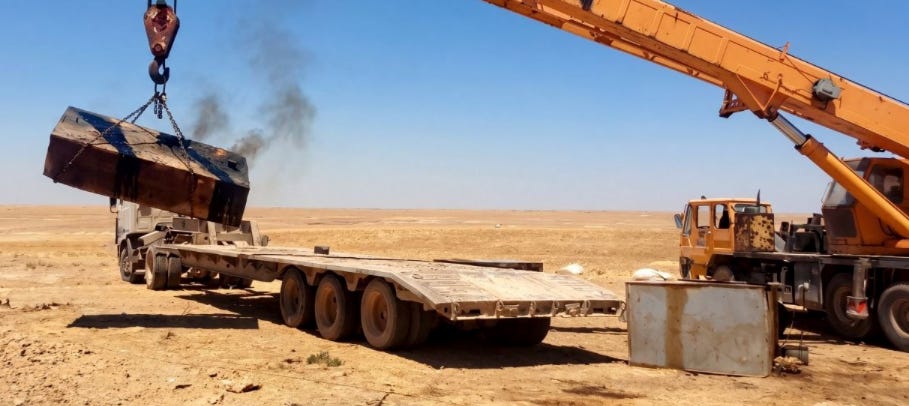
The cheapest grade will come entirely from local, electrically powered refineries with a combined capacity of 35,000 barrels per day, run under SPC supervision on crude that SPC CEO Youssef Qablawi said would come from Rmeilan or Deir Ezzor. Bashir described the plan as an expansion of an existing Hasakah contract from about 17,000 to 35,000 barrels per day, the units’ full capacity, using surplus heavy crude that Baniyas cannot process and that had previously been exported, and acknowledged that the units are uneconomic and environmentally harmful. Most of these units sit around the Rmeilan, Suwaydiyah, and Tal Adas (Krezero) fields in Hasakah, where crude deliveries stopped in August when Al-Jazira Oil Services Company’s supply arrangement expired, cutting diesel to bakeries, transport, and generators from August 30.
On September 9, Hasakah Deputy Governor Ahmad al-Hilali met with generator owners who were asking for diesel allocations, and the following day, some refineries at Tal Adas and Suwaydiyah reportedly resumed work under a six-month agreement with SPC. Earlier, on September 3, more than 1,000 workers from these refineries protested their dismissal and blocked the road to Rmeilan, claiming they had been promised integration into SPC after a three-month contract with US firm HKN paid in dollars. The return to local refining comes weeks after SPC completed the removal of some 2,000 primitive refineries in Deir Ezzor and Hasakah, and months after protests over the closure of makeshift refineries in Aleppo. Qablawi also announced plans to bring a ready-built refinery to the east and to build three more.
The effects of the hike spread quickly to services: in Hasakah, the fare to Qamishli rose from (new) SYP 300 to SYP 500, and water deliveries reached SYP 750 per cubic meter. Abdulrazzaq Habazza, secretary of the Consumer Protection Association, estimated that low-income workers could spend about 30% of their wages on transport, and that goods prices had risen around 15%. He warned that the three-tier system had been launched without an implementation mechanism, inviting mixing between grades, a risk Bashir himself acknowledged. The Minister also told Parliament that the Ministry of Social Affairs had yet to complete the database of vulnerable households on which targeting of the cheapest grade depends.
Shortages persisted alongside the price rise, which might have also exacerbated them. On September 24, Hama’s energy services directorate closed five of the city’s roughly ten stations for a week to halt fuel orders; one owner said he had cut orders for fear of an official price cut that Syrian Company for the Storage and Distribution of Petroleum Products (SADCOP) would not compensate, while residents reported hour-long queues and street-vendor petrol at (old) SYP 25,000 per liter (new SYP 250, USD 1.81). In Sweida, petrol deliveries had already been limited to two orders a day since July, with more than 200 mobile sellers charging new SYP 230–250 per liter (USD 1.67-1.81).
Separately, the Damascus Governorate ordered private generators off public sidewalks by September 30, and owners warned they would pass relocation costs on to subscribers.
Why It Matters: The ministry’s arithmetic is hard to dispute. At USD 1,590 per ton, every liter of standard diesel sold at SYP 175 still loses SYP 31, and SPC can no longer cover both its imports and the roughly USD 250 million a month it had been transferring to the Treasury. The government has done little to explain why fuel became more expensive just weeks after Damascus completed its takeover of the northeast’s oil fields, a recovery presented as the end of the country’s energy dependence.
Part of the answer surfaced only at the parliamentary hearing, a week after the hike, when the Minister said that 80,000 of the 100,000–110,000 barrels produced each day are heavy crude that Baniyas cannot refine. At the same time, the state’s supply obligations doubled: the ministry now supplies Hasakah, Deir Ezzor, and Raqqa, and has shut the burners that met 5–10% of demand. Taking the fields added consumers faster than usable barrels, a point MPs lost on, recalling earlier promises that Syria would not import a liter of products.
The gap is sharpest where the oil comes from: the governorates that watch crude trucked west were the first to block the trucks, as Qamishli did in June. It also falls on households with little margin left, in a country where about 90% of people live below the poverty line. The 550% wage increase that SPC’s transfers helped fund is being eroded by the same fuel bill, widening the distance between the recovery described in Damascus and what people pay at the pump, the bakery, and the generator.
Agriculture and industry carry the second-round effects. In the northeast, irrigation pumps, tractors, and harvest transport run on diesel. The hike came at the end of a cotton season in which a Raqqa grower said a barrel had already risen from USD 100 to USD 300, and in which the crop has almost disappeared from Deir Ezzor (see “Cotton Harvest Opens Amid Price Confusion as Fuel Costs Squeeze Growers”). It also came as farmers prepare to plant wheat while many are still owed for last season (see “Unpaid Wheat Dues Shadow the New Planting Season as the State Sells Its Surplus”).


The SYP 115 grade meant for them is waiting on a beneficiary database that the Ministry of Social Affairs has not completed. Industry is partly cushioned on fuel oil, sold at USD 400 per ton against an import cost of about USD 570, but not on electricity. With the Qatari gas grant over, the ministry plans to cut gas purchases by 2–3 million cubic meters a day, which means fewer supply hours for industry, which takes about 40% of power. Bashir’s claim that fuel is only about 2% of production costs does not hold for energy-intensive producers. Energy exceeds two-thirds of Omran’s clinker costs and makes up about half of Al-Badia’s, which is why Omran has stopped producing clinker and now grinds imported clinker instead (see “Cement Demand Returns to Pre-War Levels as Syria Turns to Imported Clinker to Fill the Gap”).

The three-tier system eases immediate pressure but introduces new risks, as a SYP 60-per-liter gap between the cheapest and the standard grade strongly incentivizes diverting subsidized diesel or blending it into the standard product. Bashir acknowledged as much, noting that three grades need around ten inspection rounds instead of one or two, and that a four-day gasoline shortage had already produced 172 station violations.
Subsidized bakery diesel was itself resold on the market until support was switched to flour. The cheapest grade will also depend on discretion: governorate committees will sell it at about 15% of stations. Its supply comes from burner refineries whose doubling to 35,000 barrels per day was handled as an extension of an existing Hasakah contract, while MPs’ questions on operating costs and on who measures crude in and diesel out went unanswered. That sits uneasily with the USD 28 million fraud uncovered in Deir Ezzor over the summer, and with the burner closures the ministry had presented as a health and environmental priority.
Bashir ruled out announcing price changes in advance because it invites hoarding, a real risk, as Hama’s station owners showed. But publishing the pricing formula and a schedule for phasing out subsidies is not the same as announcing the date of each change. Combined with direct cash support for the poorest households, it would leak less than three grades of diesel and make the next increase easier to explain.
Continue Reading the September 2026 Syria Monthly Economic Digest


Explore Previous Editions
Browse every edition of the Syria Monthly Economic Digest, featuring monthly analysis of Syria’s political economy, governance, reconstruction, and regional developments.
Never Miss an Issue
Receive the Syria Monthly Economic Digest, along with original research, expert interviews, and in-depth analysis on Syria’s political economy, governance, and reconstruction—delivered directly to your inbox.