

This article is part of the September 2026 edition of the Syria Monthly Economic Digest. Click here to explore the full edition.
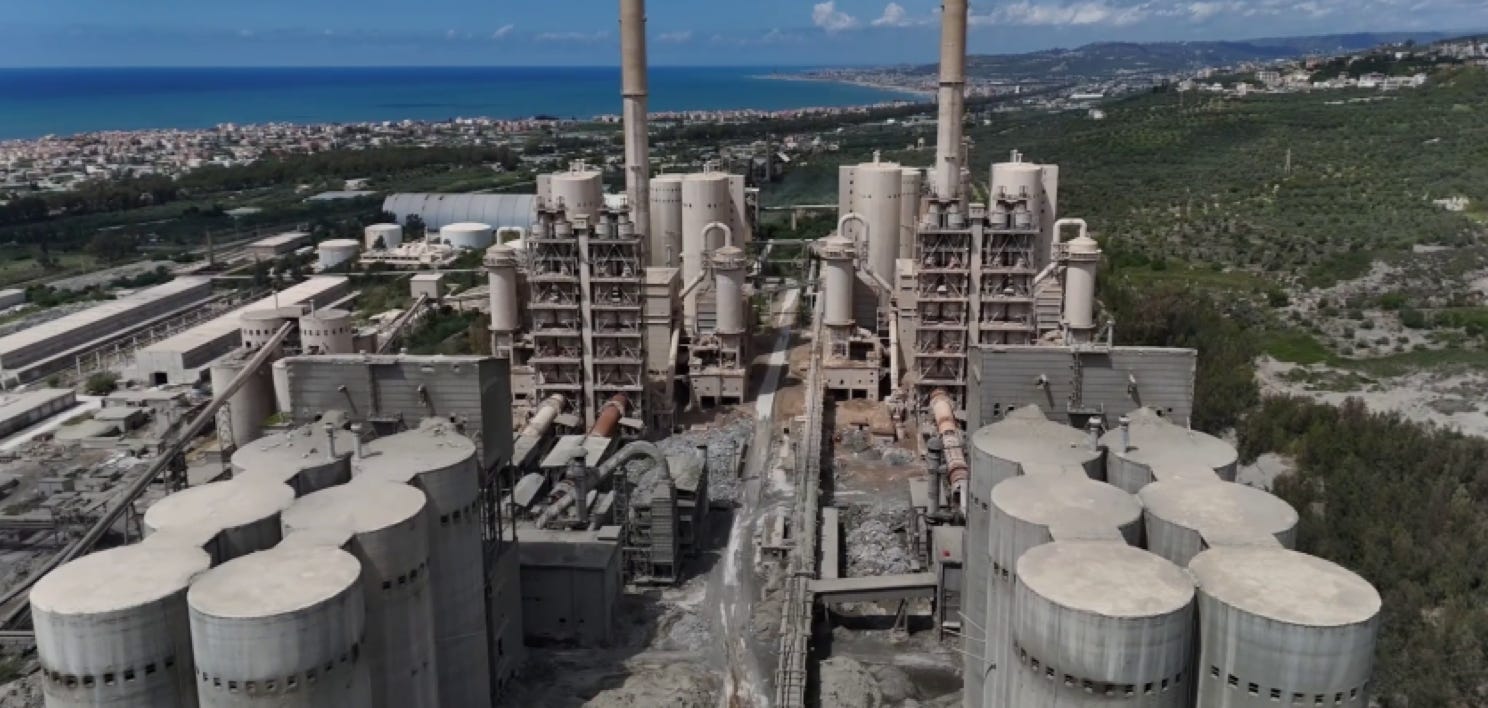
Key Developments: On October 1, the state-owned General Company for Cement and Building Materials (Omran) signed a 30-year build-operate-transfer (BOT) contract worth around USD 200 million with Turkish company ÇİMKO to rebuild the destroyed al-Muslimiyah cement plant in Aleppo. They laid the foundation stone the same day in the presence of the Minister of Economy and Industry, Nidal al-Shaar, and Aleppo Governor Azzam al-Gharib. The project includes a new production line of 5,000 tons of clinker per day (around 1.65–1.8 million tons a year) and follows a memorandum of understanding (MoU) signed in late August. It is one of the largest partnership deals Omran has concluded since 2025. Those deals include the Tartous mills, now run by UAE-based QZ Group, and Hama’s third production line, being upgraded by Iraq’s Vertex Group (USD 300-375 million). The Adra plant near Damascus has yet to be awarded despite more than ten regional bids.
On September 16, Deputy Minister of Economy and Industry Basel Abdul Hannan met with the Syrian Investment Agency (SIA) and the General Establishment of Geology and Mineral Resources (GEGMR) to discuss a national investment map for cement, a more balanced spread of projects across governorates, and faster licensing. Three days later, Omran Director-General Mahmoud Fadila said the cement industry had moved “from crisis management to rebuilding,” adding that Omran is looking for strategic partners that can bring financing, technology, and operating expertise, and that the state should not bear the cost of rehabilitation alone. He rejected the idea that these arrangements amount to privatization, since Omran keeps responsibility for overseeing investors.
Yet, as the sector is still recovering from more than a decade of war, local consumption relies more on imports than on local production. According to the Ministry of Economy and Industry, Syria imported over 3 million tons of finished cement in the first half of 2026, more than double the level a year earlier, while clinker imports for local grinding rose more than tenfold. Industry figures presented in Damascus on September 5 put 2025 consumption at around 7.3 million tons, with imports covering more than 60%. Demand is also showing up in private producers’ results: Al-Badia Cement, the country’s largest private producer, roughly doubled its net profit in the first half of the year as sales rose 80%.
Why It Matters: Given the lack of data across the country, looking at the cement market provides a relatively reliable proxy for reconstruction activity in Syria since almost every type of rebuilding, from repairing a damaged apartment to building a road or a new residential tower, requires it. Unlike most construction indicators, cement is also measurable: a small number of plants report production, and imports appear in partner countries’ customs data. In an economy where official statistics on construction output, building permits, or investment remain patchy, cement consumption is one of the clearest signals of how much is actually being built.
Consumption reached between 7.3 million tons (our estimate based on official figures) and 8 million tons (figures presented in Damascus in September) in 2025. That is more than double the 2023–2024 levels and approaching the pre-war peak of about 9 million tons (see table). However, the supply sources have changed significantly since before the war. While imports covered about a third of the market in 2010, they covered around 60% in 2025, mostly because Omran’s production fell from about 6 million tons in 2010 to under 2 million tons by 2022. Omran’s output collapsed largely because the war destroyed its Aleppo plants: al-Shahba was completely destroyed and Arab Cement was partly damaged, taking around 2 million tons of capacity out of production, while many of its remaining lines date back to the 1970s and are energy-intensive and outdated.
Türkiye remains the main supplier of finished cement, but Egypt and Saudi Arabia have emerged as suppliers since the collapse of the Assad regime. This trend continued into 2026: Turkish cement exports to Syria more than doubled in value in the first half of the year, while Egypt shipped over 330,000 tons of cement and clinker between January and June. The import mix is also shifting. Omran signed a clinker supply agreement with Egypt’s Cisco in January and began receiving shipments in March. According to the Ministry of Economy and Industry, clinker imports rose from about 5% of finished-cement import volumes in the first half of 2025 to 22% in the first half of 2026.
In practice, Syria increasingly imports semi-finished products (clinker) and grinds them at home, rather than producing clinker itself.
If the 2026 trend holds, consumption would reach around 9.5 million tons, slightly above its 2010 level, and could rise further as local demand increases.
The Ministry of Public Works and Housing announced on September 23 a target to build or rehabilitate 2 million housing units by 2035. It estimates Syria’s housing stock at 4.25 million units, of which 1.32 million are damaged, and puts the shortage at 1.9 million units, rising to 2.5 million by 2030 if supply does not accelerate. Assuming half the target is new construction and that a 100 m² concrete-frame apartment requires around 20–25 tons of cement, while repairs require only a fraction of that, the program would add roughly 2.5–3.3 million tons a year to demand until 2035. That would add to current consumption and infrastructure needs, which reconstruction estimates put above residential needs. In other words, a credible housing program would push demand well past the pre-war peak while new domestic capacity is still being built.
Yet, given current obstacles to local production, most of this additional demand would be met from abroad. Domestic production remains constrained by energy costs, and clinker is where those costs bite hardest. Making it requires firing limestone and clay in a kiln at around 1,450°C, and the rotary kiln that produces clinker alone accounts for 70–78% of the energy used in cement production, while grinding clinker into cement requires comparatively little. Earlier this year, Omran halted clinker production, citing energy tariffs that account for more than 65% of production costs, and has since relied largely on grinding imported clinker. Al-Badia’s H1 2026 accounts show the same pressure: its energy bill rose almost sixfold year on year and now makes up about half of its production costs, even as sales grew by 80%. The subsidized fuel that supported the sector’s pre-war profitability has been replaced by market-priced energy. Fadila has explained that Omran imports clinker from countries that subsidize energy, which suggests that for the most energy-intensive stage of production, importing is currently cheaper than producing at home.
The investment pipeline is meant to close this gap, with a map of the main cement plants showing most state-owned sites at the bid or proposal stage. Several have since moved forward:
Al-Muslimiyah (Aleppo): contract signed on October 1 with Türkiye’s ÇİMKO.
Tartous: mills in trial production since April under the UAE’s QZ Group.
Hama: Line 3 upgrade under way by Iraq’s Vertex Group.
Rastan: taken over by a local investor.
Raqqa: agreement between Al-Hassan Holding and China’s Jiangsu Pengfei for an integrated plant.
Al-Fayhaa: white cement plant began commercial operations in early 2026.
Adra: still unawarded despite more than ten bids.
Taken together, the new clinker lines announced at Muslimiyah, Hama, Adra and Raqqa add up to roughly 21,000 tons per day. That is around 9 million tons of cement a year, enough in principle to replace most current imports, before even counting Al-Badia’s planned second line. Most of this capacity, however, will not come online before 2027–2030, and Adra has no investor yet, Raqqa is only an agreement, and none of the projects resolve the energy cost problem that led Omran to stop producing clinker. Fadila himself presents 2027 as the turning point, suggesting the next twelve to eighteen months will rely on imports and grinding.
Over the coming years, Syria’s dependence on imported cement and clinker is likely to deepen before it eases, leaving construction costs tied to regional energy prices and to supply from Türkiye, Egypt and Saudi Arabia. This also makes the housing target only as credible as the supply chain behind it: without lower domestic energy costs or a faster rollout of clinker capacity, a large-scale building program would mostly widen the trade deficit and push up prices. The partnership model therefore carries more weight than its contract values suggest. Omran retains ownership of the assets and oversight of investors, but how quickly Adra is awarded, and how quickly Hama and Muslimiyah reach full capacity, will largely determine whether Syria’s reconstruction is built with domestic or imported cement.
Continue Reading the September 2026 Syria Monthly Economic Digest


Explore Previous Editions
Browse every edition of the Syria Monthly Economic Digest, featuring monthly analysis of Syria’s political economy, governance, reconstruction, and regional developments.
Never Miss an Issue
Receive the Syria Monthly Economic Digest, along with original research, expert interviews, and in-depth analysis on Syria’s political economy, governance, and reconstruction—delivered directly to your inbox.