

This article is part of the September 2026 edition of the Syria Monthly Economic Digest. Click here to explore the full edition.
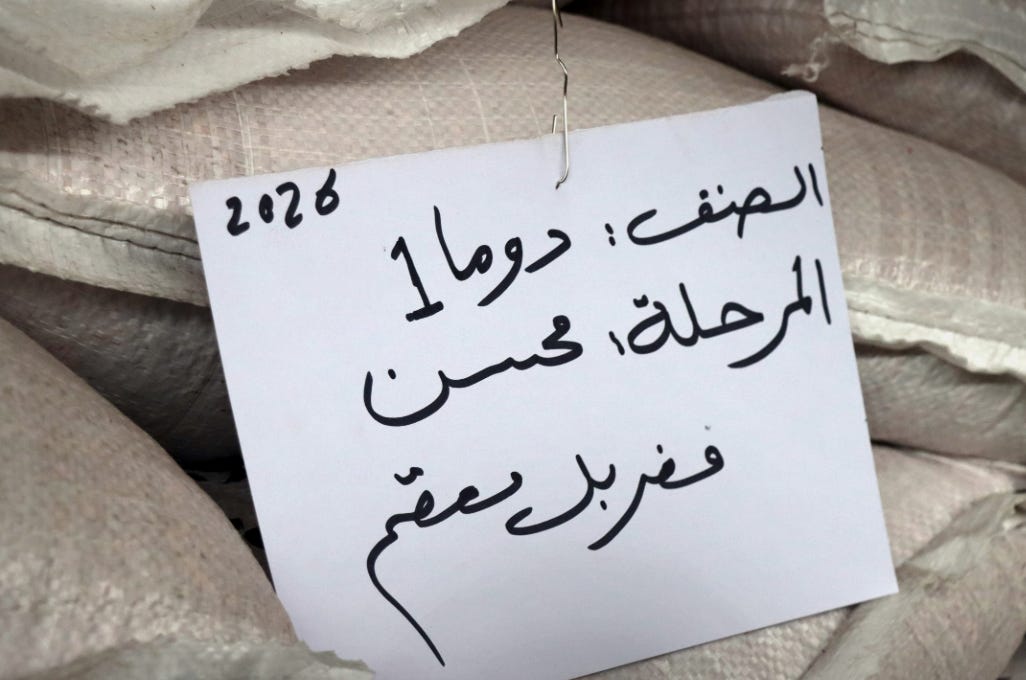
Key Developments: Owing to one of the most prolific wheat seasons in years, with procurement closing at 2.75 million tonnes, the General Authority for Supply and Procurement put 200,000 tonnes of second- and third-grade durum, deemed surplus to milling needs, up for sealed-bid sale on September 17, with bids closing on October 20.
Yet, following up on The Syria Dispatch’s coverage over the past three months (July 1, August 2; September 6), payment of wheat dues remains incomplete, months after farmers sold their harvests to the government. Daraa’s Izraa branch applies this schedule and had paid 38% of dues, about SYP 500.3 million of a SYP 1.3 billion allocation, by September 1. In Hasakah, branch head Azzo al-Hamed said on September 6 that payment had been completed only for grain delivered up to June 17, and he tied disbursement to the Grain Establishment’s lists and Central Bank cash transfers. In Raqqa, farmers with invoices dated June 9–17 were still unpaid in early September. Near Qamishli, farmers who delivered in May were still waiting on September 24, with payments limited to one invoice or installment a week. In Hassakh, governorate officials promised to settle all invoices by the end of October, including those of farmers who delivered to Damascus and Homs (full silos, relocated storage sites, and risks at some silos led some farmers to deliver their harvests outside Hassakh).
Despite the difficulties, farmers’ protests have been relatively scarce, with two events recorded in late August and early September. Farmers in Ras al-Ain protested on August 30 for their dues and a local bank branch, while on September 3, Daraa farmers gathered on the Damascus–Daraa highway before heading to the Ministry of Agriculture, demanding protection, lower taxes, and guaranteed marketing at fair prices.
Minister of Agriculture Basel al-Suwaidan blamed payment delays on scarce new-currency notes, difficulty moving cash, security conditions in the east, and unprepared bank branches. He said payment is the Grain Establishment’s responsibility, not his ministry’s.
Payment delays clashed with loan repayment management as, in Raqqa, farmers said input debts of around USD 1,000 had, in some cases, doubled, and some farmers were avoiding creditors’ calls. One farmer in Hasakah said the contractors who harvested and transported his crop were demanding cash, not app transfers (i.e., via Sham Cash) or installments. In Hasakah, the ACB deducted farmers’ outstanding fertilizer and seed loans from their wheat payments before paying them out. Some farmers alleged favoritism in who got paid, and brokers bought invoices at a discount. On Sham Cash, near Qamishli, brokers reportedly asked 7–10% to pay dues through the app.

The implications of payment delays for the upcoming wheat season have been laid out by the farmers themselves, with farmers in Hasakah warning that the delays left them unable to prepare their land, with some considering turning it to other uses. One Raqqa farmer said he could not buy fertilizer and seed and feared payments would run into February, while others warned they could leave land unsown, with plowing alone costing about USD 20 per dunum, and therefore calling for payment before planting. It should be noted that the implications of delayed payments go beyond wheat, as put by one farmer who borrowed to finance maize and cotton that he normally pays for with wheat earnings (read “Cotton Harvest Opens Amid Price Confusion as Fuel Costs Squeeze Growers”).

Regarding the next season, the General Organization for Seed Multiplication announced it will distribute certified seed from November to February, sold for cash or on credit through the bank. Its director general, Ammar al-Mohammad, urged reopening bank branches in all governorates and issuing any seasonal loan decision before planting. Distribution in Homs was still awaiting the ministry’s seed price on September 29. Officials are confident that the season will go well, with Hasakah’s deputy agriculture director, Ezzeddin al-Hasso, expecting the wheat area to double.
For the northeast, the organization’s 2026–27 plan allocates certified seed to Hasakah, Raqqa, and Deir Ezzor, while local experts warned of mixed and impure seed in the markets.
Why It Matters: Previous editions covered how the payment problem developed through an open-ended purchase commitment at a fixed price, financed with an allocation that fell short of the bill. Its less visible consequence is that the delays have eroded the price itself. Decree No. 120 raised the effective price from (new) SYP 46,000 to SYP 55,000 per tonne. However, a farmer who sold to a cash buyer in July at around 20% below the official rate received roughly SYP 44,000, less than the price that triggered protests in half of Syria’s governorates in May.
A farmer who paid a broker 7–10% to cash out dues gave back more than half of the bonus. Meanwhile, the state has used farmers’ money interest-free for three to five months. Since farmers’ leverage peaks before delivery, as the May threats to withhold grain showed, and disappears once the grain is in the silo, many may draw the obvious lesson next season. They could hold back grain, sell to traders paying cash on the spot, or deliver only once payment terms are clear. Shifting official explanations will not help. The minister cited liquidity and security, while Hasakah’s deputy governor cited full silos, and two competing deadlines (end of October in Hasakah, end of November in the bank’s circular) now set a public test for the next harvest.
More importantly, farmers are making 2026–27 planting decisions without the information they need. The seed price was not set by late September, no seasonal loan decision has been issued, diesel rose 40% on September 13, and next year’s purchase price is unknown. Planted area may well hold up, since rainfed wheat is cheap to sow and many farmers kept seed. The more likely adjustment is cash-constrained farmers cutting fertilizer, certified seed, and irrigation, which will not show in sowing statistics but in next summer’s yields, unless rainfall masks it again.
Continue Reading the September 2026 Syria Monthly Economic Digest


Explore Previous Editions
Browse every edition of the Syria Monthly Economic Digest, featuring monthly analysis of Syria’s political economy, governance, reconstruction, and regional developments.
Never Miss an Issue
Receive the Syria Monthly Economic Digest, along with original research, expert interviews, and in-depth analysis on Syria’s political economy, governance, and reconstruction—delivered directly to your inbox.