

This article is part of the September 2026 edition of the Syria Monthly Economic Digest. Click here to explore the full edition.
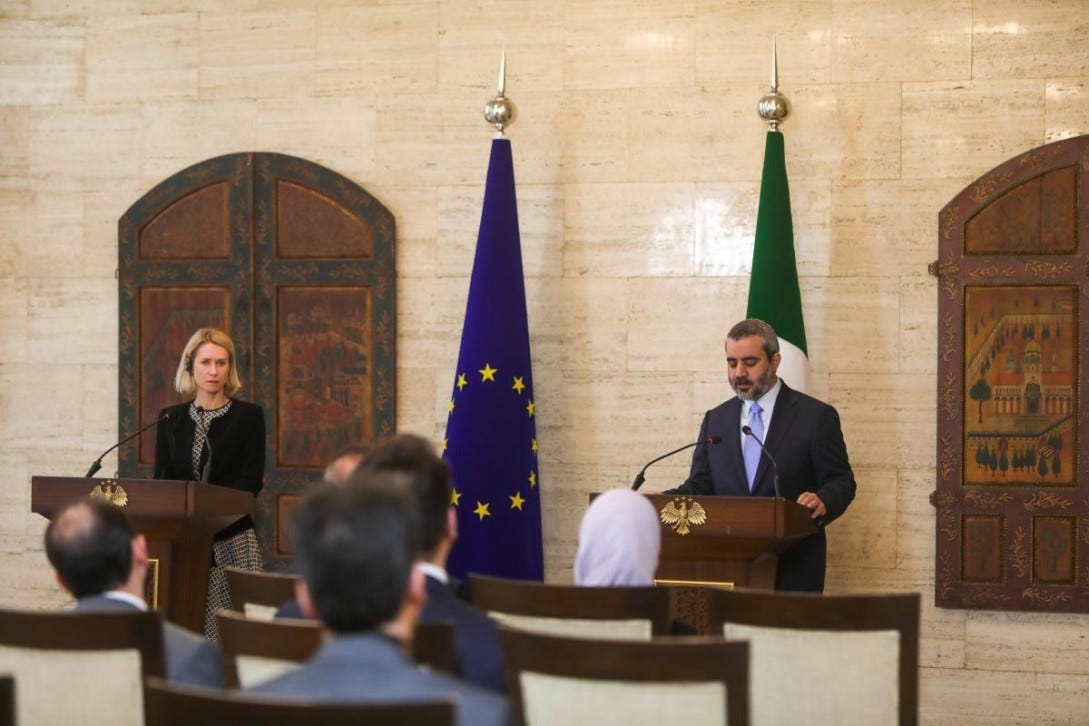
Key Developments: On September 29, EU High Representative for Foreign Affairs and Security Policy Kaja Kallas visited Damascus, three weeks after Michael Ohnmacht presented his credentials to President Ahmad al-Sharaa, restoring EU representation at ambassador level for the first time since 2012.
At a joint press conference with Foreign Minister Asaad al-Shaibani, Kallas said the EU aimed to mobilize more investment and upgrade the partnership, but stressed that this depended on Syria and that investment required security, clear rules, the rule of law, and functioning institutions. As an idea of what the Commission expects from the Syrian authorities, on September 8, the EU told the UN Human Rights Council that adopting a new Constitution and building an inclusive political system would be essential to the transition. It described the formation of the People’s Assembly and Constitutional Court and the introduction of Kurdish-language teaching as milestones.
Kallas put existing EU support at EUR 620 million for recovery, humanitarian needs, and institution-building, plus EUR 51.5 million mobilized through EU foreign policy instruments, including around EUR 18.85 million for demining. She also said the European Bank for Reconstruction and Development (EBRD) and the European Investment Bank (EIB) were discussing support for Syrian projects, though no agreement had been reached. She proposed technical talks this year, including on recovery and reconstruction, ahead of a second High-Level Political Dialogue before next summer; the first was held in May.
In turn, Shaibani said the two sides discussed a new partnership agreement to replace the 1977 Cooperation Agreement. He said Damascus sought inclusion in the EU’s 2028–2034 Multiannual Financial Framework, and called for lifting the remaining sanctions on Syrian state institutions.
The visit came days after the two met in New York on the margins of the UN General Assembly.
Leading up to this high-level engagement, Minister of Finance Yisr Barnieh had discussed on September 2 with Henrike Trautmann, Director for the Middle East at the Commission’s Directorate-General for the Middle East, North Africa and the Gulf (DG MENA), the activation of the Technical Assistance Hub due to open in Damascus with Commission funding. They also discussed workshops on public financial management, public-private partnerships, and public debt management, and support for establishing joint-stock companies. On September 22, Qutaiba Qadish, director of the Foreign Ministry’s International Cooperation Department, met Michael Karnitschnig, acting Director-General of DG MENA, in New York to discuss development cooperation and support for economic recovery.
Why It Matters: Kallas’s figures look different once read against the documents behind them. The EUR 620 million is a two-year envelope for 2026 and 2027 and includes all of the humanitarian, development, and FPI support. As a result, the Commission’s bilateral development component amounts to EUR 280 million, or EUR 140 million a year, against EUR 139 million in 2025 (see table below). Thus, the EU’s annual development effort in Syria is flat.
Yet a lack of European finance or interest is not the only reason EU support may seem limited given the scale of needs inside Syria. The Commission’s 2026–27 programming describes Syrian absorption capacity as a “binding constraint.” That echoes the gap between funds available and funds used that a joint Commission–EIB mission recorded in 1982. The technical talks Kallas proposed ahead of the next High-Level Political Dialogue are the natural place to sequence both sides of the problem: what Syrian ministries can absorb, and what Brussels is prepared to commit.
Back to development support, the 2025 measure already allocated EUR 26.5 million to state and institutional capacity, but shared that envelope with health and directed most of its funding to livelihoods, microfinance and small businesses; Syrian institutions were consulted and trained, not contracted. The 2026–27 measure narrows that envelope to public administration alone, at EUR 30 million a year, covering public financial management, procurement, payroll and statistics, and makes national and local authorities eligible for direct grants. That support will reach the Syrian state through European intermediaries, with no financing agreement and no budget support. The terms, too, remain set in Brussels: both packages are Special Measures, an exceptional instrument adopted by Commission decision rather than negotiated with Damascus. A new partnership agreement and inclusion in the EU’s 2028–2034 budget cycle would replace these unilateral decisions with a negotiated, multiannual framework, as Foreign Minister Shaibani asked for.
However, Kallas tied further investment to the rule of law and functioning institutions, but the programming has moved in the other direction. The 2026–27 document dropped the “gradual and reversible” qualifier that framed 2025 support. More generally, the EU has never specified what it means by progress on the rule of law and functioning institutions, what benchmarks would measure it, or when it would reassess its approach. This matters most now, because European leverage is greatest while a new agreement remains a prospect; once one is signed, Brussels acquires a stake in the relationship’s survival. If the coming talks lead toward the partnership Damascus is asking for, they are also the moment to state what that partnership is for and how progress would be judged.
Continue Reading the September 2026 Syria Monthly Economic Digest


Explore Previous Editions
Browse every edition of the Syria Monthly Economic Digest, featuring monthly analysis of Syria’s political economy, governance, reconstruction, and regional developments.
Never Miss an Issue
Receive the Syria Monthly Economic Digest, along with original research, expert interviews, and in-depth analysis on Syria’s political economy, governance, and reconstruction—delivered directly to your inbox.