

This article is part of the October 2026 edition of the Syria Monthly Economic Digest. Click here to explore the full edition.
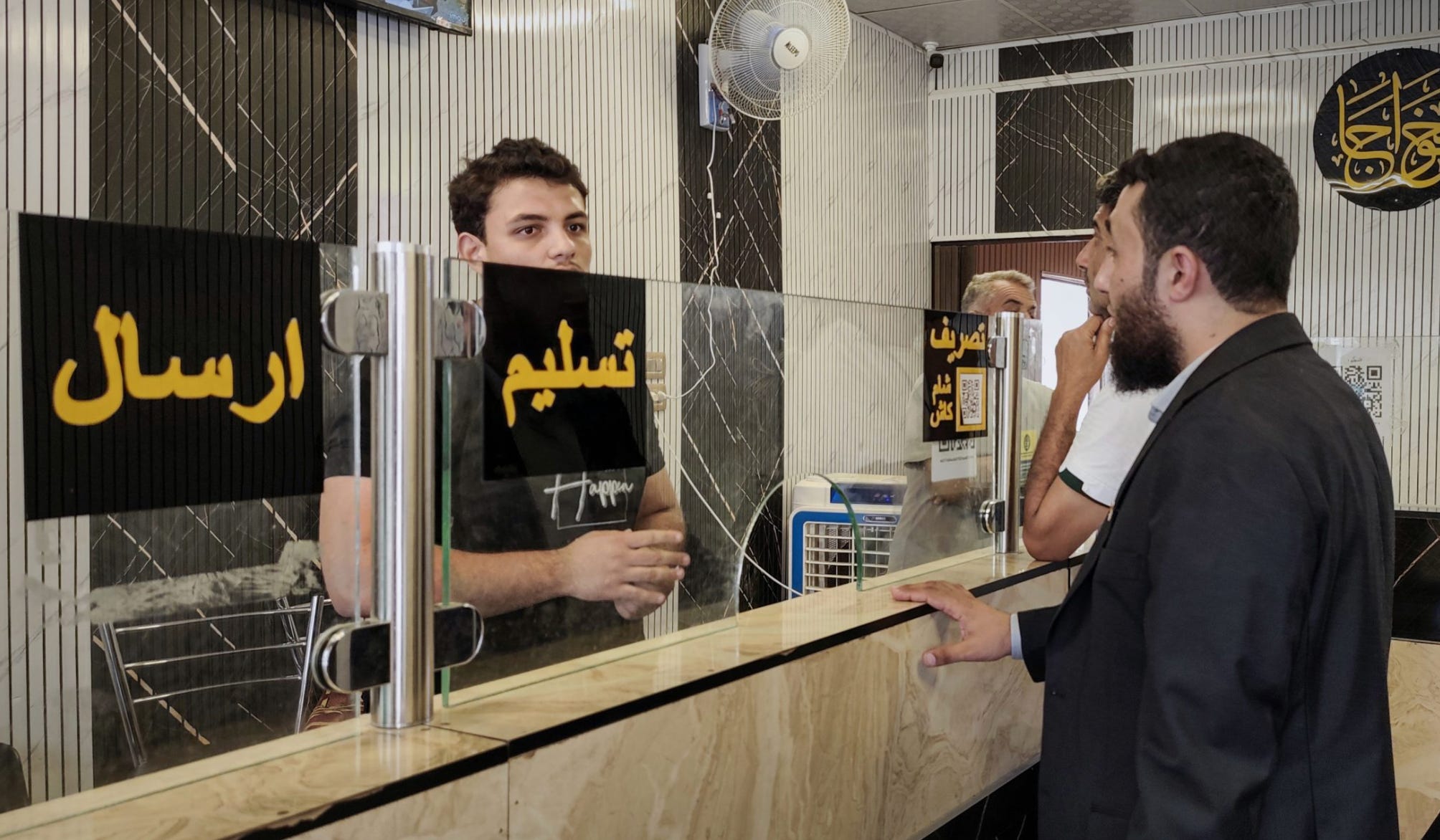
Key Developments: On October 19, the Central Bank of Syria announced the second phase of its campaign against unlicensed currency exchange and money transfer offices, which it runs jointly with the Interior Ministry.
On October 10, the bank issued 755 notices to shops and offices in ten governorates, giving them a chance to get licensed or stop. Five days later it announced that the grace period was over: from October 18, anyone exchanging or transferring money without a license would face penalties under Article 25 of Law No. 24 of 2006, whether or not they had been warned. Inspectors then detained people who kept working despite the warnings and seized the cash they were holding, and prepared their cases for court. By October 28, the bank and the Interior Ministry had filed 17 violation reports and sealed the premises involved.
Central Bank Governor Safwat Raslan wrote on Facebook the next day that the clampdown would be a core part of the bank’s work, not a temporary measure.
Article 25 of Law No. 24 of 2006
The penalties the Central Bank cited when it ended its warning phase on October 18 are set out in Article 25 of Law No. 24 of 2006, which governs exchange institutions. The current wording dates from Legislative Decree No. 6 of January 2024, issued under the Assad government. Fines are in old Syrian pounds, the currency in use when the decree was issued.
Unlicensed exchange carries five to fifteen years in prison and a fine of three times the sums confiscated, with a minimum of (old) SYP 25 million, or (new) SYP 250,000. Confiscation covers the cash seized and any amounts recorded in paper or electronic ledgers, promissory notes or other documents of value.
Moving or transferring money between Syria and abroad without a license carries the same penalties. Under Article 7, only banks and licensed exchange companies may do this, while licensed exchange offices may not.
Licensed firms that break the rules face fines of SYP 300,000 to 1.5 million for working outside the exchange business. Breaching the Central Bank’s instructions on cross-border transfers costs SYP 1.5 million to 5 million. Any other violation of the law carries three to six months’ detention, a fine of SYP 100,000 to 500,000, or both.
An attempt is punished as if the offence had been completed, and penalties double for repeat offenders.
Suspects accused of unlicensed exchange or transfers cannot be released on bail. Investigations fall under Legislative Decree No. 55 of 2011, which allows long pre-charge police custody.
Seized money is returned only after a final verdict. Confiscated funds go to the Central Bank as civil compensation and count as its revenue, while fines go to the Treasury.
Staff in the Central Bank’s legal departments act as judicial police, and their violation reports stand unless proven wrong. The bank pays no court fees at any stage.
This move seems to have done little to stabilise the Pound, as the parallel rate kept rising through the campaign while the official one did not move. The Central Bank’s bulletin held the dollar at (new) SYP 122 throughout September and October, while the parallel, or black market, rate rose 3.7% over the month, from SYP 137.65 on October 1 to 142.75 on October 31, and peaked at 143.25 on October 26.
Mokhles al-Nazer, monetary policy expert and former first deputy governor of the Central Bank until September 2026, explained that the gap between the two rates widened from 13.4% to 17.6%, the widest in at least three months. He also estimated from six goods in Damascus that shop prices implied a dollar of SYP 182–187.
October’s fluctuations were not new, however, and continued a slide that resumed in early September after the dollar had fallen back from a mid-July peak. The parallel rate rose by 4.8% in September, from SYP 131.5 on September 1 to 137.75 on September 30 and, by the end of October, it stood 8.6% above its level two months earlier.
Partly because of the depreciating pound, the cost of living has risen much faster than incomes, and wages have fallen further behind prices over the past year. The WFP’s minimum expenditure basket rose 3% in September to SYP 42,575, 22% more than in the third quarter of 2025. At that level, the minimum wage of (new) SYP 12,560 a month covers about 30% of it. Against the Kassioun cost-of-living index, which put the minimum at over SYP 80,000 and the average at 130,000 at the end of September, it covers three to five days of a family’s expenses. The latest Joint Market Monitoring Initiative (JMMI) report, based on data collected in mid-August before the September fuel price rises, found that the food part of its survival basket for a household of six cost 22.8% more than in October 2025. That rise came largely from the pound’s fall over the period, from SYP 115 to 132 to the dollar on the informal market. Affordability fell below JMMI’s threshold in 96% of the sub-districts it could classify.
In Damascus, local estimates put food alone for a family of five at about SYP 50,000 a month, while many public employees earn (old) SYP 1.5–2 million, or (new) SYP 15,000–20,000. In Hasakah, food prices rose 15–20%. Traders blamed fuel and transport costs, the cash shortage and late payment of wheat dues. In Aleppo, a tailor said his USD 60–70 a week no longer covered his household’s food.

As a result of rising costs, the WFP estimates that 7.2 million people face acute food insecurity, including 700,000 in severe need. It projects that higher living costs after the September fuel price rises could push another 250,000 people into that category. Those rises were 40% for diesel, 26% for petrol and 9% for gas, and WFP says they set off protests and transport strikes in several governorates. Meanwhile, funding shortfalls have forced it to cut food assistance from 1.3 million people to 650,000.

Syrians have also grown more critical of how the government is handling prices and the currency, even though fewer of them say they are going without. Between September 28 and October 15, the Arab Center for Research and Policy Studies and the Arab Center for Contemporary Syria Studies asked 3,600 people how things were going. Just 31% thought the government had kept the lira under control, down from 46% a year earlier, and the same share thought it had kept prices in check, down from 42%. Only 41% described the economy as good, compared with 68% who said the same about security. Household budgets tell a slightly better story: 30% said their income did not cover their basic needs, down from 42% in 2025, while 55% said they could just about cover them with nothing to spare. Many families rely on outside help, as some 40% receive remittances from relatives abroad. Of the 29% who said they wanted to emigrate, more than half gave economic reasons, above all unemployment and rising prices.
Why It Matters: At the policy level, the Central Bank’s campaign against unlicensed money changers targets a real problem, and the bank is right to want foreign currency moving through supervised channels. In fact, the IMF has urged Damascus to strengthen anti-money laundering rules, regulate the foreign exchange market, and reduce multiple exchange rates; through a crackdown, the bank seems to be answering the first two recommendations. Yet, the third one remains untouched.
In July, Governor Raslan argued that the exchange rate should not be the only measure of monetary policy (Read: Currency Replacement Ends as Syria Builds New Monetary Policy Tools). Three months on, however, the bank still seems to manage the lira with two tools outside any normal policy framework: rationing cash and closing exchange shops; neither is a durable solution. Keeping currency out of people’s hands slows demand, while closing informal money changers has yet to prove effective. In fact, Mokhles all-Nazer put the freeze down to reserves too weak to defend a new rate, and the deeper problem to the absence of a clear monetary policy framework, and seizures and sealed shops answer neither.
Looking at next year, the lack of stability in the exchange–or, rather, the continuous depreciation of the Pound–, while mattering today, will also matter for next year as it is about to collide with the 2027 budget. Finance Minister Barnieh said the budget would be completed in October, and it is due before parliament in the fourth quarter.
If the 2027 budget is built on the current official rate of 122, and the parallel rate reaches 150–160 by January, the budget’s lira allocations would have already lost 19–24% of their dollar value before the beginning of FY2027. Consequently, public salaries would buy much less, while USD-denominated imports, such as fuel and wheat, would cost more in lira than planned, thereby throwing off most budget calculations.
For reference, the 2026 budget was calculated using an exchange rate of SYP 110 per dollar, while the black market rate had reached SYP 120 per dollar at the beginning of the year.
Using today’s rate, the 2026 budget’s SYP 1.157 trillion in spending is worth about USD 8.1 billion, not the USD 10.5 billion announced.
Not all of the pressure is of Damascus’s making. Obviously, the US–Iranian war and disruptions in the Gulf and the Red Sea have raised freight and insurance costs, something particularly damaging for an economy that depends on imports. WFP attributes September’s fuel price rises partly to global supply and transport costs, and Minister of Energy Mohammad al-Bashir did the same during his hearing earlier in September.

Regardless of governmental responsibility, the combined effect of higher gas prices and the depreciation of the Pound is becoming untenable for households, and in The Syria Dispatch’s fieldwork (though mostly anecdotal evidence, and not a survey) in Syria in October and November, the cost of living was the grievance we heard most often.
Businesses are caught as well, with raw materials and imported goods priced almost in real time against the parallel dollar, meaning that every slide in the lira raises firms’ costs while their customers buy less. Traders in Hasakah reported sales at between a third and half of their earlier level, and said some shops had closed because their owners could no longer cover rent. Many sellers protect their working capital by pricing at tomorrow’s replacement cost, as highlighted by Mokhles Nazer, which passes the currency risk straight on to consumers.
For the government, regardless of whether it is at fault for the current affordability crisis, if the situation for shoppers and shopkeepers alike continues to deteriorate, they will start increasingly wondering whether the transition is actually delivering, turning a monetary problem into a political one. Since the transitional government came to power without elections, after nearly two decades of economic decline, it has few sources of legitimacy as strong as making people’s lives better, and on that score Syrians are not yet giving it much credit.
As the Arab Opinion Index shows, respondents rated the security situation positively at 68% and the political situation at 63%, but only 41% said the same of the economy, and just 31% credited the government with controlling prices or the lira. To many of those The Syria Dispatch spoke to in Damascus, whether experts or regular citizens, Syria’s recovery is starting to look K-shaped: a minority does well while most fall behind, and that sense of unfairness wears down trust faster than any single price rise.
Continue Reading the October 2026 Syria Monthly Economic Digest


Explore Previous Editions
Browse every edition of the Syria Monthly Economic Digest, featuring monthly analysis of Syria’s political economy, governance, reconstruction, and regional developments.
Never Miss an Issue
Receive the Syria Monthly Economic Digest, along with original research, expert interviews, and in-depth analysis on Syria’s political economy, governance, and reconstruction—delivered directly to your inbox.